"The most toxic and dangerous type of radioactive waste created by the nuclear industry"
This is waste generated by nuclear power plants called 'high-level radioactive waste' (HLW), also known as 'spent' or 'irradiated' fuel. This waste contains plutonium, uranium, strontium, and cesium; and will be radioactive for millions of years.
It is not like the waste currently stored at the Waste Isolation Pilot Project (WIPP) or any other waste site that exists today in the U.S.: it is far worse.
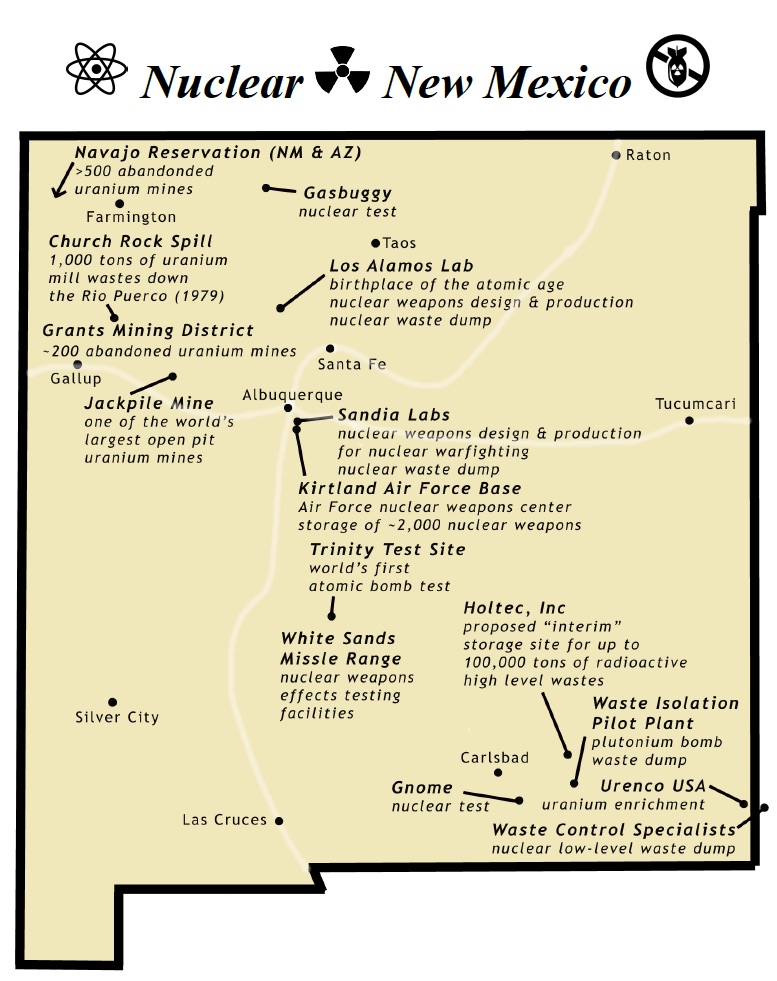
Two companies are proposing to build waste facilities near Carlsbad and Hobbs for the most toxic and dangerous type of radioactive waste created by the nuclear industry.
Holtec International is working with the Eddy-Lea Energy Alliance, LLC (ELEA) to apply for a license to build a Consolidated Interim Storage (CIS) facility approximately halfway between Carlsbad and Hobbs, and 16 miles north of WIPP.
The Nuclear Regulatory Commission (NRC) has declared the Holtec/ELEA application complete, NRC initiated a public comment period with 60 days for public comment. Note that transport of this waste poses risks to the environment and all life located near transportation routes.
Holtec proposal:
New CIS facility to store 100,000 metric tons of HLRW, with the potential to increase to 120,000 metric tons for 120 years
Shallow sub-surface burial system
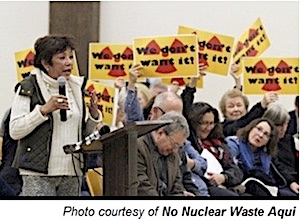
New Mexicans and Texans are fighting the attempted licensing of these two proposed CIS facilities - Waste Control Specialists near Andrews, Texas and Eddy Lee/Holtec International east of Carlsbad, New Mexico.
These sites and any transport to these sites are not only dangerous but environmentally unjust. These sites present clear examples of environmental racism.
New Mexico's demographic is largely Latino. There are many communities of color, especially in the southern part of the state where the sites are being proposed. People of color would be disproportionately affected if the Eddy Lee/Holtec CIS site were licensed and constructed.
New Mexico and Texas do not consent to either proposed CIS facility and are fighting to avoid the environmental injustice and the unnecessary shipment of irradiated high-level nuclear waste through their communities.
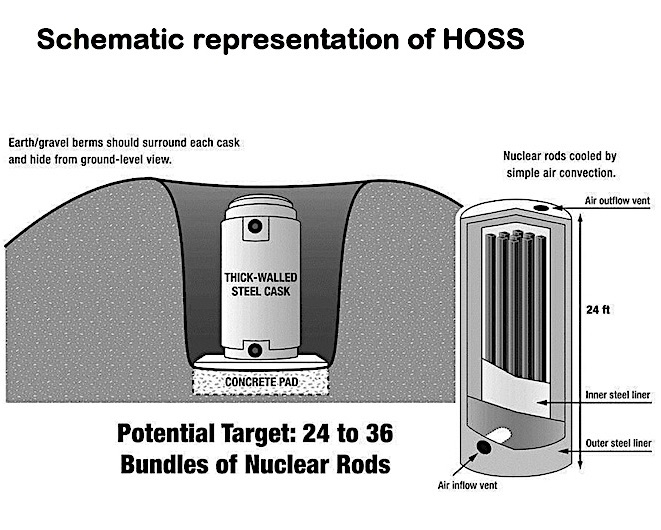
Hardened On-Site Storage (HOSS) is a community-based concept that aims to protect the public from the threats posed by the current vulnerable storage of commercial irradiated fuel.
History
For decades, high level radioactive waste has accumulated at reactor sites and continues to do so as nuclear reactors generate more waste. Without a credible plan to permanently isolate it, storage pools, where irradiated nuclear waste is currently stored until it becomes less hot, have been tightly packed and re-racked to accommodate all the waste.
Unfortunately, the pools and dry casks have no robust containment. If the cooling pumps stopped operating or the water in the pools drained out, temperatures would quickly increase, as happened in Fukushima Japan, and could result in a similar disaster.
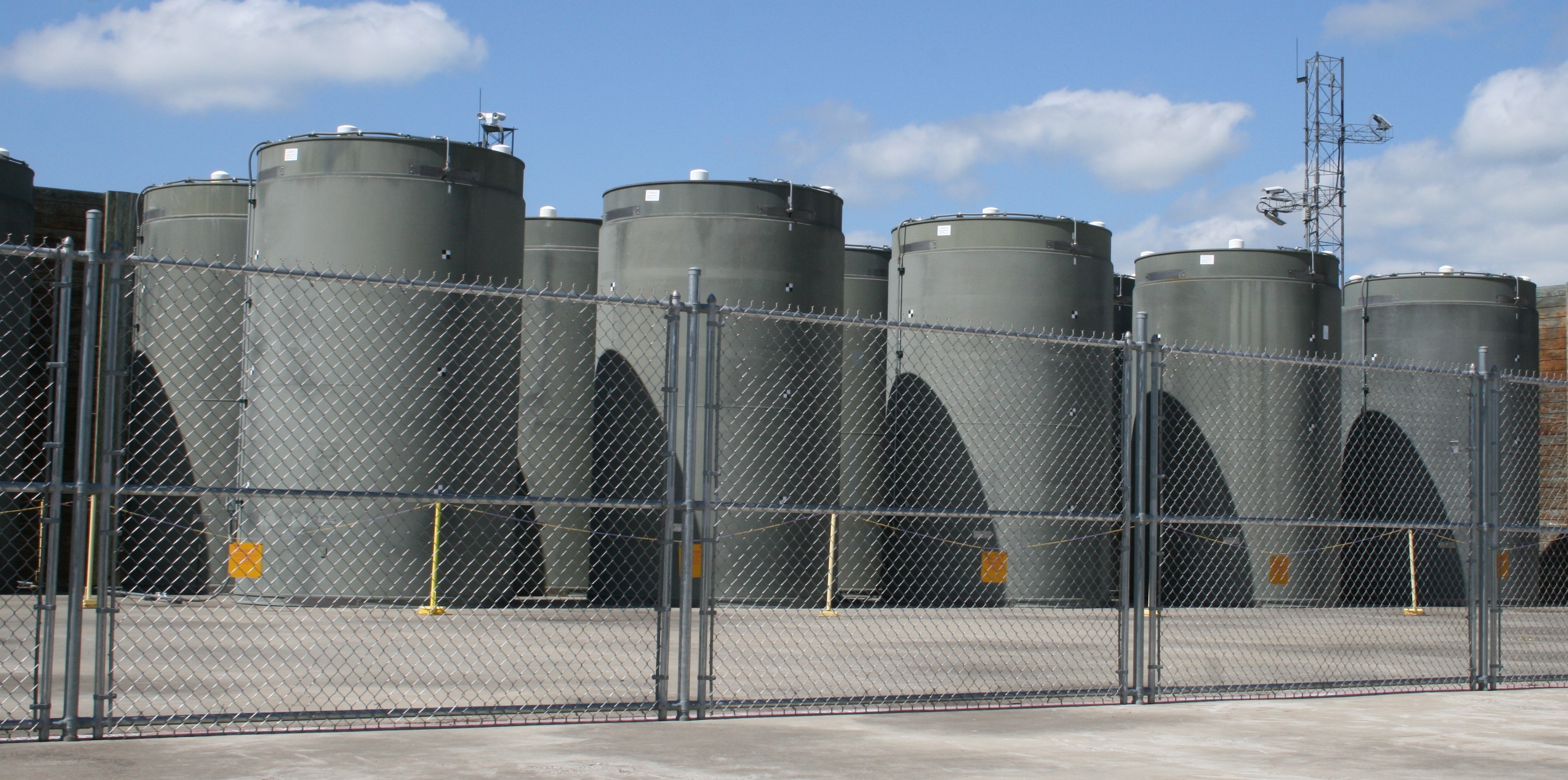
Current dry cask storage at reactor sites (pictured above) is extremely vulnerable. There is often nothing more than a chain-link fence and a short distance that separates the highly radioactive waste containers and public access.
Establishing interim hardened on-site storage (HOSS) is a top priority. Hardened on-site storage allows waste generators to store high level waste as close to the site of generation as possible, thereby exposing fewer people to radiation, as safely as possible.
Rather than storing dozens of vulnerable dry-casks next to each other in the open air, the HOSS Principles established by concerned citizens mandate:
Irradiated fuel must be stored as safely as possible as close to the site of generation as possible;
HOSS facilities must not be regarded as a permanent waste solution, and thus should not be constructed underground and the waste must be retrievable;
The facility must have real-time radiation and heat monitoring for early detection of problems with containers;
The overall objective of HOSS should be that the amount of releases projected in even severe attacks should be low enough that the storage system would be unattractive as a terrorist target;
Placement of individual canisters that makes detection difficult from outside the site boundary.
Hardened On-Site Storage (HOSS) is supported by organizations in all 50 states. The Principles of Securing Nuclear Waste at Nuclear Reactor Sites are posted here. It would provide better security at reactor sites with robust dry storage and community oversight, including real-time monitoring of heat and radiation. HOSS is rooted in values of community protection and environmental justice and will provide increased protection from human or natural disasters, like terrorist attacks and earthquakes
HOSS facilities are not permanent waste solutions, and therefore should not be constructed deep underground as the waste must be retrievable. However, they are a workable solution that will allow us to explore scientifically sound, and socially and environmentally just long-term management systems.
Nuclear Power Has No Place in a Green Energy Future
Because of: Time Delay, Success of Renewables, Huge Costs, Dangers, Weapons Connection, and Wastes
from Yahoo News, 21 Oct 21, ”…….Practical concerns also temper enthusiasm for a nuclear future. The next generation of reactors, heralded as a game changer by supporters, still haven’t been proven in the real world. Even if those technologies are as revolutionary as advertised, skeptics say it could take decades before they make a real difference in the global energy grid — too long if the worst outcomes of climate change are to be avoided.
Renewable energy technologies can be enough on their own
“The drawbacks to nuclear are compounded by the burgeoning success of renewables — both solar and wind are getting cheaper and more efficient, year after year. There is also a growing realisation that a combination of renewables, smart storage, energy efficiency and more flexible grids can now be delivered at scale and at speed — anywhere in the world.” — Jonathon Porritt, Guardian
The world doesn’t have time to wait for next-gen nuclear
“When it comes to averting the imminent effects of climate change, even the cutting edge of nuclear technology will prove to be too little, too late. Put simply, given the economic trends in existing plants and those under construction, nuclear power cannot positively impact climate change in the next ten years or more.” — Allison Macfarlane, Foreign Affairs
A major ramp-up in nuclear technologies isn’t economically feasible
“While nuclear power may have once been cheaper than wind or solar, the economics have since changed dramatically. Nuclear power plants are very expensive to build and the economics of nuclear power are getting steadily worse. By contrast, renewables continue to come down in price.” — Ian Lowe, Conversation
There’s no way to guarantee that nuclear plants will be safe
“People around the world have witnessed the Three Mile Island, Chernobyl and Fukushima accidents. It is more than enough to believe that a safe nuclear power plant is nothing but a myth.” — Jang Daul, Korea Times
More nuclear power could lead to more nuclear weapons
“Some nations — India and Pakistan, and in all probability Israel — became nuclear powers after originally seeking nuclear technology for research or to develop nuclear power. … This is important: The technology used to turn on lights or charge mobile phones shouldn’t need to involve national or international defence apparatus.” — Editorial, Nature
Nuclear waste is still a major problem
“Nuclear waste lasts for hundreds of thousands of years before they are half-decayed. Our United States government — perhaps the longest continuous government in the world — is only 232 years old. Who will be around to manage uranium wastes?” — David Ross, Courier-Journal
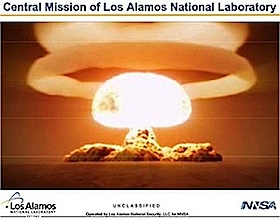
LANL’s Central Mission: Los Alamos Lab officials have recently claimed that LANL has moved away from primarily nuclear weapons to “national security”, but what truly remains as the Labs central mission? Here’s the answer from one of its own documents:
LANL’s “Central Mission”- Presented at: RPI Nuclear Data 2011 Symposium for Criticality Safety and Reactor Applications (PDF) 4/27/11
In June 2016 the New Mexico Environment Department (NMED), the Department of Energy (DOE) and Los Alamos National Security, LLC (LANS) signed a revised Consent Order governing cleanup at the Los Alamos National Laboratory (LANL). The new Consent Order is a big step backwards in achieving comprehensive, genuine cleanup at the Lab.
NMED should have kept the original, enforceable 2005 Consent Order that it fought so hard for under the Richardson Administration, modified as needed for the cleanup schedule and final compliance date.
Under Gov. Martinez, the revised 2016 Consent Order was a giveaway by NMED to DOE and the Lab, surrendering the strong enforceability of the old Consent Order. As documented below, it is clearly the reverse of the 2005 Consent Order, whose underlying goal was to make DOE and LANL get more money from Congress for accelerated cleanup.
The 2016 Consent Order was negotiated to allow DOE’s budget to drive cleanup, not what is needed to permanently protect our water.
As late as 1996 LANL was claiming that groundwater contamination from its operations was impossible, even going so far as to request a waiver from NMED from having to monitor for contamination to begin with (which fortunately NMED denied).
Since then, extensive groundwater contamination from chromium, perchlorates, high explosives and VOCs has been documented.
LANL plans to “cap and cover” some 200,000 cubic meters of toxic and radioactive wastes at Area G, creating a permanent nuclear waste dump in unlined pits and shafts.
Despite the threat to precious water resources, the revised 2016 Consent Order allows DOE to determine cleanup priorities based on its anticipated budget, which is the reverse of the original Consent Order.
The new Consent Order allows LANL and DOE to get out of future cleanup by simply claiming that it’s too expensive or impractical to clean up. (See CO quotes below.)
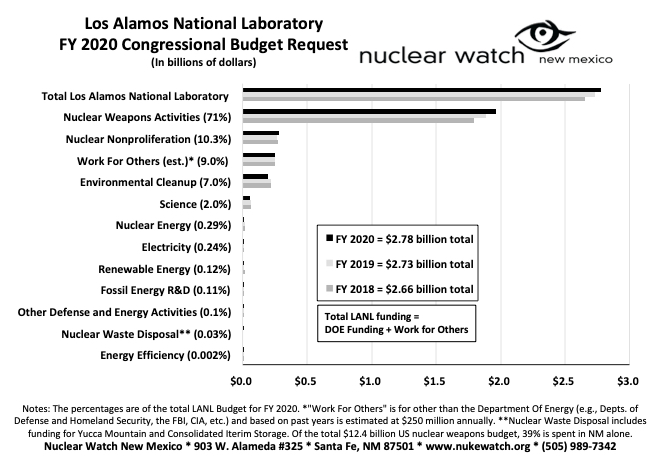
Shortly after the 2016 Consent Order went into effect, DOE took advantage of it by estimating a lifetime budget that projected a top range of $3.8 billion to clean up the Lab, while delaying completion to 2040. That works out to only around $150 million per year, when NMED is already on record that $250 million per year is needed. DOE is planning “cleanup” on the cheap.
Whose interests were represented in the 2016 Consent Order? Not New Mexico’s!
Shortly after the 2016 Consent Order went into effect, NMED Secretary Ryan Flynn displayed his true environmental colors by resigning to become the Executive Director of the New Mexico Oil and Gas Association. The Association’s main purpose is to lobby on behalf of the oil and gas industry against environmental regulations.
Before joining NMED, Mr. Flynn worked for a law firm that advertises that “Our representation of oil and gas producers, mid-stream entities, and natural gas pipelines has been a mainstay of Modrall Sperling’s natural resources practice since the early days of the firm.” Modrall Sperling has also defended LANL or LANS (LANL’s managing contractor) against environment regulations and labor complaints.
In January 2017 Kathryn Roberts, the head of NMED’s Resource Protection Division and lead Consent Order negotiator, announced that she was leaving to work as a public communications specialist for Longenecker and Associates, a DOE contractor. Prior to working at NMED, Ms. Roberts worked at LANL for four years as Group Leader for Regulatory Support and Performance.
At Longenecker Ms. Roberts joined Christine Gelles, its Corporate Vice President and Chief Strategy Officer. They know each other well, as Ms. Gelles was the former interim manager of the new DOE Environmental Management field office at the Los Alamos Lab. A Longenecker resume´ notes that Gelles “Led planning and initial regulatory interactions with New Mexico Environment Department negotiation of Los Alamos Consent Order.” She also led initial development of the LANL lifetime budget that will cheat New Mexico out of needed increased cleanup funding. See
During the 2016 Consent Order negotiations, Ms. Roberts was one of Gelles’ main counterparts on the other side of the table as head of NMED’s Resource Protection Division. Now Gelles is one of her superiors at Longenecker, when the DOE contractor could possibly bid in the future on LANL cleanup.
Section II.A of the 2016 Consent Order allowed the Lab to “settle any outstanding violations of the 2005 Consent Order.” Existing violations were then waived.
NMED pre-emptively surrendered its regulatory and enforcement powers, when the state of New Mexico really needed the money!
New Mexico could have collected more than $300 million in stipulated penalties had NMED vigorously enforced the 2005 Consent Order. At the time, New Mexico was facing a budget crisis with a projected $600 million deficit. In effect, NMED gave half of that deficit away to a polluting nuclear weapons site that has an annual budget of ~$2.4 billion and rising.
The 2005 Consent Order was all about the enforceable schedules.
The 2005 Consent Order required DOE and LANL to investigate, characterize, and clean up hazardous and mixed radioactive contaminants from 70 years of nuclear weapons research and production.
It stipulated a detailed compliance schedule that the Lab was required to meet. Ironically, the last milestone, due in December 2015, required a report from LANL on how it successfully cleaned up Area G, its largest waste dump.
Under Gov. Martinez, NMED extensions eviscerated the 2005 Consent Order.
When NMED Secretary Ryan Flynn announced a draft new Consent Order on March 30, 2016, he publicly claimed that the 2005 Consent Order was not working, hence the need for a new one to replace it.
Nuclear Watch agrees that the 2005 Consent Order wasn’t working, but that’s because Flynn granted more than 150 compliance milestone extensions at the Lab’s request, effectively eviscerating it. The 2005 Consent Order was working quite well until Gov. Martinez took office.
Some specific provisions in the 2016 Consent Order that put DOE in the drivers seat.
“DOE shall define the use of screening levels and cleanup levels at a site…” Ibid, p. 32.
“DOE shall update the milestones and targets in Appendix B on an annual basis, accounting for such factors as… changes in anticipated funding levels.” Ibid, p. 29.
“… [DOE and NMED] shall meet to discuss the appropriation and any necessary revision to the forecast, e.g. DOE did not receive adequate appropriations from Congress…” Ibid, p. 30.
“If attainment of established cleanup objectives is demonstrated to be technically infeasible, DOE may perform risk-based alternative cleanup objectives…” Ibid, p. 34. DOE can opt out because of “impracticability” or cost of cleanup. Ibid, p. 35.
Altogether, these put the Department of Energy in the driver’s seat, not the New Mexico Environment Department, and create giant loopholes that threaten comprehensive cleanup at LANL. The 2016 Consent Order and therefore cleanup at LANL will be held hostage to DOE funding, when the Department’s own track record makes clear that its priority is expanded nuclear weapons production paid for in part by cutting cleanup and nonproliferation programs.
All future cleanup does not have cradle to grave enforceable deadlines.
Under the 2016 Consent Order, all anticipated cleanup projects do not have scheduled, enforceable cleanup deadlines from the beginning to the end of the project. This will encourage a lack of accountability in LANL cleanup programs that are already slow, incomplete, and wasteful of taxpayers’ dollars.
The 2016 Consent Order eliminates all the final deadlines for completing cleanup under the 2005 Consent Order, and replaces them with an open-ended and vague scheduling process, with highly limited enforcement opportunities.
The 2005 Consent Order (Section XII) established dozens of detailed deadlines for the completion of corrective action tasks, including completion of investigations at individual sites, installation of groundwater monitoring wells, submittal of groundwater monitoring reports, evaluation of remedial alternatives for individual sites, and completion of final remedies. These deadlines were truly enforceable under Section III.G.
The 2016 Consent Order abandons the 2005 Consent Order provisions and replaces them with a so-called “Campaign Approach” under Section VIII. Under Section VIII.A.3, it would be up to the DOE, not the regulator (i.e., NMED) to select the timing and scope of each “campaign.”
“Campaigns” have enforceable cleanup deadlines for only the work scheduled for the current year, when cleanup takes many years. These campaigns are to be negotiated each year between NMED and DOE with no public participation and opportunity to comment on the schedule. To add insult to injury, the annual schedule is determined by funding at DOE’s discretion, rather than the schedule driving the funding, which was the fundamental driver of the 2005 Consent Order.
All cleanup projects should have mandatory completion dates scheduled from the beginning, and must be fully enforceable. The 2016 Consent Order miserably fails that test.
The opportunity for a public hearing was not provided.
Any extension of a final compliance date (which was December 6, 2015) under the 2005 Consent Order should have been implemented only after the opportunity for public comment and a public hearing, including formal testimony and cross-examination of witnesses.
The Environment Department was legally required to follow these public participation requirements that were explicitly incorporated into the 2005 Consent Order, but did not.
Public participation provisions in the 2005 Consent Order were not incorporated into the 2016 Consent Order.
The 2016 Consent Order explicitly limits public participation requirements that were incorporated into the 2005 Consent Order.
All notices, milestones, targets, annual negotiations, and modifications should have had public review and comment and the opportunity for a public hearing, but did not.
Comprehensive cleanup at LANL would be a win-win for northern New Mexicans, permanently protecting the environment while providing hundreds of high paying jobs.
When DOE wants to do something, it lowballs the cost. When DOE doesn’t want to do something, it highballs the cost. LANL has estimated that comprehensive cleanup of Area G would cost $29 billion. Using actual costs of cleaning up smaller dumps, Nuclear Watch has extrapolated that cleanup of Area G would cost $7 to 8 billion. See https://nukewatch.org/facts/nwd/Area_G_Comparison_Costs-11-14-12.pdf
But of that $29 billion, DOE estimated that labor costs would be $13 billion. Applying that 45% proportion to Nuclear Watch’s estimate, that would be around $3.5 billion in jobs, jobs that northern New Mexico sorely needs.
In contrast, the government’s own environmental impact statement for a $6.5 billion nuclear weapons facility for expanded plutonium pit production stated that it would not produce a single new lab job, because it would merely relocate existing lab jobs.
Comprehensive cleanup at LANL would be a real job producer!
Click the image to view and download this large printable map of DOE sites, commercial reactors, nuclear waste dumps, nuclear transportation routes, surface waters near sites and transport routes, and underlying aquifers. This map was prepared by Deborah Reade for the Alliance for Nuclear Accountability.
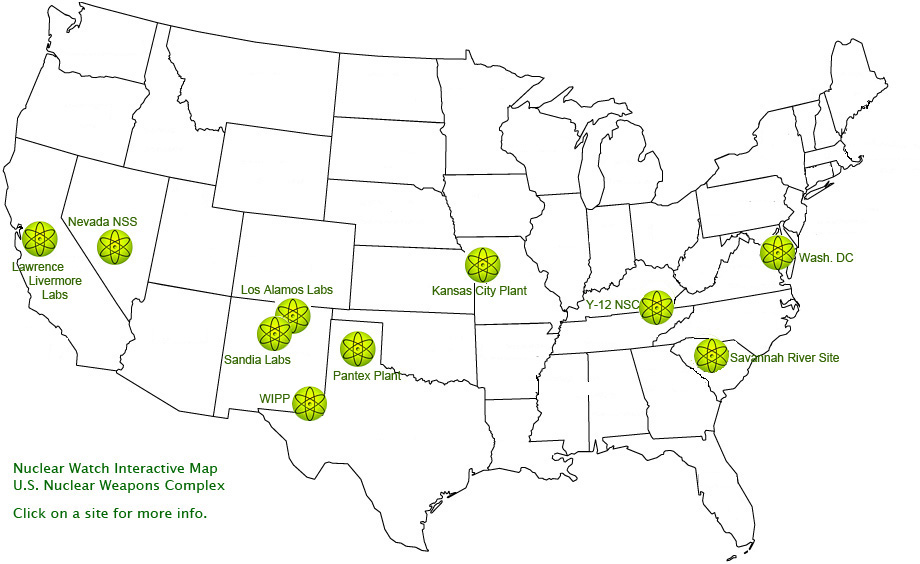
Nuclear Watch Interactive Map – U.S. Nuclear Weapons Complex
Waste Lands: America’s Forgotten Nuclear Legacy
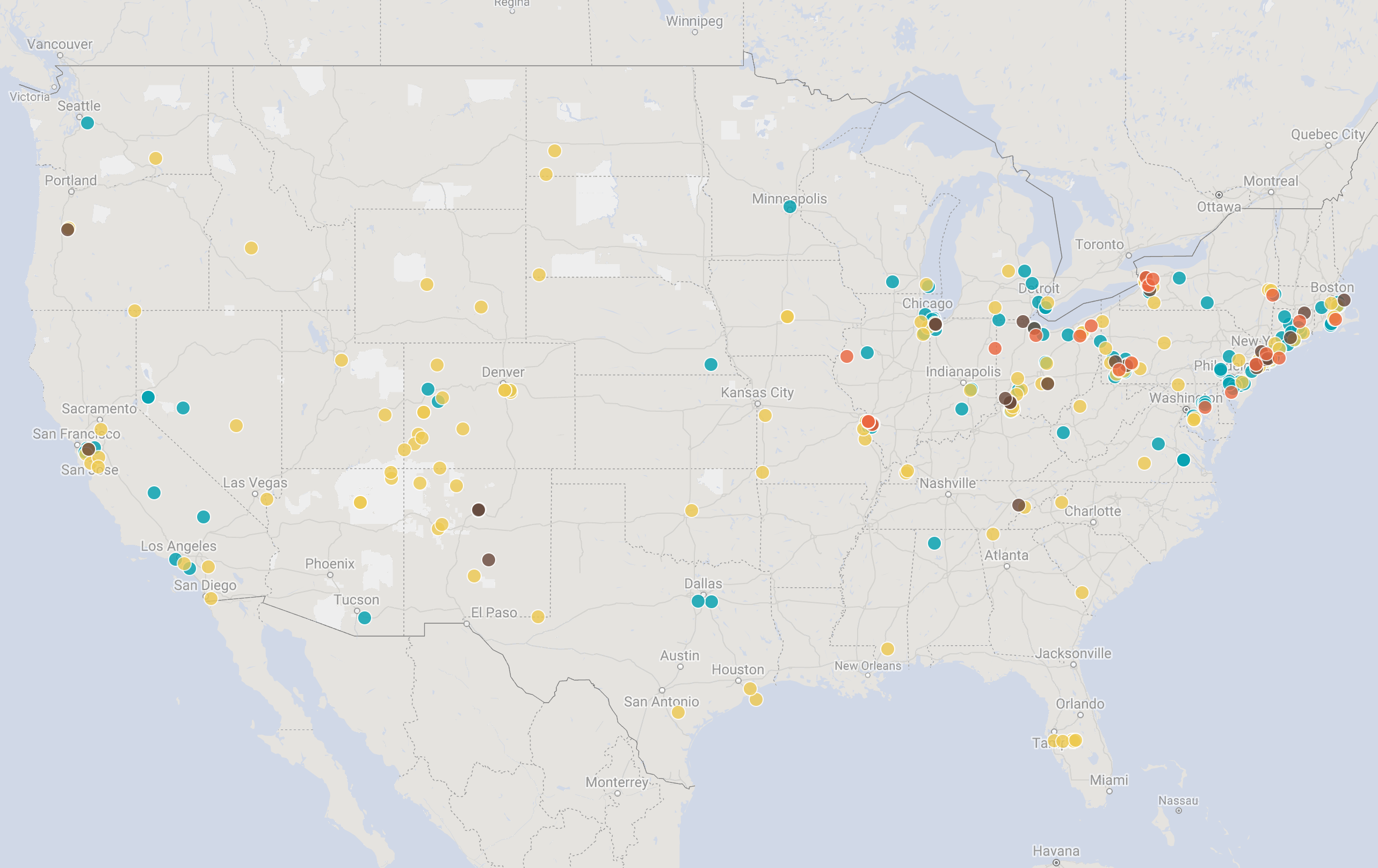
The Wall St. Journal has compiled a searchable database of contaminated sites across the US. (view)
Related WSJ report: https://www.wsj.com
In June 2016 the New Mexico Environment Department (NMED), the Department of Energy (DOE) and Los Alamos National Security, LLC (LANS) signed a revised Consent Order governing cleanup at the Los Alamos National Laboratory (LANL). The new Consent Order is a big step backwards in achieving comprehensive, genuine cleanup at the Lab.
NMED should have kept the original, enforceable 2005 Consent Order that it fought so hard for under the Richardson Administration, modified as needed for the cleanup schedule and final compliance date.
Under Gov. Martinez, the revised 2016 Consent Order was a giveaway by NMED to DOE and the Lab, surrendering the strong enforceability of the old Consent Order. As documented below, it is clearly the reverse of the 2005 Consent Order, whose underlying goal was to make DOE and LANL get more money from Congress for accelerated cleanup.
The 2016 Consent Order was negotiated to allow DOE’s budget to drive cleanup, not what is needed to permanently protect our water.
As late as 1996 LANL was claiming that groundwater contamination from its operations was impossible, even going so far as to request a waiver from NMED from having to monitor for contamination to begin with (which fortunately NMED denied).
Since then, extensive groundwater contamination from chromium, perchlorates, high explosives and VOCs has been documented.
LANL plans to “cap and cover” some 200,000 cubic meters of toxic and radioactive wastes at Area G, creating a permanent nuclear waste dump in unlined pits and shafts.
Despite the threat to precious water resources, the revised 2016 Consent Order allows DOE to determine cleanup priorities based on its anticipated budget, which is the reverse of the original Consent Order.
The new Consent Order allows LANL and DOE to get out of future cleanup by simply claiming that it’s too expensive or impractical to clean up. (See CO quotes below.)
Shortly after the 2016 Consent Order went into effect, DOE took advantage of it by estimating a lifetime budget that projected a top range of $3.8 billion to clean up the Lab, while delaying completion to 2040. That works out to only around $150 million per year, when NMED is already on record that $250 million per year is needed. DOE is planning “cleanup” on the cheap.
Whose interests were represented in the 2016 Consent Order? Not New Mexico’s!
Shortly after the 2016 Consent Order went into effect, NMED Secretary Ryan Flynn displayed his true environmental colors by resigning to become the Executive Director of the New Mexico Oil and Gas Association. The Association’s main purpose is to lobby on behalf of the oil and gas industry against environmental regulations.
Before joining NMED, Mr. Flynn worked for a law firm that advertises that “Our representation of oil and gas producers, mid-stream entities, and natural gas pipelines has been a mainstay of Modrall Sperling’s natural resources practice since the early days of the firm.” Modrall Sperling has also defended LANL or LANS (LANL’s managing contractor) against environment regulations and labor complaints.
In January 2017 Kathryn Roberts, the head of NMED’s Resource Protection Division and lead Consent Order negotiator, announced that she was leaving to work as a public communications specialist for Longenecker and Associates, a DOE contractor. Prior to working at NMED, Ms. Roberts worked at LANL for four years as Group Leader for Regulatory Support and Performance.
At Longenecker Ms. Roberts joined Christine Gelles, its Corporate Vice President and Chief Strategy Officer. They know each other well, as Ms. Gelles was the former interim manager of the new DOE Environmental Management field office at the Los Alamos Lab. A Longenecker resume´ notes that Gelles “Led planning and initial regulatory interactions with New Mexico Environment Department negotiation of Los Alamos Consent Order.” She also led initial development of the LANL lifetime budget that will cheat New Mexico out of needed increased cleanup funding. See
During the 2016 Consent Order negotiations, Ms. Roberts was one of Gelles’ main counterparts on the other side of the table as head of NMED’s Resource Protection Division. Now Gelles is one of her superiors at Longenecker, when the DOE contractor could possibly bid in the future on LANL cleanup.
Section II.A of the 2016 Consent Order allowed the Lab to “settle any outstanding violations of the 2005 Consent Order.” Existing violations were then waived.
NMED pre-emptively surrendered its regulatory and enforcement powers, when the state of New Mexico really needed the money!
New Mexico could have collected more than $300 million in stipulated penalties had NMED vigorously enforced the 2005 Consent Order. At the time, New Mexico was facing a budget crisis with a projected $600 million deficit. In effect, NMED gave half of that deficit away to a polluting nuclear weapons site that has an annual budget of ~$2.4 billion and rising.
The 2005 Consent Order was all about the enforceable schedules.
The 2005 Consent Order required DOE and LANL to investigate, characterize, and clean up hazardous and mixed radioactive contaminants from 70 years of nuclear weapons research and production.
It stipulated a detailed compliance schedule that the Lab was required to meet. Ironically, the last milestone, due in December 2015, required a report from LANL on how it successfully cleaned up Area G, its largest waste dump.
Under Gov. Martinez, NMED extensions eviscerated the 2005 Consent Order.
When NMED Secretary Ryan Flynn announced a draft new Consent Order on March 30, 2016, he publicly claimed that the 2005 Consent Order was not working, hence the need for a new one to replace it.
Nuclear Watch agrees that the 2005 Consent Order wasn’t working, but that’s because Flynn granted more than 150 compliance milestone extensions at the Lab’s request, effectively eviscerating it. The 2005 Consent Order was working quite well until Gov. Martinez took office.
Some specific provisions in the 2016 Consent Order that put DOE in the drivers seat.
“DOE shall define the use of screening levels and cleanup levels at a site…” Ibid, p. 32.
“DOE shall update the milestones and targets in Appendix B on an annual basis, accounting for such factors as… changes in anticipated funding levels.” Ibid, p. 29.
“… [DOE and NMED] shall meet to discuss the appropriation and any necessary revision to the forecast, e.g. DOE did not receive adequate appropriations from Congress…” Ibid, p. 30.
“If attainment of established cleanup objectives is demonstrated to be technically infeasible, DOE may perform risk-based alternative cleanup objectives…” Ibid, p. 34. DOE can opt out because of “impracticability” or cost of cleanup. Ibid, p. 35.
Altogether, these put the Department of Energy in the driver’s seat, not the New Mexico Environment Department, and create giant loopholes that threaten comprehensive cleanup at LANL. The 2016 Consent Order and therefore cleanup at LANL will be held hostage to DOE funding, when the Department’s own track record makes clear that its priority is expanded nuclear weapons production paid for in part by cutting cleanup and nonproliferation programs.
All future cleanup does not have cradle to grave enforceable deadlines.
Under the 2016 Consent Order, all anticipated cleanup projects do not have scheduled, enforceable cleanup deadlines from the beginning to the end of the project. This will encourage a lack of accountability in LANL cleanup programs that are already slow, incomplete, and wasteful of taxpayers’ dollars.
The 2016 Consent Order eliminates all the final deadlines for completing cleanup under the 2005 Consent Order, and replaces them with an open-ended and vague scheduling process, with highly limited enforcement opportunities.
The 2005 Consent Order (Section XII) established dozens of detailed deadlines for the completion of corrective action tasks, including completion of investigations at individual sites, installation of groundwater monitoring wells, submittal of groundwater monitoring reports, evaluation of remedial alternatives for individual sites, and completion of final remedies. These deadlines were truly enforceable under Section III.G.
The 2016 Consent Order abandons the 2005 Consent Order provisions and replaces them with a so-called “Campaign Approach” under Section VIII. Under Section VIII.A.3, it would be up to the DOE, not the regulator (i.e., NMED) to select the timing and scope of each “campaign.”
“Campaigns” have enforceable cleanup deadlines for only the work scheduled for the current year, when cleanup takes many years. These campaigns are to be negotiated each year between NMED and DOE with no public participation and opportunity to comment on the schedule. To add insult to injury, the annual schedule is determined by funding at DOE’s discretion, rather than the schedule driving the funding, which was the fundamental driver of the 2005 Consent Order.
All cleanup projects should have mandatory completion dates scheduled from the beginning, and must be fully enforceable. The 2016 Consent Order miserably fails that test.
The opportunity for a public hearing was not provided.
Any extension of a final compliance date (which was December 6, 2015) under the 2005 Consent Order should have been implemented only after the opportunity for public comment and a public hearing, including formal testimony and cross-examination of witnesses.
The Environment Department was legally required to follow these public participation requirements that were explicitly incorporated into the 2005 Consent Order, but did not.
Public participation provisions in the 2005 Consent Order were not incorporated into the 2016 Consent Order.
The 2016 Consent Order explicitly limits public participation requirements that were incorporated into the 2005 Consent Order.
All notices, milestones, targets, annual negotiations, and modifications should have had public review and comment and the opportunity for a public hearing, but did not.
Comprehensive cleanup at LANL would be a win-win for northern New Mexicans, permanently protecting the environment while providing hundreds of high paying jobs.
When DOE wants to do something, it lowballs the cost. When DOE doesn’t want to do something, it highballs the cost. LANL has estimated that comprehensive cleanup of Area G would cost $29 billion. Using actual costs of cleaning up smaller dumps, Nuclear Watch has extrapolated that cleanup of Area G would cost $7 to 8 billion. See https://nukewatch.org/facts/nwd/Area_G_Comparison_Costs-11-14-12.pdf
But of that $29 billion, DOE estimated that labor costs would be $13 billion. Applying that 45% proportion to Nuclear Watch’s estimate, that would be around $3.5 billion in jobs, jobs that northern New Mexico sorely needs.
In contrast, the government’s own environmental impact statement for a $6.5 billion nuclear weapons facility for expanded plutonium pit production stated that it would not produce a single new lab job, because it would merely relocate existing lab jobs.
Comprehensive cleanup at LANL would be a real job producer!
Important Documents & Articles Related to Nuclear Energy Production
Most Recent
Nothing Found
It seems we can’t find what you’re looking for. Perhaps searching can help.
See Also
Nuclear Watch Interactive Map – U.S. Nuclear Weapons Complex
Waste Lands: America’s Forgotten Nuclear Legacy
The Wall St. Journal has compiled a searchable database of contaminated sites across the US. (view)
Related WSJ report: https://www.wsj.com
LANL’s Central Mission: Los Alamos Lab officials have recently claimed that LANL has moved away from primarily nuclear weapons to “national security”, but what truly remains as the Labs central mission? Here’s the answer from one of its own documents:
LANL’s “Central Mission”- Presented at: RPI Nuclear Data 2011 Symposium for Criticality Safety and Reactor Applications (PDF) 4/27/11