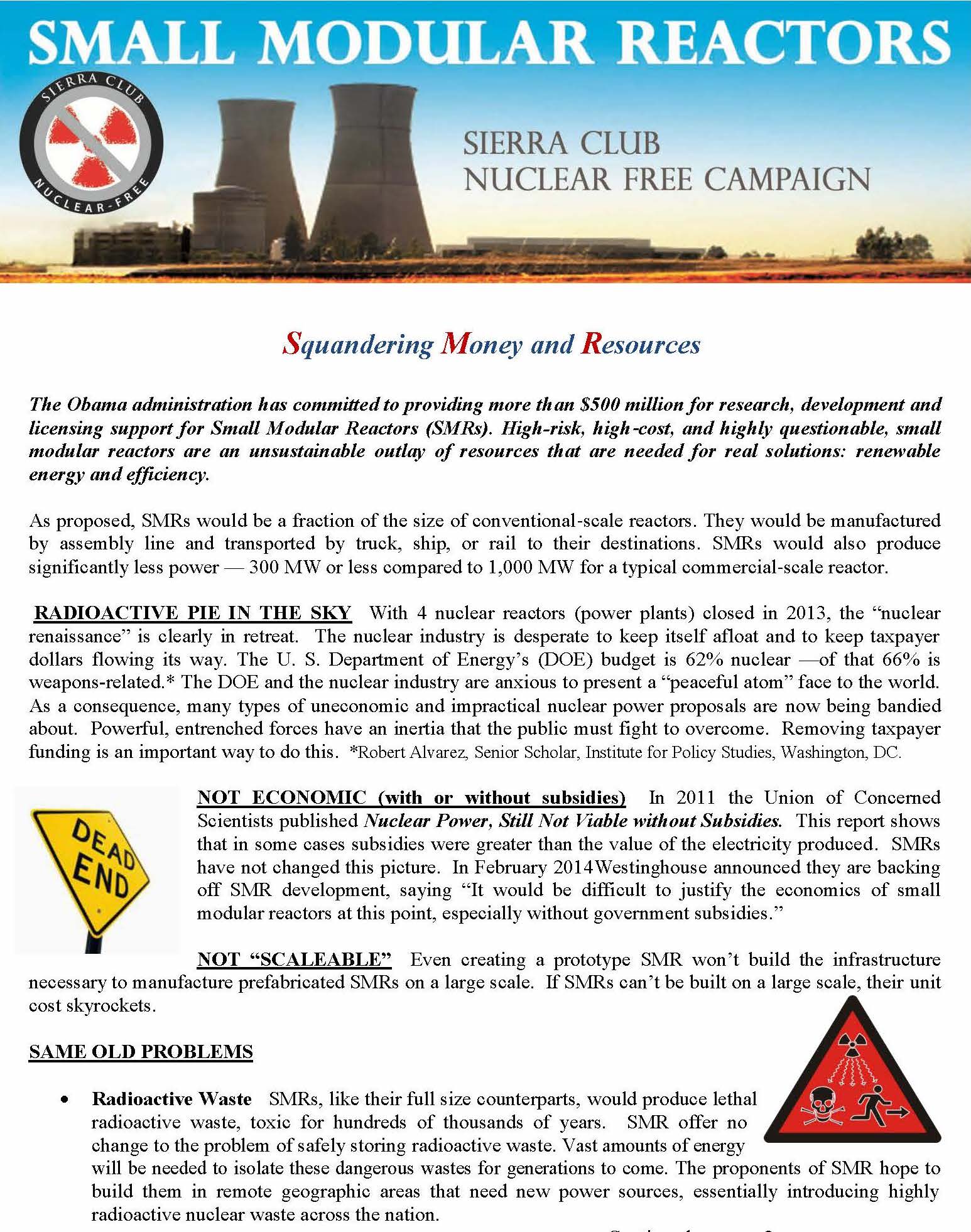
"The most toxic and dangerous type of radioactive waste created by the nuclear industry"
This is waste generated by nuclear power plants called 'high-level radioactive waste' (HLW), also known as 'spent' or 'irradiated' fuel. This waste contains plutonium, uranium, strontium, and cesium; and will be radioactive for millions of years.
It is not like the waste currently stored at the Waste Isolation Pilot Project (WIPP) or any other waste site that exists today in the U.S.: it is far worse.
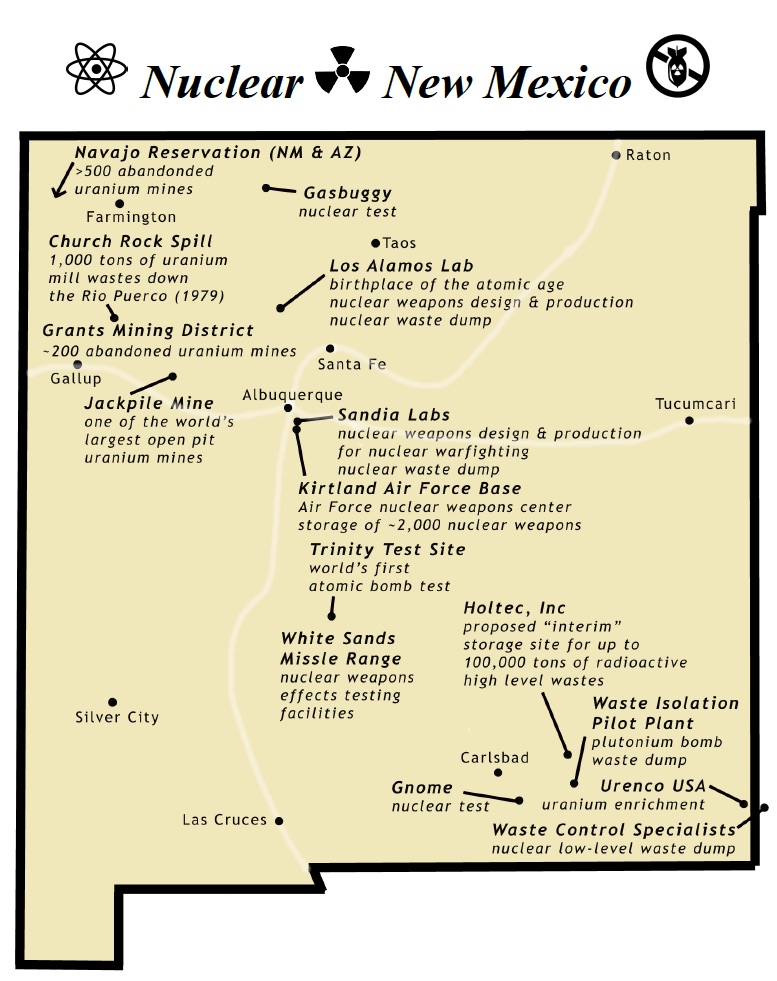
Two companies are proposing to build waste facilities near Carlsbad and Hobbs for the most toxic and dangerous type of radioactive waste created by the nuclear industry.
Holtec International is working with the Eddy-Lea Energy Alliance, LLC (ELEA) to apply for a license to build a Consolidated Interim Storage (CIS) facility approximately halfway between Carlsbad and Hobbs, and 16 miles north of WIPP.
The Nuclear Regulatory Commission (NRC) has declared the Holtec/ELEA application complete, NRC initiated a public comment period with 60 days for public comment. Note that transport of this waste poses risks to the environment and all life located near transportation routes.
Holtec proposal:
New CIS facility to store 100,000 metric tons of HLRW, with the potential to increase to 120,000 metric tons for 120 years
Shallow sub-surface burial system
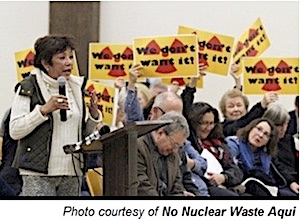
New Mexicans and Texans are fighting the attempted licensing of these two proposed CIS facilities - Waste Control Specialists near Andrews, Texas and Eddy Lee/Holtec International east of Carlsbad, New Mexico.
These sites and any transport to these sites are not only dangerous but environmentally unjust. These sites present clear examples of environmental racism.
New Mexico's demographic is largely Latino. There are many communities of color, especially in the southern part of the state where the sites are being proposed. People of color would be disproportionately affected if the Eddy Lee/Holtec CIS site were licensed and constructed.
New Mexico and Texas do not consent to either proposed CIS facility and are fighting to avoid the environmental injustice and the unnecessary shipment of irradiated high-level nuclear waste through their communities.
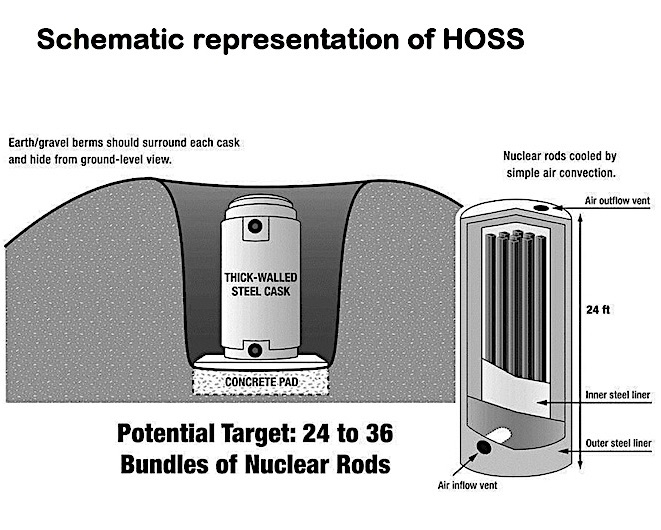
Hardened On-Site Storage (HOSS) is a community-based concept that aims to protect the public from the threats posed by the current vulnerable storage of commercial irradiated fuel.
History
For decades, high level radioactive waste has accumulated at reactor sites and continues to do so as nuclear reactors generate more waste. Without a credible plan to permanently isolate it, storage pools, where irradiated nuclear waste is currently stored until it becomes less hot, have been tightly packed and re-racked to accommodate all the waste.
Unfortunately, the pools and dry casks have no robust containment. If the cooling pumps stopped operating or the water in the pools drained out, temperatures would quickly increase, as happened in Fukushima Japan, and could result in a similar disaster.
Current dry cask storage at reactor sites (pictured above) is extremely vulnerable. There is often nothing more than a chain-link fence and a short distance that separates the highly radioactive waste containers and public access.
Establishing interim hardened on-site storage (HOSS) is a top priority. Hardened on-site storage allows waste generators to store high level waste as close to the site of generation as possible, thereby exposing fewer people to radiation, as safely as possible.
Rather than storing dozens of vulnerable dry-casks next to each other in the open air, the HOSS Principles established by concerned citizens mandate:
Irradiated fuel must be stored as safely as possible as close to the site of generation as possible;
HOSS facilities must not be regarded as a permanent waste solution, and thus should not be constructed underground and the waste must be retrievable;
The facility must have real-time radiation and heat monitoring for early detection of problems with containers;
The overall objective of HOSS should be that the amount of releases projected in even severe attacks should be low enough that the storage system would be unattractive as a terrorist target;
Placement of individual canisters that makes detection difficult from outside the site boundary.
Hardened On-Site Storage (HOSS) is supported by organizations in all 50 states. The Principles of Securing Nuclear Waste at Nuclear Reactor Sites are posted here. It would provide better security at reactor sites with robust dry storage and community oversight, including real-time monitoring of heat and radiation. HOSS is rooted in values of community protection and environmental justice and will provide increased protection from human or natural disasters, like terrorist attacks and earthquakes
HOSS facilities are not permanent waste solutions, and therefore should not be constructed deep underground as the waste must be retrievable. However, they are a workable solution that will allow us to explore scientifically sound, and socially and environmentally just long-term management systems.
Nuclear Power Has No Place in a Green Energy Future
Because of: Time Delay, Success of Renewables, Huge Costs, Dangers, Weapons Connection, and Wastes
from Yahoo News, 21 Oct 21, ”…….Practical concerns also temper enthusiasm for a nuclear future. The next generation of reactors, heralded as a game changer by supporters, still haven’t been proven in the real world. Even if those technologies are as revolutionary as advertised, skeptics say it could take decades before they make a real difference in the global energy grid — too long if the worst outcomes of climate change are to be avoided.
Renewable energy technologies can be enough on their own
“The drawbacks to nuclear are compounded by the burgeoning success of renewables — both solar and wind are getting cheaper and more efficient, year after year. There is also a growing realisation that a combination of renewables, smart storage, energy efficiency and more flexible grids can now be delivered at scale and at speed — anywhere in the world.” — Jonathon Porritt, Guardian
The world doesn’t have time to wait for next-gen nuclear
“When it comes to averting the imminent effects of climate change, even the cutting edge of nuclear technology will prove to be too little, too late. Put simply, given the economic trends in existing plants and those under construction, nuclear power cannot positively impact climate change in the next ten years or more.” — Allison Macfarlane, Foreign Affairs
A major ramp-up in nuclear technologies isn’t economically feasible
“While nuclear power may have once been cheaper than wind or solar, the economics have since changed dramatically. Nuclear power plants are very expensive to build and the economics of nuclear power are getting steadily worse. By contrast, renewables continue to come down in price.” — Ian Lowe, Conversation
There’s no way to guarantee that nuclear plants will be safe
“People around the world have witnessed the Three Mile Island, Chernobyl and Fukushima accidents. It is more than enough to believe that a safe nuclear power plant is nothing but a myth.” — Jang Daul, Korea Times
More nuclear power could lead to more nuclear weapons
“Some nations — India and Pakistan, and in all probability Israel — became nuclear powers after originally seeking nuclear technology for research or to develop nuclear power. … This is important: The technology used to turn on lights or charge mobile phones shouldn’t need to involve national or international defence apparatus.” — Editorial, Nature
Nuclear waste is still a major problem
“Nuclear waste lasts for hundreds of thousands of years before they are half-decayed. Our United States government — perhaps the longest continuous government in the world — is only 232 years old. Who will be around to manage uranium wastes?” — David Ross, Courier-Journal
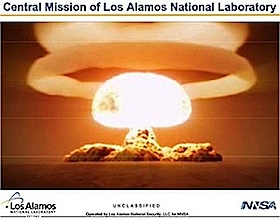
LANL’s Central Mission: Los Alamos Lab officials have recently claimed that LANL has moved away from primarily nuclear weapons to “national security”, but what truly remains as the Labs central mission? Here’s the answer from one of its own documents:
LANL’s “Central Mission”- Presented at: RPI Nuclear Data 2011 Symposium for Criticality Safety and Reactor Applications (PDF) 4/27/11
Putin clearly cannot be trusted, but this article is very one sided. First, it is alarmist to say Putin is “adding” 40 ICBMs. Instead, Russia is replacing old ones and, as the article points out, staying within New START limits. Putin claims that these new ICBMs are more capable of penetrating missile defenses. But this is largely in response to George W. Bush unilaterally tearing up the Anti-Ballistic Missile Treaty, a profoundly negative watershed in U.S. –Russian relations. And above all is continuous expansion of NATO to Russia’s border. The Russian military will be keenly aware that the life extension program for the B61 bomb that Tom Udall so ardently supports will create the world’s first nuclear smart bomb. This is contrary to U.S. claims that it only maintains stockpile safety and reliability and would never give existing nuclear weapons new military capabilities. The revamped bomb’s main mission is forward deployment in Europe against Russia.
The much-quoted ex-Sandia director Paul Robinson was prominent in undermining U.S. ratification of the long-sought-for Comprehensive Test Ban Treaty by damning it with faint praise in 1999 congressional testimony. The CTBT failed, but the labs kept the quid pro quo money for so-called Stockpile Stewardship. There is hardly a nuke that Robinson doesn’t like. In the past, he argued for a “To Whom it May Concern” target list (fill in the blank) for U.S. nuclear weapons.
Finally, the 900 pound gorilla. This article has no mention of U.S. plans to spend at least a trillion dollars over the next 30 years on “modernization” of nuclear forces. This will rebuild every existing type of nuclear weapon in the planned stockpile, and buy completely new missiles, subs and bombers to deliver them. That makes Putin look like a chump.
You bet that the for-profit, giant defense contractors running the Los Alamos and Sandia Labs (Bechtel and Lockheed Martin) and their politicians are closely watching deteriorating relations with Russia (which the U.S. has done so much to cause). They can hear the cash registers going ca-ching, ca-ching! Meanwhile, as schools and bridges are falling apart and the 70th anniversaries of the Hiroshima and Nagasaki bombings approach, the nuclear weapons labs are internally trumpeting “The Second Nuclear Age.”
Putin’s plans to add nukes closely watched in New Mexico
By Michael Coleman / Journal Washington Bureau
PUBLISHED: Sunday, June 21, 2015 at 12:02 am
WASHINGTON – Russian President Vladimir Putin’s announcement last week that he plans to add 40 new intercontinental ballistic missiles to his country’s nuclear arsenal could have implications for New Mexico’s nuclear weapons laboratories and the spending debate on Capitol Hill.
Putin’s announcement was a blunt reminder of Russia’s nuclear might amid tensions with the West over Ukraine.
Relations between Russia and the West have plunged to their lowest point since the Cold War with Moscow’s annexation of Ukraine’s Crimean Peninsula and support for a pro-Russia separatist insurgency in eastern Ukraine.
“Over 40 new intercontinental ballistic missiles capable of penetrating any, even the most technologically advanced, missile defense systems, will join the nuclear forces in the current year,” Putin said.
The declaration came at the opening of an arms show at a shooting range in Alabino, just west of Moscow. Sen. Tom Udall, a New Mexico Democrat and member of the Senate Appropriations Committee, said Putin’s nuclear weapons declaration was troubling.
“Putin’s military aggression is disturbing on a number of fronts,” Udall told the Journal. “A nuclear conflict should never occur in today’s world, and the U.S. and Russia should continue to commit to our agreements to reduce these weapons and prevent proliferation to additional countries.”
Russia’s nuclear developments are likely to be closely watched by workers at Sandia and Los Alamos national laboratories.
“These developments do underscore the importance of the work at our national nuclear labs, which keep the nation’s arsenal safe, secure and reliable, and provide critical capabilities to track and prevent proliferation,” Udall said.
UDALL: This military aggression is “disturbing”
UDALL: This military aggression is “disturbing”
Last year, Russia added 38 ICBMs to its arsenal, according to Defense Minister Sergei Shoigu. Modernizing its nuclear forces is a top priority for the Russian military, which needs to gradually decommission its aging Soviet-built ICBMs.
No violation
Nuclear policy experts interviewed by the Journal this week said the addition of the nuclear weapons would not put Russia in violation of the 2010 New START agreement, in which the U.S. and Russia both agreed to nuclear weapons limits.
“Putin’s move is mainly symbolic, because 40 more ICBMs does not significantly affect the strategic balance and keeps Russia within the limits of the New START agreement,” said Gary Samore, who served for four years as President Barack Obama’s White House Coordinator for Arms Control and Weapons of Mass Destruction.
Rodney Wilson, director of nonproliferation programs at Sandia, referred the Journal‘s questions about implications for the New Mexico lab to the National Nuclear Security Administration, which oversees the labs.
An NNSA spokeswoman also declined to comment on the labs’ work related to Russian nuclear arms issues and instead referred the Journal‘s questions to the State Department or the White House.
White House spokesman Josh Earnest dismissed Putin’s pledge to build more nuclear weapons as “saber-rattling” and said it “does nothing to de-escalate conflict.”
“The United States has repeatedly stressed our commitment to the collective defense of our NATO allies,” Earnest told reporters at the White House this week. “That is a commitment that we are willing to back up with action, if necessary. And that stands in pretty stark contrast to the saber-rattling that we’ve seen from Mr. Putin.
“And you could also make a case – and I think with some credibility – that invoking the nuclear arsenal is even an escalation of that saber-rattling,” Earnest added. “That’s unnecessary and not constructive.”
The U.S. and the EU have slapped Russia with economic sanctions, and Washington and its NATO allies have pondered an array of measures in response to Russia’s moves toward Ukraine. The three Baltic members of the alliance – Estonia, Latvia and Lithuania – have asked NATO to permanently deploy ground troops to their nations as a deterrent against an increasingly assertive Russia.
And Polish Defense Minister Tomasz Siemoniak says he and U.S. Defense Secretary Ashton Carter have held talks about placing U.S. heavy army equipment in Poland. The uptick in Russia’s nuclear ambitions would seem to stymie President Barack Obama’s call for a nuclear-free world during a much heralded 2009 speech in Prague in which Obama vowed “America’s commitment to seek the peace and security of a world without nuclear weapons.”
Asked whether there is a possibility of another U.S.-Russian arms race, Earnest suggested that Russia – hit hard by falling energy prices – may not be able to afford Putin’s latest nuclear pledge.
“There are legitimate questions that have been raised about whether or not Russia would be able to succeed in following through on many of the claims and threats that President Putin has had to offer,” Earnest said.
Work at labs
Paul Robinson, a former director of Sandia National Laboratories, said Putin’s announcement last week reinforces the importance of the work done at Sandia and Los Alamos, which are integral to the nation’s nuclear weapons complex.
Both labs are heavily involved in maintaining the nuclear stockpile, and working to prevent the spread of nuclear weapons and materials around the world.
ROBINSON: Concerned about a new weapon
ROBINSON: Concerned about a new weapon
“Nuclear deterrence is just as important as it ever was, and to say we’re going to relax and we don’t have to worry about strategic war any more would be a huge mistake,” Robinson said in a Journal interview, adding that he is concerned about Russia’s reported work on developing a new tactical nuclear weapon that would emit low radiation and could be used in conventional warfare.
“I think it is time for us to worry about it,” said Robinson, who was an ambassador and chief negotiator during U.S.-Soviet nuclear arms talks in Geneva in the 1980s.
“Clearly, if these things are going to arise again to threaten our future, (the labs) would do almost anything they could in being a part to protect it.”
Steven Pifer, director of Arms Control and Non-Proliferation Initiative at the nonpartisan Brookings Institution, said Putin’s announcement might trigger additional sympathy for nuclear weapons spending on Capitol Hill. Nuclear weapons budgets remain steady – including for work on the B61 Life Extension Project carried out at both New Mexico labs – but some in Congress are questioning the need for increases.
“My guess is that it might increase a little bit the push for doing more on the nuclear side, but I don’t think it’s going to have a huge impact,” Pifer said.
“The more worrisome thing is, why does Putin feel the need to keep talking about nuclear weapons? I sincerely hope he does not see these things as weapons of coercion, because that could be potentially very dangerous. I hope there are sensible people around him who are explaining to him just exactly what one should do to manage nuclear weapons in a responsible way.”
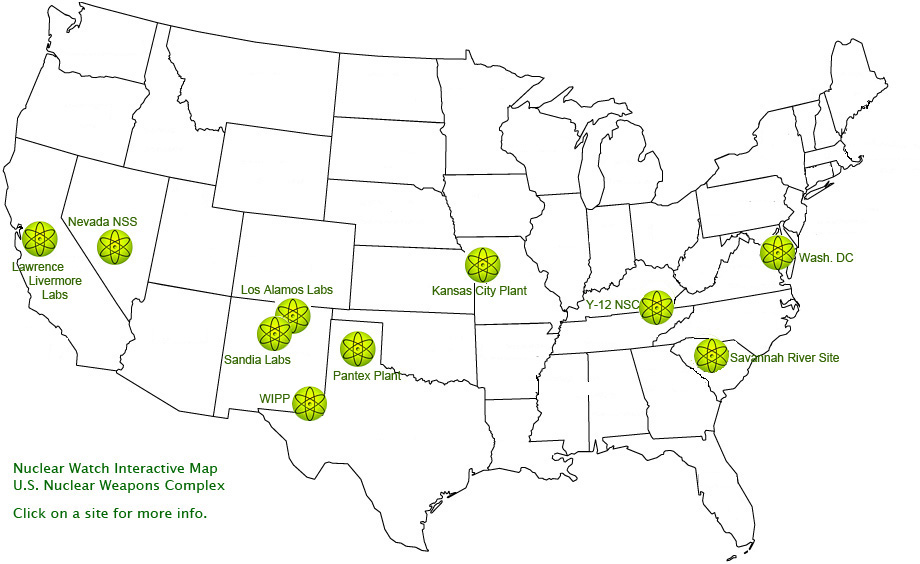
Click the image to view and download this large printable map of DOE sites, commercial reactors, nuclear waste dumps, nuclear transportation routes, surface waters near sites and transport routes, and underlying aquifers. This map was prepared by Deborah Reade for the Alliance for Nuclear Accountability.
Nuclear Watch Interactive Map – U.S. Nuclear Weapons Complex
Waste Lands: America’s Forgotten Nuclear Legacy
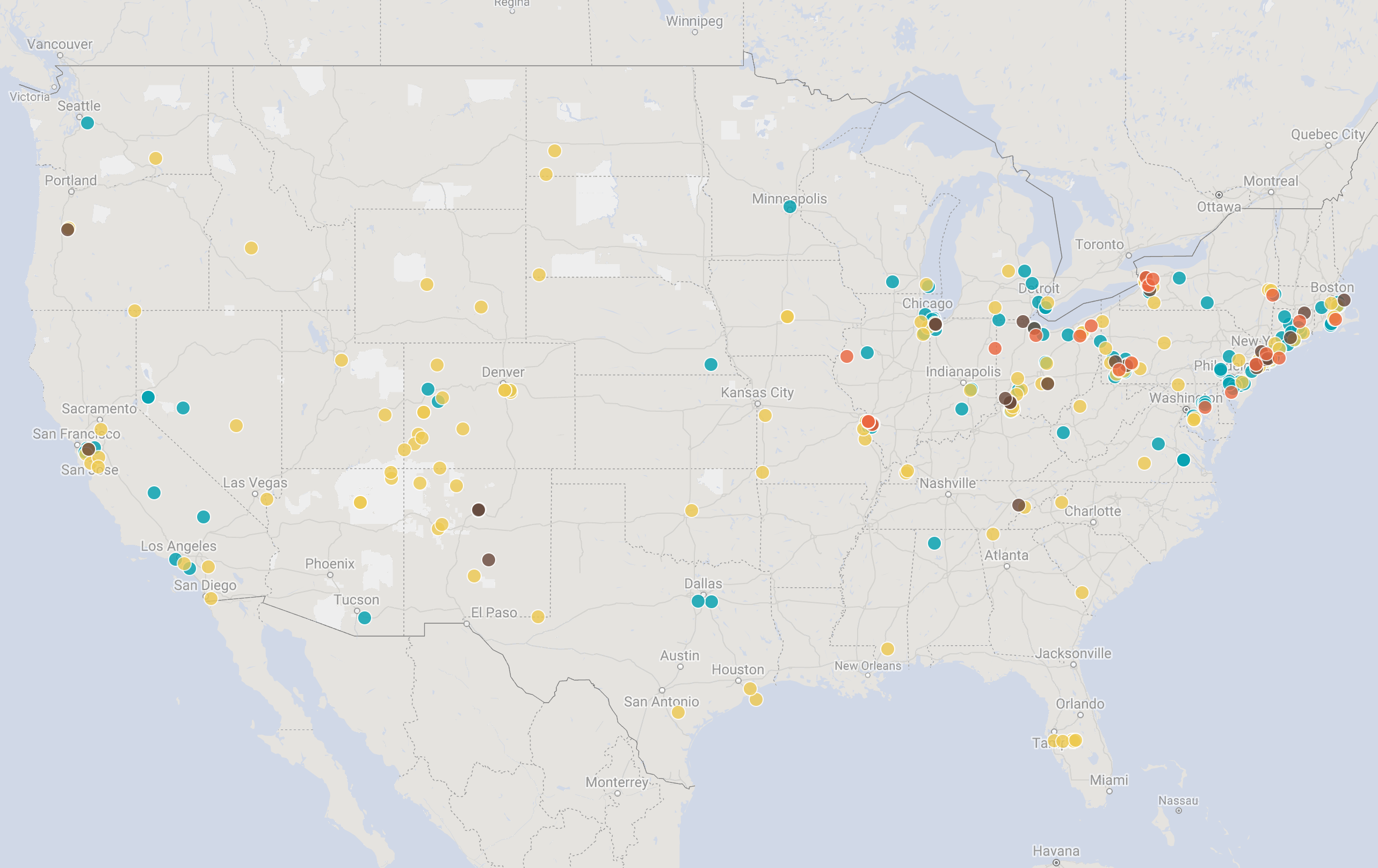
The Wall St. Journal has compiled a searchable database of contaminated sites across the US. (view)
Related WSJ report: https://www.wsj.com
Putin clearly cannot be trusted, but this article is very one sided. First, it is alarmist to say Putin is “adding” 40 ICBMs. Instead, Russia is replacing old ones and, as the article points out, staying within New START limits. Putin claims that these new ICBMs are more capable of penetrating missile defenses. But this is largely in response to George W. Bush unilaterally tearing up the Anti-Ballistic Missile Treaty, a profoundly negative watershed in U.S. –Russian relations. And above all is continuous expansion of NATO to Russia’s border. The Russian military will be keenly aware that the life extension program for the B61 bomb that Tom Udall so ardently supports will create the world’s first nuclear smart bomb. This is contrary to U.S. claims that it only maintains stockpile safety and reliability and would never give existing nuclear weapons new military capabilities. The revamped bomb’s main mission is forward deployment in Europe against Russia.
The much-quoted ex-Sandia director Paul Robinson was prominent in undermining U.S. ratification of the long-sought-for Comprehensive Test Ban Treaty by damning it with faint praise in 1999 congressional testimony. The CTBT failed, but the labs kept the quid pro quo money for so-called Stockpile Stewardship. There is hardly a nuke that Robinson doesn’t like. In the past, he argued for a “To Whom it May Concern” target list (fill in the blank) for U.S. nuclear weapons.
Finally, the 900 pound gorilla. This article has no mention of U.S. plans to spend at least a trillion dollars over the next 30 years on “modernization” of nuclear forces. This will rebuild every existing type of nuclear weapon in the planned stockpile, and buy completely new missiles, subs and bombers to deliver them. That makes Putin look like a chump.
You bet that the for-profit, giant defense contractors running the Los Alamos and Sandia Labs (Bechtel and Lockheed Martin) and their politicians are closely watching deteriorating relations with Russia (which the U.S. has done so much to cause). They can hear the cash registers going ca-ching, ca-ching! Meanwhile, as schools and bridges are falling apart and the 70th anniversaries of the Hiroshima and Nagasaki bombings approach, the nuclear weapons labs are internally trumpeting “The Second Nuclear Age.”
Putin’s plans to add nukes closely watched in New Mexico
By Michael Coleman / Journal Washington Bureau
PUBLISHED: Sunday, June 21, 2015 at 12:02 am
WASHINGTON – Russian President Vladimir Putin’s announcement last week that he plans to add 40 new intercontinental ballistic missiles to his country’s nuclear arsenal could have implications for New Mexico’s nuclear weapons laboratories and the spending debate on Capitol Hill.
Putin’s announcement was a blunt reminder of Russia’s nuclear might amid tensions with the West over Ukraine.
Relations between Russia and the West have plunged to their lowest point since the Cold War with Moscow’s annexation of Ukraine’s Crimean Peninsula and support for a pro-Russia separatist insurgency in eastern Ukraine.
“Over 40 new intercontinental ballistic missiles capable of penetrating any, even the most technologically advanced, missile defense systems, will join the nuclear forces in the current year,” Putin said.
The declaration came at the opening of an arms show at a shooting range in Alabino, just west of Moscow. Sen. Tom Udall, a New Mexico Democrat and member of the Senate Appropriations Committee, said Putin’s nuclear weapons declaration was troubling.
“Putin’s military aggression is disturbing on a number of fronts,” Udall told the Journal. “A nuclear conflict should never occur in today’s world, and the U.S. and Russia should continue to commit to our agreements to reduce these weapons and prevent proliferation to additional countries.”
Russia’s nuclear developments are likely to be closely watched by workers at Sandia and Los Alamos national laboratories.
“These developments do underscore the importance of the work at our national nuclear labs, which keep the nation’s arsenal safe, secure and reliable, and provide critical capabilities to track and prevent proliferation,” Udall said.
UDALL: This military aggression is “disturbing”
UDALL: This military aggression is “disturbing”
Last year, Russia added 38 ICBMs to its arsenal, according to Defense Minister Sergei Shoigu. Modernizing its nuclear forces is a top priority for the Russian military, which needs to gradually decommission its aging Soviet-built ICBMs.
No violation
Nuclear policy experts interviewed by the Journal this week said the addition of the nuclear weapons would not put Russia in violation of the 2010 New START agreement, in which the U.S. and Russia both agreed to nuclear weapons limits.
“Putin’s move is mainly symbolic, because 40 more ICBMs does not significantly affect the strategic balance and keeps Russia within the limits of the New START agreement,” said Gary Samore, who served for four years as President Barack Obama’s White House Coordinator for Arms Control and Weapons of Mass Destruction.
Rodney Wilson, director of nonproliferation programs at Sandia, referred the Journal‘s questions about implications for the New Mexico lab to the National Nuclear Security Administration, which oversees the labs.
An NNSA spokeswoman also declined to comment on the labs’ work related to Russian nuclear arms issues and instead referred the Journal‘s questions to the State Department or the White House.
White House spokesman Josh Earnest dismissed Putin’s pledge to build more nuclear weapons as “saber-rattling” and said it “does nothing to de-escalate conflict.”
“The United States has repeatedly stressed our commitment to the collective defense of our NATO allies,” Earnest told reporters at the White House this week. “That is a commitment that we are willing to back up with action, if necessary. And that stands in pretty stark contrast to the saber-rattling that we’ve seen from Mr. Putin.
“And you could also make a case – and I think with some credibility – that invoking the nuclear arsenal is even an escalation of that saber-rattling,” Earnest added. “That’s unnecessary and not constructive.”
The U.S. and the EU have slapped Russia with economic sanctions, and Washington and its NATO allies have pondered an array of measures in response to Russia’s moves toward Ukraine. The three Baltic members of the alliance – Estonia, Latvia and Lithuania – have asked NATO to permanently deploy ground troops to their nations as a deterrent against an increasingly assertive Russia.
And Polish Defense Minister Tomasz Siemoniak says he and U.S. Defense Secretary Ashton Carter have held talks about placing U.S. heavy army equipment in Poland. The uptick in Russia’s nuclear ambitions would seem to stymie President Barack Obama’s call for a nuclear-free world during a much heralded 2009 speech in Prague in which Obama vowed “America’s commitment to seek the peace and security of a world without nuclear weapons.”
Asked whether there is a possibility of another U.S.-Russian arms race, Earnest suggested that Russia – hit hard by falling energy prices – may not be able to afford Putin’s latest nuclear pledge.
“There are legitimate questions that have been raised about whether or not Russia would be able to succeed in following through on many of the claims and threats that President Putin has had to offer,” Earnest said.
Work at labs
Paul Robinson, a former director of Sandia National Laboratories, said Putin’s announcement last week reinforces the importance of the work done at Sandia and Los Alamos, which are integral to the nation’s nuclear weapons complex.
Both labs are heavily involved in maintaining the nuclear stockpile, and working to prevent the spread of nuclear weapons and materials around the world.
ROBINSON: Concerned about a new weapon
ROBINSON: Concerned about a new weapon
“Nuclear deterrence is just as important as it ever was, and to say we’re going to relax and we don’t have to worry about strategic war any more would be a huge mistake,” Robinson said in a Journal interview, adding that he is concerned about Russia’s reported work on developing a new tactical nuclear weapon that would emit low radiation and could be used in conventional warfare.
“I think it is time for us to worry about it,” said Robinson, who was an ambassador and chief negotiator during U.S.-Soviet nuclear arms talks in Geneva in the 1980s.
“Clearly, if these things are going to arise again to threaten our future, (the labs) would do almost anything they could in being a part to protect it.”
Steven Pifer, director of Arms Control and Non-Proliferation Initiative at the nonpartisan Brookings Institution, said Putin’s announcement might trigger additional sympathy for nuclear weapons spending on Capitol Hill. Nuclear weapons budgets remain steady – including for work on the B61 Life Extension Project carried out at both New Mexico labs – but some in Congress are questioning the need for increases.
“My guess is that it might increase a little bit the push for doing more on the nuclear side, but I don’t think it’s going to have a huge impact,” Pifer said.
“The more worrisome thing is, why does Putin feel the need to keep talking about nuclear weapons? I sincerely hope he does not see these things as weapons of coercion, because that could be potentially very dangerous. I hope there are sensible people around him who are explaining to him just exactly what one should do to manage nuclear weapons in a responsible way.”
Important Documents & Articles Related to Nuclear Energy Production
Most Recent
Nothing Found
It seems we can’t find what you’re looking for. Perhaps searching can help.
See Also
Nuclear Watch Interactive Map – U.S. Nuclear Weapons Complex
Waste Lands: America’s Forgotten Nuclear Legacy
The Wall St. Journal has compiled a searchable database of contaminated sites across the US. (view)
Related WSJ report: https://www.wsj.com
LANL’s Central Mission: Los Alamos Lab officials have recently claimed that LANL has moved away from primarily nuclear weapons to “national security”, but what truly remains as the Labs central mission? Here’s the answer from one of its own documents:
LANL’s “Central Mission”- Presented at: RPI Nuclear Data 2011 Symposium for Criticality Safety and Reactor Applications (PDF) 4/27/11