"The most toxic and dangerous type of radioactive waste created by the nuclear industry"
This is waste generated by nuclear power plants called 'high-level radioactive waste' (HLW), also known as 'spent' or 'irradiated' fuel. This waste contains plutonium, uranium, strontium, and cesium; and will be radioactive for millions of years.
It is not like the waste currently stored at the Waste Isolation Pilot Project (WIPP) or any other waste site that exists today in the U.S.: it is far worse.
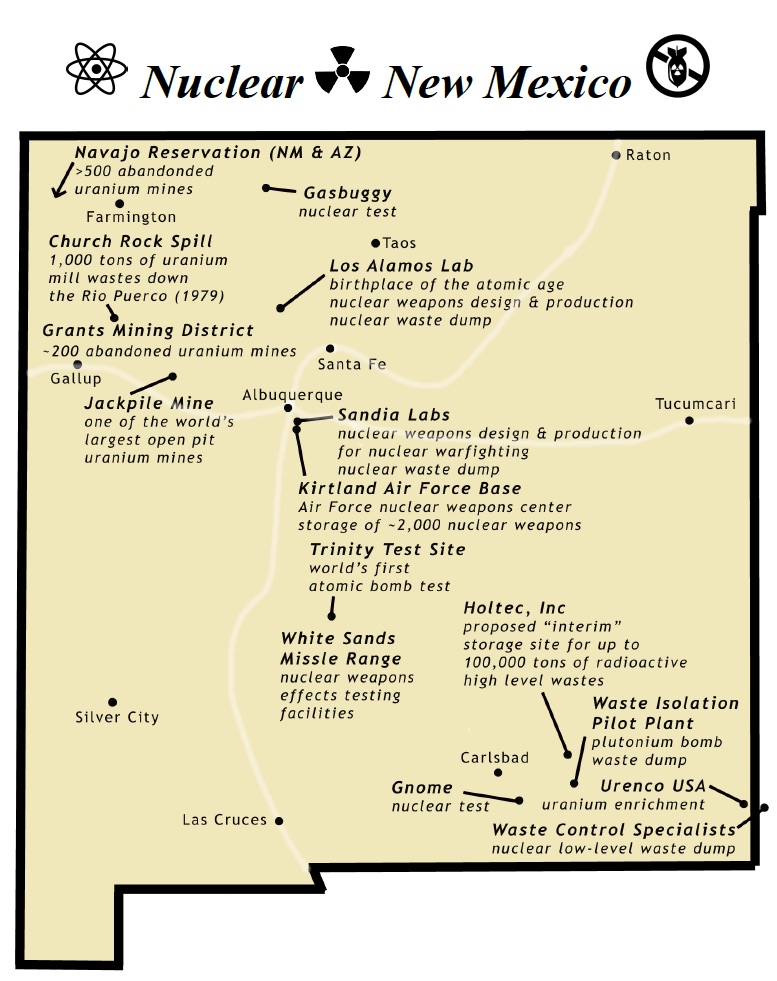
Two companies are proposing to build waste facilities near Carlsbad and Hobbs for the most toxic and dangerous type of radioactive waste created by the nuclear industry.
Holtec International is working with the Eddy-Lea Energy Alliance, LLC (ELEA) to apply for a license to build a Consolidated Interim Storage (CIS) facility approximately halfway between Carlsbad and Hobbs, and 16 miles north of WIPP.
The Nuclear Regulatory Commission (NRC) has declared the Holtec/ELEA application complete, NRC initiated a public comment period with 60 days for public comment. Note that transport of this waste poses risks to the environment and all life located near transportation routes.
Holtec proposal:
New CIS facility to store 100,000 metric tons of HLRW, with the potential to increase to 120,000 metric tons for 120 years
Shallow sub-surface burial system
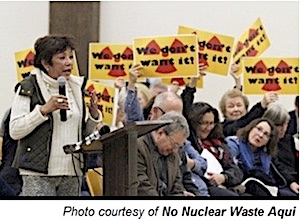
New Mexicans and Texans are fighting the attempted licensing of these two proposed CIS facilities - Waste Control Specialists near Andrews, Texas and Eddy Lee/Holtec International east of Carlsbad, New Mexico.
These sites and any transport to these sites are not only dangerous but environmentally unjust. These sites present clear examples of environmental racism.
New Mexico's demographic is largely Latino. There are many communities of color, especially in the southern part of the state where the sites are being proposed. People of color would be disproportionately affected if the Eddy Lee/Holtec CIS site were licensed and constructed.
New Mexico and Texas do not consent to either proposed CIS facility and are fighting to avoid the environmental injustice and the unnecessary shipment of irradiated high-level nuclear waste through their communities.
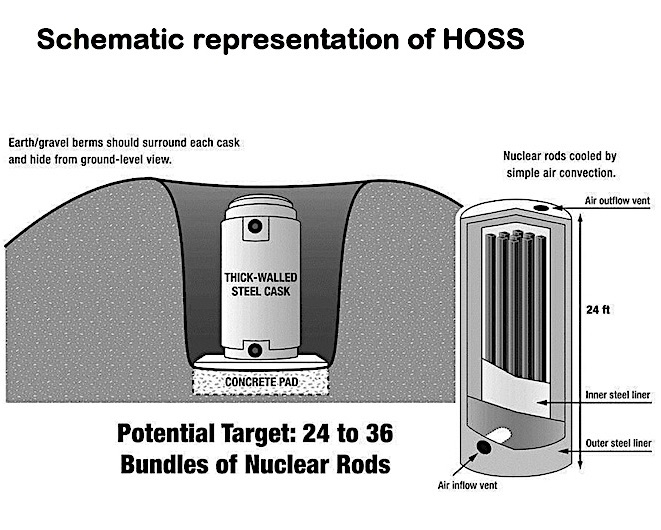
Hardened On-Site Storage (HOSS) is a community-based concept that aims to protect the public from the threats posed by the current vulnerable storage of commercial irradiated fuel.
History
For decades, high level radioactive waste has accumulated at reactor sites and continues to do so as nuclear reactors generate more waste. Without a credible plan to permanently isolate it, storage pools, where irradiated nuclear waste is currently stored until it becomes less hot, have been tightly packed and re-racked to accommodate all the waste.
Unfortunately, the pools and dry casks have no robust containment. If the cooling pumps stopped operating or the water in the pools drained out, temperatures would quickly increase, as happened in Fukushima Japan, and could result in a similar disaster.
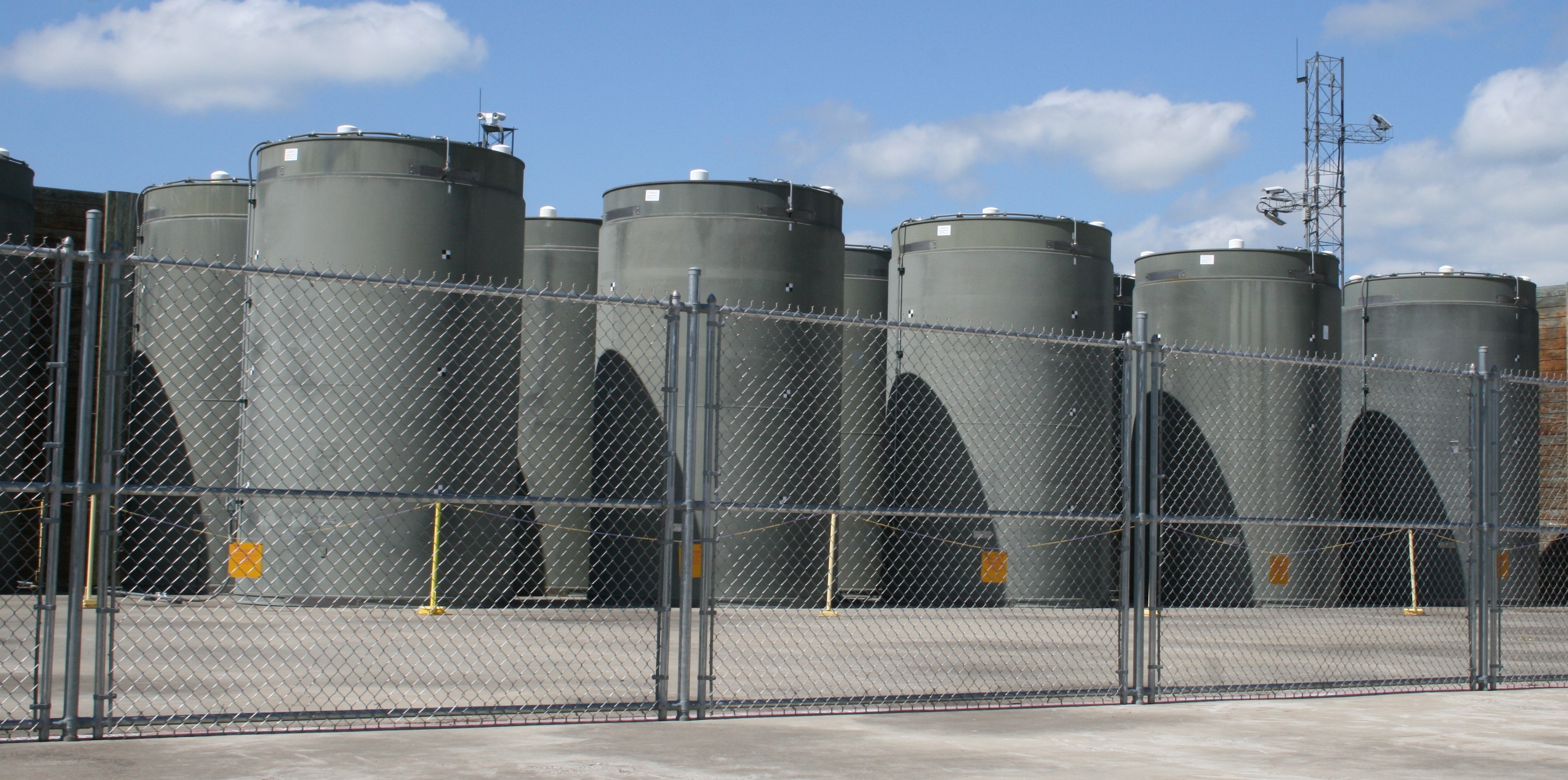
Current dry cask storage at reactor sites (pictured above) is extremely vulnerable. There is often nothing more than a chain-link fence and a short distance that separates the highly radioactive waste containers and public access.
Establishing interim hardened on-site storage (HOSS) is a top priority. Hardened on-site storage allows waste generators to store high level waste as close to the site of generation as possible, thereby exposing fewer people to radiation, as safely as possible.
Rather than storing dozens of vulnerable dry-casks next to each other in the open air, the HOSS Principles established by concerned citizens mandate:
Irradiated fuel must be stored as safely as possible as close to the site of generation as possible;
HOSS facilities must not be regarded as a permanent waste solution, and thus should not be constructed underground and the waste must be retrievable;
The facility must have real-time radiation and heat monitoring for early detection of problems with containers;
The overall objective of HOSS should be that the amount of releases projected in even severe attacks should be low enough that the storage system would be unattractive as a terrorist target;
Placement of individual canisters that makes detection difficult from outside the site boundary.
Hardened On-Site Storage (HOSS) is supported by organizations in all 50 states. The Principles of Securing Nuclear Waste at Nuclear Reactor Sites are posted here. It would provide better security at reactor sites with robust dry storage and community oversight, including real-time monitoring of heat and radiation. HOSS is rooted in values of community protection and environmental justice and will provide increased protection from human or natural disasters, like terrorist attacks and earthquakes
HOSS facilities are not permanent waste solutions, and therefore should not be constructed deep underground as the waste must be retrievable. However, they are a workable solution that will allow us to explore scientifically sound, and socially and environmentally just long-term management systems.
Nuclear Power Has No Place in a Green Energy Future
Because of: Time Delay, Success of Renewables, Huge Costs, Dangers, Weapons Connection, and Wastes
from Yahoo News, 21 Oct 21, ”…….Practical concerns also temper enthusiasm for a nuclear future. The next generation of reactors, heralded as a game changer by supporters, still haven’t been proven in the real world. Even if those technologies are as revolutionary as advertised, skeptics say it could take decades before they make a real difference in the global energy grid — too long if the worst outcomes of climate change are to be avoided.
Renewable energy technologies can be enough on their own
“The drawbacks to nuclear are compounded by the burgeoning success of renewables — both solar and wind are getting cheaper and more efficient, year after year. There is also a growing realisation that a combination of renewables, smart storage, energy efficiency and more flexible grids can now be delivered at scale and at speed — anywhere in the world.” — Jonathon Porritt, Guardian
The world doesn’t have time to wait for next-gen nuclear
“When it comes to averting the imminent effects of climate change, even the cutting edge of nuclear technology will prove to be too little, too late. Put simply, given the economic trends in existing plants and those under construction, nuclear power cannot positively impact climate change in the next ten years or more.” — Allison Macfarlane, Foreign Affairs
A major ramp-up in nuclear technologies isn’t economically feasible
“While nuclear power may have once been cheaper than wind or solar, the economics have since changed dramatically. Nuclear power plants are very expensive to build and the economics of nuclear power are getting steadily worse. By contrast, renewables continue to come down in price.” — Ian Lowe, Conversation
There’s no way to guarantee that nuclear plants will be safe
“People around the world have witnessed the Three Mile Island, Chernobyl and Fukushima accidents. It is more than enough to believe that a safe nuclear power plant is nothing but a myth.” — Jang Daul, Korea Times
More nuclear power could lead to more nuclear weapons
“Some nations — India and Pakistan, and in all probability Israel — became nuclear powers after originally seeking nuclear technology for research or to develop nuclear power. … This is important: The technology used to turn on lights or charge mobile phones shouldn’t need to involve national or international defence apparatus.” — Editorial, Nature
Nuclear waste is still a major problem
“Nuclear waste lasts for hundreds of thousands of years before they are half-decayed. Our United States government — perhaps the longest continuous government in the world — is only 232 years old. Who will be around to manage uranium wastes?” — David Ross, Courier-Journal
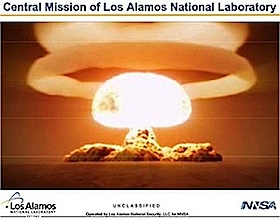
LANL’s Central Mission: Los Alamos Lab officials have recently claimed that LANL has moved away from primarily nuclear weapons to “national security”, but what truly remains as the Labs central mission? Here’s the answer from one of its own documents:
LANL’s “Central Mission”- Presented at: RPI Nuclear Data 2011 Symposium for Criticality Safety and Reactor Applications (PDF) 4/27/11
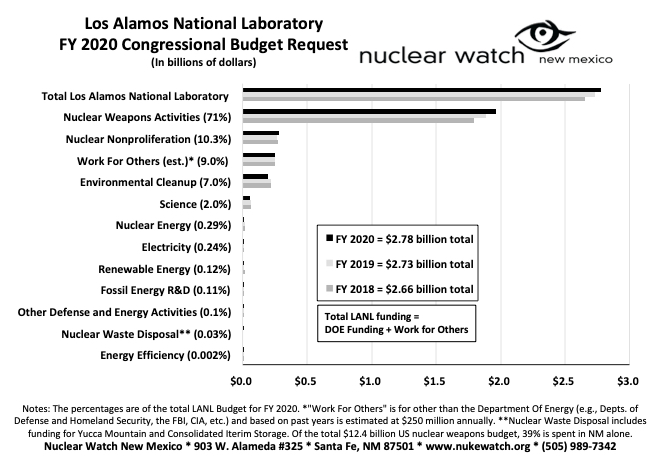
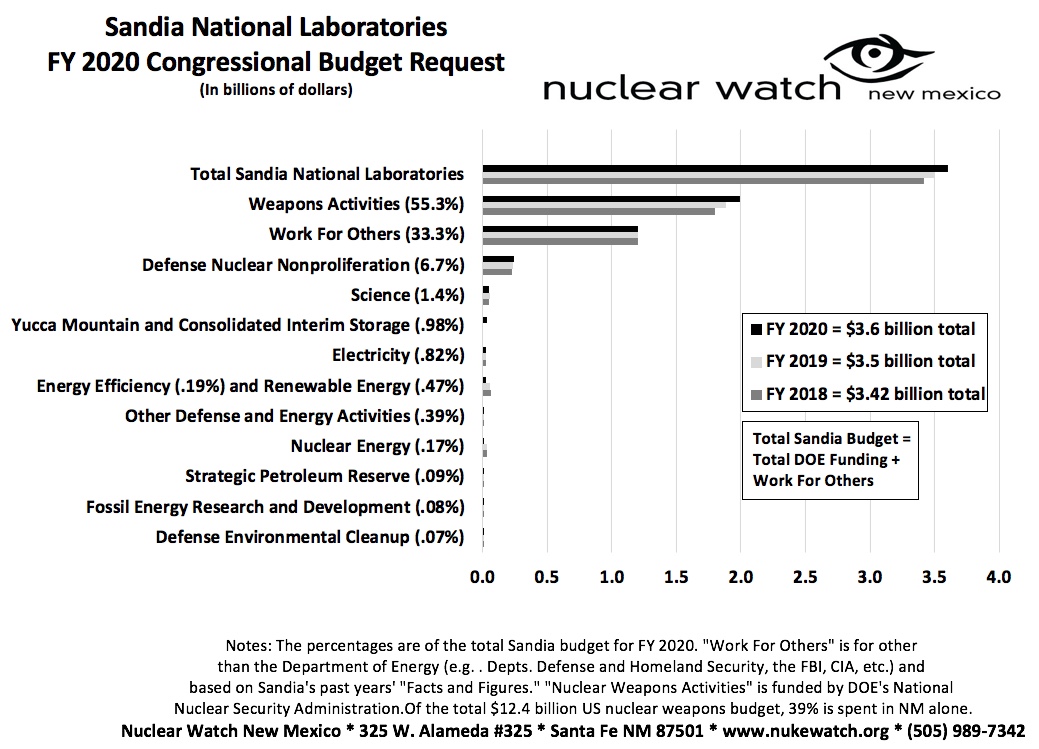
The National Nuclear Security Administration, a division of the U.S. Department of Energy, is tasked with securing and maintaining the nation’s nuclear arsenal. It oversees Los Alamos National Laboratory and Sandia National Laboratories in New Mexico.
For years the agency’s MO has included expectations of nearly automatic budget increases, bloated projects that are never finished, duplicative red tape and a bureaucracy that resists efforts to rein it in.
Critics say it has become a massive jobs program.
Ten of its major projects are collectively over budget to the tune of $16 billion and behind schedule by 38 years, according to the U.S. Government Accountability Office. For instance, at LANL a new $213 million security system to protect sensitive nuclear bomb-making facilities doesn’t work. So, taxpayers are being asked to lay out an additional $41 million to fix it.
The chairwoman of the Senate Homeland Security subcommittee that oversees finances and contracts largely blames the agency’s reliance on private contractors – more than 92,000. LANL and Sandia are operated by private contractors, LANL by a consortium led by Bechtel, and Sandia by Lockheed Martin.
Former Lockheed Martin CEO Norman Augustine told Congress this spring that accountability and internal structure problems pose a national security risk. And there’s no doubt NNSA’s work is critical to U.S. national security, but taxpayers also are tired of watching their money being thrown at an insatiable beast that too often fails to deliver results.
As long as the NNSA remains impervious to calls for improving its culture and tightening up its accountability, the inefficiencies and waste will keep coming.
A congressionally appointed panel recently began studying whether to overhaul the agency. (Former Sen. Jeff Bingaman had said he was open to just getting rid of it.) Energy Secretary Ernest Moniz says the review is a chance to “have this dialogue and reach a conclusion.”
It’s way past time for that talk. The panel should come up with a well-thought-out plan to either overhaul NNSA from top to bottom or outright kill it and let the DOE take on its oversight duties.
This editorial first appeared in the Albuquerque Journal. It was written by members of the editorial board and is unsigned as it represents the opinion of the newspaper rather than the writers.
My response:
Abolish NNSA, but increase federal oversight and independent review
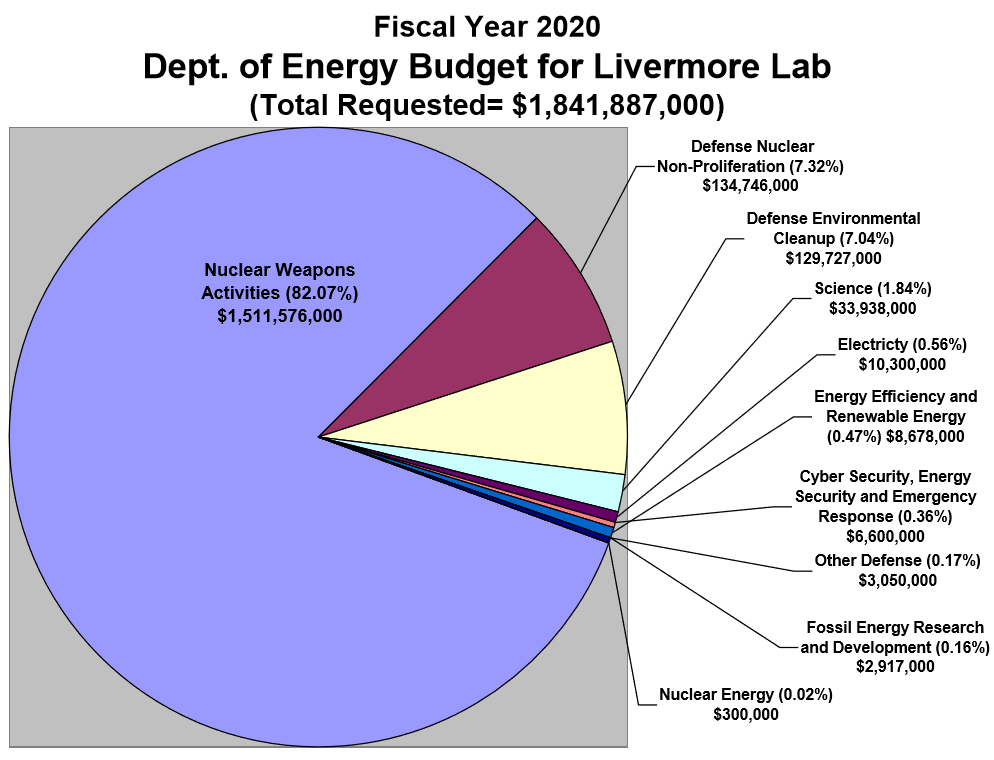
Kudos for the editorial “Time past for coddling bloated nuclear agency.” The money the National Nuclear Security Administration (NNSA) has wasted on out-of-control nuclear weapons projects is appalling. Some examples are the Chemistry and Metallurgy Research Replacement Project at Los Alamos (estimated costs exploded from $660 million to $5.8 billion), the failed National Ignition Facility at the Livermore Lab in California ($1 billion to $5 billion), the MOX Fuel Fabrication Facility in South Carolina ($1 billion to $7 billion), and now the Uranium Processing Facility at the Y-12 Plant in Tennessee ($1 billion to $10 billion).
Despite all this chronic mismanagement NNSA’s proposed budget was increased 17% above FY 2013 sequester levels. That’s right, the guilty were rewarded, while schools, firefighting, environmental protection, etc. were cut.
But while NNSA is truly dysfunctional, its contractors deserve more scrutiny as well. After all, the agency is simply out manned, with some 2,600 (and declining) employees trying to oversee more than 50,000 contractor employees nation-wide. Moreover, these contractors have inherent conflicts-of-interest. For instance, the lab directors wear two hats, first as those responsible for annual certification of the safety, security and reliability of the nuclear weapons stockpile, which gives them enormous leverage. Their second hat is as presidents of the executive boards of the for-profit corporations running the labs. How can we be sure they are always acting in the best interests of the country while they are pushing a never-ending cycle of extremely costly “Life Extension Programs” for existing nuclear weapons? Ironically, these programs may actually erode confidence in stockpile reliability by intentionally introducing major changes that can’t be full-scale tested.
As your editorial noted a congressionally appointed panel is beginning to study the NNSA’s future. I make some recommendations for that panel:
• The NNSA is a failed experiment and should be abolished. Its nuclear weapons programs should revert back to “Defense Programs” within the Department of Energy, as it was pre-2000.
• As guarantors of the nuclear weapons stockpile, the lab directors should be just lab directors, their jobs institutionally insulated from the for-profit motivations of the private corporations running the labs.
• Duplicative bureaucratic red tape should be eliminated, but federal oversight should be increased, not decreased (witness a protesting 82-year-old nun infiltrating an extremely sensitive area at Y-12 despite contractor security assurances). Concrete benchmarks need to be put back into now toothless annual Performance Evaluation Plans so that contractors are held truly accountable. NNSA’s past practice of granting waivers for poor performance while handing out contract extensions (as was done for the Los Alamos and Livermore Labs) must end.
• DOE should be required to seek concurrence from the congressionally chartered Defense Nuclear Facilities Safety Board early in the design of nuclear facilities. Past NNSA delays in meeting safety concerns have been a prime driver of exploding project costs.
• Congress should establish a stringent change control process for nuclear weapons, including a requirement for outside review of all proposed major changes. Because the labs lack conservatism in maintaining the pedigree of tested, reliable designs, independent expert review could save 100’s of billion of dollars over the next few decades and help maintain confidence in stockpile reliability. As a past example, a group of eminent independent scientists called the JASONs found that the cores of nuclear weapons, the plutonium pits, have reliable life times of around a century, in contrast to NNSA’s previous claims of 45 years. This helped to convince Congress to delete funding for NNSA’s proposed, enormously expensive new-design nuclear weapons and related expanded plutonium pit production.
• Finally, the congressionally appointed panel deliberating on NNSA’s future should itself be above reproach. One member, former Congresswoman Heather Wilson, pocketed $450,000 in no-bid “consulting” contracts with the Los Alamos and Sandia Labs, in between her terms representing New Mexico’s First District and her Senate campaign that largely championed the labs. She should resign from the panel so that its future recommendations are not tainted by her clear conflict-of-interest.
Click the image to view and download this large printable map of DOE sites, commercial reactors, nuclear waste dumps, nuclear transportation routes, surface waters near sites and transport routes, and underlying aquifers. This map was prepared by Deborah Reade for the Alliance for Nuclear Accountability.
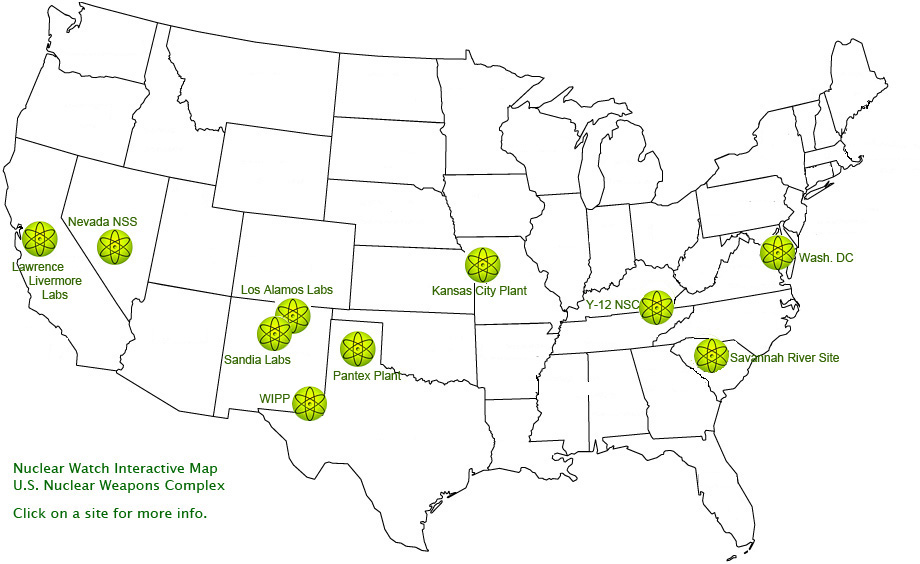
Nuclear Watch Interactive Map – U.S. Nuclear Weapons Complex
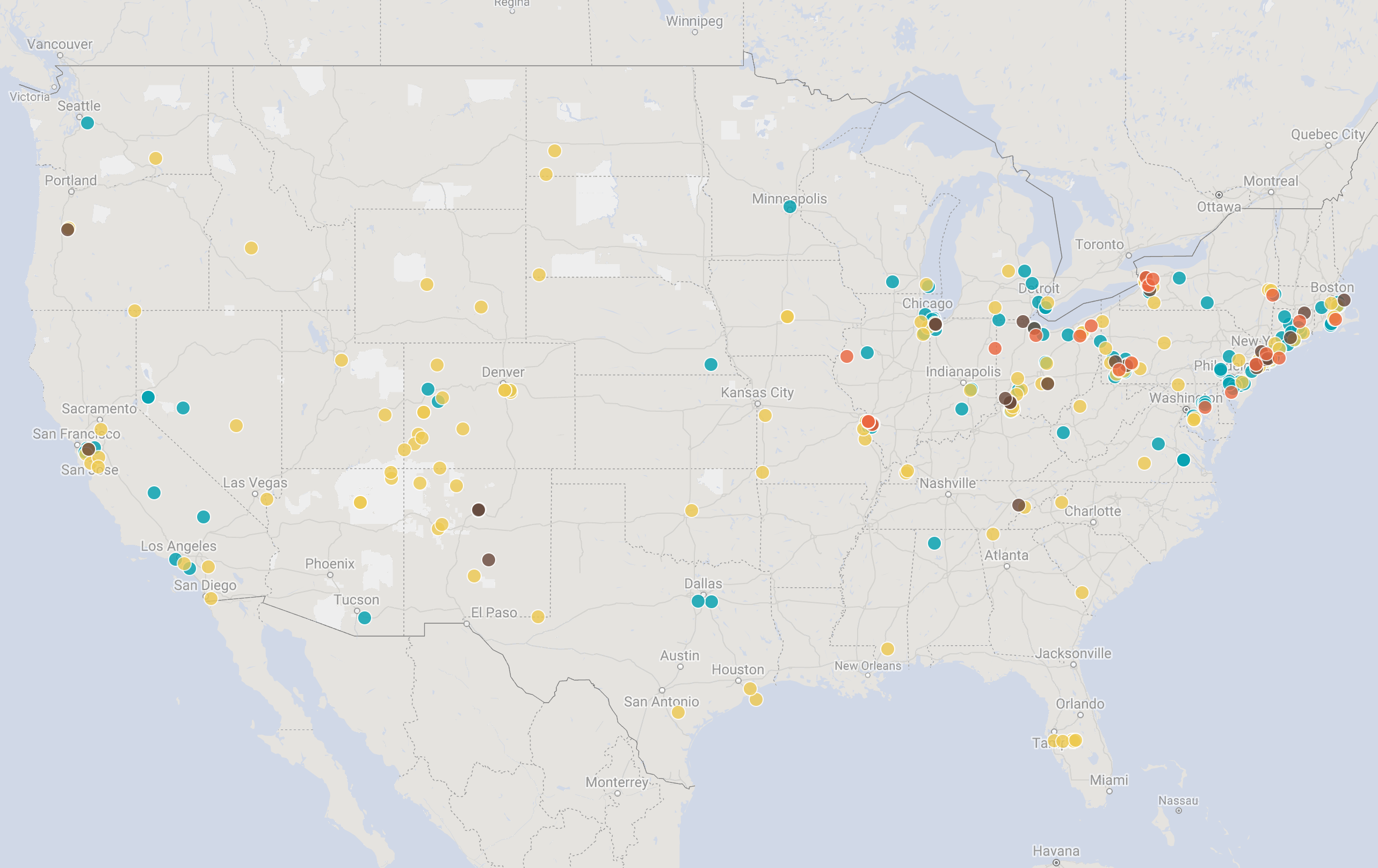
Waste Lands: America’s Forgotten Nuclear Legacy
The Wall St. Journal has compiled a searchable database of contaminated sites across the US. (view)
Related WSJ report: https://www.wsj.com
The National Nuclear Security Administration, a division of the U.S. Department of Energy, is tasked with securing and maintaining the nation’s nuclear arsenal. It oversees Los Alamos National Laboratory and Sandia National Laboratories in New Mexico.
For years the agency’s MO has included expectations of nearly automatic budget increases, bloated projects that are never finished, duplicative red tape and a bureaucracy that resists efforts to rein it in.
Critics say it has become a massive jobs program.
Ten of its major projects are collectively over budget to the tune of $16 billion and behind schedule by 38 years, according to the U.S. Government Accountability Office. For instance, at LANL a new $213 million security system to protect sensitive nuclear bomb-making facilities doesn’t work. So, taxpayers are being asked to lay out an additional $41 million to fix it.
The chairwoman of the Senate Homeland Security subcommittee that oversees finances and contracts largely blames the agency’s reliance on private contractors – more than 92,000. LANL and Sandia are operated by private contractors, LANL by a consortium led by Bechtel, and Sandia by Lockheed Martin.
Former Lockheed Martin CEO Norman Augustine told Congress this spring that accountability and internal structure problems pose a national security risk. And there’s no doubt NNSA’s work is critical to U.S. national security, but taxpayers also are tired of watching their money being thrown at an insatiable beast that too often fails to deliver results.
As long as the NNSA remains impervious to calls for improving its culture and tightening up its accountability, the inefficiencies and waste will keep coming.
A congressionally appointed panel recently began studying whether to overhaul the agency. (Former Sen. Jeff Bingaman had said he was open to just getting rid of it.) Energy Secretary Ernest Moniz says the review is a chance to “have this dialogue and reach a conclusion.”
It’s way past time for that talk. The panel should come up with a well-thought-out plan to either overhaul NNSA from top to bottom or outright kill it and let the DOE take on its oversight duties.
This editorial first appeared in the Albuquerque Journal. It was written by members of the editorial board and is unsigned as it represents the opinion of the newspaper rather than the writers.
My response:
Abolish NNSA, but increase federal oversight and independent review
Kudos for the editorial “Time past for coddling bloated nuclear agency.” The money the National Nuclear Security Administration (NNSA) has wasted on out-of-control nuclear weapons projects is appalling. Some examples are the Chemistry and Metallurgy Research Replacement Project at Los Alamos (estimated costs exploded from $660 million to $5.8 billion), the failed National Ignition Facility at the Livermore Lab in California ($1 billion to $5 billion), the MOX Fuel Fabrication Facility in South Carolina ($1 billion to $7 billion), and now the Uranium Processing Facility at the Y-12 Plant in Tennessee ($1 billion to $10 billion).
Despite all this chronic mismanagement NNSA’s proposed budget was increased 17% above FY 2013 sequester levels. That’s right, the guilty were rewarded, while schools, firefighting, environmental protection, etc. were cut.
But while NNSA is truly dysfunctional, its contractors deserve more scrutiny as well. After all, the agency is simply out manned, with some 2,600 (and declining) employees trying to oversee more than 50,000 contractor employees nation-wide. Moreover, these contractors have inherent conflicts-of-interest. For instance, the lab directors wear two hats, first as those responsible for annual certification of the safety, security and reliability of the nuclear weapons stockpile, which gives them enormous leverage. Their second hat is as presidents of the executive boards of the for-profit corporations running the labs. How can we be sure they are always acting in the best interests of the country while they are pushing a never-ending cycle of extremely costly “Life Extension Programs” for existing nuclear weapons? Ironically, these programs may actually erode confidence in stockpile reliability by intentionally introducing major changes that can’t be full-scale tested.
As your editorial noted a congressionally appointed panel is beginning to study the NNSA’s future. I make some recommendations for that panel:
• The NNSA is a failed experiment and should be abolished. Its nuclear weapons programs should revert back to “Defense Programs” within the Department of Energy, as it was pre-2000.
• As guarantors of the nuclear weapons stockpile, the lab directors should be just lab directors, their jobs institutionally insulated from the for-profit motivations of the private corporations running the labs.
• Duplicative bureaucratic red tape should be eliminated, but federal oversight should be increased, not decreased (witness a protesting 82-year-old nun infiltrating an extremely sensitive area at Y-12 despite contractor security assurances). Concrete benchmarks need to be put back into now toothless annual Performance Evaluation Plans so that contractors are held truly accountable. NNSA’s past practice of granting waivers for poor performance while handing out contract extensions (as was done for the Los Alamos and Livermore Labs) must end.
• DOE should be required to seek concurrence from the congressionally chartered Defense Nuclear Facilities Safety Board early in the design of nuclear facilities. Past NNSA delays in meeting safety concerns have been a prime driver of exploding project costs.
• Congress should establish a stringent change control process for nuclear weapons, including a requirement for outside review of all proposed major changes. Because the labs lack conservatism in maintaining the pedigree of tested, reliable designs, independent expert review could save 100’s of billion of dollars over the next few decades and help maintain confidence in stockpile reliability. As a past example, a group of eminent independent scientists called the JASONs found that the cores of nuclear weapons, the plutonium pits, have reliable life times of around a century, in contrast to NNSA’s previous claims of 45 years. This helped to convince Congress to delete funding for NNSA’s proposed, enormously expensive new-design nuclear weapons and related expanded plutonium pit production.
• Finally, the congressionally appointed panel deliberating on NNSA’s future should itself be above reproach. One member, former Congresswoman Heather Wilson, pocketed $450,000 in no-bid “consulting” contracts with the Los Alamos and Sandia Labs, in between her terms representing New Mexico’s First District and her Senate campaign that largely championed the labs. She should resign from the panel so that its future recommendations are not tainted by her clear conflict-of-interest.
Important Documents & Articles Related to Nuclear Energy Production
Most Recent
Nothing Found
It seems we can’t find what you’re looking for. Perhaps searching can help.
See Also
Nuclear Watch Interactive Map – U.S. Nuclear Weapons Complex
Waste Lands: America’s Forgotten Nuclear Legacy
The Wall St. Journal has compiled a searchable database of contaminated sites across the US. (view)
Related WSJ report: https://www.wsj.com
LANL’s Central Mission: Los Alamos Lab officials have recently claimed that LANL has moved away from primarily nuclear weapons to “national security”, but what truly remains as the Labs central mission? Here’s the answer from one of its own documents:
LANL’s “Central Mission”- Presented at: RPI Nuclear Data 2011 Symposium for Criticality Safety and Reactor Applications (PDF) 4/27/11