No Lethal High-Level Waste To New Mexico

Background

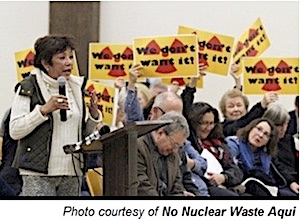
No Nuclear Waste
Photo Courtesy of No Nuclear Waste Aqui

"The most toxic and dangerous type of radioactive waste created by the nuclear industry"

This is waste generated by nuclear power plants called 'high-level radioactive waste' (HLW), also known as 'spent' or 'irradiated' fuel. This waste contains plutonium, uranium, strontium, and cesium; and will be radioactive for millions of years.

It is not like the waste currently stored at the Waste Isolation Pilot Project (WIPP) or any other waste site that exists today in the U.S.: it is far worse.

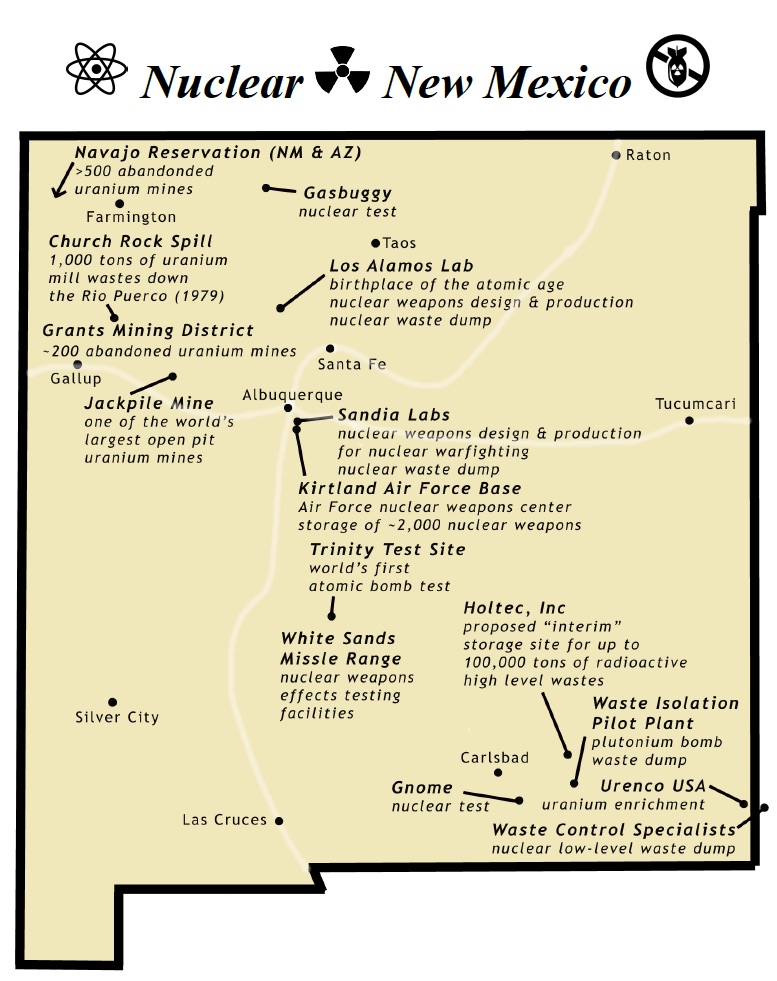
Two companies are proposing to build waste facilities near Carlsbad and Hobbs for the most toxic and dangerous type of radioactive waste created by the nuclear industry.

Holtec International is working with the Eddy-Lea Energy Alliance, LLC (ELEA) to apply for a license to build a Consolidated Interim Storage (CIS) facility approximately halfway between Carlsbad and Hobbs, and 16 miles north of WIPP.

The Nuclear Regulatory Commission (NRC) has declared the Holtec/ELEA application complete, NRC initiated a public comment period with 60 days for public comment. Note that transport of this waste poses risks to the environment and all life located near transportation routes.

Holtec proposal:

  • New CIS facility to store 100,000 metric tons of HLRW, with the potential to increase to 120,000 metric tons for 120 years
  • Shallow sub-surface burial system

New Mexicans and Texans are fighting the attempted licensing of these two proposed CIS facilities - Waste Control Specialists near Andrews, Texas and Eddy Lee/Holtec International east of Carlsbad, New Mexico.

These sites and any transport to these sites are not only dangerous but environmentally unjust. These sites present clear examples of environmental racism.

New Mexico's demographic is largely Latino. There are many communities of color, especially in the southern part of the state where the sites are being proposed. People of color would be disproportionately affected if the Eddy Lee/Holtec CIS site were licensed and constructed.

New Mexico and Texas do not consent to either proposed CIS facility and are fighting to avoid the environmental injustice and the unnecessary shipment of irradiated high-level nuclear waste through their communities.

NRC Environmental Report

Here's the Federal Register Notice

Consolidated Interim Storage Handout

A Better Option: Hardened On-Site Storage (HOSS)

Hardened On-Site Storage

Overview

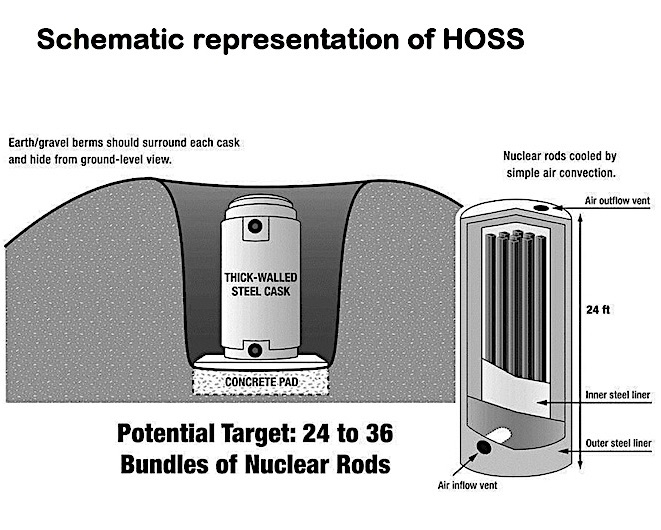
Hardened On-Site Storage (HOSS) is a community-based concept that aims to protect the public from the threats posed by the current vulnerable storage of commercial irradiated fuel.


History

For decades, high level radioactive waste has accumulated at reactor sites and continues to do so as nuclear reactors generate more waste. Without a credible plan to permanently isolate it, storage pools, where irradiated nuclear waste is currently stored until it becomes less hot, have been tightly packed and re-racked to accommodate all the waste.

Unfortunately, the pools and dry casks have no robust containment. If the cooling pumps stopped operating or the water in the pools drained out, temperatures would quickly increase, as happened in Fukushima Japan, and could result in a similar disaster.

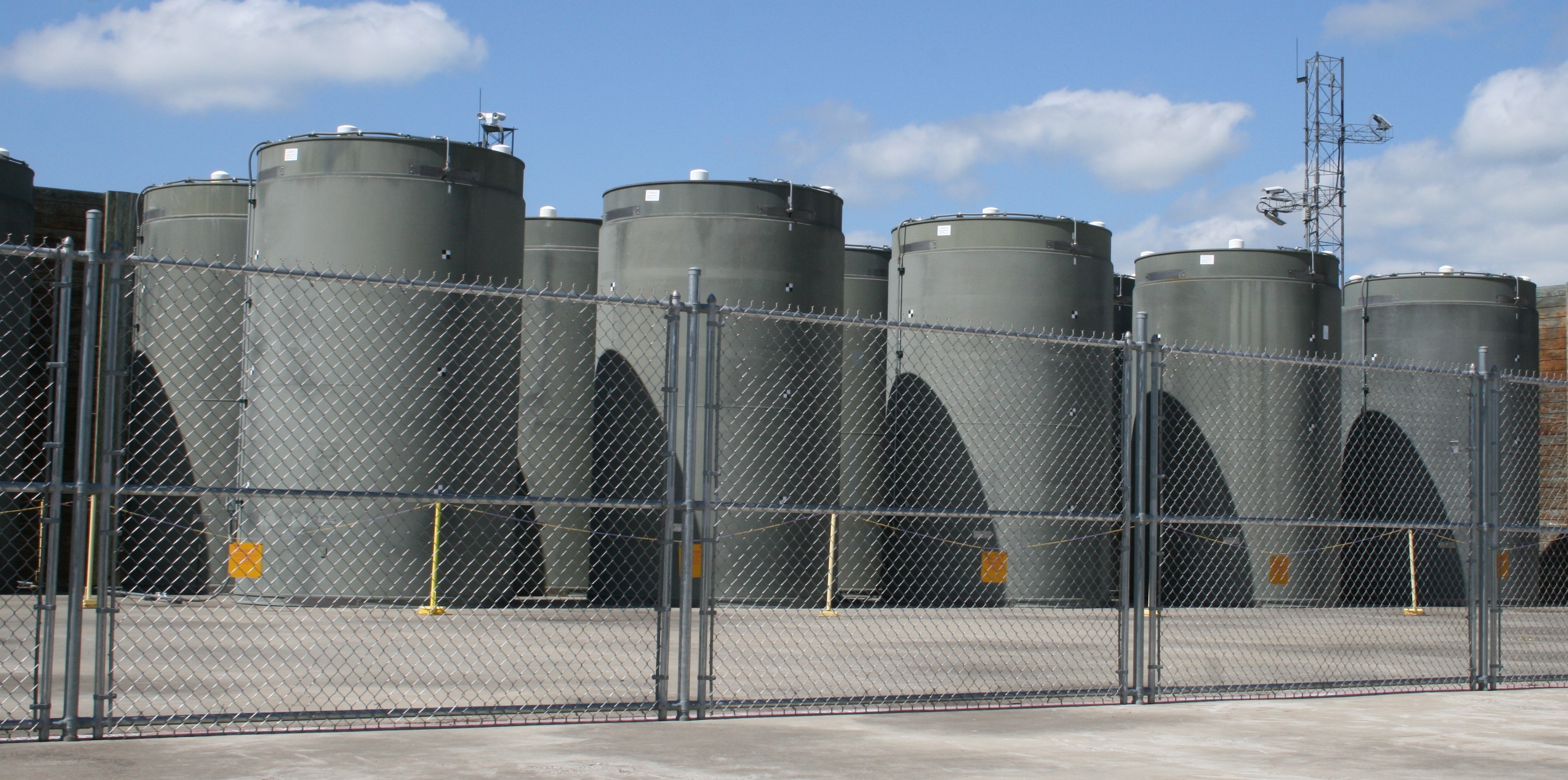
cask storage at reactor sites
Current dry cask storage at reactor sites (pictured above) is extremely vulnerable. There is often nothing more than a chain-link fence and a short distance that separates the highly radioactive waste containers and public access.

Establishing interim hardened on-site storage (HOSS) is a top priority. Hardened on-site storage allows waste generators to store high level waste as close to the site of generation as possible, thereby exposing fewer people to radiation, as safely as possible.

Rather than storing dozens of vulnerable dry-casks next to each other in the open air, the HOSS Principles established by concerned citizens mandate:

  • Irradiated fuel must be stored as safely as possible as close to the site of generation as possible;
  • HOSS facilities must not be regarded as a permanent waste solution, and thus should not be constructed underground and the waste must be retrievable;
  • The facility must have real-time radiation and heat monitoring for early detection of problems with containers;
  • The overall objective of HOSS should be that the amount of releases projected in even severe attacks should be low enough that the storage system would be unattractive as a terrorist target;
  • Placement of individual canisters that makes detection difficult from outside the site boundary.

Hardened On-Site Storage (HOSS) is supported by organizations in all 50 states. The Principles of Securing Nuclear Waste at Nuclear Reactor Sites are posted here. It would provide better security at reactor sites with robust dry storage and community oversight, including real-time monitoring of heat and radiation. HOSS is rooted in values of community protection and environmental justice and will provide increased protection from human or natural disasters, like terrorist attacks and earthquakes

HOSS facilities are not permanent waste solutions, and therefore should not be constructed deep underground as the waste must be retrievable. However, they are a workable solution that will allow us to explore scientifically sound, and socially and environmentally just long-term management systems.

Nuclear Power Has No Place in a Green Energy Future

Because of: Time Delay, Success of Renewables, Huge Costs, Dangers, Weapons Connection, and Wastes

from Yahoo News, 21 Oct 21, ”…….Practical concerns also temper enthusiasm for a nuclear future. The next generation of reactors, heralded as a game changer by supporters, still haven’t been proven in the real world. Even if those technologies are as revolutionary as advertised, skeptics say it could take decades before they make a real difference in the global energy grid — too long if the worst outcomes of climate change are to be avoided.

Renewable energy technologies can be enough on their own
“The drawbacks to nuclear are compounded by the burgeoning success of renewables — both solar and wind are getting cheaper and more efficient, year after year. There is also a growing realisation that a combination of renewables, smart storage, energy efficiency and more flexible grids can now be delivered at scale and at speed — anywhere in the world.” — Jonathon Porritt, Guardian

The world doesn’t have time to wait for next-gen nuclear
“When it comes to averting the imminent effects of climate change, even the cutting edge of nuclear technology will prove to be too little, too late. Put simply, given the economic trends in existing plants and those under construction, nuclear power cannot positively impact climate change in the next ten years or more.” — Allison Macfarlane, Foreign Affairs

A major ramp-up in nuclear technologies isn’t economically feasible
“While nuclear power may have once been cheaper than wind or solar, the economics have since changed dramatically. Nuclear power plants are very expensive to build and the economics of nuclear power are getting steadily worse. By contrast, renewables continue to come down in price.” — Ian Lowe, Conversation

There’s no way to guarantee that nuclear plants will be safe
“People around the world have witnessed the Three Mile Island, Chernobyl and Fukushima accidents. It is more than enough to believe that a safe nuclear power plant is nothing but a myth.” — Jang Daul, Korea Times

More nuclear power could lead to more nuclear weapons
“Some nations — India and Pakistan, and in all probability Israel — became nuclear powers after originally seeking nuclear technology for research or to develop nuclear power. … This is important: The technology used to turn on lights or charge mobile phones shouldn’t need to involve national or international defence apparatus.” — Editorial, Nature

Nuclear waste is still a major problem
“Nuclear waste lasts for hundreds of thousands of years before they are half-decayed. Our United States government — perhaps the longest continuous government in the world — is only 232 years old. Who will be around to manage uranium wastes?” — David Ross, Courier-Journal

Atomic Histories & Nuclear Testing

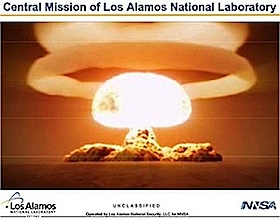
LANL’s Central Mission: Los Alamos Lab officials have recently claimed that LANL has moved away from primarily nuclear weapons to “national security”, but what truly remains as the Labs central mission? Here’s the answer from one of its own documents:

LANL’s “Central Mission”- Presented at: RPI Nuclear Data 2011 Symposium for Criticality Safety and Reactor Applications (PDF) 4/27/11

It seems we can’t find what you’re looking for. Perhaps searching can help.

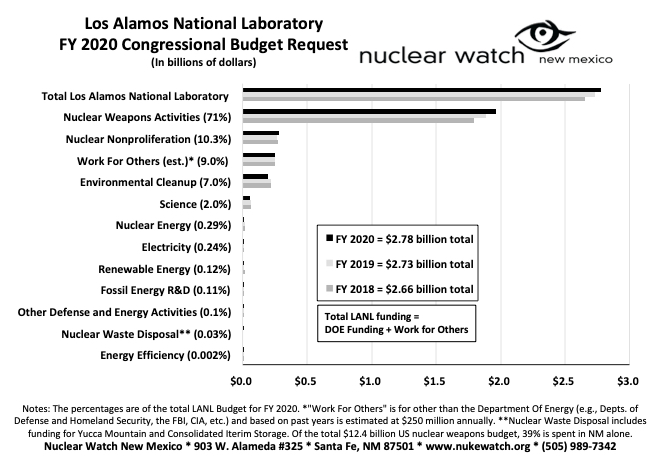
NukeWatch Compilation of the DOE/NNSA FY 2020 Budget Request – VIEW

please co-sign my WIPP comments!

Dear Fellow Travelers on the Long Road to Safety at WIPP:
I am writing to you as a battle-weary compatriot. For so many New Mexicans, the merest mention of WIPP induces a glazed-over, burned-out feeling associated with the “done deal,” the “one that got away.”

Incredibly, safeguards we originally fought for at WIPP are being stealthily erased behind closed doors right now—a potential disaster for our state’s natural resources and inhabitants. What’s going on? Some of us pessimists predicted this long ago: the attempt to sneak high-level waste into a repository that was never designed for it.

Leaking liquid waste from Hanford, Washington is about to be “re-classified” so its true origin as high-level waste can be disguised long enough to drag it into our state and down to WIPP. This stuff is “Superhot,” so thermally AND radioactively hot that it poses an entirely different set of environmental risks than the plutonium-contaminated “gloves and booties” long used to exemplify WIPP waste. Yes, plutonium lasts an unimaginably long time, but it doesn’t generate as much volatile activity as this liquid waste. The new high-level waste from Hanford is hot enough–both kinds of hot–to blast bigger, faster escape pathways out of the WIPP site that the longer-lasting waste could then travel along. The result? The Rustler Aquifer, Pecos River, Rio Grande and Gulf of Mexico hit by a nasty soup of chemical and radioactive debris that could last almost forever.

If the Yucca Mountain repository in Nevada, designed from day one to hold high-level waste, couldn’t even attain certification, why should we get stuck with waste for which our dump was never intended? Especially when we got so many promises over the years from politicians that this scenario was illegal and could never come to pass?

I am asking you to consider the written comments I have prepared for our state Environment Department and, if you agree, to add your name to them. I’m asking this because I bet you don’t all have time to write your own lengthy treatises on the subject. We all see that it’s disgraceful for our elected officials to look the other way, clear their throats, hum and whistle a jaunty tune as decades of promises are broken and centuries of pollution recklessly set in motion. Shouldn’t we have public hearings when a change of this magnitude is being considered?

If you agree with me, please co-sign my comments below, and add anything else you’d like at the bottom…
(Fill in your name and contact info, then copy into an email)
…and submit before 5 p.m. on June 10 (yes, next Monday, sorry)
to:
trais.kliphuis@state.nm.us

Thanks. Sasha Pyle, Santa Fe (WIPP gadfly since the 1980’s with CCNS, NukeWatch and ANA)

SHOULD THE WASTE ISOLATION PILOT PLANT IN NEW MEXICO RECEIVE RE-NAMED HIGH-LEVEL NUCLEAR WASTE?

Written Comment Submitted to the New Mexico Environment Department
June 2013

Trais Kliphuis
New Mexico Environment Department
2905 Rodeo Park Drive East, Building 1
Santa Fe, NM 87505

WIPP has been controversial for nearly three decades already, among scientists and citizens concerned about its safety. Now, long after the initial public outcry, it seems that the facility is quietly on the verge of seeing its mission and its risks expanded significantly, but this time with quite limited opportunities for public comment. WIPP opened against a substantial tide of opposition. But that does not mean it has carte blanche today to alter its course in ways that substantially increase its potential to taint New Mexico’s resources and future inhabitants. Any change to its operations that renders it more dangerous should be accompanied by at least the same level of scrutiny as its original mission. The fact that it is already receiving waste does not mean it is suddenly appropriate for any radwaste that anyone in the rest of the country wants to get rid of.

It is interesting to note that if WIPP were proposed today, it likely would never get the green light to begin operations. Discussion of appropriate nuclear waste disposal technologies has largely shifted over the last quarter-century to above-ground retrievable and monitored storage of dangerous nuclear materials, hence away from deep geologic repositories–much less those that are designed explicitly to render the waste invisible and irretrievable, an environmentally irresponsible approach at best–and one that only WIPP employs. Promoted as a “Pilot Plant,” WIPP is now destined to be the only one of its kind. There is literally nowhere else to build the dozens of equally large repositories that would be required to solve the nation’s nuclear waste backlog. WIPP is an idea whose time has come and gone.

A crisis of leaking tanks of liquid high-level Cold War waste at the Department of Energy’s Hanford Reservation in Washington State has provided the impetus for the current push to redefine WIPP’s mission. Anyone knowledgeable in nuclear waste issues knows that the Hanford crisis is very real. A perennial nuclear contractor, Bechtel Corporation, is working on a 13 billion dollar contract (triple the original estimate) of taxpayer money to complete a waste treatment plant that would address the Hanford waste, and they have failed to do so. The question facing us now is: should New Mexico be punished for Bechtel’s (and DOE’s) failure?

Equally importantly, if WIPP cannot solve more than a minute fraction of the Hanford crisis, is it worth exponentially increasing long-term environmental hazards at the WIPP site–only to leave Hanford still polluted as well?

If the Yucca Mountain facility in Nevada, which was expressly configured for high-level waste, could not attain certification, doesn’t that mean there are clear standards that must be met for disposal of these very dangerous materials? How is it possible that a completely different type of facility could be magically re-designated for this purpose when its very design and construction are not appropriate to meet those standards?

It is a matter of record that New Mexicans have been repeatedly promised that this use of WIPP would never come to pass. The 1992 WIPP Land Withdrawal Bill, reflecting input from New Mexico’s Legislature, Congressional delegation, Governor, Attorney General, and Environment Department (at the public’s insistence) clearly protects New Mexicans from such weakening of the WIPP permit. EPA containment standards, mandating a 10,000 year period of non-migration; an upper limit on the quantities of waste that would come to WIPP; and a stringent adherence to acceptance of only transuranic waste are all stipulated in the Land Withdrawal Bill and carry the force of law.

Additionally, in 2004, the excluded waste prohibition (agreed upon by NMED, EPA and the U.S. Department of Energy) amended the final language of the WIPP permit to specifically exclude from disposal at WIPP: tank waste and any waste “previously managed as high level waste.” Alteration of this would require a Class 3 Permit Modification request, thus allowing hearings for public input. DOE’s own language makes clear that undoing the waste exclusion would be a modification requiring a full public comment cycle.

According to the EPA, Class 1 and Class 2 modifications do not substantially alter existing permit conditions or significantly affect the overall operation of the facility. Class 3 modifications cover major changes that substantially alter the facility or its operations.

The current attempt to re-classify high-level waste so as to bring it to WIPP, and the designation of this change in policy as a Class 2 modification, patently violate this prohibition.

Waste that is not allowed into our state by one name cannot be allowed to enter under another name. Re-naming the high-level waste “transuranic” when it hits our border in no way addresses the major scientific concerns about its safe disposal. The attempt to run this major change through as a Class 2 modification is deceptive and illegal. Violating the Land Withdrawal Bill and the 2004 waste exclusion would be legally actionable at once.

If New Mexicans have been promised repeatedly, with the force of law, in 1992 and 2004 and many other points over the last 30 years, that high level waste would not come to WIPP, what has changed—besides the Administration?

This raises the question: is WIPP regulated according to the physical reality of what will actually happen to nuclear waste underground, or by the artifice of paper-shuffling and magic language, mere words on paper that happen above ground–and have no relation to the site itself, its toxic contents, and its containment performance over the very long future? And it also raises the question: was WIPP’s purpose truly to solve some fraction of our nation’s nuclear waste crisis, or merely to give the appearance of doing so, to keep tax dollars flowing into nuclear weapons (and hence, waste) production?

The site and the science of WIPP have always been shaky, and widely contested. It is likely the repository will be unable to safely contain even the waste for which it was built. Introducing a new “Superhot” waste stream—both thermally and radioactively much hotter than plutonium-dusted “gloves and booties” (a famous DOE description of WIPP waste)–could greatly accelerate the formation of a hot radioactive slurry that will force escape pathways open from the site. The long-lasting plutonium-contaminated waste for which WIPP was originally built could thus find its way into the biosphere much more quickly and widely once the “Superhot” waste has spurred the formation of waste migration pathways. WIPP has always run the risk of eventually polluting the Rustler Aquifer, the Pecos River, the Rio Grande and the Gulf of Mexico. Do we really want that to happen on a larger scale, with a wider variety of radioactive and chemical pollutants, with greatly increased radioactivity, and much sooner? Is that to be our gift to the region’s inhabitants in the future?

We already have to live with the facility’s unknown and unquantifiable risks. Expanding the mission augments these risks unacceptably.

Would allowing one kind of high-level waste to be buried at WIPP open the door to the specter of spent fuel rods coming our way? Are we supposed to solve every nuclear crisis in the country, to become our nation’s nuclear outhouse? This shift in mission is no minor technicality; it represents an enormous turnaround in national waste disposal policy.

If scientific consensus was divided on WIPP’s original mission, it is not divided on the dangers of using a salt repository to contain high-level waste. The hydrophilic (water-attracting) nature of salt as a disposal medium, already extremely dubious as a choice for transuranic waste, is even more inappropriate for waste streams with the heat and radioactivity of high-level waste. This change does not have support from the technical community, only from people who hope to profit from expanding WIPP’s mission.

Here in New Mexico we have a sizeable community of people who are quite familiar with the process of speaking at public hearings on nuclear issues. Many dozens of organizations, and hundreds (indeed, thousands) of individual citizens have testified at NEPA hearings over the years on nuclear issues relating to mission alterations at Los Alamos, specific proposed facilities, cleanup, DOE “Modernization,” and so on. Although the National Environmental Policy Act is not the dominant governing legislation for this permit modification, NEPA has conditioned citizens to expect their “day in court” when they can speak about the nuclear industries that loom so large in our state history and landscape. People expect to present oral commentary and back it up with written submissions. NMED should expect no less from the public.

Now NMED must fulfill its Constitutional obligation to protect New Mexico from risky abuses of natural resources necessary for life and survival in this region. NMED’s job is to regulate. Political arguments and pressure for jobs will always form a large part of the chatter any time nuclear projects are proposed. Boosters will predictably focus on the jobs side of the equation. It is not NMED’s mandate to promote these boom-and-bust jobs that will be long forgotten while the radioactive and chemical materials are still threatening our descendants, 100, 1000, 10,000 years from now. It is NMED’s job to prevent contamination of our land and its inhabitants, no matter which Administration sits in the Roundhouse.

No matter how many closed-door meetings are held, no matter how hidden this process is from public view, no matter how many attempts are made to minimize public awareness and input, we are watching very closely to see what NMED’s legacy will be. We believe the regulatory framework for WIPP should be bedrock, not shifting sands of expediency that erode and eventually collapse public confidence in government. NMED must deny the permit modification request, and it must deny its viability as a Class 2 request.

We also know that if you learn of significant public demand for real hearings, you are obligated to provide them. Consider this a statement of public demand, please. Thank you for your consideration.

_________________________
name
_________________________
city
_________________________
state

LANL FY 2020 Budget Request – VIEW

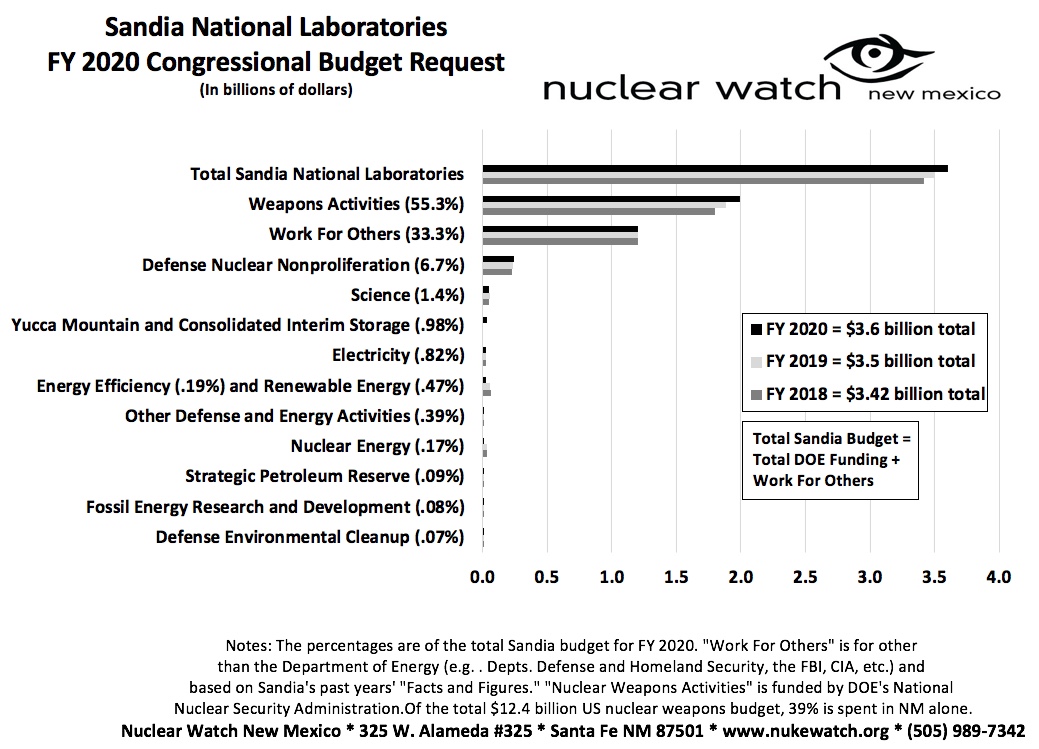
Sandia FY 2020 Budget Request – VIEW

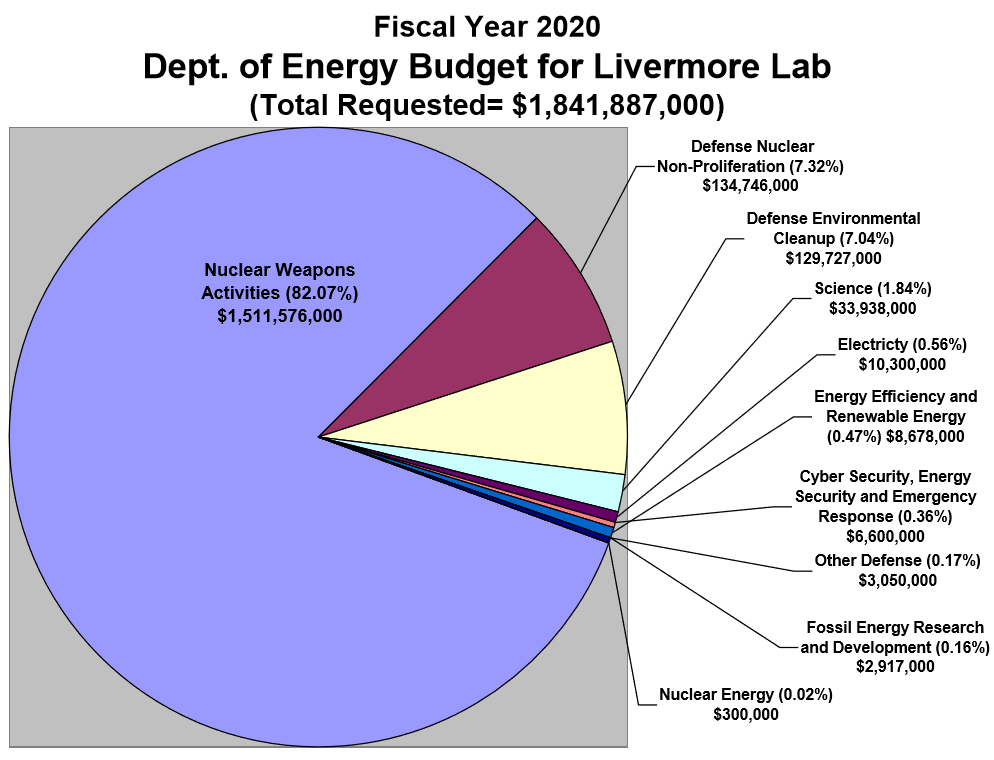
Livermore Lab FY 2020 Budget Chart – Courtesy TriValley CAREs – VIEW

Updates

It seems we can’t find what you’re looking for. Perhaps searching can help.

________________________________

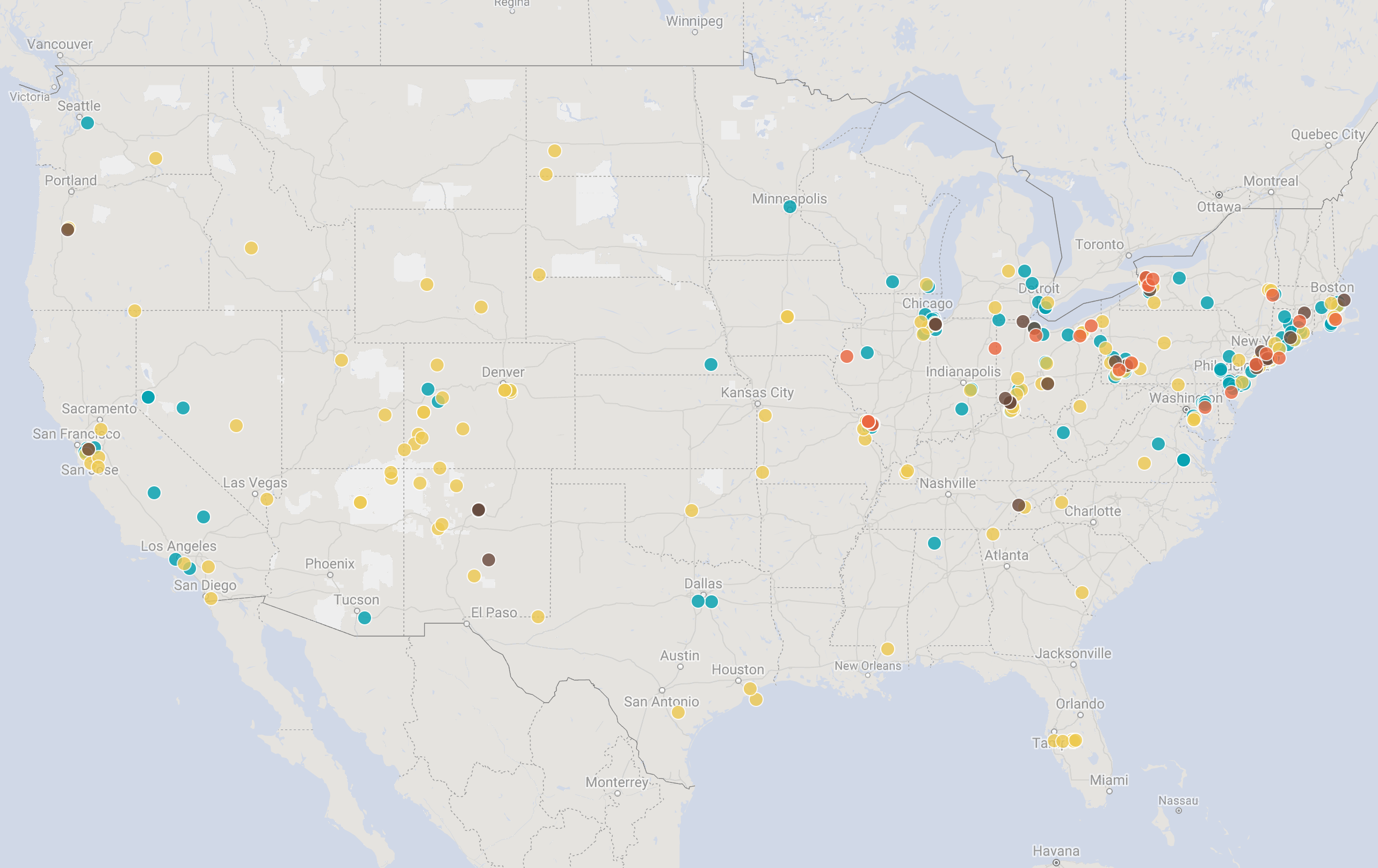
Click the image to view and download this large printable map of DOE sites, commercial reactors, nuclear waste dumps, nuclear transportation routes, surface waters near sites and transport routes, and underlying aquifers. This map was prepared by Deborah Reade for the Alliance for Nuclear Accountability.

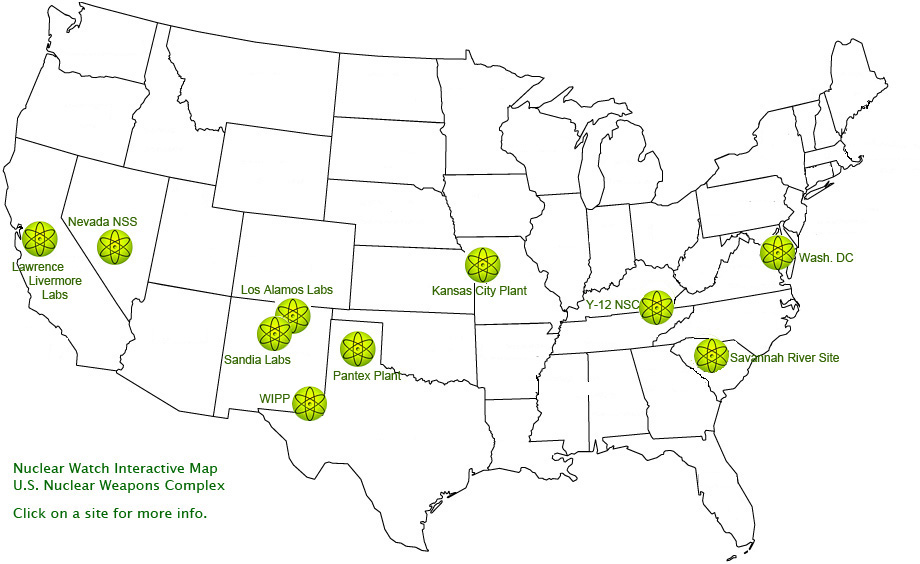
Nuclear Watch Interactive Map – U.S. Nuclear Weapons Complex

Waste Lands: America’s Forgotten Nuclear Legacy

The Wall St. Journal has compiled a searchable database of contaminated sites across the US. (view)
Related WSJ report: https://www.wsj.com

Atomic Histories & Nuclear Testing

NukeWatch Compilation of the DOE/NNSA FY 2020 Budget Request – VIEW

please co-sign my WIPP comments!

Dear Fellow Travelers on the Long Road to Safety at WIPP:
I am writing to you as a battle-weary compatriot. For so many New Mexicans, the merest mention of WIPP induces a glazed-over, burned-out feeling associated with the “done deal,” the “one that got away.”

Incredibly, safeguards we originally fought for at WIPP are being stealthily erased behind closed doors right now—a potential disaster for our state’s natural resources and inhabitants. What’s going on? Some of us pessimists predicted this long ago: the attempt to sneak high-level waste into a repository that was never designed for it.

Leaking liquid waste from Hanford, Washington is about to be “re-classified” so its true origin as high-level waste can be disguised long enough to drag it into our state and down to WIPP. This stuff is “Superhot,” so thermally AND radioactively hot that it poses an entirely different set of environmental risks than the plutonium-contaminated “gloves and booties” long used to exemplify WIPP waste. Yes, plutonium lasts an unimaginably long time, but it doesn’t generate as much volatile activity as this liquid waste. The new high-level waste from Hanford is hot enough–both kinds of hot–to blast bigger, faster escape pathways out of the WIPP site that the longer-lasting waste could then travel along. The result? The Rustler Aquifer, Pecos River, Rio Grande and Gulf of Mexico hit by a nasty soup of chemical and radioactive debris that could last almost forever.

If the Yucca Mountain repository in Nevada, designed from day one to hold high-level waste, couldn’t even attain certification, why should we get stuck with waste for which our dump was never intended? Especially when we got so many promises over the years from politicians that this scenario was illegal and could never come to pass?

I am asking you to consider the written comments I have prepared for our state Environment Department and, if you agree, to add your name to them. I’m asking this because I bet you don’t all have time to write your own lengthy treatises on the subject. We all see that it’s disgraceful for our elected officials to look the other way, clear their throats, hum and whistle a jaunty tune as decades of promises are broken and centuries of pollution recklessly set in motion. Shouldn’t we have public hearings when a change of this magnitude is being considered?

If you agree with me, please co-sign my comments below, and add anything else you’d like at the bottom…
(Fill in your name and contact info, then copy into an email)
…and submit before 5 p.m. on June 10 (yes, next Monday, sorry)
to:
trais.kliphuis@state.nm.us

Thanks. Sasha Pyle, Santa Fe (WIPP gadfly since the 1980’s with CCNS, NukeWatch and ANA)

SHOULD THE WASTE ISOLATION PILOT PLANT IN NEW MEXICO RECEIVE RE-NAMED HIGH-LEVEL NUCLEAR WASTE?

Written Comment Submitted to the New Mexico Environment Department
June 2013

Trais Kliphuis
New Mexico Environment Department
2905 Rodeo Park Drive East, Building 1
Santa Fe, NM 87505

WIPP has been controversial for nearly three decades already, among scientists and citizens concerned about its safety. Now, long after the initial public outcry, it seems that the facility is quietly on the verge of seeing its mission and its risks expanded significantly, but this time with quite limited opportunities for public comment. WIPP opened against a substantial tide of opposition. But that does not mean it has carte blanche today to alter its course in ways that substantially increase its potential to taint New Mexico’s resources and future inhabitants. Any change to its operations that renders it more dangerous should be accompanied by at least the same level of scrutiny as its original mission. The fact that it is already receiving waste does not mean it is suddenly appropriate for any radwaste that anyone in the rest of the country wants to get rid of.

It is interesting to note that if WIPP were proposed today, it likely would never get the green light to begin operations. Discussion of appropriate nuclear waste disposal technologies has largely shifted over the last quarter-century to above-ground retrievable and monitored storage of dangerous nuclear materials, hence away from deep geologic repositories–much less those that are designed explicitly to render the waste invisible and irretrievable, an environmentally irresponsible approach at best–and one that only WIPP employs. Promoted as a “Pilot Plant,” WIPP is now destined to be the only one of its kind. There is literally nowhere else to build the dozens of equally large repositories that would be required to solve the nation’s nuclear waste backlog. WIPP is an idea whose time has come and gone.

A crisis of leaking tanks of liquid high-level Cold War waste at the Department of Energy’s Hanford Reservation in Washington State has provided the impetus for the current push to redefine WIPP’s mission. Anyone knowledgeable in nuclear waste issues knows that the Hanford crisis is very real. A perennial nuclear contractor, Bechtel Corporation, is working on a 13 billion dollar contract (triple the original estimate) of taxpayer money to complete a waste treatment plant that would address the Hanford waste, and they have failed to do so. The question facing us now is: should New Mexico be punished for Bechtel’s (and DOE’s) failure?

Equally importantly, if WIPP cannot solve more than a minute fraction of the Hanford crisis, is it worth exponentially increasing long-term environmental hazards at the WIPP site–only to leave Hanford still polluted as well?

If the Yucca Mountain facility in Nevada, which was expressly configured for high-level waste, could not attain certification, doesn’t that mean there are clear standards that must be met for disposal of these very dangerous materials? How is it possible that a completely different type of facility could be magically re-designated for this purpose when its very design and construction are not appropriate to meet those standards?

It is a matter of record that New Mexicans have been repeatedly promised that this use of WIPP would never come to pass. The 1992 WIPP Land Withdrawal Bill, reflecting input from New Mexico’s Legislature, Congressional delegation, Governor, Attorney General, and Environment Department (at the public’s insistence) clearly protects New Mexicans from such weakening of the WIPP permit. EPA containment standards, mandating a 10,000 year period of non-migration; an upper limit on the quantities of waste that would come to WIPP; and a stringent adherence to acceptance of only transuranic waste are all stipulated in the Land Withdrawal Bill and carry the force of law.

Additionally, in 2004, the excluded waste prohibition (agreed upon by NMED, EPA and the U.S. Department of Energy) amended the final language of the WIPP permit to specifically exclude from disposal at WIPP: tank waste and any waste “previously managed as high level waste.” Alteration of this would require a Class 3 Permit Modification request, thus allowing hearings for public input. DOE’s own language makes clear that undoing the waste exclusion would be a modification requiring a full public comment cycle.

According to the EPA, Class 1 and Class 2 modifications do not substantially alter existing permit conditions or significantly affect the overall operation of the facility. Class 3 modifications cover major changes that substantially alter the facility or its operations.

The current attempt to re-classify high-level waste so as to bring it to WIPP, and the designation of this change in policy as a Class 2 modification, patently violate this prohibition.

Waste that is not allowed into our state by one name cannot be allowed to enter under another name. Re-naming the high-level waste “transuranic” when it hits our border in no way addresses the major scientific concerns about its safe disposal. The attempt to run this major change through as a Class 2 modification is deceptive and illegal. Violating the Land Withdrawal Bill and the 2004 waste exclusion would be legally actionable at once.

If New Mexicans have been promised repeatedly, with the force of law, in 1992 and 2004 and many other points over the last 30 years, that high level waste would not come to WIPP, what has changed—besides the Administration?

This raises the question: is WIPP regulated according to the physical reality of what will actually happen to nuclear waste underground, or by the artifice of paper-shuffling and magic language, mere words on paper that happen above ground–and have no relation to the site itself, its toxic contents, and its containment performance over the very long future? And it also raises the question: was WIPP’s purpose truly to solve some fraction of our nation’s nuclear waste crisis, or merely to give the appearance of doing so, to keep tax dollars flowing into nuclear weapons (and hence, waste) production?

The site and the science of WIPP have always been shaky, and widely contested. It is likely the repository will be unable to safely contain even the waste for which it was built. Introducing a new “Superhot” waste stream—both thermally and radioactively much hotter than plutonium-dusted “gloves and booties” (a famous DOE description of WIPP waste)–could greatly accelerate the formation of a hot radioactive slurry that will force escape pathways open from the site. The long-lasting plutonium-contaminated waste for which WIPP was originally built could thus find its way into the biosphere much more quickly and widely once the “Superhot” waste has spurred the formation of waste migration pathways. WIPP has always run the risk of eventually polluting the Rustler Aquifer, the Pecos River, the Rio Grande and the Gulf of Mexico. Do we really want that to happen on a larger scale, with a wider variety of radioactive and chemical pollutants, with greatly increased radioactivity, and much sooner? Is that to be our gift to the region’s inhabitants in the future?

We already have to live with the facility’s unknown and unquantifiable risks. Expanding the mission augments these risks unacceptably.

Would allowing one kind of high-level waste to be buried at WIPP open the door to the specter of spent fuel rods coming our way? Are we supposed to solve every nuclear crisis in the country, to become our nation’s nuclear outhouse? This shift in mission is no minor technicality; it represents an enormous turnaround in national waste disposal policy.

If scientific consensus was divided on WIPP’s original mission, it is not divided on the dangers of using a salt repository to contain high-level waste. The hydrophilic (water-attracting) nature of salt as a disposal medium, already extremely dubious as a choice for transuranic waste, is even more inappropriate for waste streams with the heat and radioactivity of high-level waste. This change does not have support from the technical community, only from people who hope to profit from expanding WIPP’s mission.

Here in New Mexico we have a sizeable community of people who are quite familiar with the process of speaking at public hearings on nuclear issues. Many dozens of organizations, and hundreds (indeed, thousands) of individual citizens have testified at NEPA hearings over the years on nuclear issues relating to mission alterations at Los Alamos, specific proposed facilities, cleanup, DOE “Modernization,” and so on. Although the National Environmental Policy Act is not the dominant governing legislation for this permit modification, NEPA has conditioned citizens to expect their “day in court” when they can speak about the nuclear industries that loom so large in our state history and landscape. People expect to present oral commentary and back it up with written submissions. NMED should expect no less from the public.

Now NMED must fulfill its Constitutional obligation to protect New Mexico from risky abuses of natural resources necessary for life and survival in this region. NMED’s job is to regulate. Political arguments and pressure for jobs will always form a large part of the chatter any time nuclear projects are proposed. Boosters will predictably focus on the jobs side of the equation. It is not NMED’s mandate to promote these boom-and-bust jobs that will be long forgotten while the radioactive and chemical materials are still threatening our descendants, 100, 1000, 10,000 years from now. It is NMED’s job to prevent contamination of our land and its inhabitants, no matter which Administration sits in the Roundhouse.

No matter how many closed-door meetings are held, no matter how hidden this process is from public view, no matter how many attempts are made to minimize public awareness and input, we are watching very closely to see what NMED’s legacy will be. We believe the regulatory framework for WIPP should be bedrock, not shifting sands of expediency that erode and eventually collapse public confidence in government. NMED must deny the permit modification request, and it must deny its viability as a Class 2 request.

We also know that if you learn of significant public demand for real hearings, you are obligated to provide them. Consider this a statement of public demand, please. Thank you for your consideration.

_________________________
name
_________________________
city
_________________________
state
LANL FY 2020 Budget Request – VIEW

Sandia FY 2020 Budget Request – VIEW

Livermore Lab FY 2020 Budget Chart – Courtesy TriValley CAREs – VIEW

NUCLEAR POWER

Important Documents & Articles Related to Nuclear Energy Production

Most Recent

It seems we can’t find what you’re looking for. Perhaps searching can help.

Nuclear Watch Interactive Map – U.S. Nuclear Weapons Complex

Waste Lands: America’s Forgotten Nuclear Legacy

The Wall St. Journal has compiled a searchable database of contaminated sites across the US. (view)
Related WSJ report: https://www.wsj.com

LANL’s Central Mission: Los Alamos Lab officials have recently claimed that LANL has moved away from primarily nuclear weapons to “national security”, but what truly remains as the Labs central mission? Here’s the answer from one of its own documents:

LANL’s “Central Mission”- Presented at: RPI Nuclear Data 2011 Symposium for Criticality Safety and Reactor Applications (PDF) 4/27/11