
Screenshot from USA Today article January 5, 2026 usatoday.com/graphics/interactives/us-nuclear-weapons-expansion-fallout-map/
THE NUCLEAR SPONGE
Fallout maps show what could happen if America’s nuclear missile silos were attacked
By Davis Winkie, Ramon Padilla, Stephen Beard, Karina Zaiets and Carlie Procell, USA TODAY | usatoday.com
U.S. nuclear strategy revolves around the idea of the “triad.” Each of the military’s methods for delivering a nuclear strike represents a leg – the air leg (bomber planes), the sea leg (missile submarines) and the land leg (silo-based intercontinental ballistic missiles).
In recent years, arms control advocates have argued that the land leg of the triad is useless compared with its peers and makes the world a more dangerous place. The root of the debate is the vulnerability of the underground silos: An enemy can – and probably would – destroy them in a first strike against the United States.
Those opposed to land-based nuclear missiles, such as Daryl Kimball of the Arms Control Association, say that this vulnerability would push the president into a “use-or-lose logic” if he or she believed the United States were under nuclear attack. If the president launched a nuclear missile counterattack under a false warning, the results would be catastrophic.
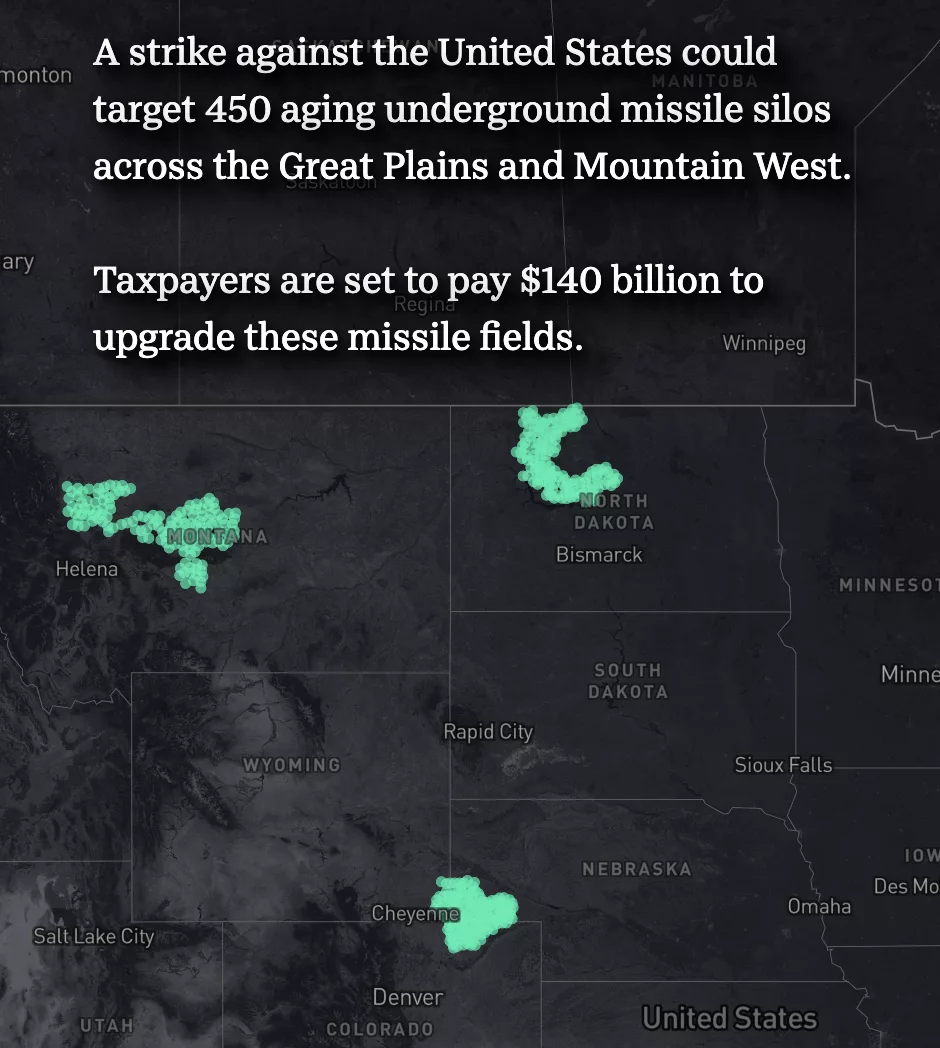
The naysayers also highlight the cost of replacing the existing 1970s-vintage fleet of 400 Minuteman III missiles with the under-development Sentinel missiles, which the Air Force estimated will cost $140 billion (an increase from a 2020 estimate of $78 billion).
US nuke silos get $140 billion upgrade. Are they a liability or asset?
“Today, the U.S. has 400 Minuteman III ICBMs on alert – ready for launch on minutes’ notice – rotating among 450 blast-resistant underground silos across the country’s heartland. Congress mandates this number of missiles.”
By Davis Winkie, USA TODAY | usatoday.com
The sponge metaphor first emerged in 1978 when the Air Force’s top general announced a new plan to base cutting-edge nuclear missiles in the Southwest.
The “Missile, Experimental,” or MX, a powerful intercontinental ballistic missile, or ICBM, could hurl up to 11 nuclear weapons accurately against targets on the other side of the world.
All land-based ICBMs, including the MX, have an inherent vulnerability: when based in underground launch silos, they can be targeted in a surprise nuclear attack by enemies aiming to knock out America’s ability to retaliate.
But to Gen. Lew Allen, a nuclear physicist and bomber pilot who was then the Air Force’s chief of staff, that vulnerability was an advantage during the country’s arms race with the Soviet Union.
Crumbling silos, rushed deals – how US blew missile budget by billions
Kimball of the Arms Control Association exhorted Americans to take a harder look at the Sentinel program in the coming years.
“Whether you’re in Kimball, Nebraska, (which arguably has) the world’s highest concentration of ICBMs per capita, or you’re in … Washington DC, we’ve got to be asking harder questions about this program,” he said. “Otherwise, we’re going to continue to spend too much and risk too much just by going forward.”
By Davis Winkie, USA TODAY | usatoday.com
By July 2024, the public knew the program had blown its budget. But the announcement was nonetheless staggering.
The projected price of an Air Force program to build a next-generation nuclear missile – dubbed Sentinel – had risen 81%, from $77.7 billion to nearly $141 billion. (That’s the equivalent of Americans’ combined medical debt as calculated in 2021, according to a research study.)
“There are reasons for this cost growth, but there are no excuses,” said William LaPlante, Under Secretary of Defense overseeing acquisitions at the time.
Since then, military officials and contractor Northrop Grumman have made a flurry of changes to get the Sentinel missile program back on track.
Is it too late to rethink US nuclear strategy? Experts review options.
USA TODAY asked nuclear strategy experts for their suggestions about next steps for U.S. nuclear policy. Their responses offer competing road maps for how to keep America safe. Most of them are wary of the current trajectory of the Sentinel program, whether they want to see it accelerated, tweaked or canceled.
By Davis Winkie, USA TODAY | usatoday.com
Daryl Kimball, executive director of the Arms Control Association, said lawmakers need to reconsider whether it makes sense to maintain 400 intercontinental ballistic missiles, known as ICBMs, until 2075. He also questioned whether the United States needs them at all; he believes the country’s nuclear bombers and nuclear missile submarines are sufficient to deter enemy attacks.
A pair of nuclear researchers at the Federation of American Scientists, Matt Korda and Mackenzie Knight-Boyle, argued in a 2024 memo that the mandate for at least 400 missiles set by Congress is “arbitrary” and serves political interests. They say Congress should stop requiring a minimum number of missiles and instead let national security needs drive the scale of the Sentinel program.
Since then, military officials and contractor Northrop Grumman have made a flurry of changes to get the Sentinel missile program back on track.