
This past Saturday marked 60 years since the 1966 Palomares mid-air crash that left plutonium contamination scattered around the Spanish village. Dr. Michael E. Ketterer, Professor Emeritus of Chemistry and Biochemistry at Northern Arizona University in Flagstaff, AZ, has authored “Palomares: Reflections of an American, sixty years later.” See his English language version here and below and the Spanish version here.
| January 17, 2026 eldiario.es
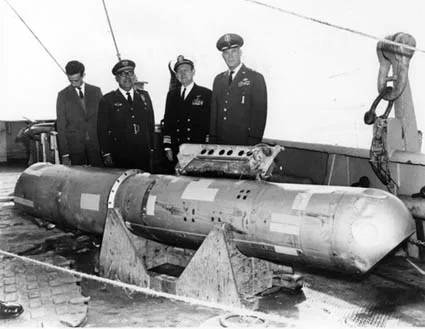
By U.S. Navy, Courtesy of the Natural Resources Defense Council – Transferred from en.wikipedia to Commons by EH101 using CommonsHelper., The original uploader was Asterion at English Wikipedia., 31 May 2007 (original upload date), Public Domain, https://commons.wikimedia.org/w/index.php?curid=2630293
During the early morning hours of January 17, 1966, the six-year-old author was in his bed, asleep in the Buffalo, New York suburb of North Tonawanda. During those very same moments, a crash took place between two US planes: a B-52 bomber and a fully loaded KC-135, which were in the midst of refueling the bomber in-flight. The B-52 was crossing the Iberian Peninsula that morning as part of US Air Force’s Strategic Air Command’s daily routes, performing vigilance on the Soviet Union. Three thermonuclear bombs fell to the land, and a fourth fell into the sea, after the collision in the skies over Palomares, a small village located about two kilometers from the Mediterranean, in the province of Almeria, Andalucía in southeastern Spain.
All of that happened before I got out of bed that day.
Two of the bombs were destroyed upon impact, although neither produced a nuclear explosion. Instead, several kilograms of plutonium (Pu) were dispersed on a windy day, onto several square kilometers of the tomato fields and residential zones of Palomares. An additional bomb was found by a local resident; fortunately, it wasn’t significantly damaged since its parachute had opened. On the other hand, the fourth bomb appeared to have been lost in the Mediterranean, and very soon, that was obviously true. The US Air Force’s top priority quickly became to use whatever resources and heroes that were available, for an urgent mission: find the lost bomb before the Soviets could do so. The search and recovery of the bomb became the success story, and the history that was told. That was the lesson learned from Palomares, among the two governments, their military forces, and in the press. The photos of the military commanders from both countries posing with the recovered bomb aboard the USS Petrel are some of the most famous Internet images of Palomares.
Of course, I was just a boy, innocent and ignorant of all these stunning events, lying horizontal in my bed. My mom got me up; that aUernoon, like every Monday, I went to kindergarten. Perhaps my parents heard some brief men\on on the black and white TV that night. Possibly they read something in the January 18 1966 edition of the Buffalo Evening News. I don’t remember anything, even though I could read in 1966, and definitely, I liked to watch TV. The ships that contained a minor frac\on of the Pu left Spain before the end of my year of kindergarten. It was the same departure among the press. During 1975-1976, I was a neighborhood newspaper carrier for the Buffalo Evening News; reading nearly every edi\on, I’m pretty certain I never saw any mention of Palomares. I am very certain that I delivered the paper on the tenth anniversary date, January 17, 1976, on a day with single-digit temperatures; however, I don’t remember a story about Palomares in that day’s edi\on that I tucked into the front doors of North Tonawanda.
The years passed by; the Pu stayed in place, and as for myself, I didn’t learn a thing about Palomares. I completed kindergarten; I finished primary school where I learned Castilian Spanish; I went to high school where I studied chemistry and the sciences. I passed through my bachelor’s studies, doctoral studies, and much of my career as a chemist in industry, US EPA, and as a faculty member at three different universi\es. I wasn’t any different despite all that – I was the same as millions of Americans, ignorant, uninformed – through the first four decades of my life.
In the early 2000’s, I began to conduct research on quantities and sources of plutonium in the ambient environment. I started using mass spectrometry to study the Pu from lots of different places. I learned that Pu from weapons-test fallout is ubiquitous, but there were some other sites, highly contaminated, where addi\onal Pu sources were present. I read that typically, these addi\onal sources besides fallout exhibited dis\nct isotope composi\ons. For the first time, I read a lot about the 1966 accident, and its hasty cleanup. I thought to myself, everything about Palomares is almost incredible, although at the same time, all is an enormous tragedy. Moreover, everyone I asked during those years – parents, aunts, uncles, friends – no one remembered anything about the Palomares disaster, including any details about the number of casual\es, nor anything about the soil Pu. Nobody mentioned the fourth bomb, nor the heroes of the recovery opera\on, nor the surviving B-52 crew members. It seemed that all of them had been forgotten, and tossed away. I was educated, but I had been guilty of the same. Why didn’t anyone in the USA during the early 2000’s remember anything? Ignorance, and social amnesia.
In 2006, forty years after the crash, I finished a short research project, studying an individual par\cle from the bomb, which had been found in a Palomares soil sample collected by one of my colleagues. I published as second author, a paper in Journal of Environmental Radioactivity, along with collaborators from Finland and Spain. I was responsible for genera\ng the ICPMS data, and was the person who organized the research team. The ICPMS work, performed on the Northern Arizona University campus in Flagstaff, showed that the bomb par\cle of a few microns in size contained Pu from a pit fabricated at Rocky Flats during the late 50’s – early 60’s period. Perhaps, these results are of interest among the scien\fic community. However, if I were not a specialist in Pu studies, never, ever would I have known the slightest thing about Palomares.
Today marks sixty years since that forgotten morning. It seems to me that people in the USA of 2026 are ignorant about Palomares, exactly like I was in 1966 – with eyes shut at the moment of the crash. We don’t know anything, when we don’t want to listen, see, nor confront reality. The price here of the Cold War that isn’t being accounted for: Palomares’ cleanup was slipshod, and no doubt exposed thousands of Spanish and American workers to a great deal of plutonium. Furthermore, the large majority of the Pu remains in Palomares’ soils in 2026; the population undoubtedly has experienced excessive exposure to Pu, directly in residential settings.
However, on this morning of January 17, 2026, it is impera\ve to say, to all those on the other side of the Atlan\c, that 60 years are way too long. I’m not a youngster; I’m an old man with gray hair, a lot of wrinkles, and less patience. Today is the day, and I, the boy lying in the bed in 1966, wish to atone to Spain. Because no one else in my country is recognizing our responsibility, I should. The USA was responsible in 1966, and s\ll is, in 2026. It’s a lie and mythology, to say that everything’s just fine over there, there’s nothing to worry about on the Pu, it’s not dangerous, and you are the confused idiot.
Palomares is an example of the nuclear mythology of the Cold War. The truth is, that Palomares is akin to a sandbox full of plutonium, it is not clean, it never was properly cleaned up, and the large majority of the Pu is presently located within Almeria soils. The Pu shall remain in the soils
of Almeria, together with the mythology, at least until we write the true history, and we demand better from all of those responsible among both countries.
If the levels of soil in Palomares were found in San Francisco, California, near the Hunters Point contaminated site, the US would have been obligated to apply a removal standard of 2.59 picocuries per gram (96 becquerels per kilogram) of Pu-239+240. Hunters Point is the loca\on where the US Navy decontaminated vessels used in 1950’s atomic tests performed at the Pacific Proving Ground. The wealthy city and its financial interests seek to renovate the Hunters Point location, as part of gentrification plans. Accordingly, it is necessary to put a conservative cleanup standard in place, affording good protec\on of public health. A conservative standard such as 2.59 pCi/g, or even stricter, should be put into effect in Palomares. Why are the residents of San Francisco any better? Are the chemical properties of Pu different on the two sides of the Atlantic? When one embraces nuclear mythology, one is able to believe in whatever answer one wants, to the weighty questions of Palomares.
In July 2025, the US Congress passed a law, RECA (Radiation Exposure and Compensation Act) which pays compensation to specific cancer victims, for causes of fallout, uranium mines, and in specific locations in Missouri, Kentucky, and Tennessee. The present, newly passed RECA will end in 2028, and has a lot of limitations – there are alarming examples of exclusions throughout the United States, such as Pike and Scioto counties in Ohio, which RECA turned its back upon. Palomares is a second, very alarming example. The US will bear an enormous responsibility, to construct the next, better version of RECA, covering all those affected by fallout and other types of nuclear contamina\on. Why shouldn’t Palomares victims be included in the next RECA? It is easy to imagine that the victims exist in the present day, on both sides of the Atlantic. It is even easier to imagine that very high levels of Pu are still common in Palomares soils.
I made a short visit to Palomares in 2023, and as a Pu specialist, I was uncomfortable pondering the proximity between plutonium and where people lived. I was filled with sadness, thinking about all the opportunities for internal exposure, every day of people’s lives. In the timeline of the Pu, 60 years is nothing. In the timeline of societal memory, it is enough to erase everything. Do we suppose all of the people know the details, the history, and the risks that remain in 2026? Concerning events that occurred in 1966, before the majority of the people were even born? Is there information available for residents, tourists or immigrants, addressing the Pu in Palomares? Outside previously utilized US nuclear sites, there’s no signs, information, or visitor centers; that includes Rocky Flats, the workshop where the Palomares Pu pit was manufactured. The sign on the fence outside the first bomb’s point of impact simply says, “restricted area, entry prohibited, violators subject to prosecution”. For what reason, is this place restricted? Nothing is written on the sign about the Pu, nor the disaster. The irony is that Palomares is a mirror image of the Rocky Flats surroundings; six or seven decades later, it’s the same situation in both places. The countryside near Palomares, just as the open space near Rocky Flats, contain forgotten atoms and microscopic particles of Pu, produced by the same reactors.
The Rocky Flats surroundings are growing and developing in the 2020’s; the new arrivals suffer from ignorance. I’ve seen the steady development near Palomares, which is comparable to that around Rocky Flats. No doubt, there won’t be a lot of familiarity among the foreign visitors on the beaches of Almeria, just as is the case among the visitors to the Rocky Flats Na\onal Wildlife Refuge. Recently, native Coloradan filmmaker Jeff Gipe produced a documentary, Half Life of Memory, on the theme of ignorance and social amnesia concerning Rocky Flats – unfortunately there should be a sequel, the Almerian version.
All of that is the price of the Cold War and its forgotten history. It is never too late, on the other hand, to learn and accept everything that occurred during the existing political climate of the time. We need to view with clarity the reality of the contamination that exists to this day, in order to improve the situation and advance towards protection of human health. Just as at many contaminated locations in the USA, there aren’t perfect solutions, but there are intelligent, pragmatic responses. The 17th of January 2026 is a good day to start. I don’t have the power to do very much; I am only a retired person with a voice of reason. No, I couldn’t do anything in 1966 but today, I can! I am informed about Palomares; I reject nuclear mythology, and I embrace the evidence and objec\ve data. A single voice isn’t nothing at all.
The USA is obligated to assist all those affected by Palomares in both hemispheres. The next RECA in the US should include Palomares, because that would represent justice, atonement, and a long-overdue apology to our neighbors in the Iberian Peninsula.