
Courting Disaster: How Not to Manage Existential Threats to National Security

Washington’s pursuit of national ballistic missile defense for the last twenty years has, as much as anything else, driven Russian and Chinese strategic nuclear weapons acquisition decisions.

BY: ROBERT GALLUCCI | nationalinterest.org

Photo: National Interest

There are a small number of threats to our nation’s security, involving truly catastrophic consequences, which may be managed by good public policy. Some of these involve uncertainties over scientific or technological developments that could lead to good, as well as very bad outcomes. Think designer biology, quantum computing and artificial intelligence. But two stand out both for the certainty and magnitude of their destructive impact: climate change and nuclear weapons.

What does good public policy look like when dealing with nuclear weapons? It looks like actions that reduce uncertainty, increase transparency and security, and decrease numbers. It is called “arms control.”
Continue reading

The Possibility of Nuclear War Between India and Pakistan Is Greater Than Experts Would Prefer

ARTICLE BY KYLE MIZOKAMI | nationalinterest.org

Experts believe Pakistan’s nuclear stockpile is steadily growing. In 1998, the stockpile was estimated at five to twenty-five devices, depending on how much enriched uranium each bomb required. Today Pakistan is estimated to have an arsenal of 110 to 130 nuclear bombs. In 2015 the Carnegie Endowment for International Peace and the Stimson Center estimated Pakistan’s bomb-making capability at twenty devices annually, which on top of the existing stockpile meant Pakistan could quickly become the third-largest nuclear power in the world.

Pakistan and India are clearly in the midst of a nuclear arms race that could, in relative terms, lead to absurdly high nuclear stockpiles reminiscent of the Cold War. It is clear that an arms-control agreement for the subcontinent is desperately needed.

Continue reading

Iran launches more advanced machines to speed up nuclear enrichment: official

Tehran has rejected the Trump administration’s demand that a a new deal imposing stricter limits on its nuclear capacity as well as curbs on its ballistic missile programme and on its regional behaviour.

ARTICLE BY PARISA HAFEZI | reuters.com

FILE PHOTO: An Iranian flag flutters in front of the International Atomic Energy Agency (IAEA) headquarters in Vienna, Austria September 9, 2019. REUTERS/Leonhard Foeger/File Photo – REUTERS

DUBAI (Reuters) – Iran said on Monday it had launched a new batch of advanced centrifuges to accelerate uranium enrichment, further reducing compliance with the 2015 nuclear deal following the withdrawal of its arch-foe the United States. Iran has gradually shed commitments made under the deal with world powers since being hit with renewed U.S. sanctions that have crippled its oil exports. Germany said on Monday Iran’s announced roll-out of modernised centrifuges jeopardises the accord and called on Tehran to return to it.

Responding to Washington’s “maximum pressure” campaign, Iran has bypassed the restrictions of the deal step-by-step – including by breaching both its cap on stockpiled enriched uranium and on the level of enrichment.

Tehran, however, has left room for diplomacy by saying that talks are possible if Washington lifts all the sanctions and itself returns to the nuclear deal.

“If they (Washington) return to their commitments, we also will go back to our commitments,” Salehi said, adding that “Iran is ready to fully implement the deal if its rights are respected”.

Continue reading

Calling the National Nuclear Security Administration's latest Record of Decision (Federal Register, October 4, 2019) for the Continued Operation of the Y-12 National Security Complex , "an obvious attempt by the government to deliberately circumvent this Court's ruling," the Oak Ridge Environmental Peace Alliance, Nuclear Watch New Mexico, the Natural Resources Defense Council and four individual co-plaintiffs today filed a Motion to Enforce the judgment handed down in federal court in September by Chief United States District Judge Pamela Reeves.

"Within hours of the Judge's September ruling, NNSA told reporters that it would keep right on doing what it was doing, including building the UPF bomb plant. Then they published the new Record of Decision which is a direct challenge to the Court—it says they have decided they will comply with the Court's order at some uncertain date in the future, and in the meantime, it's business as usual. We went to court in the first place, because 'business as usual' was violating the law." — OREPA coordinator Ralph Hutchison

Continue reading

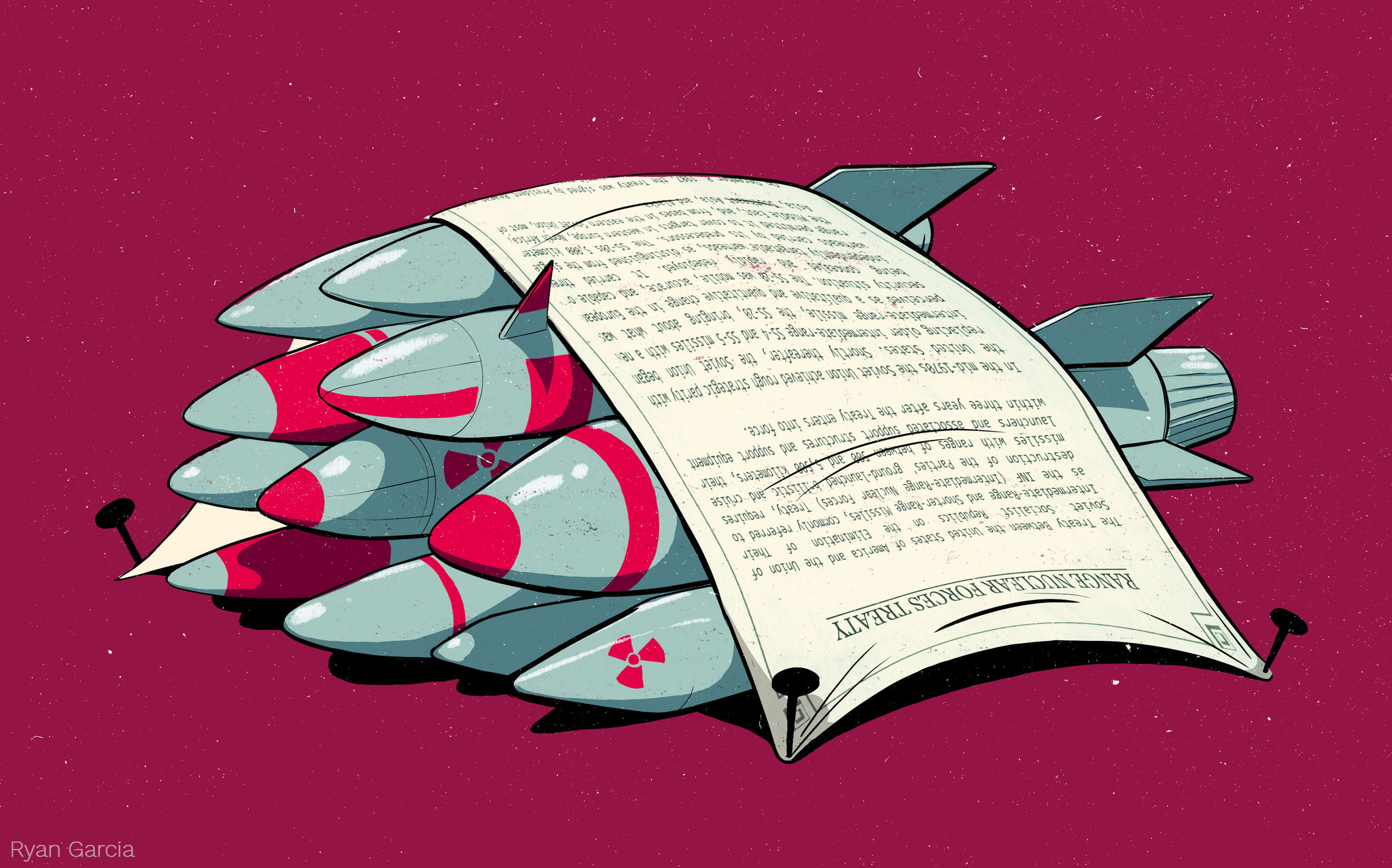
Don’t Tear Up This Treaty

Arms control isn’t perfect. But abandoning treaties without a plan for the future is dangerous.

ryan garcia

The Editorial Board

The editorial board represents the opinions of the board, its editor and the publisher. It is separate from the newsroom and the Op-Ed section.

nytimes.com | Dec. 15, 2018

Every American president from John F. Kennedy to Barack Obama has successfully negotiated an agreement with the Soviet Union, or the Russian federation, to reduce the threat from both countries’ vast nuclear arsenals. More than a dozen treaties limiting nuclear testing, nuclear weapons, activities in outer space and missile defense have been part of this mix.

The need for such restraint is irrefutable: No weapons are more lethal and potentially more destabilizing to the world than those that have earned the moniker “city killers.”Continue reading

A near-disaster at a federal nuclear weapons laboratory takes a hidden toll on America’s arsenal

Repeated safety lapses hobble Los Alamos National Laboratory’s work on the cores of U.S. nuclear warheads

The Center for Public Integrity, Patrick MaloneScience | June 29, 2017 science.org

Technicians at the government’s Los Alamos National Laboratory settled on what seemed like a surefire way to win praise from their bosses in August 2011: In a hi-tech testing and manufacturing building pivotal to sustaining America’s nuclear arsenal, they gathered eight rods painstakingly crafted out of plutonium, and positioned them side-by-side on a table to photograph how nice they looked.

At many jobs, this would be innocent bragging. But plutonium is the unstable, radioactive, man-made fuel of a nuclear explosion, and it isn’t amenable to showboating. When too much is put in one place, it becomes “critical” and begins to fission uncontrollably, spontaneously sparking a nuclear chain reaction, which releases energy and generates a deadly burst of radiation.

The resulting blue glow — known as Cherenkov radiation — has accidentally and abruptly flashed at least 60 times since the dawn of the nuclear age, signaling an instantaneous nuclear charge and causing a total of 21 agonizing deaths. So keeping bits of plutonium far apart is one of the bedrock rules that those working on the nuclear arsenal are supposed to follow to prevent workplace accidents. It’s Physics 101 for nuclear scientists, but has sometimes been ignored at Los Alamos.

Scroll to top