"The most toxic and dangerous type of radioactive waste created by the nuclear industry"
This is waste generated by nuclear power plants called 'high-level radioactive waste' (HLW), also known as 'spent' or 'irradiated' fuel. This waste contains plutonium, uranium, strontium, and cesium; and will be radioactive for millions of years.
It is not like the waste currently stored at the Waste Isolation Pilot Project (WIPP) or any other waste site that exists today in the U.S.: it is far worse.
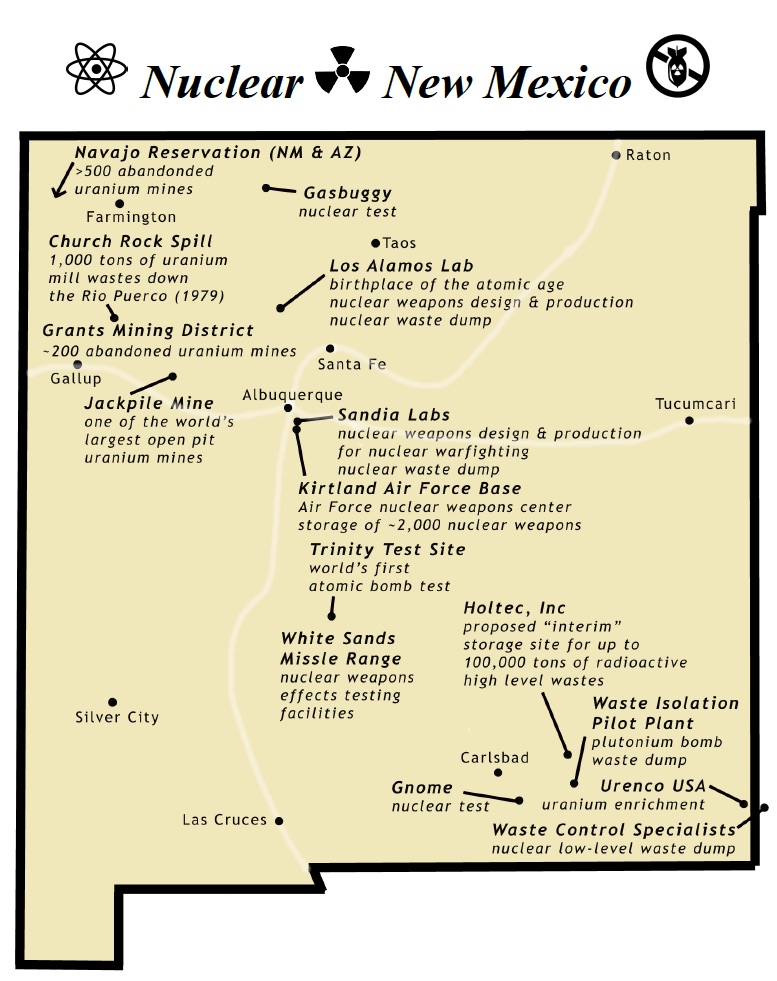
Two companies are proposing to build waste facilities near Carlsbad and Hobbs for the most toxic and dangerous type of radioactive waste created by the nuclear industry.
Holtec International is working with the Eddy-Lea Energy Alliance, LLC (ELEA) to apply for a license to build a Consolidated Interim Storage (CIS) facility approximately halfway between Carlsbad and Hobbs, and 16 miles north of WIPP.
The Nuclear Regulatory Commission (NRC) has declared the Holtec/ELEA application complete, NRC initiated a public comment period with 60 days for public comment. Note that transport of this waste poses risks to the environment and all life located near transportation routes.
Holtec proposal:
New CIS facility to store 100,000 metric tons of HLRW, with the potential to increase to 120,000 metric tons for 120 years
Shallow sub-surface burial system
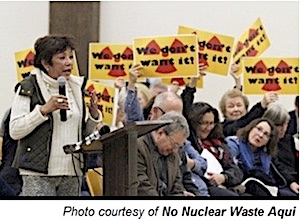
New Mexicans and Texans are fighting the attempted licensing of these two proposed CIS facilities - Waste Control Specialists near Andrews, Texas and Eddy Lee/Holtec International east of Carlsbad, New Mexico.
These sites and any transport to these sites are not only dangerous but environmentally unjust. These sites present clear examples of environmental racism.
New Mexico's demographic is largely Latino. There are many communities of color, especially in the southern part of the state where the sites are being proposed. People of color would be disproportionately affected if the Eddy Lee/Holtec CIS site were licensed and constructed.
New Mexico and Texas do not consent to either proposed CIS facility and are fighting to avoid the environmental injustice and the unnecessary shipment of irradiated high-level nuclear waste through their communities.
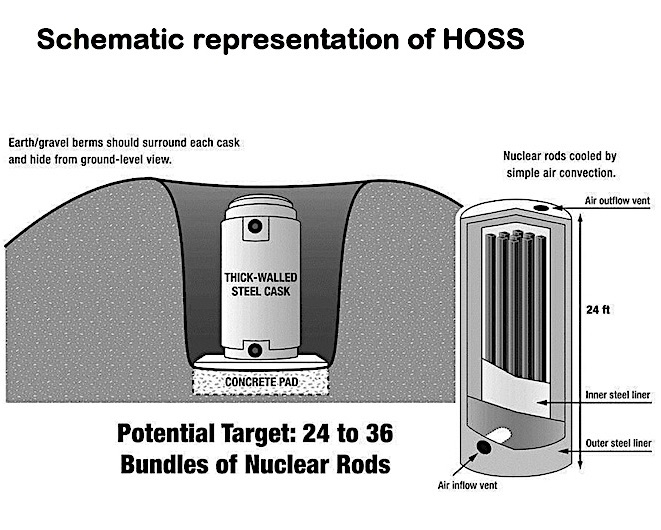
Hardened On-Site Storage (HOSS) is a community-based concept that aims to protect the public from the threats posed by the current vulnerable storage of commercial irradiated fuel.
History
For decades, high level radioactive waste has accumulated at reactor sites and continues to do so as nuclear reactors generate more waste. Without a credible plan to permanently isolate it, storage pools, where irradiated nuclear waste is currently stored until it becomes less hot, have been tightly packed and re-racked to accommodate all the waste.
Unfortunately, the pools and dry casks have no robust containment. If the cooling pumps stopped operating or the water in the pools drained out, temperatures would quickly increase, as happened in Fukushima Japan, and could result in a similar disaster.
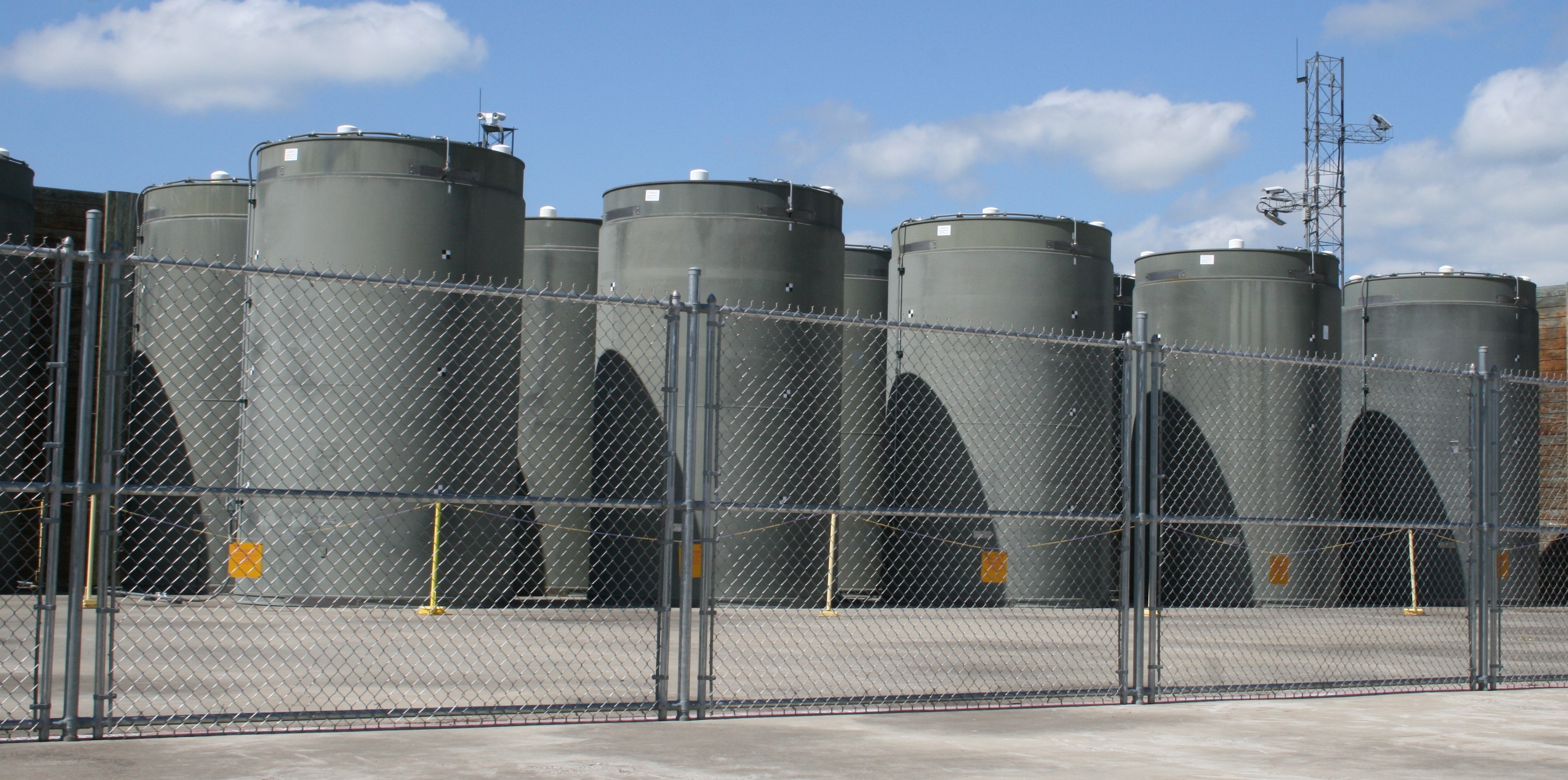
Current dry cask storage at reactor sites (pictured above) is extremely vulnerable. There is often nothing more than a chain-link fence and a short distance that separates the highly radioactive waste containers and public access.
Establishing interim hardened on-site storage (HOSS) is a top priority. Hardened on-site storage allows waste generators to store high level waste as close to the site of generation as possible, thereby exposing fewer people to radiation, as safely as possible.
Rather than storing dozens of vulnerable dry-casks next to each other in the open air, the HOSS Principles established by concerned citizens mandate:
Irradiated fuel must be stored as safely as possible as close to the site of generation as possible;
HOSS facilities must not be regarded as a permanent waste solution, and thus should not be constructed underground and the waste must be retrievable;
The facility must have real-time radiation and heat monitoring for early detection of problems with containers;
The overall objective of HOSS should be that the amount of releases projected in even severe attacks should be low enough that the storage system would be unattractive as a terrorist target;
Placement of individual canisters that makes detection difficult from outside the site boundary.
Hardened On-Site Storage (HOSS) is supported by organizations in all 50 states. The Principles of Securing Nuclear Waste at Nuclear Reactor Sites are posted here. It would provide better security at reactor sites with robust dry storage and community oversight, including real-time monitoring of heat and radiation. HOSS is rooted in values of community protection and environmental justice and will provide increased protection from human or natural disasters, like terrorist attacks and earthquakes
HOSS facilities are not permanent waste solutions, and therefore should not be constructed deep underground as the waste must be retrievable. However, they are a workable solution that will allow us to explore scientifically sound, and socially and environmentally just long-term management systems.
Nuclear Power Has No Place in a Green Energy Future
Because of: Time Delay, Success of Renewables, Huge Costs, Dangers, Weapons Connection, and Wastes
from Yahoo News, 21 Oct 21, ”…….Practical concerns also temper enthusiasm for a nuclear future. The next generation of reactors, heralded as a game changer by supporters, still haven’t been proven in the real world. Even if those technologies are as revolutionary as advertised, skeptics say it could take decades before they make a real difference in the global energy grid — too long if the worst outcomes of climate change are to be avoided.
Renewable energy technologies can be enough on their own
“The drawbacks to nuclear are compounded by the burgeoning success of renewables — both solar and wind are getting cheaper and more efficient, year after year. There is also a growing realisation that a combination of renewables, smart storage, energy efficiency and more flexible grids can now be delivered at scale and at speed — anywhere in the world.” — Jonathon Porritt, Guardian
The world doesn’t have time to wait for next-gen nuclear
“When it comes to averting the imminent effects of climate change, even the cutting edge of nuclear technology will prove to be too little, too late. Put simply, given the economic trends in existing plants and those under construction, nuclear power cannot positively impact climate change in the next ten years or more.” — Allison Macfarlane, Foreign Affairs
A major ramp-up in nuclear technologies isn’t economically feasible
“While nuclear power may have once been cheaper than wind or solar, the economics have since changed dramatically. Nuclear power plants are very expensive to build and the economics of nuclear power are getting steadily worse. By contrast, renewables continue to come down in price.” — Ian Lowe, Conversation
There’s no way to guarantee that nuclear plants will be safe
“People around the world have witnessed the Three Mile Island, Chernobyl and Fukushima accidents. It is more than enough to believe that a safe nuclear power plant is nothing but a myth.” — Jang Daul, Korea Times
More nuclear power could lead to more nuclear weapons
“Some nations — India and Pakistan, and in all probability Israel — became nuclear powers after originally seeking nuclear technology for research or to develop nuclear power. … This is important: The technology used to turn on lights or charge mobile phones shouldn’t need to involve national or international defence apparatus.” — Editorial, Nature
Nuclear waste is still a major problem
“Nuclear waste lasts for hundreds of thousands of years before they are half-decayed. Our United States government — perhaps the longest continuous government in the world — is only 232 years old. Who will be around to manage uranium wastes?” — David Ross, Courier-Journal
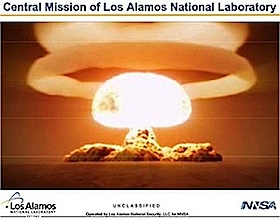
LANL’s Central Mission: Los Alamos Lab officials have recently claimed that LANL has moved away from primarily nuclear weapons to “national security”, but what truly remains as the Labs central mission? Here’s the answer from one of its own documents:
LANL’s “Central Mission”- Presented at: RPI Nuclear Data 2011 Symposium for Criticality Safety and Reactor Applications (PDF) 4/27/11
The New Mexico Environment Department’s Hazardous Waste Bureau is extending the public comment period on the proposed changes to the Draft Consent Order which governs legacy clean-up at Los Alamos National Laboratory.
The public comment period now continues through May 31. To obtain a copy of the documents or a portion thereof, visit the NMED website at https://web.archive.org/web/20170109131949/https://www.env.nm.gov/HWB/lanlperm.html under Consent Order.
Written comments must be based on information available for review and include, to the extent practicable, all referenced factual materials.
NMED is scheduled to present on the public comments received to date at the May 18 Northern New Mexico Citizens’ Advisory Committee meeting at the Cities of Gold Hotel, 10-A Cities of Gold Road, Santa Fe, New Mexico from 1:00 P.M. to 5:00 P.M.
AND WE HAVE EXPANDED OUR COMMENTS
Please let your voice be heard and turn in public comments. Copy the sample comments below and paste into an email. Please modify as you see fit, then email to the address below. If you don’t mind, please cc: us at: info(at)nukewatch(dot)org
[date]
Ms. Kathryn Roberts
New Mexico Environment Department
Post Office Box 5469
Santa Fe, New Mexico 87502
Via email to kathryn.roberts@state.nm.us
Dear Ms. Roberts,
I urge the New Mexico Environment Department (NMED) to abandon the proposed 2016 Compliance Order on Consent, or Consent Order, for Los Alamos National Laboratory (LANL), released for public comment on March 30, 2016. It creates serious problems and represents a giant step backwards in achieving the goal of genuine cleanup of the Laboratory.
The Environment Department should keep the existing Consent Order that went into effect March 1, 2005, while modifying and updating a cleanup schedule that includes a realistic final compliance date. I also formally request that NMED provide the opportunity for a public hearing on the revised cleanup schedule and new completion date, in accordance with the New Mexico Hazardous Waste Act and the 2005 Consent Order.
GENERAL COMMENTS
The opportunity for a public hearing must be provided
Any extension of a final compliance date must be treated as a Class 3 permit modification to the 2005 Consent Order and therefore requires a 60-day public comment period.
Any extension of a final compliance date under the 2005 Consent Order can be implemented only after the opportunity for public comment and a public hearing, including formal testimony and cross-examination of witnesses.
The Environment Department is legally required to follow these public participation requirements that explicitly incorporated into the 2005 Consent Order.
Withdraw the proposed draft 2016 Consent Order
The proposed draft represents a big step backwards in achieving the goal of genuine cleanup of the Laboratory.
The Environment Department should keep the current 2005 Consent Order and revise the Section XII cleanup schedule and final compliance date.
I request that the Environment Department withdraw the proposed draft 2016 Consent Order.
The public deserves the opportunity to comment on all following drafts
It seems likely that a later draft – after the Lab’s and public comments are incorporated into a revised draft – and after closed-door negotiations between the Environment Department and the Laboratory – could be substantially different from the current draft.
I request that the public have the opportunity to review and comment on any further drafts of a revised proposed 2016 Consent Order.
Public participation provisions in the existing 2005 Consent Order must be incorporated into the proposed draft 2016 Consent Order
The proposed draft 2016 Consent Order explicitly limits public participation requirements incorporated into the existing 2005 Consent Order.
I request that all notices, milestones, targets, annual negotiations, and modifications require public review and comment, and the opportunity for a public hearing.
The current state of cleanup must be updated and next steps scheduled
Work under the existing 2005 Consent Order needs to be subject to public review. In 2005 DOE agreed to complete cleanup under the Consent Order by December 6, 2015, which did not happen. In order for the public to understand where the work under the existing Consent Order stands, LANL should be required to provide a current, publicly available list of the status of all cleanup projects under the 2005 Consent Order.
Further, I request that next steps for cleanup at every site listed in the 2005 Consent Order be documented in detail and given a scheduled completion date, or alternatively verified as already completed.
All documents submitted under the 2005 Consent Order must be incorporated into any revised Consent Order.
All documents must be made public as required in the 2005 Consent Order
The State and the Lab must make all communications, documents, submittals, approvals, notices of deficiencies and denials under any revised Consent Order readily and electronically available to the public.
The State and the Lab must notify individuals by e-mail of all submittals, as required in the 2005 Consent Order.
The Environment Department must respond in writing to all public comments
I request that the State reply individually to each and every comment submitted.
The Lab’s comments and NMED’s response to comments must be made public.
All future work must have enforceable deadlines
The proposed draft 2016 Consent Order proposes a “Campaign” approach with enforceable cleanup deadlines limited to the work scheduled only for that year.
I request that all anticipated cleanup projects have scheduled, enforceable cleanup deadlines from the beginning of any revised Consent Order.
The Consent Order cannot be open-ended
Any Consent Order for LANL cleanup must have a final compliance date to which the State and the Lab agree to and are so bound.
The public should be given an opportunity for a public hearing on the new final compliance date as required by New Mexico’s hazardous waste regulations.
SPECIFIC COMMENTS
The Proposed 2016 Consent Order Must Not Extend the Original Final Compliance Date Without Required Public Participation
The proposed 2016 consent order would indefinitely extend the final compliance date for completing corrective action at the Laboratory, without the opportunity for a public hearing with formal testimony and cross-examination of witnesses. Any extension of a final compliance date under the 2005 Consent Order requires a 60-day public comment period and the opportunity for a public hearing, including formal testimony and cross-examination. The Environment Department is legally required to follow these procedural requirements.
The legal requirements that mandate a public hearing are clear. Section XII of the 2005 Consent Order establishes the compliance schedule for implementation and completion of corrective actions at specific sites at the Laboratory. This schedule is mandatory. The final report that was to be submitted under the 2005 Consent Order – therefore, the final compliance date – was the remedy completion report for the huge Area G waste dump, required to be submitted by December 6, 2015. The proposed 2016 Consent Order would indefinitely extend this final compliance date by not designating a specific final compliance date.
But this revision must be treated as a major Class 3 permit modification. Section III.W.5 of the 2005 Consent Order explicitly provides for the preservation of full procedural rights for the public as follows:
This Consent Order hereby incorporates all rights, procedures and other protections afforded the Respondents [DOE and UC, now LANS] and the public pursuant to the regulations at 20.4.1.900 NMAC (incorporating 40 C.F.R. § 270.42) and 20.4.1.901 NMAC, including, but not limited to, opportunities for public participation, including public notice and comment, administrative hearings, and judicial appeals concerning, for example, remedy selection decisions of the [Environment] Department.
Thus, extension of a final compliance date under the 2005 Consent Order requires a 60-day public comment period and the opportunity for a public hearing, including formal testimony and cross-examination.
The Proposed New Consent Order Must Not Limit Other Public Participation Procedures
The proposed 2016 Consent Order expressly limits public participation requirements in a way that completely diverges from those provided in the 2005 Consent Order. As explained above, the 2005 Consent Order explicitly protects procedural due process rights available to the public. The proposed 2016 Consent Order explicitly removes these protections, as follows:
The Parties agree that the rights, procedures and other protections set forth at 20.4.1.900 NMAC (incorporating 40 C.F.R. § 270.42), 20.4.1.901 NMAC, and 20.4.1.902 NMAC, including, but not limited to, opportunities for public participation, including public notice and comment, administrative hearings, and judicial appeals, do not apply to modification of the Consent Order itself. [Emphasis added]
Thus, as proposed in the above language, the Parties (the Environment Department, Department of Energy and Los Alamos National Security, LLC) have inappropriately agreed to remove the due process rights, procedures and other protections provided to the public under the Resource Conservation and Recovery Act (RCRA) and the New Mexico Hazardous Waste Act. This provision must be stripped from the proposed 2016 Consent Order.
The Proposed New Consent Order Must Not Eliminate Enforceable Deadlines
The proposed 2016 consent order would eliminate all the deadlines for completing cleanup under the 2005 Consent Order, and replace them with an open-ended and vague scheduling process, with limited enforcement opportunities.
The 2005 Consent Order, in Section XII, established dozens of deadlines for the completion of corrective action tasks, including completion of investigations at individual sites, installation of groundwater monitoring wells, submittal of groundwater monitoring reports, evaluation of remedial alternatives for individual sites, and completion of final remedies. These deadlines are enforceable under section III.G.
The proposed 2016 Consent Order would abandon the 2005 Consent Order provisions and replace them with a so-called “Campaign Approach” under Section VIII. Under Section VIII.A.3, it would be up to the DOE, not the regulator at the New Mexico Environment Department, to select the timing and scope of each “campaign.”
Enforceable deadlines for cleanup tasks would apply no more than one year into the future. Deadlines would be based on “Campaigns” negotiated each year with DOE with no public participation and opportunity to comment on the schedule. To add insult to injury, the annual schedule would be determined by funding at DOE’s discretion, rather than the schedule driving the funding, which was the fundamental approach of the 2005 Consent Order.
All cleanup projects must mandatory completion dates scheduled from the beginning date of any revised Consent Order, and must be fully enforceable.
Existing Violations Must Not Be Eliminated
Section II.A of the proposed 2016 Consent Order would “settle any outstanding violations of the 2005 Consent Order.” This is a get out of jail free card. Without enforceable schedules from the beginning, any consent order is not truly unenforceable, and the Environment Department would be abdicating its responsibility to protect human health and the environment as required by the federal Resource Conservation and Recovery Act (RCRA) and the New Mexico Hazardous Waste Act. NMED must not surrender its regulatory and enforcement powers!
Attorney General Approval Must Be Obtained
The 2005 Consent Order was signed by the Attorney General of New Mexico for purposes of the Covenant Not to Sue (section III.) and the Reservation of Rights (section III.). As indicated on the draft signature page, there is no indication of the NM Attorney General plans to sign the proposed 2016 Consent Order. Yet it would provide the State of New Mexico with a covenant not to sue DOE on behalf of the State of New Mexico, not merely on behalf of the Environment Department. The Attorney General was an active participant, representing the People of New Mexico, in the 2005 Consent Order. The Environment Department has a responsibility to ensure that the NM Attorney General is consulted, and his approval obtained, before any consent order is adopted.
The Proposed 2016 Consent Order Must Not Omit Detailed Requirements Found in the 2005 Consent Order
The 2005 Consent Order includes numerous detailed requirements for such things as well installation, sample collection, and preparation of work plans and reports. These ensure that the cleanup work is done properly, consistently, and according to standard industry practices. They also ensured that work plans and reports were consistent, easy for the Environment Department to review, and easy for the public to understand. The proposed 2016 Consent Order omits many such requirements, which should be corrected.
The Proposed 2016 Consent OrderMust Not Allow Budget To Dictate Cleanup
The proposed 2016 Consent Order allows DOE to provide cleanup priorities based on anticipated budget, which is backwards. . By the time NMED receives an estimated annual cleanup budget from DOE, the horse has left the barn. The original purpose of the 2005 Consent Order was to compel DOE and LANL to ask Congress for additional funds to accelerate cleanup. The giant loophole in the proposed 2016 Consent Order that allows DOE and LANL to say that they don’t have sufficient funding and therefore can choose to exempt themselves from cleanup should be eliminated.
Cleanup Levels Must Remain Strict
Section IX Cleanup Objectives and Cleanup Levels of the proposed 2016 Consent Order would allow DOE to “develop site specific ecological cleanup levels” to mitigate unacceptable ecological risk due to release of site-related contaminants. There is no mention of NMED’s role in this process. DOE would be allowed to demonstrate to NMED that any particular “cleanup objective is impracticable.” To do this, DOE may consider such things as technical difficulty, the cost of the project, hazards to workers or to the public, and any other basis that may support a finding of impracticability. If NMED approves the impracticability request, DOE can then propose alternative cleanup methods using site-specific risk assessments. All of this could take place behind closed doors, as there are no public participation requirements in this section. Please clarify what cleanup levels will be used and when and where they will be applied.
New Mexico deserves better
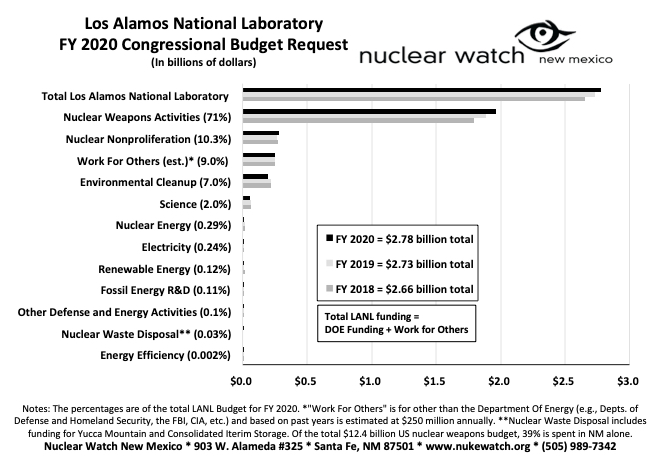
In closing, the Environment Department’s proposed 2016 Consent Order allows the federal government to leave Northern New Mexico contaminated if DOE believes that cleanup is too difficult or costly– a sorry situation indeed for a nuclear weapons facility that receives over 2 billion taxpayer dollars a year. Instead, the New Mexico Environment Department should implement a new revised Consent Order that is aggressive and enforceable and in which the State of New Mexico stays in the driver’s seat, not LANL and DOE. That would be a real win-win for New Mexicans, helping to permanently protect the environment and our precious water resources while creating hundreds of high-paying cleanup jobs. .
Click the image to view and download this large printable map of DOE sites, commercial reactors, nuclear waste dumps, nuclear transportation routes, surface waters near sites and transport routes, and underlying aquifers. This map was prepared by Deborah Reade for the Alliance for Nuclear Accountability.
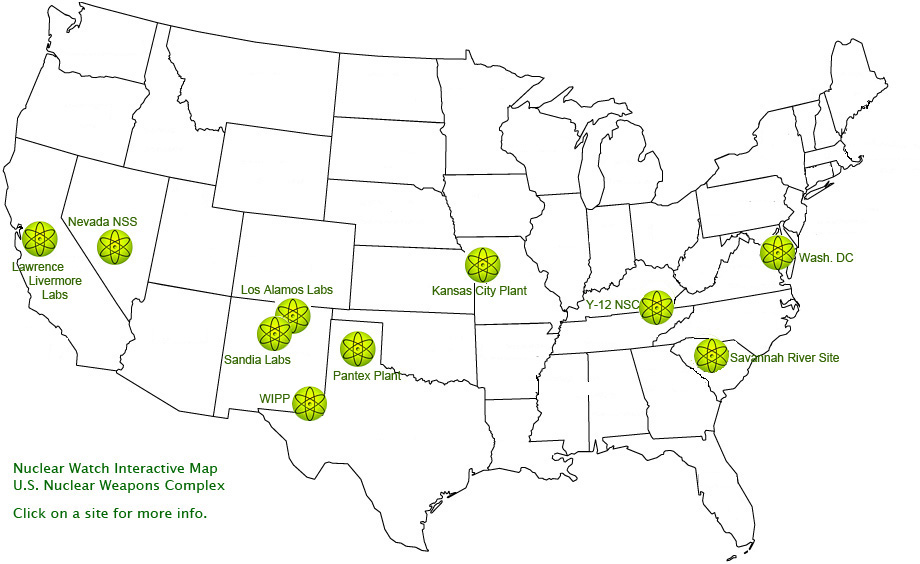
Nuclear Watch Interactive Map – U.S. Nuclear Weapons Complex
Waste Lands: America’s Forgotten Nuclear Legacy
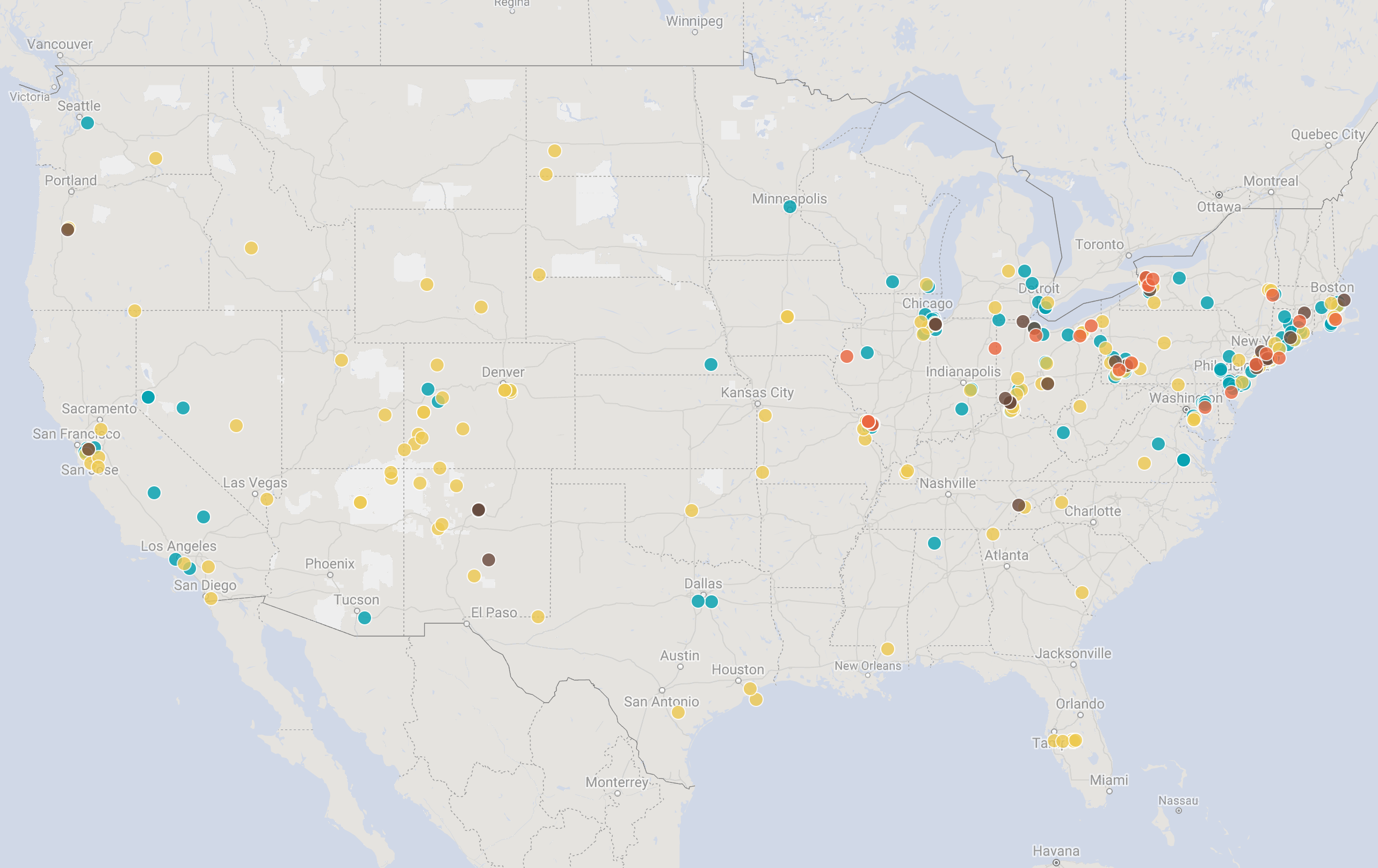
The Wall St. Journal has compiled a searchable database of contaminated sites across the US. (view)
Related WSJ report: https://www.wsj.com
The New Mexico Environment Department’s Hazardous Waste Bureau is extending the public comment period on the proposed changes to the Draft Consent Order which governs legacy clean-up at Los Alamos National Laboratory.
The public comment period now continues through May 31. To obtain a copy of the documents or a portion thereof, visit the NMED website at https://web.archive.org/web/20170109131949/https://www.env.nm.gov/HWB/lanlperm.html under Consent Order.
Written comments must be based on information available for review and include, to the extent practicable, all referenced factual materials.
NMED is scheduled to present on the public comments received to date at the May 18 Northern New Mexico Citizens’ Advisory Committee meeting at the Cities of Gold Hotel, 10-A Cities of Gold Road, Santa Fe, New Mexico from 1:00 P.M. to 5:00 P.M.
AND WE HAVE EXPANDED OUR COMMENTS
Please let your voice be heard and turn in public comments. Copy the sample comments below and paste into an email. Please modify as you see fit, then email to the address below. If you don’t mind, please cc: us at: info(at)nukewatch(dot)org
[date]
Ms. Kathryn Roberts
New Mexico Environment Department
Post Office Box 5469
Santa Fe, New Mexico 87502
Via email to kathryn.roberts@state.nm.us
Dear Ms. Roberts,
I urge the New Mexico Environment Department (NMED) to abandon the proposed 2016 Compliance Order on Consent, or Consent Order, for Los Alamos National Laboratory (LANL), released for public comment on March 30, 2016. It creates serious problems and represents a giant step backwards in achieving the goal of genuine cleanup of the Laboratory.
The Environment Department should keep the existing Consent Order that went into effect March 1, 2005, while modifying and updating a cleanup schedule that includes a realistic final compliance date. I also formally request that NMED provide the opportunity for a public hearing on the revised cleanup schedule and new completion date, in accordance with the New Mexico Hazardous Waste Act and the 2005 Consent Order.
GENERAL COMMENTS
The opportunity for a public hearing must be provided
Any extension of a final compliance date must be treated as a Class 3 permit modification to the 2005 Consent Order and therefore requires a 60-day public comment period.
Any extension of a final compliance date under the 2005 Consent Order can be implemented only after the opportunity for public comment and a public hearing, including formal testimony and cross-examination of witnesses.
The Environment Department is legally required to follow these public participation requirements that explicitly incorporated into the 2005 Consent Order.
Withdraw the proposed draft 2016 Consent Order
The proposed draft represents a big step backwards in achieving the goal of genuine cleanup of the Laboratory.
The Environment Department should keep the current 2005 Consent Order and revise the Section XII cleanup schedule and final compliance date.
I request that the Environment Department withdraw the proposed draft 2016 Consent Order.
The public deserves the opportunity to comment on all following drafts
It seems likely that a later draft – after the Lab’s and public comments are incorporated into a revised draft – and after closed-door negotiations between the Environment Department and the Laboratory – could be substantially different from the current draft.
I request that the public have the opportunity to review and comment on any further drafts of a revised proposed 2016 Consent Order.
Public participation provisions in the existing 2005 Consent Order must be incorporated into the proposed draft 2016 Consent Order
The proposed draft 2016 Consent Order explicitly limits public participation requirements incorporated into the existing 2005 Consent Order.
I request that all notices, milestones, targets, annual negotiations, and modifications require public review and comment, and the opportunity for a public hearing.
The current state of cleanup must be updated and next steps scheduled
Work under the existing 2005 Consent Order needs to be subject to public review. In 2005 DOE agreed to complete cleanup under the Consent Order by December 6, 2015, which did not happen. In order for the public to understand where the work under the existing Consent Order stands, LANL should be required to provide a current, publicly available list of the status of all cleanup projects under the 2005 Consent Order.
Further, I request that next steps for cleanup at every site listed in the 2005 Consent Order be documented in detail and given a scheduled completion date, or alternatively verified as already completed.
All documents submitted under the 2005 Consent Order must be incorporated into any revised Consent Order.
All documents must be made public as required in the 2005 Consent Order
The State and the Lab must make all communications, documents, submittals, approvals, notices of deficiencies and denials under any revised Consent Order readily and electronically available to the public.
The State and the Lab must notify individuals by e-mail of all submittals, as required in the 2005 Consent Order.
The Environment Department must respond in writing to all public comments
I request that the State reply individually to each and every comment submitted.
The Lab’s comments and NMED’s response to comments must be made public.
All future work must have enforceable deadlines
The proposed draft 2016 Consent Order proposes a “Campaign” approach with enforceable cleanup deadlines limited to the work scheduled only for that year.
I request that all anticipated cleanup projects have scheduled, enforceable cleanup deadlines from the beginning of any revised Consent Order.
The Consent Order cannot be open-ended
Any Consent Order for LANL cleanup must have a final compliance date to which the State and the Lab agree to and are so bound.
The public should be given an opportunity for a public hearing on the new final compliance date as required by New Mexico’s hazardous waste regulations.
SPECIFIC COMMENTS
The Proposed 2016 Consent Order Must Not Extend the Original Final Compliance Date Without Required Public Participation
The proposed 2016 consent order would indefinitely extend the final compliance date for completing corrective action at the Laboratory, without the opportunity for a public hearing with formal testimony and cross-examination of witnesses. Any extension of a final compliance date under the 2005 Consent Order requires a 60-day public comment period and the opportunity for a public hearing, including formal testimony and cross-examination. The Environment Department is legally required to follow these procedural requirements.
The legal requirements that mandate a public hearing are clear. Section XII of the 2005 Consent Order establishes the compliance schedule for implementation and completion of corrective actions at specific sites at the Laboratory. This schedule is mandatory. The final report that was to be submitted under the 2005 Consent Order – therefore, the final compliance date – was the remedy completion report for the huge Area G waste dump, required to be submitted by December 6, 2015. The proposed 2016 Consent Order would indefinitely extend this final compliance date by not designating a specific final compliance date.
But this revision must be treated as a major Class 3 permit modification. Section III.W.5 of the 2005 Consent Order explicitly provides for the preservation of full procedural rights for the public as follows:
This Consent Order hereby incorporates all rights, procedures and other protections afforded the Respondents [DOE and UC, now LANS] and the public pursuant to the regulations at 20.4.1.900 NMAC (incorporating 40 C.F.R. § 270.42) and 20.4.1.901 NMAC, including, but not limited to, opportunities for public participation, including public notice and comment, administrative hearings, and judicial appeals concerning, for example, remedy selection decisions of the [Environment] Department.
Thus, extension of a final compliance date under the 2005 Consent Order requires a 60-day public comment period and the opportunity for a public hearing, including formal testimony and cross-examination.
The Proposed New Consent Order Must Not Limit Other Public Participation Procedures
The proposed 2016 Consent Order expressly limits public participation requirements in a way that completely diverges from those provided in the 2005 Consent Order. As explained above, the 2005 Consent Order explicitly protects procedural due process rights available to the public. The proposed 2016 Consent Order explicitly removes these protections, as follows:
The Parties agree that the rights, procedures and other protections set forth at 20.4.1.900 NMAC (incorporating 40 C.F.R. § 270.42), 20.4.1.901 NMAC, and 20.4.1.902 NMAC, including, but not limited to, opportunities for public participation, including public notice and comment, administrative hearings, and judicial appeals, do not apply to modification of the Consent Order itself. [Emphasis added]
Thus, as proposed in the above language, the Parties (the Environment Department, Department of Energy and Los Alamos National Security, LLC) have inappropriately agreed to remove the due process rights, procedures and other protections provided to the public under the Resource Conservation and Recovery Act (RCRA) and the New Mexico Hazardous Waste Act. This provision must be stripped from the proposed 2016 Consent Order.
The Proposed New Consent Order Must Not Eliminate Enforceable Deadlines
The proposed 2016 consent order would eliminate all the deadlines for completing cleanup under the 2005 Consent Order, and replace them with an open-ended and vague scheduling process, with limited enforcement opportunities.
The 2005 Consent Order, in Section XII, established dozens of deadlines for the completion of corrective action tasks, including completion of investigations at individual sites, installation of groundwater monitoring wells, submittal of groundwater monitoring reports, evaluation of remedial alternatives for individual sites, and completion of final remedies. These deadlines are enforceable under section III.G.
The proposed 2016 Consent Order would abandon the 2005 Consent Order provisions and replace them with a so-called “Campaign Approach” under Section VIII. Under Section VIII.A.3, it would be up to the DOE, not the regulator at the New Mexico Environment Department, to select the timing and scope of each “campaign.”
Enforceable deadlines for cleanup tasks would apply no more than one year into the future. Deadlines would be based on “Campaigns” negotiated each year with DOE with no public participation and opportunity to comment on the schedule. To add insult to injury, the annual schedule would be determined by funding at DOE’s discretion, rather than the schedule driving the funding, which was the fundamental approach of the 2005 Consent Order.
All cleanup projects must mandatory completion dates scheduled from the beginning date of any revised Consent Order, and must be fully enforceable.
Existing Violations Must Not Be Eliminated
Section II.A of the proposed 2016 Consent Order would “settle any outstanding violations of the 2005 Consent Order.” This is a get out of jail free card. Without enforceable schedules from the beginning, any consent order is not truly unenforceable, and the Environment Department would be abdicating its responsibility to protect human health and the environment as required by the federal Resource Conservation and Recovery Act (RCRA) and the New Mexico Hazardous Waste Act. NMED must not surrender its regulatory and enforcement powers!
Attorney General Approval Must Be Obtained
The 2005 Consent Order was signed by the Attorney General of New Mexico for purposes of the Covenant Not to Sue (section III.) and the Reservation of Rights (section III.). As indicated on the draft signature page, there is no indication of the NM Attorney General plans to sign the proposed 2016 Consent Order. Yet it would provide the State of New Mexico with a covenant not to sue DOE on behalf of the State of New Mexico, not merely on behalf of the Environment Department. The Attorney General was an active participant, representing the People of New Mexico, in the 2005 Consent Order. The Environment Department has a responsibility to ensure that the NM Attorney General is consulted, and his approval obtained, before any consent order is adopted.
The Proposed 2016 Consent Order Must Not Omit Detailed Requirements Found in the 2005 Consent Order
The 2005 Consent Order includes numerous detailed requirements for such things as well installation, sample collection, and preparation of work plans and reports. These ensure that the cleanup work is done properly, consistently, and according to standard industry practices. They also ensured that work plans and reports were consistent, easy for the Environment Department to review, and easy for the public to understand. The proposed 2016 Consent Order omits many such requirements, which should be corrected.
The Proposed 2016 Consent OrderMust Not Allow Budget To Dictate Cleanup
The proposed 2016 Consent Order allows DOE to provide cleanup priorities based on anticipated budget, which is backwards. . By the time NMED receives an estimated annual cleanup budget from DOE, the horse has left the barn. The original purpose of the 2005 Consent Order was to compel DOE and LANL to ask Congress for additional funds to accelerate cleanup. The giant loophole in the proposed 2016 Consent Order that allows DOE and LANL to say that they don’t have sufficient funding and therefore can choose to exempt themselves from cleanup should be eliminated.
Cleanup Levels Must Remain Strict
Section IX Cleanup Objectives and Cleanup Levels of the proposed 2016 Consent Order would allow DOE to “develop site specific ecological cleanup levels” to mitigate unacceptable ecological risk due to release of site-related contaminants. There is no mention of NMED’s role in this process. DOE would be allowed to demonstrate to NMED that any particular “cleanup objective is impracticable.” To do this, DOE may consider such things as technical difficulty, the cost of the project, hazards to workers or to the public, and any other basis that may support a finding of impracticability. If NMED approves the impracticability request, DOE can then propose alternative cleanup methods using site-specific risk assessments. All of this could take place behind closed doors, as there are no public participation requirements in this section. Please clarify what cleanup levels will be used and when and where they will be applied.
New Mexico deserves better
In closing, the Environment Department’s proposed 2016 Consent Order allows the federal government to leave Northern New Mexico contaminated if DOE believes that cleanup is too difficult or costly– a sorry situation indeed for a nuclear weapons facility that receives over 2 billion taxpayer dollars a year. Instead, the New Mexico Environment Department should implement a new revised Consent Order that is aggressive and enforceable and in which the State of New Mexico stays in the driver’s seat, not LANL and DOE. That would be a real win-win for New Mexicans, helping to permanently protect the environment and our precious water resources while creating hundreds of high-paying cleanup jobs. .
Important Documents & Articles Related to Nuclear Energy Production
Most Recent
Nothing Found
It seems we can’t find what you’re looking for. Perhaps searching can help.
See Also
Nuclear Watch Interactive Map – U.S. Nuclear Weapons Complex
Waste Lands: America’s Forgotten Nuclear Legacy
The Wall St. Journal has compiled a searchable database of contaminated sites across the US. (view)
Related WSJ report: https://www.wsj.com
LANL’s Central Mission: Los Alamos Lab officials have recently claimed that LANL has moved away from primarily nuclear weapons to “national security”, but what truly remains as the Labs central mission? Here’s the answer from one of its own documents:
LANL’s “Central Mission”- Presented at: RPI Nuclear Data 2011 Symposium for Criticality Safety and Reactor Applications (PDF) 4/27/11