No Lethal High-Level Waste To New Mexico

Background

No Nuclear Waste
Photo Courtesy of No Nuclear Waste Aqui

"The most toxic and dangerous type of radioactive waste created by the nuclear industry"

This is waste generated by nuclear power plants called 'high-level radioactive waste' (HLW), also known as 'spent' or 'irradiated' fuel. This waste contains plutonium, uranium, strontium, and cesium; and will be radioactive for millions of years.

It is not like the waste currently stored at the Waste Isolation Pilot Project (WIPP) or any other waste site that exists today in the U.S.: it is far worse.

Two companies are proposing to build waste facilities near Carlsbad and Hobbs for the most toxic and dangerous type of radioactive waste created by the nuclear industry.

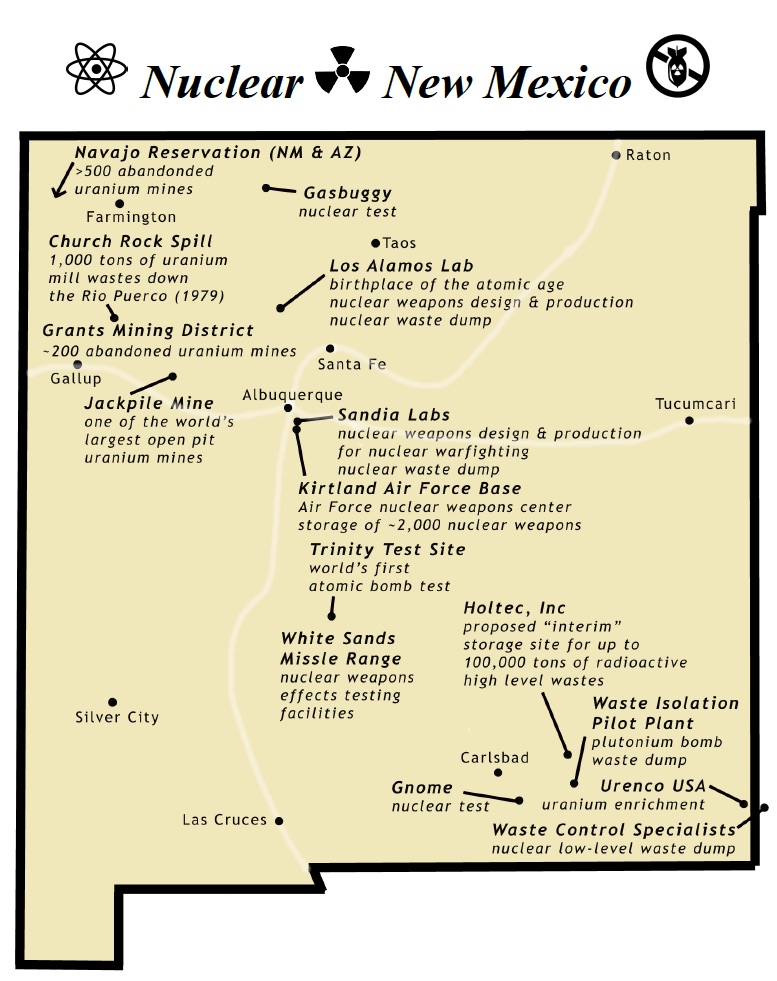
Holtec International is working with the Eddy-Lea Energy Alliance, LLC (ELEA) to apply for a license to build a Consolidated Interim Storage (CIS) facility approximately halfway between Carlsbad and Hobbs, and 16 miles north of WIPP.

The Nuclear Regulatory Commission (NRC) has declared the Holtec/ELEA application complete, NRC initiated a public comment period with 60 days for public comment. Note that transport of this waste poses risks to the environment and all life located near transportation routes.

Holtec proposal:

  • New CIS facility to store 100,000 metric tons of HLRW, with the potential to increase to 120,000 metric tons for 120 years
  • Shallow sub-surface burial system

New Mexicans and Texans are fighting the attempted licensing of these two proposed CIS facilities - Waste Control Specialists near Andrews, Texas and Eddy Lee/Holtec International east of Carlsbad, New Mexico.

These sites and any transport to these sites are not only dangerous but environmentally unjust. These sites present clear examples of environmental racism.

New Mexico's demographic is largely Latino. There are many communities of color, especially in the southern part of the state where the sites are being proposed. People of color would be disproportionately affected if the Eddy Lee/Holtec CIS site were licensed and constructed.

New Mexico and Texas do not consent to either proposed CIS facility and are fighting to avoid the environmental injustice and the unnecessary shipment of irradiated high-level nuclear waste through their communities.

NRC Environmental Report

Here's the Federal Register Notice

Consolidated Interim Storage Handout

A Better Option: Hardened On-Site Storage (HOSS)

Hardened On-Site Storage

Overview

Hardened On-Site Storage (HOSS) is a community-based concept that aims to protect the public from the threats posed by the current vulnerable storage of commercial irradiated fuel.


History

For decades, high level radioactive waste has accumulated at reactor sites and continues to do so as nuclear reactors generate more waste. Without a credible plan to permanently isolate it, storage pools, where irradiated nuclear waste is currently stored until it becomes less hot, have been tightly packed and re-racked to accommodate all the waste.

Unfortunately, the pools and dry casks have no robust containment. If the cooling pumps stopped operating or the water in the pools drained out, temperatures would quickly increase, as happened in Fukushima Japan, and could result in a similar disaster.

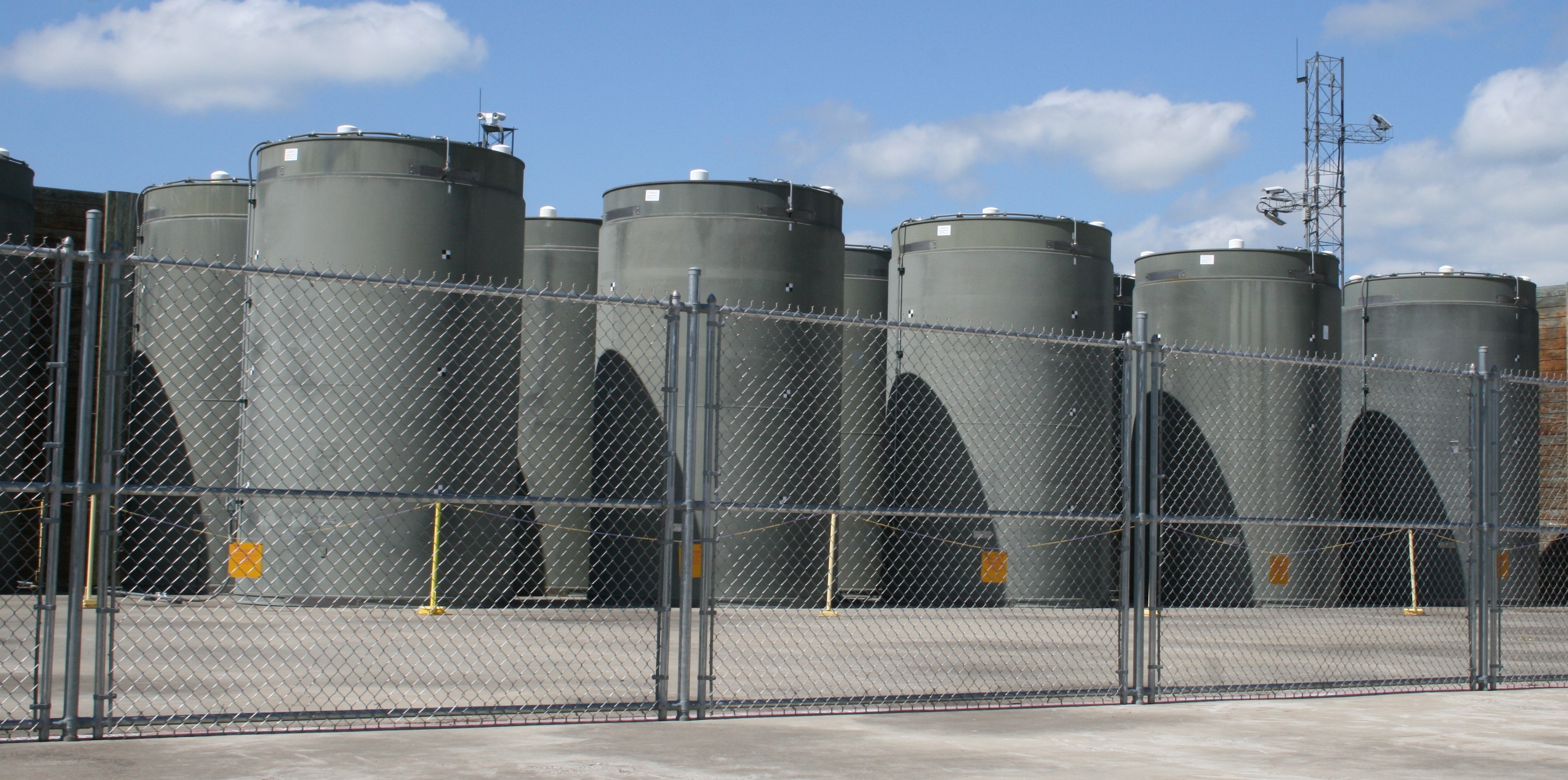
cask storage at reactor sites
Current dry cask storage at reactor sites (pictured above) is extremely vulnerable. There is often nothing more than a chain-link fence and a short distance that separates the highly radioactive waste containers and public access.

Establishing interim hardened on-site storage (HOSS) is a top priority. Hardened on-site storage allows waste generators to store high level waste as close to the site of generation as possible, thereby exposing fewer people to radiation, as safely as possible.

Rather than storing dozens of vulnerable dry-casks next to each other in the open air, the HOSS Principles established by concerned citizens mandate:

  • Irradiated fuel must be stored as safely as possible as close to the site of generation as possible;
  • HOSS facilities must not be regarded as a permanent waste solution, and thus should not be constructed underground and the waste must be retrievable;
  • The facility must have real-time radiation and heat monitoring for early detection of problems with containers;
  • The overall objective of HOSS should be that the amount of releases projected in even severe attacks should be low enough that the storage system would be unattractive as a terrorist target;
  • Placement of individual canisters that makes detection difficult from outside the site boundary.

Hardened On-Site Storage (HOSS) is supported by organizations in all 50 states. The Principles of Securing Nuclear Waste at Nuclear Reactor Sites are posted here. It would provide better security at reactor sites with robust dry storage and community oversight, including real-time monitoring of heat and radiation. HOSS is rooted in values of community protection and environmental justice and will provide increased protection from human or natural disasters, like terrorist attacks and earthquakes

HOSS facilities are not permanent waste solutions, and therefore should not be constructed deep underground as the waste must be retrievable. However, they are a workable solution that will allow us to explore scientifically sound, and socially and environmentally just long-term management systems.

Nuclear Power Has No Place in a Green Energy Future

Because of: Time Delay, Success of Renewables, Huge Costs, Dangers, Weapons Connection, and Wastes

from Yahoo News, 21 Oct 21, ”…….Practical concerns also temper enthusiasm for a nuclear future. The next generation of reactors, heralded as a game changer by supporters, still haven’t been proven in the real world. Even if those technologies are as revolutionary as advertised, skeptics say it could take decades before they make a real difference in the global energy grid — too long if the worst outcomes of climate change are to be avoided.

Renewable energy technologies can be enough on their own
“The drawbacks to nuclear are compounded by the burgeoning success of renewables — both solar and wind are getting cheaper and more efficient, year after year. There is also a growing realisation that a combination of renewables, smart storage, energy efficiency and more flexible grids can now be delivered at scale and at speed — anywhere in the world.” — Jonathon Porritt, Guardian

The world doesn’t have time to wait for next-gen nuclear
“When it comes to averting the imminent effects of climate change, even the cutting edge of nuclear technology will prove to be too little, too late. Put simply, given the economic trends in existing plants and those under construction, nuclear power cannot positively impact climate change in the next ten years or more.” — Allison Macfarlane, Foreign Affairs

A major ramp-up in nuclear technologies isn’t economically feasible
“While nuclear power may have once been cheaper than wind or solar, the economics have since changed dramatically. Nuclear power plants are very expensive to build and the economics of nuclear power are getting steadily worse. By contrast, renewables continue to come down in price.” — Ian Lowe, Conversation

There’s no way to guarantee that nuclear plants will be safe
“People around the world have witnessed the Three Mile Island, Chernobyl and Fukushima accidents. It is more than enough to believe that a safe nuclear power plant is nothing but a myth.” — Jang Daul, Korea Times

More nuclear power could lead to more nuclear weapons
“Some nations — India and Pakistan, and in all probability Israel — became nuclear powers after originally seeking nuclear technology for research or to develop nuclear power. … This is important: The technology used to turn on lights or charge mobile phones shouldn’t need to involve national or international defence apparatus.” — Editorial, Nature

Nuclear waste is still a major problem
“Nuclear waste lasts for hundreds of thousands of years before they are half-decayed. Our United States government — perhaps the longest continuous government in the world — is only 232 years old. Who will be around to manage uranium wastes?” — David Ross, Courier-Journal

Atomic Histories & Nuclear Testing

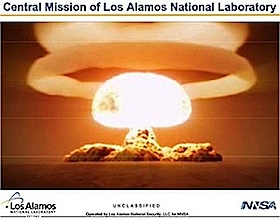
LANL’s Central Mission: Los Alamos Lab officials have recently claimed that LANL has moved away from primarily nuclear weapons to “national security”, but what truly remains as the Labs central mission? Here’s the answer from one of its own documents:

LANL’s “Central Mission”- Presented at: RPI Nuclear Data 2011 Symposium for Criticality Safety and Reactor Applications (PDF) 4/27/11

It seems we can’t find what you’re looking for. Perhaps searching can help.

NukeWatch Compilation of the DOE/NNSA FY 2020 Budget Request – VIEW

More WIPP Fallout: NNSA Cuts Los Alamos Lab’s Award Fees by 90%

FOR IMMEDIATE RELEASE December 29, 2014
Contact:  Jay Coghlan, Nuclear Watch NM, 505.989.7342, c. 505.470.3154, jay@nukewatch.org

More WIPP Fallout:
NNSA Cuts Los Alamos Lab’s Award Fees by 90%
Watchdogs Say Management Contract Should Be Put Out for Bid

Santa Fe, NM – Today, Los Alamos Lab Director Charles McMillan notified LANL employees that the National Nuclear Security Administration (NNSA) had slashed FY 2014 management award fees to $6.25 million. Seventeen million dollars were available in fixed fees, and around $40 million in incentive fees, resulting in a 90% cut to potential awards. In addition, NNSA declined to grant a previously pro forma one-year contract extension, and most remarkably rescinded a contract extension from an earlier year (see more below). As justification, the agency invoked a ““First Degree” performance failure… [that] created damage to DOE property or costs for cleaning, decontaminating, renovating, replacing or rehabilitating property that in aggregate exceed $2.5 million.”

This is more fallout from WIPP. The Los Alamos National Laboratory (LANL) used unapproved radioactive waste treatment procedures that resulted in a ruptured drum at the Waste Isolation Pilot Plant, contaminating 21 workers and indefinitely closing that multi-billion dollar facility. It will cost an estimated half-billion dollars to reopen WIPP, which will likely double. Additionally, the New Mexico Environment Department has proposed $54 million in fines against LANL and WIPP, and Congress has cut $40 million from cleanup programs at the Lab, while adding $100 million to help reopen WIPP.

LANL is managed by Los Alamos National Security, LLC (LANS), whose two main partners are the University of California (UC) and the privately held Bechtel Corporation. UC ran the Lab as a nonprofit until June 2006, and received approximately $8 million in annual compensation. In contrast, the for-profit LANS was awarded $51.9 million in FY 2013, or more than six times the old nonprofit fee, for no apparent improvement in contract management. LANL Director Charles McMillan is compensated $1.5 million annually, while also acting as president of the for-profit limited liability corporation, a possible conflict of interest.

Because of grossly substandard performance, the Project On Government Oversight and Nuclear Watch New Mexico had jointly asked the Department of Energy Secretary to cut LANS’ FY 2014 incentive fee at least in half. NNSA’s final decision far exceeds our request. Jay Coghlan, Director of Nuclear Watch New Mexico, commented, “We strongly praise NNSA for gutting LANS’ award fees. This sends an unmistakable message to contractors that they will be held accountable, which has been sorely missing to date. However, in light of LANS’ miserable performance, NNSA should take the next big step and put the management contract out to bid. NNSA and Congress should also consider whether for-profit management of the nuclear weapons complex is really in the country’s best interests, when the track record demonstrates that it’s not.”

In addition to the WIPP fiasco, another monumental failure occurred in July 2012 when three elderly protestors broke into a highly secure area, previously thought impregnable, at the Y-12 nuclear weapons plant in Oak Ridge, TN. The for-profit contractor had self-appraised its security program management as “excellent” and physical security as “good” in the preceding official “Performance Evaluation Report,” which the NNSA approved and paid for with taxpayer dollars.

Concerning LANS’ own substandard performance, LANL has been incapable of conducting major operations at its main plutonium facility since the end of June 2013 because of serious nuclear criticality safety concerns. This belies the fact that the Lab is the country’s only designated, so-called “Plutonium Center of Excellence.” Bechtel has had a particularly troubled performance history with the Department of Energy. Under Bechtel management estimated costs for the Waste Treatment Plant at the Hanford nuclear reservation soared from $3.5 billion to $13 billion, with numerous complaints of retaliation against whistleblowers.

Similarly, under Bechtel’s partnership management of the Los Alamos Lab, estimated costs for the Chemistry and Metallurgy Research Replacement Project (CMRR) mushroomed from around $600 million to $6.5 billion, leading to cancellation of the proposed “Nuclear Facility.” Lab Director McMillan now pushes for a multi-billion dollar “modular” substitute for the CMRR Nuclear Facility, whose mission would be expanded production of plutonium pits, the fissile cores of nuclear weapons. However, existing nuclear weapons don’t need expanded pit production, implying that it would be for unspecified future nuclear weapons. In any event, LANL has questionable competency to perform any plutonium pit production at all.

On a final related matter, to its credit NNSA posted the LANS FY 2014 Fee Determination Letter and Notice of Reduction. However, the agency did not post the full Performance Evaluation Report upon which they are based. Jay Coghlan commented, “NNSA’s decision to slash LANS’ fees is very welcomed, but far greater transparency is still needed. Nuclear Watch New Mexico successfully sued in the past to make full Performance Evaluation Reports publicly available. We will sue again if our current Freedom of Information Act request for the full FY 2014 Performance Evaluation Report is not soon satisfied.”

LANS received a 68% contractor performance rating for FY 2012, but was given a waiver by the NNSA fee determination officer (who soon thereafter became the NNSA Administrator). That waiver gave LANS additional taxpayer-paid fees and granted it another contract extension, when the required minimum threshold was 80%. Nuclear Watch New Mexico discovered this after litigation that obtained the full FY 2012 Performance Evaluation Report. Congress subsequently required NNSA to report any future waivers to the Armed Services and Appropriations Committees, effectively ending that practice. This does, however, demonstrate the importance of public access to NNSA’s full Performance Evaluation Reports, so that taxpayers can know that nuclear weapons contractors are being held accountable.

# # #

References:

1.   NNSA, FY 2014 Performance Evaluation Report, Fee Determination Letter, Los Alamos National Security, LLC, https://web.archive.org/web/20170128035135/https://nnsa.energy.gov/sites/default/files/nnsa/inlinefiles/FY14%20LANS%20FDO%20Letter.pdf

2.   NNSA, Contracting Officer’s Notice of Reduction of LANS FY 2014 Fixed Fee and Forfeiture of Previously Earned Award Term, https://web.archive.org/web/20170212143207/https://nnsa.energy.gov/sites/default/files/nnsa/inlinefiles/Contracting%20Officer%20Notice%20of%20Reduction%20of%20LANS%20FY14%20Fixed%20Fee%20and%20Incentive%20Fee.pdf

3.   December 3, 2014 joint POGO and Nuclear Watch NM letter to DOE Secretary Ernest Moniz urging reduced award fees for the Los Alamos Lab contractor. https://nukewatch.org/importantdocs/resources/POGO-NukeWatch-Moniz-Sandia-performance-12-19-14.pdf

4.   LANL Director Charles McMillan December 29, 2014 announcement to Lab employees:

To/MS:LANL-ALL
From/MS: Charles F. McMillan, DIR, A100
Phone/Fax:7-5101/7-2997
Symbol:DIR-14-246
Date: December 29, 2014

SUBJECT:  FY2014 NNSA PERFORMANCE REVIEW

NNSA has presented the Laboratory with our annual performance
evaluation report (PER) for FY2014. As expected the overall
results are not, with several notable exceptions, positive.

The fee for Fiscal Year 2014 was reduced to $6.25 million.  Given
the events surrounding our breached drum at WIPP and the severity
of the issue, the Laboratory received a rating of
“unsatisfactory” in operations and infrastructure and a score of
zero in that area which accounted for the significant reduction
in fee.

Although the WIPP incident weighed very heavily on our overall
evaluation from NNSA we performed well in the areas of our core
nuclear weapons work, global security, and science. This good
performance prompted written praise from NNSA Field Office
Manager Kim Davis Lebak as well as in the PER. Lebak said, “The
majority of the work performed by the Laboratory met or exceeded
NNSA expectations.”

I want to emphasize that our true value as a Laboratory should be
measured by the contributions we make to national security. This
is something we can all be very proud of. According to the PER
our nuclear weapons mission and global security mission each
“exceeded expectations.”  The PER cited many weapons program
highlights including: assisting Pantex to surpass the recovery
schedule for W76-1 production, execution of the Leda experiment
at Nevada, advances in the plutonium strategy, and excellent
progress in support of B61-12.  In global security, according to
the PER, “The Laboratory’s efforts were high impact and largely
successful, especially in the areas of Nuclear Safeguards and
Security, the Nuclear Counterterrorism Program, the Nuclear Non-
Compliance Verification Program and Non-Proliferation Research
and Development.”

Despite the challenges of fiscal uncertainty during the past
year, the Laboratory has made significant strides in many areas.
Our mission deliverables included multiple activities and studies
that increased our understanding of the U.S. nuclear deterrent.

An update to the W78 life expectancy study was delivered, along
with analyses related to the B61, W76, W78, and W88 systems.  In
the broader national security mission the Laboratory was
instrumental in supporting the removal of low-enriched uranium
from Russia, hosting the IAEA non-destructive inspector training
course, and developing USAF satellite-based treaty verification
instruments.

In addition, the PER calls out our science, technology and
engineering missions for advancing the state of research and
utilization of the exceptional scientific resources of the
Laboratory including Laboratory Directed Research and Development
(LDRD).   According to the PER, “The Laboratory has reinforced
its stature as one of the preeminent scientific institutions of
the nation.” Indeed, we pushed the boundaries of science,
technology and engineering with major feats, such as: being
chosen to develop SuperCam for the Mars 2020 mission, supplying
unique RAPTOR telescope data on the birth of a black hole,
leading the development of a “desktop” human surrogate device,
and collaboration on the characterization of the damage to the
Fukushima nuclear plant.

Operationally, despite setbacks and shortcomings, we saw progress
and momentum in key areas:
*             Safety and environmental performance are at historically
positive levels.  Injuries and days away from work due to
safety issues are lower than ever before.  The Laboratory
was named a “Star Site” of the Voluntary Protection Plan
program, the largest site in the DOE complex to earn the
star level;
*             Site-wide energy usage was reduced and water consumption
was reduced by 18 percent over last fiscal year;
*             An upgrade project for plutonium facility security was
completed and seismic and fire protection upgrades at TA-55
were completed; and
*             Significant progress was made on construction projects,
including TA-55 revitalization, the Transuranic Waste
Facility, and the Los Alamos Neutron Science Center.

To position the Laboratory to deliver on our future national
security missions we made significant progress with NNSA on
plutonium strategy including the “modular” approach to
infrastructure that will reduce risk associated with the
construction of targeted facilities while meeting mission needs,
safety and security, and regulatory requirements.  We also
awarded a contract to Cray Inc. to build the next-generation
supercomputer, Trinity.  Trinity will play a key role in
assessing future issues, both known and unknown, in the U.S.
nuclear deterrent.

Although this was a very tough year for the Laboratory I am
optimistic that next year will be better. I am determined to do
all that I can to make it so. My personal priorities will be to
continue to make progress on getting PF-4 fully restarted,
continuing collaboration with DOE on an effective and efficient
transition of the Environmental Management program scope, and
enhancing our management and leadership capabilities by filling
key vacancies and correcting operational deficiencies.

I would like to personally thank each of you for the hard work
and wish you and your family members a safe and happy holiday
season. Enjoy your well-deserved break and come back in the New
Year rededicated to serving the national security needs of this
country.

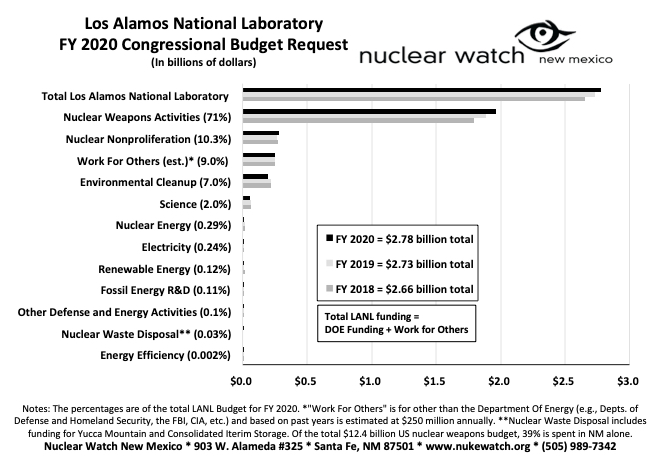
LANL FY 2020 Budget Request – VIEW

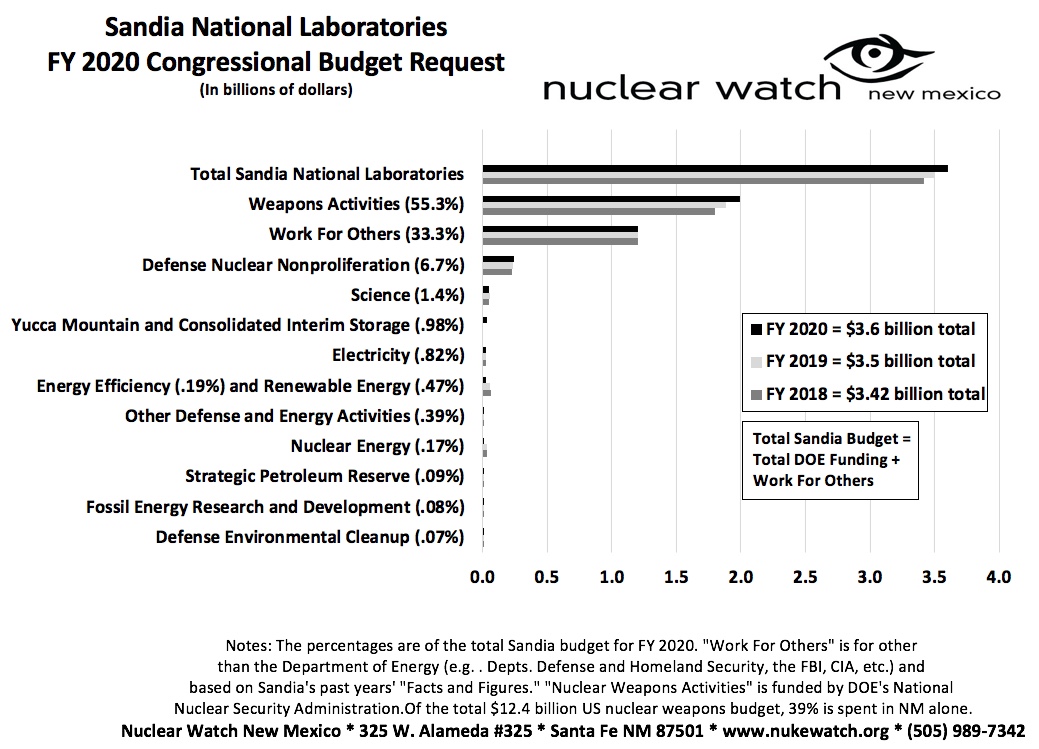
Sandia FY 2020 Budget Request – VIEW

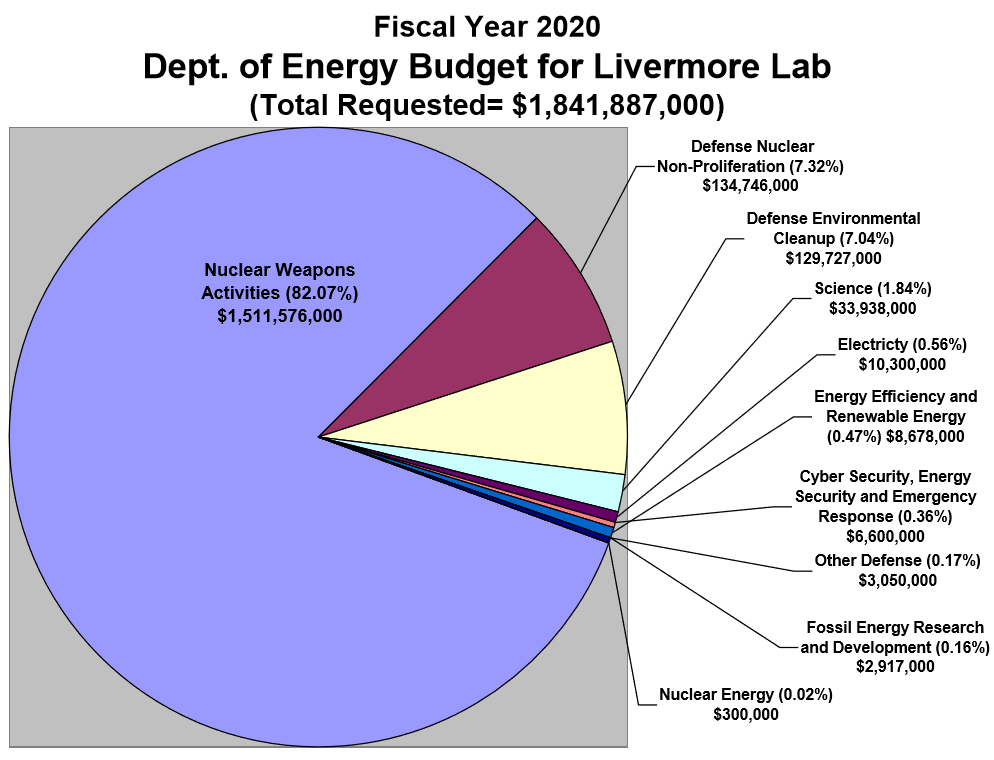
Livermore Lab FY 2020 Budget Chart – Courtesy TriValley CAREs – VIEW

Updates

It seems we can’t find what you’re looking for. Perhaps searching can help.

________________________________

Click the image to view and download this large printable map of DOE sites, commercial reactors, nuclear waste dumps, nuclear transportation routes, surface waters near sites and transport routes, and underlying aquifers. This map was prepared by Deborah Reade for the Alliance for Nuclear Accountability.

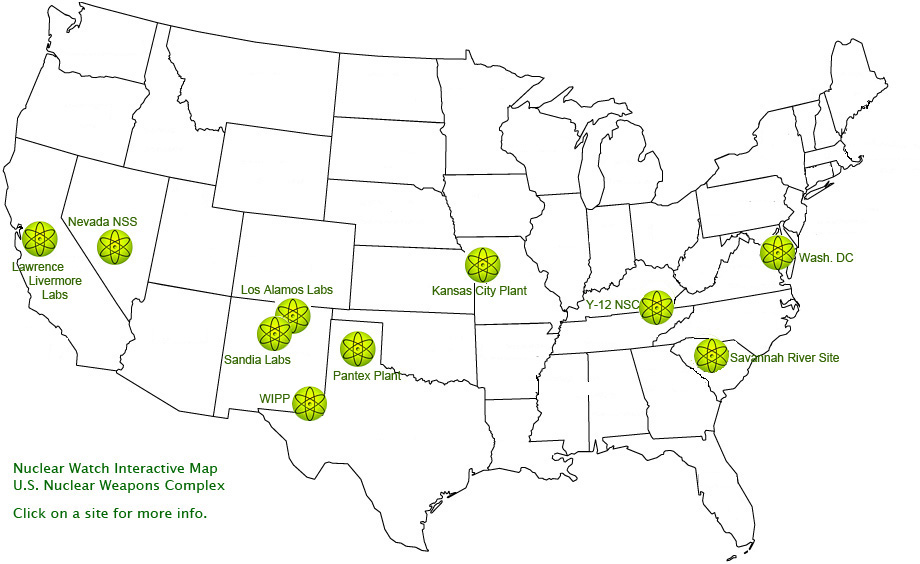
Nuclear Watch Interactive Map – U.S. Nuclear Weapons Complex

Waste Lands: America’s Forgotten Nuclear Legacy

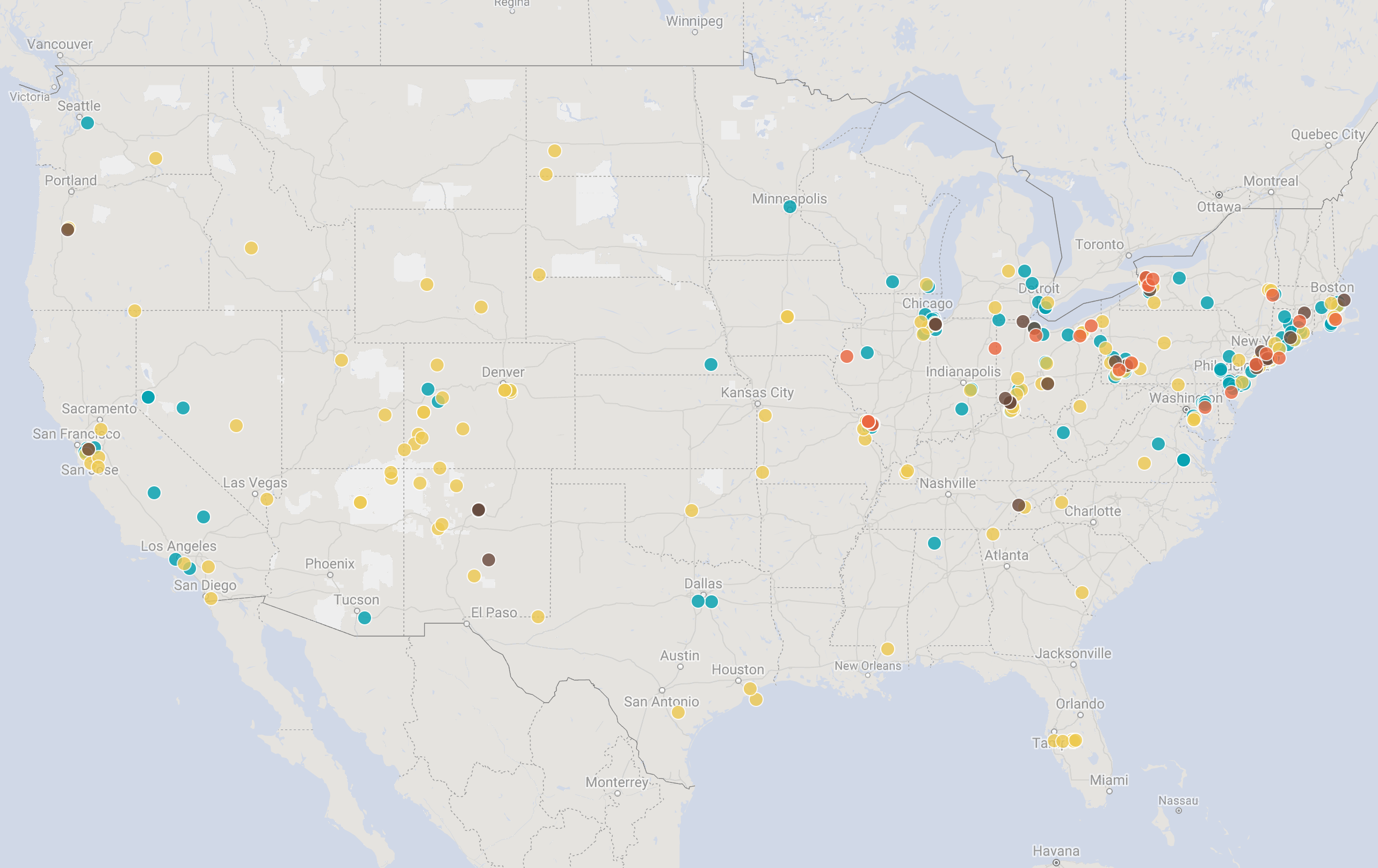
The Wall St. Journal has compiled a searchable database of contaminated sites across the US. (view)
Related WSJ report: https://www.wsj.com

Atomic Histories & Nuclear Testing

NukeWatch Compilation of the DOE/NNSA FY 2020 Budget Request – VIEW

More WIPP Fallout: NNSA Cuts Los Alamos Lab’s Award Fees by 90%

FOR IMMEDIATE RELEASE December 29, 2014
Contact:  Jay Coghlan, Nuclear Watch NM, 505.989.7342, c. 505.470.3154, jay@nukewatch.org

More WIPP Fallout:
NNSA Cuts Los Alamos Lab’s Award Fees by 90%
Watchdogs Say Management Contract Should Be Put Out for Bid

Santa Fe, NM – Today, Los Alamos Lab Director Charles McMillan notified LANL employees that the National Nuclear Security Administration (NNSA) had slashed FY 2014 management award fees to $6.25 million. Seventeen million dollars were available in fixed fees, and around $40 million in incentive fees, resulting in a 90% cut to potential awards. In addition, NNSA declined to grant a previously pro forma one-year contract extension, and most remarkably rescinded a contract extension from an earlier year (see more below). As justification, the agency invoked a ““First Degree” performance failure… [that] created damage to DOE property or costs for cleaning, decontaminating, renovating, replacing or rehabilitating property that in aggregate exceed $2.5 million.”

This is more fallout from WIPP. The Los Alamos National Laboratory (LANL) used unapproved radioactive waste treatment procedures that resulted in a ruptured drum at the Waste Isolation Pilot Plant, contaminating 21 workers and indefinitely closing that multi-billion dollar facility. It will cost an estimated half-billion dollars to reopen WIPP, which will likely double. Additionally, the New Mexico Environment Department has proposed $54 million in fines against LANL and WIPP, and Congress has cut $40 million from cleanup programs at the Lab, while adding $100 million to help reopen WIPP.

LANL is managed by Los Alamos National Security, LLC (LANS), whose two main partners are the University of California (UC) and the privately held Bechtel Corporation. UC ran the Lab as a nonprofit until June 2006, and received approximately $8 million in annual compensation. In contrast, the for-profit LANS was awarded $51.9 million in FY 2013, or more than six times the old nonprofit fee, for no apparent improvement in contract management. LANL Director Charles McMillan is compensated $1.5 million annually, while also acting as president of the for-profit limited liability corporation, a possible conflict of interest.

Because of grossly substandard performance, the Project On Government Oversight and Nuclear Watch New Mexico had jointly asked the Department of Energy Secretary to cut LANS’ FY 2014 incentive fee at least in half. NNSA’s final decision far exceeds our request. Jay Coghlan, Director of Nuclear Watch New Mexico, commented, “We strongly praise NNSA for gutting LANS’ award fees. This sends an unmistakable message to contractors that they will be held accountable, which has been sorely missing to date. However, in light of LANS’ miserable performance, NNSA should take the next big step and put the management contract out to bid. NNSA and Congress should also consider whether for-profit management of the nuclear weapons complex is really in the country’s best interests, when the track record demonstrates that it’s not.”

In addition to the WIPP fiasco, another monumental failure occurred in July 2012 when three elderly protestors broke into a highly secure area, previously thought impregnable, at the Y-12 nuclear weapons plant in Oak Ridge, TN. The for-profit contractor had self-appraised its security program management as “excellent” and physical security as “good” in the preceding official “Performance Evaluation Report,” which the NNSA approved and paid for with taxpayer dollars.

Concerning LANS’ own substandard performance, LANL has been incapable of conducting major operations at its main plutonium facility since the end of June 2013 because of serious nuclear criticality safety concerns. This belies the fact that the Lab is the country’s only designated, so-called “Plutonium Center of Excellence.” Bechtel has had a particularly troubled performance history with the Department of Energy. Under Bechtel management estimated costs for the Waste Treatment Plant at the Hanford nuclear reservation soared from $3.5 billion to $13 billion, with numerous complaints of retaliation against whistleblowers.

Similarly, under Bechtel’s partnership management of the Los Alamos Lab, estimated costs for the Chemistry and Metallurgy Research Replacement Project (CMRR) mushroomed from around $600 million to $6.5 billion, leading to cancellation of the proposed “Nuclear Facility.” Lab Director McMillan now pushes for a multi-billion dollar “modular” substitute for the CMRR Nuclear Facility, whose mission would be expanded production of plutonium pits, the fissile cores of nuclear weapons. However, existing nuclear weapons don’t need expanded pit production, implying that it would be for unspecified future nuclear weapons. In any event, LANL has questionable competency to perform any plutonium pit production at all.

On a final related matter, to its credit NNSA posted the LANS FY 2014 Fee Determination Letter and Notice of Reduction. However, the agency did not post the full Performance Evaluation Report upon which they are based. Jay Coghlan commented, “NNSA’s decision to slash LANS’ fees is very welcomed, but far greater transparency is still needed. Nuclear Watch New Mexico successfully sued in the past to make full Performance Evaluation Reports publicly available. We will sue again if our current Freedom of Information Act request for the full FY 2014 Performance Evaluation Report is not soon satisfied.”

LANS received a 68% contractor performance rating for FY 2012, but was given a waiver by the NNSA fee determination officer (who soon thereafter became the NNSA Administrator). That waiver gave LANS additional taxpayer-paid fees and granted it another contract extension, when the required minimum threshold was 80%. Nuclear Watch New Mexico discovered this after litigation that obtained the full FY 2012 Performance Evaluation Report. Congress subsequently required NNSA to report any future waivers to the Armed Services and Appropriations Committees, effectively ending that practice. This does, however, demonstrate the importance of public access to NNSA’s full Performance Evaluation Reports, so that taxpayers can know that nuclear weapons contractors are being held accountable.

# # #

References:

1.   NNSA, FY 2014 Performance Evaluation Report, Fee Determination Letter, Los Alamos National Security, LLC, https://web.archive.org/web/20170128035135/https://nnsa.energy.gov/sites/default/files/nnsa/inlinefiles/FY14%20LANS%20FDO%20Letter.pdf

2.   NNSA, Contracting Officer’s Notice of Reduction of LANS FY 2014 Fixed Fee and Forfeiture of Previously Earned Award Term, https://web.archive.org/web/20170212143207/https://nnsa.energy.gov/sites/default/files/nnsa/inlinefiles/Contracting%20Officer%20Notice%20of%20Reduction%20of%20LANS%20FY14%20Fixed%20Fee%20and%20Incentive%20Fee.pdf

3.   December 3, 2014 joint POGO and Nuclear Watch NM letter to DOE Secretary Ernest Moniz urging reduced award fees for the Los Alamos Lab contractor. https://nukewatch.org/importantdocs/resources/POGO-NukeWatch-Moniz-Sandia-performance-12-19-14.pdf

4.   LANL Director Charles McMillan December 29, 2014 announcement to Lab employees:

To/MS:LANL-ALL
From/MS: Charles F. McMillan, DIR, A100
Phone/Fax:7-5101/7-2997
Symbol:DIR-14-246
Date: December 29, 2014

SUBJECT:  FY2014 NNSA PERFORMANCE REVIEW

NNSA has presented the Laboratory with our annual performance
evaluation report (PER) for FY2014. As expected the overall
results are not, with several notable exceptions, positive.

The fee for Fiscal Year 2014 was reduced to $6.25 million.  Given
the events surrounding our breached drum at WIPP and the severity
of the issue, the Laboratory received a rating of
“unsatisfactory” in operations and infrastructure and a score of
zero in that area which accounted for the significant reduction
in fee.

Although the WIPP incident weighed very heavily on our overall
evaluation from NNSA we performed well in the areas of our core
nuclear weapons work, global security, and science. This good
performance prompted written praise from NNSA Field Office
Manager Kim Davis Lebak as well as in the PER. Lebak said, “The
majority of the work performed by the Laboratory met or exceeded
NNSA expectations.”

I want to emphasize that our true value as a Laboratory should be
measured by the contributions we make to national security. This
is something we can all be very proud of. According to the PER
our nuclear weapons mission and global security mission each
“exceeded expectations.”  The PER cited many weapons program
highlights including: assisting Pantex to surpass the recovery
schedule for W76-1 production, execution of the Leda experiment
at Nevada, advances in the plutonium strategy, and excellent
progress in support of B61-12.  In global security, according to
the PER, “The Laboratory’s efforts were high impact and largely
successful, especially in the areas of Nuclear Safeguards and
Security, the Nuclear Counterterrorism Program, the Nuclear Non-
Compliance Verification Program and Non-Proliferation Research
and Development.”

Despite the challenges of fiscal uncertainty during the past
year, the Laboratory has made significant strides in many areas.
Our mission deliverables included multiple activities and studies
that increased our understanding of the U.S. nuclear deterrent.

An update to the W78 life expectancy study was delivered, along
with analyses related to the B61, W76, W78, and W88 systems.  In
the broader national security mission the Laboratory was
instrumental in supporting the removal of low-enriched uranium
from Russia, hosting the IAEA non-destructive inspector training
course, and developing USAF satellite-based treaty verification
instruments.

In addition, the PER calls out our science, technology and
engineering missions for advancing the state of research and
utilization of the exceptional scientific resources of the
Laboratory including Laboratory Directed Research and Development
(LDRD).   According to the PER, “The Laboratory has reinforced
its stature as one of the preeminent scientific institutions of
the nation.” Indeed, we pushed the boundaries of science,
technology and engineering with major feats, such as: being
chosen to develop SuperCam for the Mars 2020 mission, supplying
unique RAPTOR telescope data on the birth of a black hole,
leading the development of a “desktop” human surrogate device,
and collaboration on the characterization of the damage to the
Fukushima nuclear plant.

Operationally, despite setbacks and shortcomings, we saw progress
and momentum in key areas:
*             Safety and environmental performance are at historically
positive levels.  Injuries and days away from work due to
safety issues are lower than ever before.  The Laboratory
was named a “Star Site” of the Voluntary Protection Plan
program, the largest site in the DOE complex to earn the
star level;
*             Site-wide energy usage was reduced and water consumption
was reduced by 18 percent over last fiscal year;
*             An upgrade project for plutonium facility security was
completed and seismic and fire protection upgrades at TA-55
were completed; and
*             Significant progress was made on construction projects,
including TA-55 revitalization, the Transuranic Waste
Facility, and the Los Alamos Neutron Science Center.

To position the Laboratory to deliver on our future national
security missions we made significant progress with NNSA on
plutonium strategy including the “modular” approach to
infrastructure that will reduce risk associated with the
construction of targeted facilities while meeting mission needs,
safety and security, and regulatory requirements.  We also
awarded a contract to Cray Inc. to build the next-generation
supercomputer, Trinity.  Trinity will play a key role in
assessing future issues, both known and unknown, in the U.S.
nuclear deterrent.

Although this was a very tough year for the Laboratory I am
optimistic that next year will be better. I am determined to do
all that I can to make it so. My personal priorities will be to
continue to make progress on getting PF-4 fully restarted,
continuing collaboration with DOE on an effective and efficient
transition of the Environmental Management program scope, and
enhancing our management and leadership capabilities by filling
key vacancies and correcting operational deficiencies.

I would like to personally thank each of you for the hard work
and wish you and your family members a safe and happy holiday
season. Enjoy your well-deserved break and come back in the New
Year rededicated to serving the national security needs of this
country.
LANL FY 2020 Budget Request – VIEW

Sandia FY 2020 Budget Request – VIEW

Livermore Lab FY 2020 Budget Chart – Courtesy TriValley CAREs – VIEW

NUCLEAR POWER

Important Documents & Articles Related to Nuclear Energy Production

Most Recent

It seems we can’t find what you’re looking for. Perhaps searching can help.

Nuclear Watch Interactive Map – U.S. Nuclear Weapons Complex

Waste Lands: America’s Forgotten Nuclear Legacy

The Wall St. Journal has compiled a searchable database of contaminated sites across the US. (view)
Related WSJ report: https://www.wsj.com

LANL’s Central Mission: Los Alamos Lab officials have recently claimed that LANL has moved away from primarily nuclear weapons to “national security”, but what truly remains as the Labs central mission? Here’s the answer from one of its own documents:

LANL’s “Central Mission”- Presented at: RPI Nuclear Data 2011 Symposium for Criticality Safety and Reactor Applications (PDF) 4/27/11