
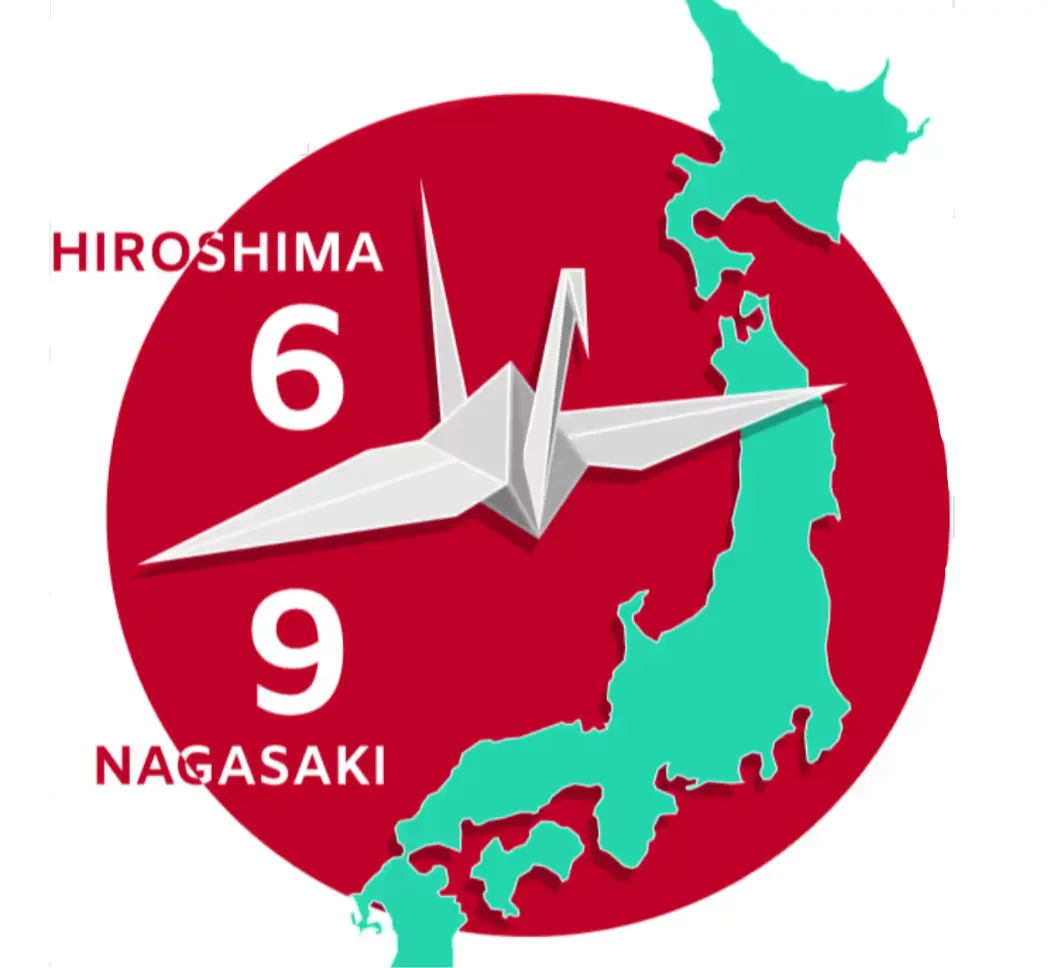
Recommended Reading: John Hersey and the horrors of Hiroshima
The American journalist’s account of the Hiroshima bombing and its aftermath, told through the eyes of Japanese survivors, forced the world to reckon with the terrifying power of nuclear weapons.
Iain MacGregor August 5, 2026 engelsbergideas.com
The New START treaty – enforced since 2011 and the last remaining arms‑control agreement between the United States and Russia – expired in February 2026 with nothing to replace it. The final legal barrier limiting the world’s two largest nuclear arsenals was removed, ushering in what analysts describe as a period of Great Power uncertainty. China, meanwhile, is rapidly expanding and modernising its nuclear forces, with its stockpile more than doubling in just five years and further growth expected throughout the decade.
In the Middle East, the erosion of nuclear restraint has accelerated sharply. Recent US-Israeli attacks have pushed Iran closer than ever to abandoning the Nuclear Non‑Proliferation Treaty (NPT): Tehran still possesses enough enriched uranium to place it within short technical reach of multiple nuclear warheads, while senior political and security figures openly debate withdrawal from the NPT as a defensive necessity rather than a diplomatic taboo. The precedent – of a major regional power crossing the nuclear threshold outside any arms‑control framework – would reverberate far beyond the region.
North Korea, emboldened by global fragmentation, insists that its arsenal is ‘irreversible’. Across Europe and Asia, public opinion in countries such as Poland, Turkey and South Korea is shifting toward domestic nuclear capability as confidence in US security guarantees becomes frayed. The precarious equilibrium of the non‑proliferation era is cracking just when the living memory of the bomb’s human cost has never been more vital.
In such a landscape, the work of remembering what nuclear weapons do – not in theory, but to human bodies and cities – becomes urgent again. Eighty years ago, one American writer succeeded in forcing the world to confront this reality. His name was John Hersey, and the story he told in August 1946 in the New Yorker magazine, about the world’s first nuclear strike against the Japanese port city of Hiroshima the previous year, remains one of the clearest moral documents of the atomic age…
Ian MacGregor outlines precisely above the current state and reality of the new nuclear arms race we are now in, more dangerous than the first.
“Rationality will not save us… this is very important: at the end we lucked out. It was luck that prevented nuclear war.” Robert McNamara
• All weapons states are “modernizing” and keeping their nuclear weapons indefinitely, contrary to the 1970 NonProliferation Treaty.
• There are multiple nuclear weapons powers with competing interests.
• There is increased chance of regional nuclear wars (e.g., India-Pakistan).
• Artificial intelligence could sideline human judgement in the command and control of nuclear weapons.
The US “modernizing” every leg of the triad in its nuclear weapons arsenal means Nuclear Weapons Forever. It’s a $2 trillion endeavor to rebuild nuclear warheads extended for decades with new military capabilities, design and build completely new-design nuclear weapons, build new ICBMs, new cruise missiles, heavy stealth bombers and strategic submarines, and construct new nuclear weapons production facilities expected to be operational until 2080.
Meanwhile, taxes are cut for the ultrarich, homelessness explodes and health care is drastically cut. How is this national security?
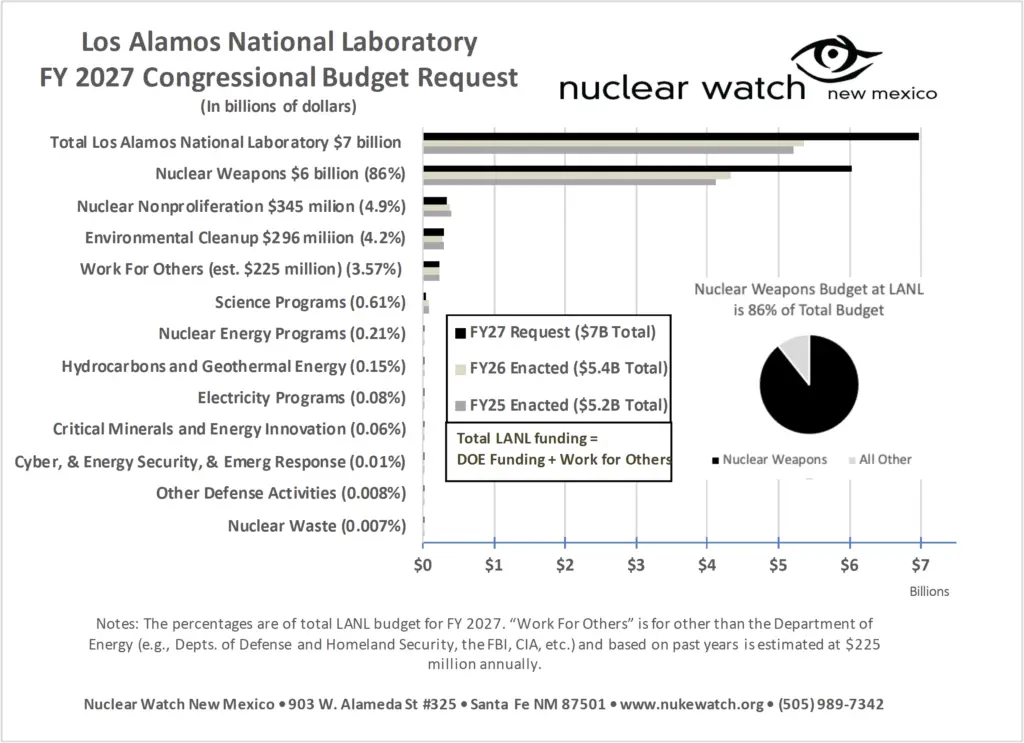
This October 1st, Los Alamos Lab will receive a $1 billion increase in budget for nuclear weapons programs alone. Everything else is being cut. Non-proliferation budget is staying flat, cleanup’s being cut, renewable energy is just completely gone. 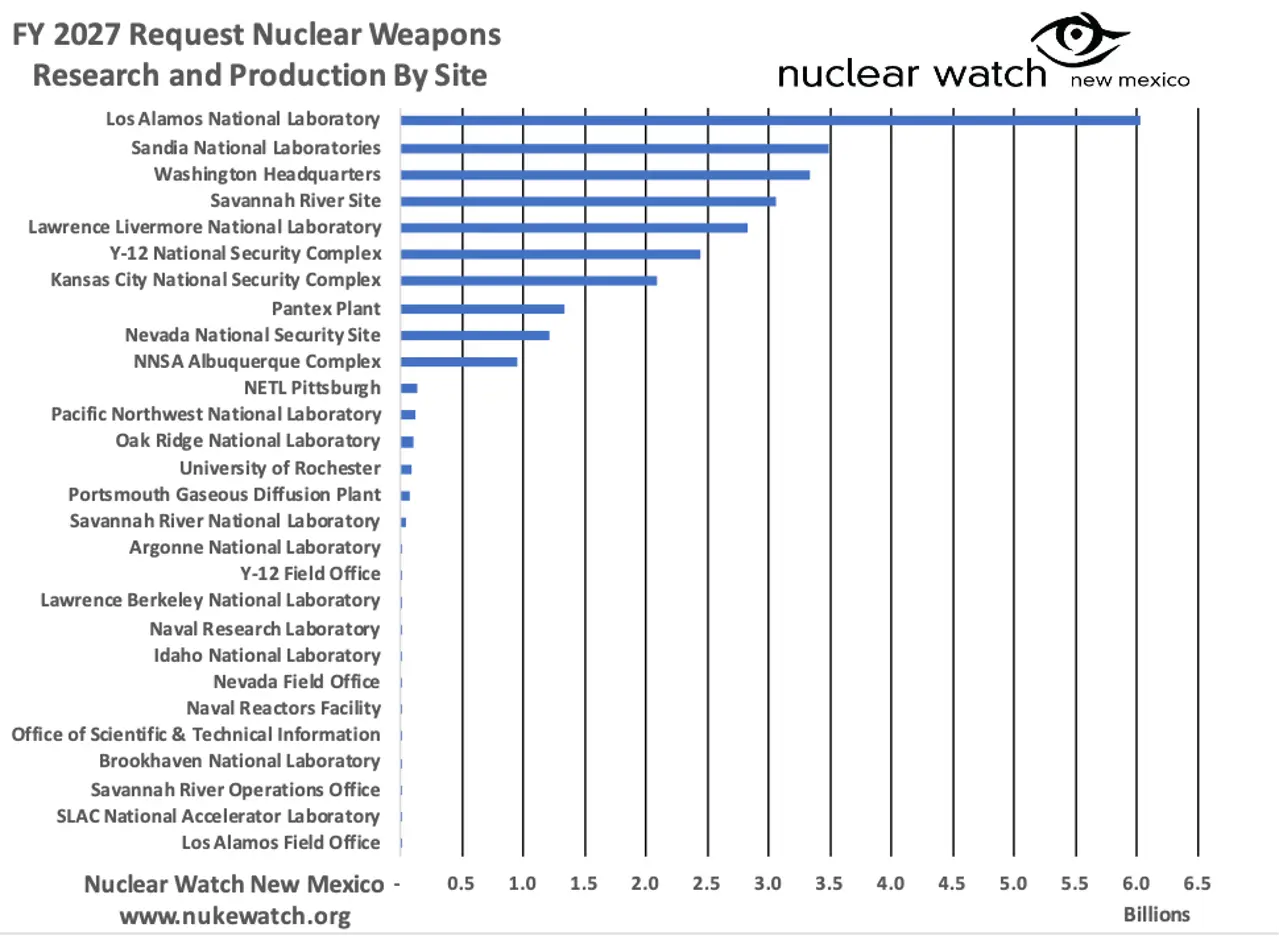
Concerning all the other sites in the DOE nuclear weapons complex, Los Alamos is almost double the next. The next site with the most money is Sandia, also in our very own state (Sandia is also in California, but this shows the key position that the land of enchantment plays).
The push for “modernization” of the US’s nuclear arsenal is directly linked to plutonium pit production at Los Alamos, specifically expanding plutonium pit production. Plutonium “pits” are the radioactive fissile cores of nuclear weapons. New plutonium pits are not needed to maintain the existing stockpile – it is all for future, new designs. And these new weapons cannot be tested because of the testing moratorium – or conversely could pressure the US to resume testing. In 2006, independent experts have concluded pits last at least 85 years (their average age is now 43). There is no estimated expiration date. There are at least 15,000 existing pits at NNSA’s Pantex Plant in Texas. All of this planned future pit production is exorbitantly expensive, yet the National Nuclear Security Administration still has no credible cost estimate for this >$60 billion program.
The one-word rationale for nuclear weapons is always “a safe, secure and effective nuclear deterrent…” But the Pentagon rejects “minimal deterrence” while “reiterating the need to maintain counterforce capabilities.” Moreover, the U.S. and Russia have always rejected minimal deterrence in favor of nuclear warfighting capabilities that could end civilization overnight. That is why we have 1,000s of nuclear weapons and are funneling billions of dollars into mass death machines, even though everybody knows that a nuclear war must never be fought and can never be won. Deterrence relies upon the flawed assumption that all actors will behave rationally, and that accidents or miscalculations will never occur. History says otherwise; “deterrence” has already been fraught by accidents and miscalculations. Nuclear warfighting capabilities are driving so-called “modernization,” particularly plutonium pit production.
See more on the myth of deterrence here:
Deterrence is the Threat: NukeWatch Presentation for Western New Mexico University – April 1, 2025
There is a Legal Mandate to Disarm.
- The National Nuclear Security Administration is required by Congress to produce plutonium “pit” bomb cores.
- However, the U.S. Constitution declares that “all Treaties made… shall be the supreme Law of the Land.” (Article 6)
- The 1970 NonProliferation Treaty (NPT) required “negotiations in good faith on effective measures relating to cessation of the nuclear arms race at an early date and to nuclear disarmament…”
- The recent NPT Review Conference failed for the third consecutive time to make any progress whatsoever toward nuclear disarmament.
- The failure to ever honor the NPT led to the Treaty on the Prohibition of Nuclear Weapons, similar to chemical and biological weapons bans.
- We will be at the TPNW Review Conference at the UN in December 2026!
What to do Now?
What is NNSA hiding? NNSA is covering up three crucial documents despite congressional and public Freedom of Information Act requests:
- A new independent pit life study that could counter NNSA’s claims that aging drives the need for new production.
- A critical “Special Study” on NNSA leadership and management of its troubled plutonium pit production program.
- A new LANL “Probabilistic Seismic Hazard Analysis” that was already nearly a decade overdue.
We just filed suit against DOE on item #2:
Nuclear Watchdog Sues for Plutonium Pit Production “Special Study”
And we’re working hard on getting the others released as well, through more lawsuits if we need to.
What can you do now?
Be active! Good change does not come by itself.
- The Pit Production PEIS sprung from successful citizen litigation. Public comment is important and can build the case for more litigation. Send comments now from this very room!
- Actively support NMED in LANL cleanup and WIPP permit modification. This is especially important with new Governor.
- Keep your eyes on the prize! We can win a world without nuclear weapons if we remain determined.
Recommended reading: Daniel Ellsberg’s The Doomsday Machine; Archbishop John Wester’s pastoral letter A Conversation Toward Nuclear Disarmament