
UPF Lawsuit

Atomic Histories & Nuclear Testing

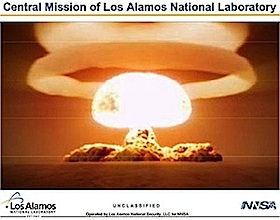
LANL’s Central Mission: Los Alamos Lab officials have recently claimed that LANL has moved away from primarily nuclear weapons to “national security”, but what truly remains as the Labs central mission? Here’s the answer from one of its own documents:

LANL’s “Central Mission”- Presented at: RPI Nuclear Data 2011 Symposium for Criticality Safety and Reactor Applications (PDF) 4/27/11

Plaintiffs Demand Release of Critical Documents and Extension of Public Comment Period on Expanded Plutonium Bomb Core Production

FOR IMMEDIATE RELEASE, July 6, 2026

Contact: Jay Coghlan, Nuclear Watch New Mexico, 505.989.7342, c. 505.470.3154 | Email
Scott Yundt, Tri-Valley CAREs, 925.443.7148 | Email

Georgetown, SC — Today the South Carolina Environmental Law Project (SCELP) notified the Department of Energy’s semi-autonomous nuclear weapons agency, the National Nuclear Security Administration (NNSA), that it must publicly release three critical documents. At issue is the fact that NNSA is withholding important information from American taxpayers during a public comment period for a Pit Production Programmatic Environmental Impact Statement (PEIS).[1] The public comment period ends this July 16 (ironically the 81st anniversary of the Trinity Test of the first plutonium pit).

Plutonium “pits” are the radioactive fissile cores or “triggers” of nuclear weapons. None of NNSA’s future pit production is to maintain the safety and reliability of the existing nuclear weapons stockpile. Instead, it is all for new-design nuclear weapons that could prompt the U.S. to return to testing and accelerate the new arms race.

SCELP, representing the nonprofit organizations Savannah River Site Watch, Tri-Valley CAREs and Nuclear Watch New Mexico, sued NNSA to force it to comply with the National Environmental Policy Act. This resulted in a federal judge finding NNSA violated NEPA and the agency ultimately agreeing to complete a Pit Production PEIS. Now it appears that NNSA is cherry-picking information to support its aggressive agenda of expanded plutonium pit production and suppressing negative information that could work against it.

The three documents that SCELP is demanding are:

  1. A new plutonium pit life study by independent scientists known as the JASONs. NNSA claims that potential aging effects drive the need for the immediate production of new pits, thereby ruling out the alternative of reusing some 15,000 existing pits. In contrast, a 2006 JASON pit life study concluded that most pit types have reliable lives of more than 100 years and those that don’t have relatively easy fixes[2] (the average pit age is now ~43). We believe that NNSA has been withholding an unclassified summary of the new JASON pit life study since the end of 2025. NNSA has not released it despite requests by Members of Congress and public Freedom of Information Act requests.
  2. A Department of Energy “Special Study” on NNSA leadership and management of its troubled plutonium pit production program, scheduled for completion in December 2025.[3] That Study is expected to be critical of the new pit production plant at the Savannah River Site (SRS) in South Carolina, which will be the most expensive building in US history ($30 billion-plus). DOE has not released this Special Study despite requests by Members of Congress and public Freedom of Information Act requests.
  3. A new “Probabilistic Seismic Hazard Analysis” (PSHA) for the Los Alamos National Laboratory (LANL) that is nearly a decade overdue.[4] A 2007 LANL seismic analysis prompted badly needed seismic upgrades to the Lab’s plutonium pit production facility. NNSA’s April 2026 draft Pit Production PEIS stated that the new PSHA would be completed in early 2026,[5] yet it is still not available for public comment.

Continue reading

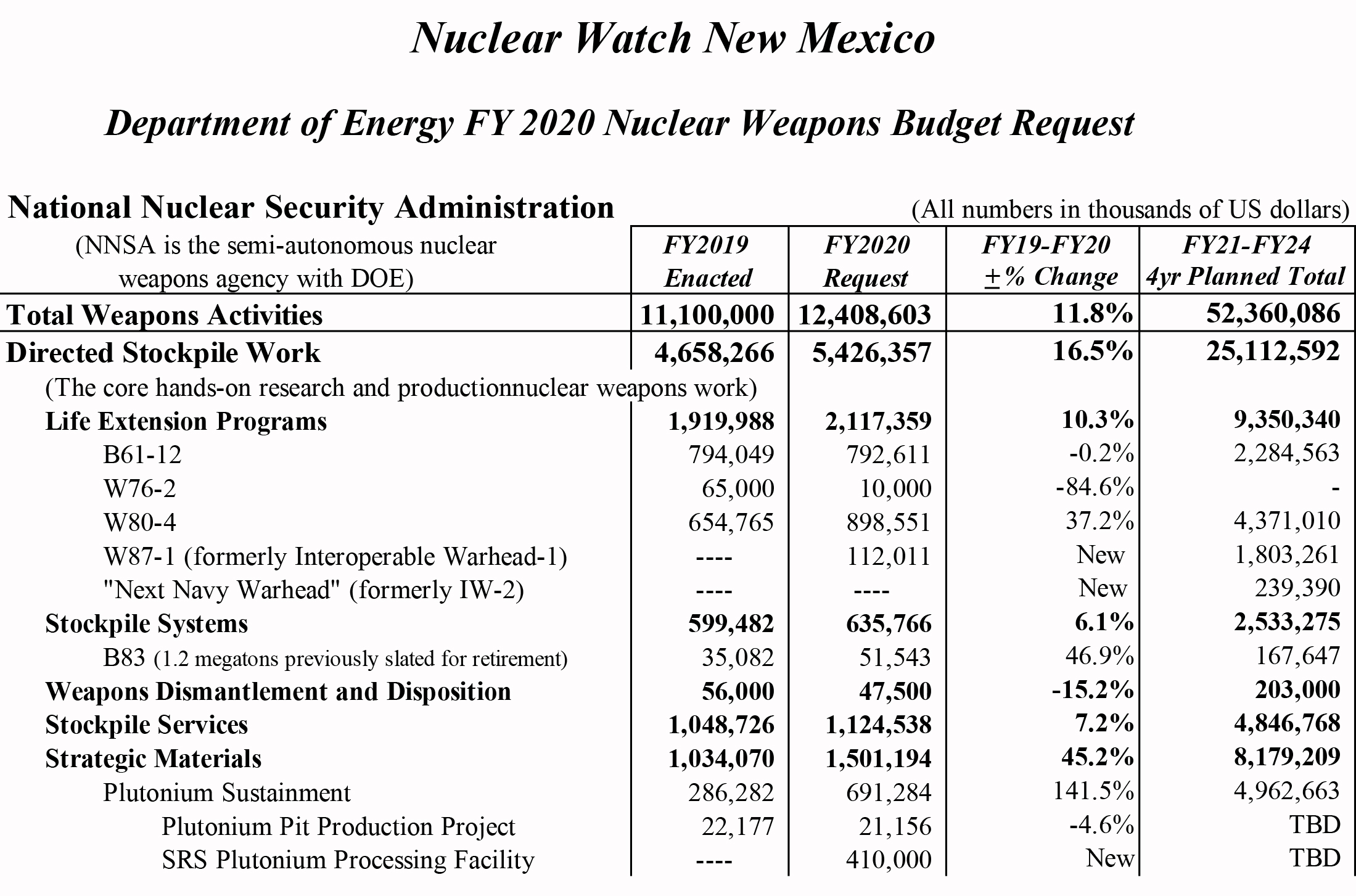
NukeWatch Compilation of the DOE/NNSA FY 2020 Budget Request – VIEW

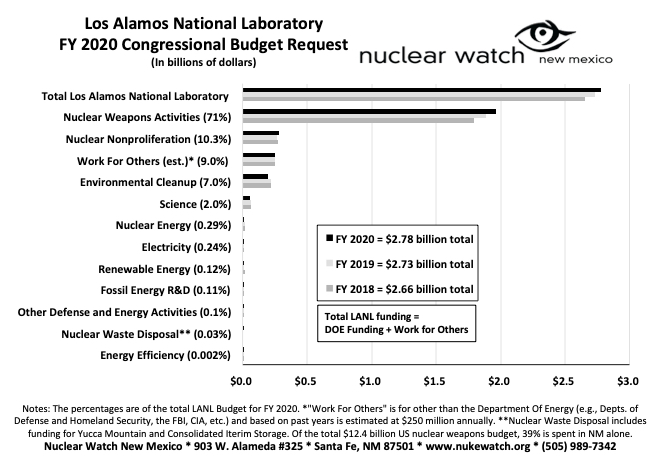
LANL FY 2020 Budget Request – VIEW

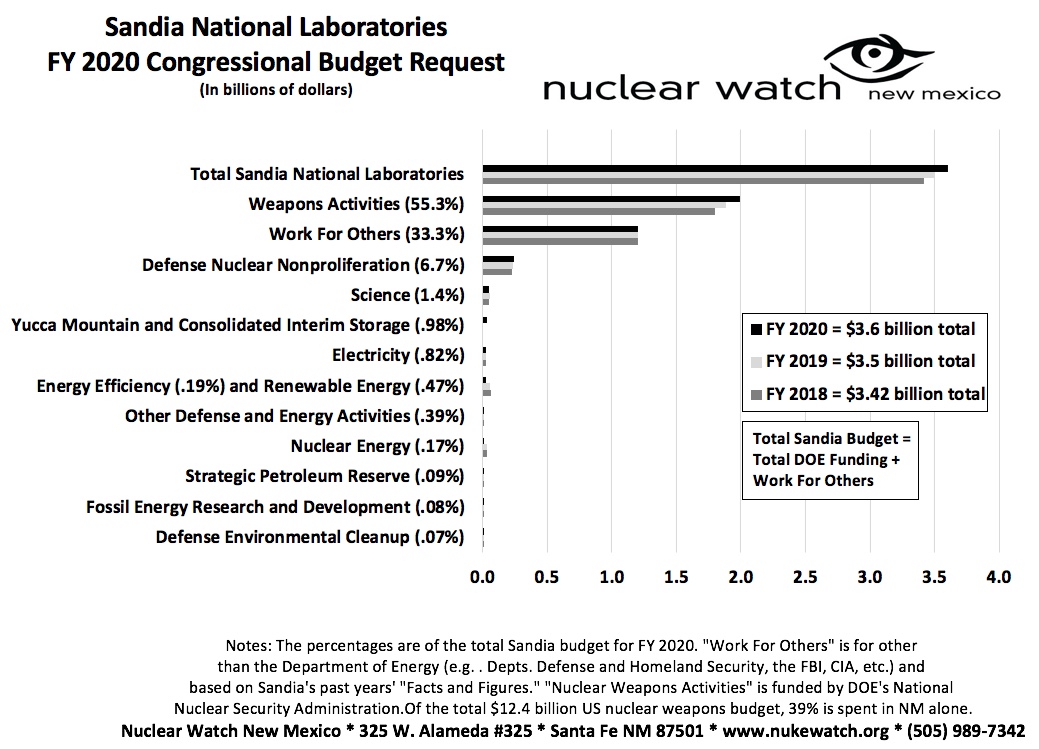
Sandia FY 2020 Budget Request – VIEW

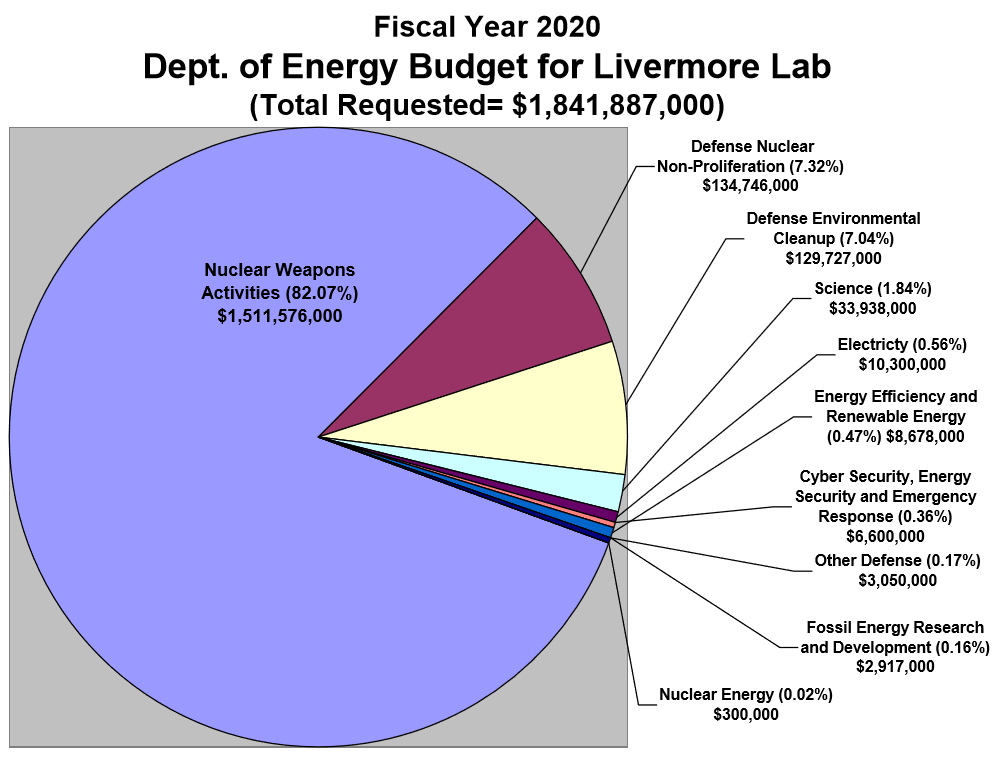
Livermore Lab FY 2020 Budget Chart – Courtesy TriValley CAREs – VIEW

UPF Lawsuit Documents & Resources

Memo from David Jackson on Seismic Risks at UPF

"I have reviewed the relevant documents associated with NNSA’s analysis of seismic risks at the Y-12 National Security Complex, and I find the agency’s analysis to be badly lacking. In my expert opinion, NNSA’s review is not a scientifically based review of seismic risks."

Memo from Robert Alvarez on Inadequacy of Existing DOE/NNSA UPF & Y-12 Site Analyses

"In my expert opinion, the NNSA's current methodology for reviewing the environmental impacts of its modernization of the Y -12 National Security Complex falls far short of what is logically or legally required, in large part because the NNSA is failing to consider its actions as a unified whole."


2019


 Reply to Government RE: Motion to Enforce November 2019

 Government’s Response to Motion to Enforce


 Motion to Enforce October 2019


 NNSA Amended Record of Decision, Oct 2019


Ruling of Judge Pamela Reeves in legal challenge to UPF bomb plant


Response to Government Motion for Summary Judgement and Reply


Exhibit RE: Earthquake Activity


Motion for Summary Judgment


Memo in Support of Motion for Summary Judgment


2017


September 2017

 Answer to Complaint for Relief


September 28, 2017

 Motion to Transfer Venue


September 28. 2017

 Memo Supporting Change of Venue Motion


September 28. 2017

 Declaration by Geoffrey Beausoleil

[embeddoc url="https://nukewatch.org/wp-content/uploads/2020/02/UPF-Fact-sheet-6.17.pdf" download="all" viewer="google"]