

“Scoping” means determining the issues that should be included in public analyses required by the National Environmental Policy Act (NEPA) of proposed major actions by the federal government. According to the Department of Energy ‘s own NEPA implementation regulations, DOE must prepare a new or supplemental site-wide environmental impact statement (SWEIS) for its major sites when there are “significant new circumstances or information relevant to environmental concerns.” The last site-wide EIS for the Los Alamos National Laboratory (LANL) was completed in 2008 and is badly outdated. Moreover, since 2018 the National Nuclear Security Administration (NNSA), DOE’s semi-autonomous nuclear weapons agency, has been aggressively expanding the production of plutonium “pit” bomb cores for nuclear weapons at the Lab.
On August 19, 2022, NNSA finally announced its intent to prepare a new LANL SWEIS, but apparently the agency will not address expanded plutonium pit production.1 NNSA’s dubious argument is that it performed the legally required NEPA analysis for expanded plutonium pit production in a 2008 Complex Transformation Programmatic Environmental Impact Statement, the 2008 LANL SWEIS and a woefully inadequate “Supplement Analysis” in 2020 that concluded a new SWEIS was not needed. 2 3
This is meant to be a guide to (or list of) the issues that must be addressed in a new draft LANL SWEIS. It is not completely exhaustive, nor is it a comprehensive fact sheet on the substance of the issues. Nuclear Watch New Mexico will offer suggested scoping comments for interested citizens and submit its own comprehensive formal comments before the October 3 deadline or extended deadline (see “Timing” below).

October xxxx, 2022
Via LANLSWEIS@nnsa.doe.gov
Dear National Nuclear Security Administration:
Pursuant to National Environmental Policy Act (NEPA) requirements, the following issues should be analyzed and considered within the scope of the new Site-Wide Environmental Impact Statement for Continued Operations of the Los Alamos National Laboratory.
The last Los Alamos National Laboratory (LANL) Site-Wide Environmental Impact Statement (SWEIS) was completed in 2008 and is badly outdated. Since 2018 the National Nuclear Security Administration (NNSA), the Department of Energy’s semi-autonomous nuclear weapons agency, has been aggressively expanding the production of plutonium “pit” bomb cores for nuclear weapons at the Lab.
On August 19, 2022, NNSA finally announced its intent to prepare a new LANL SWEIS, but apparently the agency will not address expanded plutonium pit production.[1] NNSA’s legally dubious claim is that it performed the required NEPA analysis for expanded plutonium pit production in a 2008 Complex Transformation Programmatic Environmental Impact Statement, the 2008 LANL SWEIS and a woefully inadequate “Supplement Analysis” of the 2008 SWEIS completed in 2020. This last document concluded that a new SWEIS was not needed, after which NNSA issued an Amended Record of Decision expanding plutonium pit production at LANL to at least 30 pits per year.[2]
June 16, 2022 | FACT SHEETS
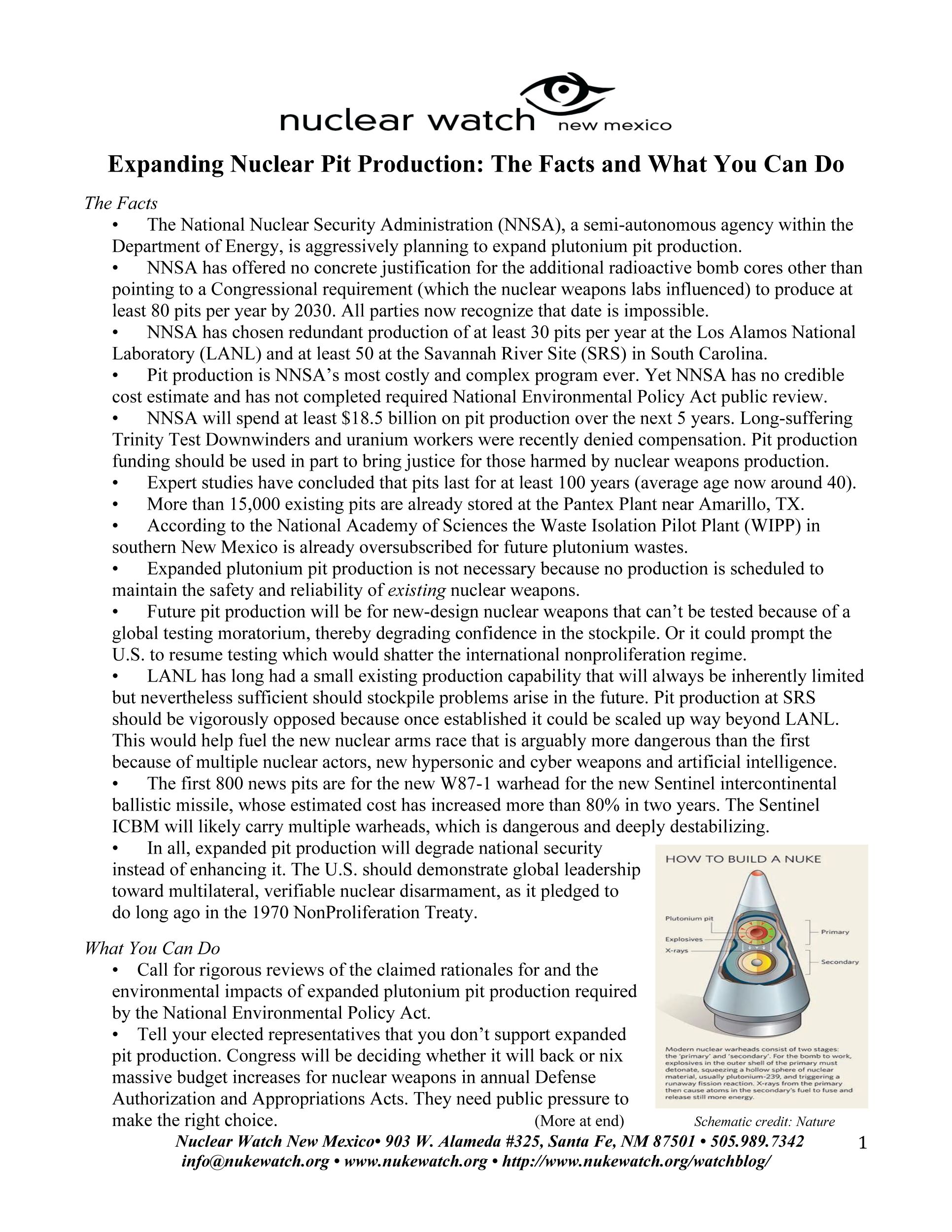
Summary: The United States is aggressively expanding the production of plutonium “pit” bomb cores to at least 80 pits per year, which the Pentagon has called the number one issue in its $1.7 trillion plan to “modernize” nuclear forces. The average age of plutonium pits is around 40 years. Los Alamos Lab Director Thom Mason has said that “The best way to deal with this dilemma [of uncertainty about aging effects] is to take it off the table. We do that by making new pits, immediately.” Thus, he justifies spending tens of billions of dollars, creating additional occupational and public risks, generating more radioactive wastes with uncertain disposal pathways, fundamentally transforming the Lab into a nuclear weapons production site and fueling the increasingly dangerous new nuclear arms race.
But does independent review of pit aging data support this need to immediately produce new pits? The answer is no given that independent experts concluded in 2006 that pits last at least a century with no determined end date. Further, no future pit production is scheduled to maintain the safety and reliability of the existing nuclear weapons stockpile – it is all for speculative new designs which could raise reliability issues or even prompt the U.S. to resume testing.
June 6, 2022 | FACT SHEETS
Introduction: In 1991, in response to the ongoing collapse of the Soviet Union, President George H. Bush ordered the withdrawal of all nuclear-armed sea-launched cruise missiles (SLCMs) from U.S. surface ships and submarines. In 2018 President Trump’s Nuclear Posture Review proposed to redeploy SLCMs on Virginia-class attack submarines, saying they would provide the United States with “a needed non-strategic regional presence” that would address “the increasing need for flexible and low-yield options.”1 Congress subsequently approved $15.2 million in FY 2022 funding for the Navy’s new cruise missile and nuclear warhead.
In March 2022 President Biden transmitted a new classified Nuclear Posture Review to Congress that reportedly canceled the Sea-Launched Cruise Missile. In parallel, his proposed FY 2023 budget for the National Nuclear Security Administration (NNSA) has no funding for the SLCM nuclear warhead. This has prompted some congressional pushback, with one suggested compromise being continuing modest research funding. But as a Congressional Research Service analysis put it: “The Navy indicated that the program was “cost prohibitive and the acquisition schedule would have delivered capability late to need.”

August 22, 2019
The Department of Energy’s (DOE’s) Environmental Management Los Alamos (EMLA) field office has repeatedly claimed that “> [i.e., more than] ½ of legacy cleanup has been completed.”1 This claim doesn’t explain how this is measured. Does it mean ½ of the time, ½ of the cost, ½ of the sites, or ½ of the wastes? However it is measured, New Mexicans need to know that DOE and the Los Alamos National Laboratory (LANL) are NOT talking about real comprehensive cleanup.
When EMLA and its cleanup contractor (N3B) talk about cleanup, they mean specific narrow measures for specific sites, including much paperwork and studies instead of actual cleanup. Contrary to EMLA’s self-proclaimed openness and transparency, the claim of greater that half-completed cleanup is based on decisions made without public input to leave the vast majority of radioactive and toxic wastes permanently buried above our precious groundwater.
While some Lab cleanup started in the late 1980s, tracking of the cleanup budget didn’t start until 1997, which is the date used as the beginning of “prior costs” in recent DOE Congressional Budget Requests. 2 EMLA’s current estimated date for completion of planned cleanup is 2037. That would be 22 years down and 18 to go, if we look at 1997 to 2037, which would be ½ of the time if EMLA completes its planned cleanup by 2037. If decisions are made to remove more wastes, which would be the right thing to do, cleanup could last for decades more while generating 100’s of high-paying jobs. Real, comprehensive cleanup would be well worth the wait!
On March 1, 2005, after arduous negotiations and threats of litigation, the New Mexico Environment Department (NMED), Department of Energy (DOE), and Los Alamos National Laboratory (LANL) entered into a Consent Order specifying the schedule for investigation and cleanup of the Lab’s hundreds of contaminated sites.
In June 2016, NMED and LANL signed a new Consent Order that solved many of LANL’s problems by removing fines and enforceable schedules.
Read/Download the full fact sheet pdf HERE
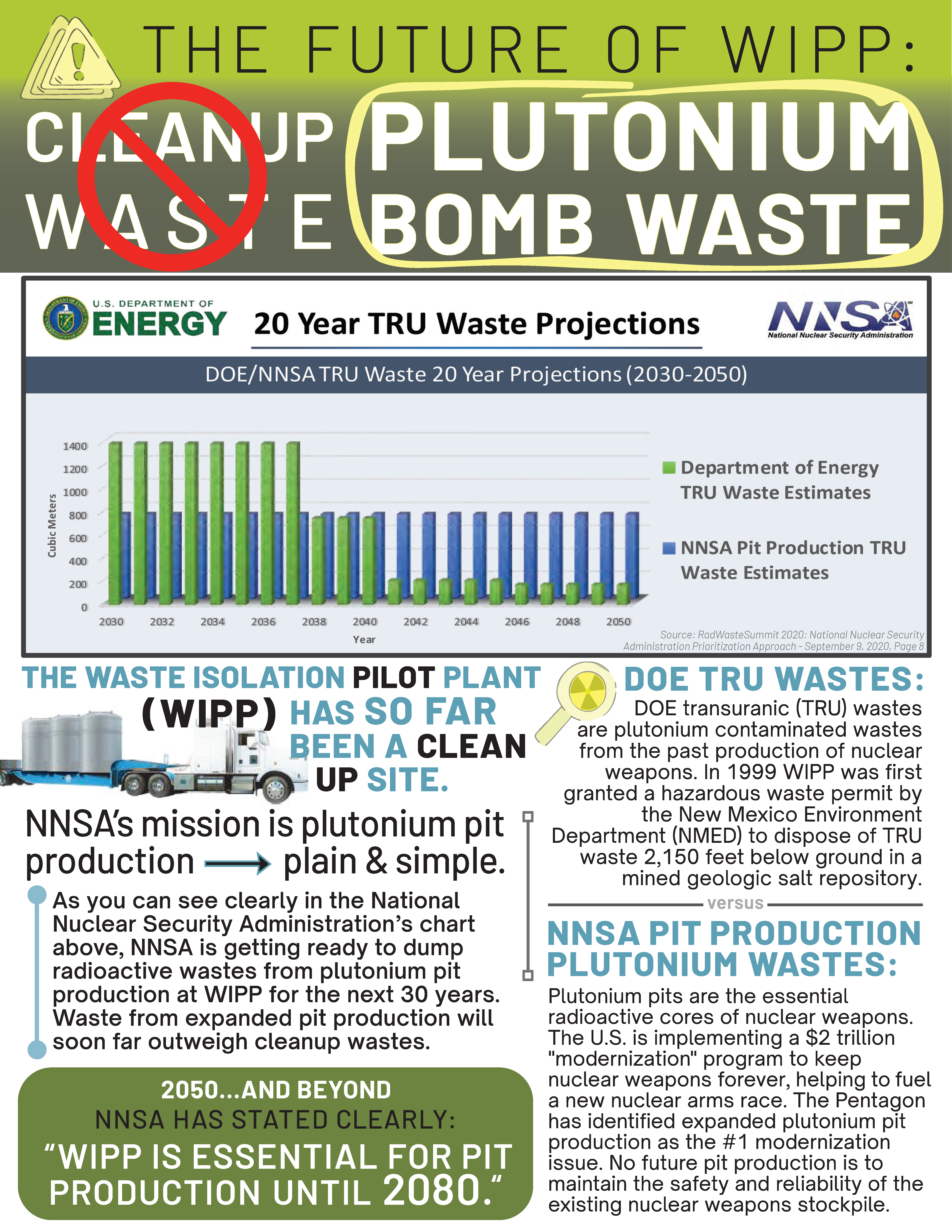
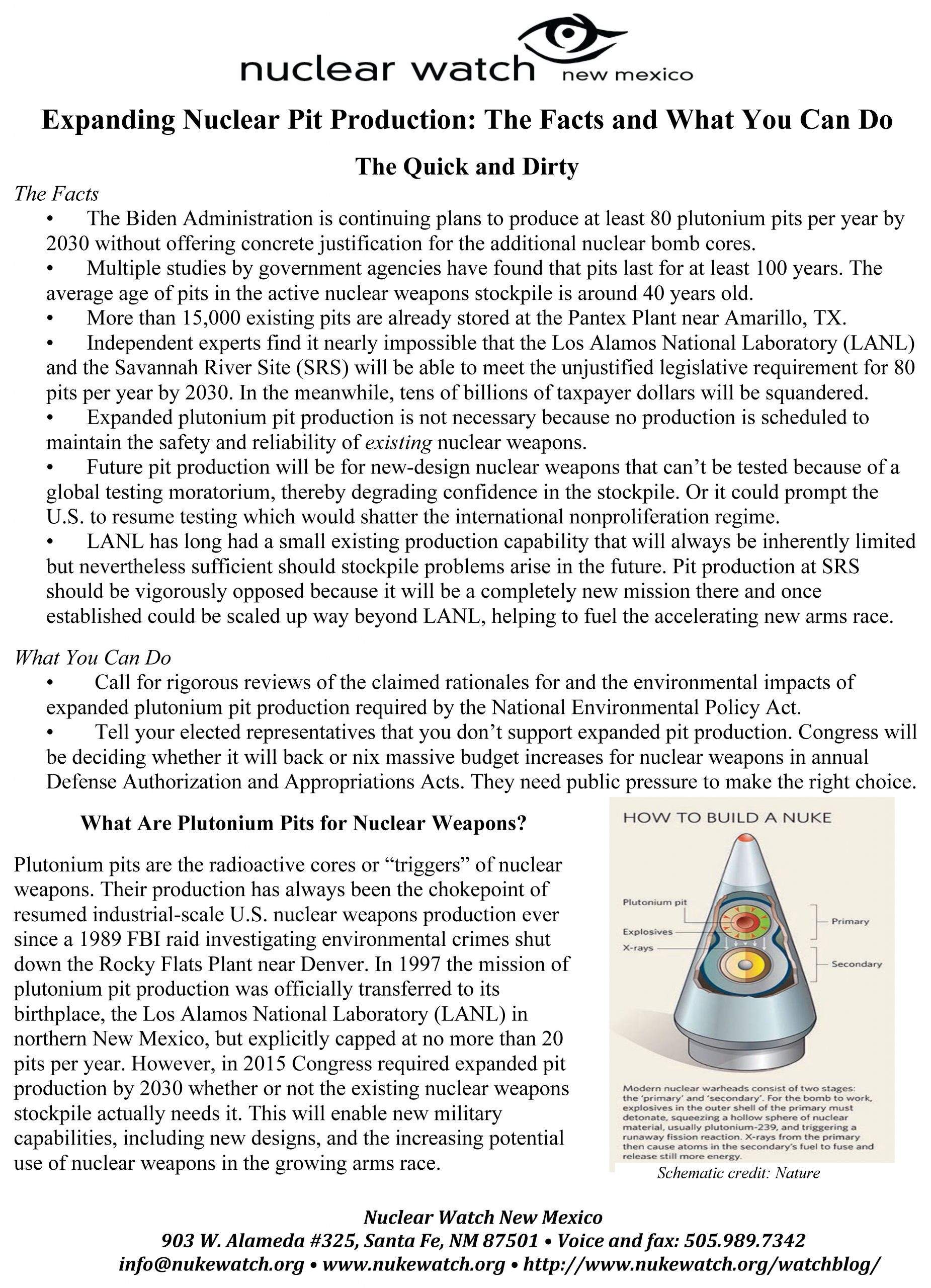
Plutonium pits are the radioactive cores or “triggers” of nuclear weapons. Their production has always been a chokepoint of resumed industrial-scale U.S. nuclear weapons production ever since a 1989 FBI raid investigating environmental crimes shut down the Rocky Flats Plant near Denver.Continue reading
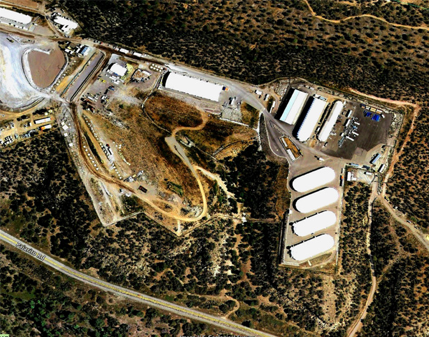
New Mexicans should push their politicians to vigorously lobby for comprehensive cleanup at the Los Alamos National Laboratory (LANL). Unlike nuclear weapons programs, cleanup would be a win-win that permanently protects the environment while creating hundreds of high paying jobs. Continue reading
Over the last decade funding for the Los Alamos National Laboratory’s (LANL’s) nuclear weapons programs has increased by 20%. However, funding for needed cleanup has remained flat at one-tenth of the $1.9 billion requested for nuclear weapons programs in FY 2019 ($191.6 million requested for cleanup in FY 2019). Continue reading
The National Nuclear Security Administration’s own documents have explicitly stated that expanded pit production would have no significant positive effect on job creation and the regional economy of northern New Mexico. Nuclear Watch argues that expanded plutonium pit production could actually have negative effect if it blocks other economic alternatives such as comprehensive cleanup, which could be the real job producer.Continue reading
The 2005 LANL Cleanup Consent Order was all about the enforceable schedules. It required DOE and LANL to investigate, characterize, and clean up hazardous and mixed radioactive contaminants from 70 years of nuclear weapons research and production. It stipulated a detailed compliance schedule that the Lab was required to meet…Continue reading
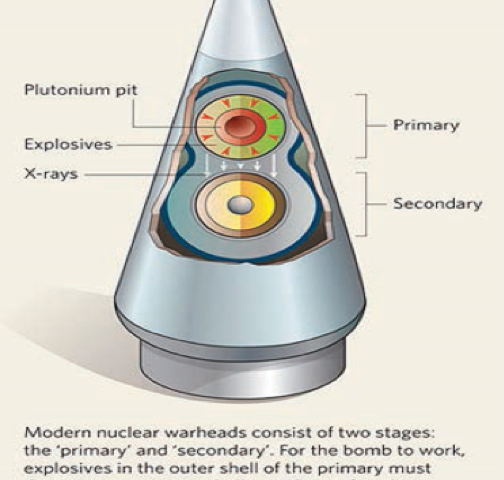
Plutonium pit production is a chokepoint of resumed U.S. nuclear weapons production. Citizens have defeated four past government attempts to expand pit production. Now Trump promises to increase military spending, and Congress has already required expanded pit production at the Los Alamos Lab regardless of the technical needs of the stockpile. This will enable the continuing evolution of the U.S. nuclear weapons stockpile with new military capabilities. Trump’s pending federal budget will likely fund new and upgraded plutonium facilities expected to be operational for at least the next half-century. Continue reading
This is the unsung story of successful citizen activism against repeated government attempts to expand the production of plutonium pit cores, which has always been the choke point of resumed U.S. nuclear weapons production. This history is a critical part of the march toward a future world free of nuclear weapons.
In April 2015 the U.S. State Department issued a so-called Fact Sheet entitled Myths and Facts Regarding the Nuclear Non-Proliferation Treaty and Regime. Its targeted audience was international delegations attending the 2015 NonProliferation Treaty (NPT) Review Conference. Given the increasing dissatisfaction of non-nuclear weapons states, the State Department argued that numerical stockpile reductions since the end of the Cold War is ample evidence that the U.S. is complying with the NPT’s Article VI obligation for nuclear disarmament.Continue reading
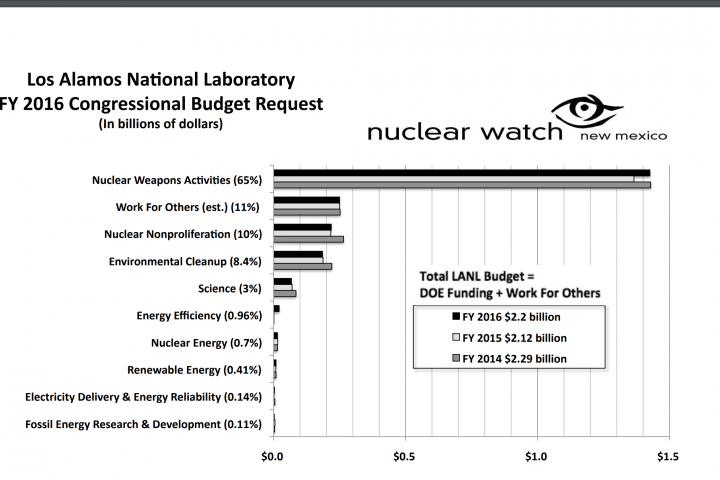
View/Download Full PDF HERE
View/Download Full PDF HERE
by Dr. James Doyle, Assisted by Jay Coghlan and Scott Kovac (NukeWatch) Nov 16, 2014
View/Download Full PDF HERE