“At Los Alamos and Sandia National Laboratories, the breakdown in the bilateral agreement may deal a decisive blow to already deteriorated relationships between scientists at New Mexico’s national laboratories and their Russian counterparts, who had been working together to iron out the technical aspects of plutonium disposition under the deal, according to Don Hancock with the Southwest Research and Information Center in Albuquerque.”
Ed Lyman of Union of Concerned Scientists said “Even until last week, the U.S. was optimistic that this was one area that Russia and the U.S. could cooperate.”
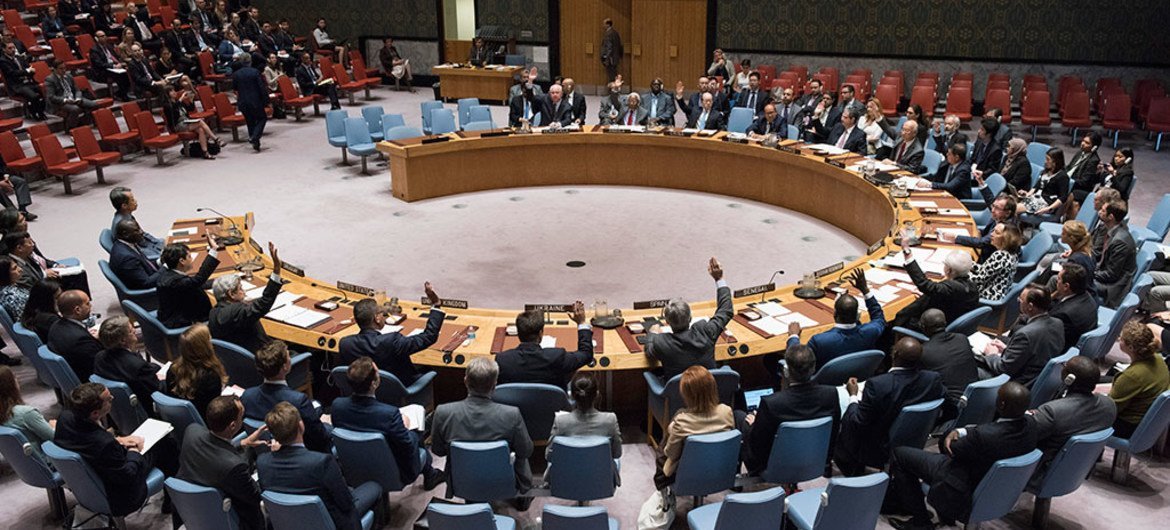
“Reaffirming that proliferation of weapons of mass destruction, and their means of delivery, threatens international peace and security, the United Nations Security Council today adopted a resolution urging all States who haven’t done so to sign the Comprehensive Nuclear-Test-Ban Treaty”
“A world free of nuclear of weapons goes by stopping testing too, and then taking steps that will reinforce the agreements that are already here, and then leading us towards what we all want: a world free of nuclear weapons; a world free of any attempt of modernization that some are talking about today.”
Former Secretary of Defense William Perry has just published a new book, a memoir titled “My Journey at the Nuclear Brink”. At the same time, NTI has launched the online William J. Perry Project, to “educate and engage the public on the dangers of nuclear weapons in the 21st century”.
“I hope to encourage young people to take the baton I am trying to pass to them. My generation created this existential problem- their generation must find a way to solve it.”
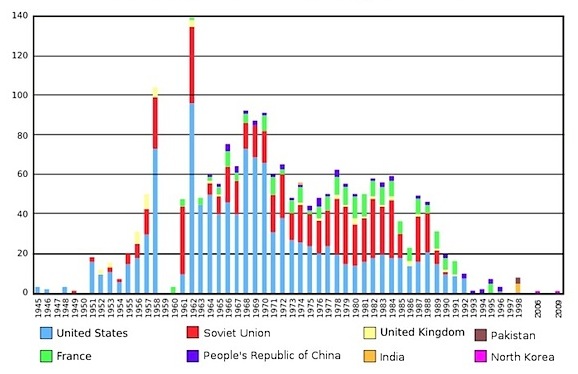
The first nuclear weapon test was carried out by the United States at the Trinity site on July 16, 1945, with a yield approximately equivalent to 20 kilotons. The first hydrogen bomb, codenamed “Ivy Mike”, was tested at the Enewetak atoll in the Marshall Islands in November 1952, also by the United States. The largest nuclear weapon ever tested was the “Tsar Bomba” of the Soviet Union at Novaya Zemlya on October 30, 1961, with an estimated yield of around 50 megatons.
In 1963, many (but not all) nuclear and many non-nuclear states signed the Limited Test Ban Treaty, pledging to refrain from testing nuclear weapons in the atmosphere, underwater, or in outer space. The treaty permitted underground nuclear testing. France continued atmospheric testing until 1974, China continued up until 1980. Neither has ever signed the treaty.[1]
The United States conducted its last underground test in 1992, the Soviet Union in 1990, the U.K. in 1991, and both China and France in 1996. After signing the Comprehensive Test Ban Treaty in 1996 (which has as of 2012 not yet entered into force), all these states have pledged to discontinue all nuclear testing. Non-signatories India and Pakistan last tested nuclear weapons in 1998. The most recent nuclear test was by North Korea on Feb. 12, 2013.
For a more detailed resource on the history of Nuclear testing, see this United Nations guide,released August 29, 2012, the official ‘International Day Against Nuclear Tests’.
Former Los Alamos National Laboratory director Siegfried Hecker recounts the epic story of how American and Russian scientists joined forces to avert some of the greatest post-Cold War nuclear dangers.
Hecker is currently a senior fellow at Stanford University’s Center for International Security and Cooperation, and a research professor of Management Science and Engineering.
Hans Kristensen, Federation of American Scientists, writes:
“The Pentagon’s arguments for why the LRSO is needed and why the amendments [to strip funding] are unacceptable are amazingly shallow – some of them even plain wrong.”
Here is a particularly disturbing argument:
“The Kendall letter from March also defends the LRSO because it gives the Pentagon the ability to rapidly increase the number of deployed warheads significantly on its strategic launchers. He does so by bluntly describing it as a means to exploit the fake bomber weapon counting rule (one bomber one bomb no matter what they can actually carry) of the New START Treaty to essentially break out from the treaty limit without formally violating it:
Additionally, cruise missiles provide added leverage to the U.S. nuclear deterrent under the New Strategic Arms Reduction Treaty. The accounting rules for nuclear weapons carried on aircraft are such that the aircraft only counts as one weapon, even if the aircraft carries multiple cruise missiles.
It is disappointing to see a DOD official justifying the LRSO as a means to take advantage of a loophole in the treaty to increase the number of deployed strategic nuclear weapons above 1,550 warheads. Not least because the 2013 Nuclear Employment Strategy determined that the Pentagon, even when the New START Treaty is implemented in 2018, will still have up to one-third more nuclear weapons deployed than are needed to meet US national and international security commitments. (more at FAS)
“…the declassified material, released Oct. 3 by the Energy Department, suggests that Oppenheimer opposed the hydrogen bomb project on technical and military grounds, not out of Soviet sympathies…”
1983: Once-classified documents show how close Soviet Union came to launching nuclear war
“Chilling new evidence that Britain and America came close to provoking the Soviet Union into launching a nuclear attack has emerged in former classified documents written at the height of the cold war… Cabinet memos and briefing papers released under the Freedom of Information Act reveal that a major war games exercise, Operation Able Archer, conducted in November 1983 by the US and its Nato allies was so realistic it made the Russians believe that a nuclear strike on its territory was a real possibility…”
Russia has given many expliantions for their recent exit from the MOX pact. Overall it is clear that MOX is a “good idea gone bad”. For more see the links below.
Citing “the threat to strategic stability posed by US hostile actions against Russia”. ref
“The NESC reports on nuclear war were multi-volume, highly classified studies and none has ever been declassified in their entirety. The summaries published here today- for the annual reports from 1957 to 1963- provide a glimpse of the full reports, although important elements remain classified. Besides the summaries and fuller reports for 1962 and 1963, today’s posting includes a number of special studies prepared by the NESC, including an especially secret report requested by President Eisenhower that led to the production of the comprehensive U.S. nuclear war plan in 1960, the Single Integrated Operational Plan (SIOP)…”
“The defilement of Fukushima wasn’t just the result of a natural catastrophe. It was also the aftermath of a manmade disaster caused by a slapdash approach to nuclear safety. Five years on, the Japanese government isn’t handling these issues any more responsibly.”
TEPCO and its network of partner companies at Fukushima Daiichi have yet to identify the location and condition of melted fuel in the three most seriously damaged reactors. Removing it safely represents a challenge unprecedented in the history of nuclear power. Quantities of melted fuel are believed to have accumulated at the bottom of the damaged reactors’ containment vessels, but dangerously high radiation has prevented engineers from accurately gauging the state of the fuel deposits.
TEPCO is now worried that the scorpion robot will not be able to reach the space beneath the pressure vessel, and like its predecessor, will not be able to work for very long in the damaged plant (the scorpion is designed to handle 1,000 total sieverts). The high level of radiation may force TEPCO, a nationally-owned company, to rethink its robot-based strategy for locating the molten fuel. The firm is currently in the early stages of a cleanup that’s expected to last decades. Until TEPCO knows the precise location of the melted fuel, and until it’s able to ascertain the structural damage in each of the three reactors affected, the company won’t be able to decommission the plant and remove the fuel.
“The United States is planning to purchase a new fleet of nuclear-capable air-launched cruise missiles (ALCMs) that will be far more advanced than the ones they are slated to replace, according to members of Congress and other sources, raising questions about the plan’s consistency with a pledge made by the Obama administration not to provide nuclear weapons with new capabilities.
“The development of the new missile also has sparked a debate about whether it could be more ‘usable’ than the existing ALCM, thereby lowering the threshold for when the United States might consider using nuclear weapons.
In a Dec. 15 letter to President Barack Obama urging him to cancel the new cruise missile, also known as the long-range standoff weapon, Sen. Ed Markey (D-Mass.) and seven other senators wrote that the ‘proposed missile is a significantly altered version’ of the existing ALCM. The letter did not say what specific capabilities the new missile would provide, but claimed the proposal contradicts the policy statement from the 2010 ‘Nuclear Posture Review [NPR] Report’ that efforts to sustain U.S. nuclear weapons ‘will not support new military missions or provide for new military capabilities.’
Advocates of the new missile argue that it provides a continuing ability to quickly add missiles to bombers. They note that the New Strategic Arms Reduction Treaty does not cap the number of weapons that can be carried on each bomber.
The source said the technical characteristics of the new missile are still being defined because the program is still in the early development stage but that the goal is to increase the range and accuracy of the missile. The source said another goal is to incorporate the latest stealth features, making the missile much more difficult for adversary air defense systems to detect.
Regarding the proposed life extension program for the ALCM warhead, known as the W80-4, the source who has been briefed said a goal of that program is to permit ‘greater flexibility in actually picking’ the desired yield. The ALCM warhead is believed have a built-in option to allow detonation at lower or higher yields.
According to the source, increasing the accuracy of the missile allows for more flexibility in the warhead yield, thus enhancing the overall capability of the weapons system.
The source said the briefings made it clear that the Pentagon is envisioning potential uses for the new cruise missile that go beyond ‘the original mission space’ of the ALCM.
For example, the source said that, in the event of a major conflict with China, the Pentagon has talked about using the new missile to destroy Chinese air defenses as a warning to Beijing against escalating the conflict further.”
“Franklin Miller, a veteran nuclear strategist now at the Scowcroft Group, points out that Mr Obama would never have persuaded the Senate to ratify the New START treaty in 2010 had he not pledged to renew America’s nuclear weapons on land, sea and in the air. That agreement allows for what is known as the ‘bomber discount’, which counts an aircraft carrying several bombs as a single warhead. The LRS-B (the upcoming Long-Range Strike Bomber) will be able to carry internally a payload of cruise missiles, the new B61-12 bombs or a smaller stand-off missile with a conventional warhead. It is improbable that any president would forgo that option while Russia retains it.”
Lockheed Martin manages the Nevada National Security Site, Sandia National Laboratories, together with Bechtel The Y-12 National Security Site, and the Pantex Plant in Texas.
Last fall, Washington Business Journal reported that
“if anyone is benefitting from the unease between Russia and the rest of the world, it would have to be Bethesda-based Lockheed Martin Corp. (NYSE: LMT). The company is positioned to make large profits off what could very well be an international military spending spree by Russia’s neighbors.”
“Yesterday, the department’s inspector general released a revised special inquiry report with fewer redactions in response to an appeal under the Freedom of Information Act. The new document is still heavy with white out but does show more of who was helping Sandia as well as who they were trying to influence on Capitol Hill and the Obama administration…”
Former Secretary of Defense Perry and Former Ass’t Secretary of Defense Weber to Obama:
“Because they can be launched without warning and come in both nuclear and conventional variants, cruise missiles are a uniquely destabilizing type of weapon.
Two years ago, when Britain decided not to pursue a sea-launched nuclear cruise missile, Philip Hammond, then-British defense secretary and now-foreign secretary, explained the problem well: ‘A cruise-based deterrent would carry significant risk of miscalculation and unintended escalation. At the point of firing, other states could have no way of knowing whether we had launched a conventional cruise missile or one with a nuclear warhead. Such uncertainty could risk triggering a nuclear war at a time of tension.
One of us (William J. Perry) led the Defense Department’s development and procurement of the current air-launched cruise missile and the B-2 stealth bomber in the late 1970s and early 1980s. At that time, the United States needed the cruise missile to keep the aging B-52, which is quite vulnerable to enemy air defense systems, in the nuclear mission until the more effective B-2 replaced it. The B-52 could safely launch the long-range cruise missile far from Soviet air defenses. We needed large numbers of air-launched nuclear cruise missiles to be able to overwhelm Soviet air defenses and thus help offset NATO’s conventional-force inferiority in Europe, but such a posture no longer reflects the reality of today’s U.S. conventional military dominance.
With the updated B-2 and B61 expected to remain in service for many decades, and the planned deployment of new B-3 penetrating bombers with B61 bombs starting in 2025, there is scant justification for spending tens of billions of dollars on a new nuclear air-launched cruise missile and related warhead life-extension program.
We therefore urge President Obama to cancel the current plan to develop and buy 1,000 to 1,100 new nuclear-capable air-launched cruise missiles. Such strong U.S. leadership, coupled with a challenge to the other major nuclear powers to eliminate or, in the cases of China and India, forgo deployment of this extremely destabilizing class of weapons, would reduce the risk of nuclear weapons use and be a historic practical step in the direction of a world without nuclear weapons.”
William J. Perry was U.S. secretary of defense from 1994 to 1997. Andy Weber was assistant secretary of defense for nuclear, chemical and biological defense programs from 2009 to 2014.
Bishop Oscar Cantú, Chairman, Committee on International Justice & Peace, U.S. Conference of Catholic Bishops, at “The Pope and the Bomb: New Nuclear Dangers and Moral Dilemmas” event on September 17, 2015, with moderator E.J. Dionne Jr., Washington Post columnist, former Sen. Sam Nunn, NTI Co-Chairman and CEO, and Prof. Maryann Cusimano Love, Associate Professor of International Relations, The Catholic University of America.
Note that five of the ten “Worst Things” directly involve New Mexico’s ex-Congresswoman Heather Wilson. (read more)
Nukewatch’s Jay Coghlan adds these remarks in regard to Heather Wilson:
Ex-Congresswoman Heather Wilson was appointed by John Boehner to be on the Congressional Advisory Panel on the Governance of the Nuclear Security Enterprise. In December 2014 the Panel came out with its long awaited report, “A New Foundation for the Nuclear Enterprise”, which benefited the contractors. For example, it argued for diminished federal oversight over contractors, which flies in the face of reality (e.g., constant cost overruns, WIPP, Y-12 security incident, etc., etc.)
Perhaps most alarmingly, the Panel recommended that congressional oversight be strengthened by having the DOE Secretary report to the Senate Energy and Natural Resources and Armed Services Committees, and to the House Energy and Commerce and Armed Services Committees. This would likely have the opposite effect, as it seems to preclude the traditional jurisdiction of the House and Senate Energy and Water Development Appropriations Subcommittees, which have provided key oversight in the past, and have often cut certain nuclear weapons programs.
I publicly called on Heather Wilson to resign from that Panel because of her conflict-of-interests. She did not. To add insult to injury, the co-chair of the Panel is Norm Augustine, ex-CEO of Lockheed Martin. LM’s tentacles are very widespread.
Lockheed Martin had $32 billion in federal contracts in 2014 (classified projects unknown). (ref) and (API)
This included $28 million for IRS data management. (ref)
In the nuclear weapons complex, in addition to Sandia Labs it runs the combined Y12-Pantex nuclear weapons production contract ($2 billion requested in FY 2016) with Bechtel, as Consolidated Nuclear Security, LLC.
Between 2008 and 2015 Lockheed Martin had 169,345 contracts with the US government, worth $293 billion. (ref)
Nuclear Watch New Mexico denounces the $4.7 million settlement agreement as a slap on the wrist for the world’s biggest defense contractor. Lockheed Martin clearly broke the law by engaging in illegal lobbying activities to extend its Sandia contract without competition, and engaged in deep and systemic corruption, including paying Congresswoman Heather Wilson $10,000 a month starting the day after she left office for so-called consulting services that had no written work requirements. There should be criminal prosecutions for clear violations of federal anti-lobbying laws, and Lockheed Marin should be barred from future competition for the Sandia Labs contract, expected next year.