
Nuclear News Archives

4 things to know about the end of the U.S.-Russia nuclear arms treaty

“For the first time in decades, there are no limits on the world’s largest nuclear arsenals. Congress must act now.

By Austin Headrick, American Friends Service Committee | February 4, 2026 afsc.org

The world changed forever in August 1945, when the United States dropped atomic bombs on Hiroshima and Nagasaki, killing an estimated 110,000 to 210,000 people. Scientists, activists, policymakers, and peacebuilders—including organizers at AFSC—have spent the decades since calling for disarmament and an end to all nuclear threats. One crucial result of that work was arms control treaties that limited nuclear arsenals.

But now, that work is being unraveled. On Feb. 5, 2026, the last remaining U.S.-Russia nuclear arms reduction treaty, expired. The New Strategic Arms Reduction Treaty (New START)  had placed limits on deployed nuclear weapons and created channels for inspections and monitoring. 

With the end of the treaty, the guardrails that create transparency and prevent a nuclear arms race end.

Here is what you need to know:

1. The U.S. and Russia hold nearly all the world’s nuclear weapons.

The United States and Russia together possess almost 90% of the world’s nuclear weapons. That is why New START matters even to people far from Washington and Moscow. A world with no limits on the two largest nuclear stockpiles is a more dangerous world.

Without New START, there would be no legally binding guardrails on the two countries’ long-range nuclear weapons for the first time since the first U.S.-Soviet arms control agreements in the early 1970s.

And the risk is not only long-term nuclear development. Without limits, either side could increase the number of nuclear weapons ready to launch relatively quickly by “uploading” additional warheads onto existing missiles, which can fuel pressure for the other side to respond.

2. Arms control makes everyone safer.

New START capped the U.S. and Russia at 1,550 deployed nuclear weapons and limited deployed delivery systems, with an overall limit on launchers and bombers. Those numbers are more than technical details. They limit how many weapons can be used quickly in a crisis.
Continue reading

Los Alamos confirms UMich data center to be used for nuclear weapons research

“A representative of Los Alamos National Laboratory confirmed nuclear weapons research will be a priority for its portion of the data center it intends to construct in collaboration with the University of Michigan in Ypsilanti Township.”

| January 30, 2026 michigandaily.com

Patrick Fitch, deputy laboratory director for science, technology, and engineering at Los Alamos, was present at the University’s open house on the project in Ypsilanti Thursday. When The Michigan Daily asked if Los Alamos intended to use its portion of the data center to support  nuclear weapons research, Fitch said yes.

“The short answer is yes, because aspects of a nuclear weapon is key to our simulation expertise,” Fitch said. “We want this loop to include large investments in national security, so that spins back into the basic science, and what we learn here — that list of non-nuclear weapons stuff — spins into nuclear weapons.”

The proposed data center has garnered significant opposition from Ypsilanti residents and U-M community members who worry about its potential to negatively impact the surrounding environment and electrical grid, as well the possibility that the facility could be used in the development of nuclear weapons. The University has maintained the facility will not “manufacture” nuclear weapons.

Some activists consider this statement misleading, as data centers are generally used for computing activities and not manufacturing. However, their computing capabilities could be used to support nuclear research in other ways, including in the production of plutonium pits, which serve as the cores of nuclear weapons. While plutonium pits need not be located at a data center, their development requires intensive computing power. Los Alamos has operated under federal directive to modernize the United State’s nuclear arsenal through the development of these pits since 2018.

*The featured image differs from the article photo due to usage rights. Photo: Google Data Center, Council Bluffs Iowa (49062863796).jpg
chaddavis.photography from United States, CC BY 2.0, via Wikimedia Commons

Barring last-minute nuclear deal, US and Russia teeter on brink of new arms race

SUMMARY:

• New START treaty set to expire on February 5

• Trump hasn’t responded to Putin’s offer to extend missile limits

• End in sight to more than 50 years of mutual constraints

• Chinese build-up leaves US facing two big nuclear rivals

By  and  | REUTERS, January 29, 2026 reuters.com

LONDON/WASHINGTON, Jan 30 (Reuters) – The United States and Russia could embark on an unrestrained nuclear arms race for the first time since the Cold War, unless they reach an eleventh-hour deal before their last remaining arms control treaty expires in less than a week.

The New START treaty is set to end on February 5. Without it, there would be no constraints on long-range nuclear arsenals for the first time since Richard Nixon and Soviet leader Leonid Brezhnev signed two historic agreements in 1972 on the first-ever trip by a U.S. president to Moscow.

It is now 85 seconds to midnight.

2026 Doomsday Clock Announcement: Complete Livestream

On January 27, 2026, the Doomsday Clock was set at 85 seconds to midnight, the closest the Clock has ever been to midnight in its history.

The Bulletin of the Atomic Scientists’ Science and Security Board (SASB), which sets the Clock, called for urgent action to limit nuclear arsenals, create international guidelines on the use of AI, and form multilateral agreements to address global biological threats.

Partnership for a World without Nuclear Weapons: Statement on the Fifth Anniversary of the Treaty on the Prohibition of Nuclear Weapons

ALBUQUERQUE—Wednesday, January 21, 2026—The Partnership for a World without Nuclear Weapons released a statement in recognition of the fifth anniversary of the entry into force of the Treaty on the Prohibition of Nuclear Weapons:

We hope for its further expansion through additional ratifications, now that a majority of the world’s countries have signed the Treaty. In July 2017, the Vatican was the first nation-state to sign and ratify the Treaty as part of its “unwavering commitment to the total elimination of nuclear weapons.”

We condemn the fact that the nuclear weapons powers have never honored their long-held obligations under the 1970 NonProliferation Treaty to enter serious negotiations leading to global nuclear disarmament.

In contrast, the Treaty on the Prohibition of Nuclear Weapons was a great step toward the light of peace. The nuclear-armed states have a moral obligation to hear the voices of the majority of the world, and to listen to those who face the threat of annihilation due to the reckless decisions of any one of their nine leaders. Russia’s nuclear saber-rattling over Ukraine makes this clear, while ongoing crises in the Middle East further escalate the risks. Meanwhile, the nuclear weapons powers are engaged in massive “modernization” programs, designed to keep nuclear weapons forever.

The international legal force of the nuclear weapons ban treaty is limited to those states that have formally ratified it. But its moral power does not recognize boundaries between nations, nor lines on a map. The moral power of this Treaty is global and universal. We hope and pray that it will exert moral pressure on the nuclear weapons states to finally honor their disarmament obligations under the Non-Proliferation Treaty.

On the fifth anniversary of the Treaty on the Prohibition of Nuclear Weapons, we specifically call upon world leaders to demonstrate measurable progress toward nuclear disarmament. Eight decades of nuclear threats are far too long, as evidenced by the horrors documented by the atomic bombing museums in Japan. It is long past time for the nuclear weapons powers to begin to make tangible progress toward that end.

As our close colleague Robert McElroy, Cardinal of Washington, DC, declared last August in Hiroshima on the 80th anniversary of the atomic bombing:

“We refuse to live in a world of nuclear proliferation and risk-taking. We will resist, we will organize, we will pray, we will not cease, until the world’s nuclear arsenals have been destroyed.”

Continue reading

A Grave Problem with South Carolina’s New Nuclear Warhead

In South Carolina, contractors say new plutonium pit warhead waste will be shipped to New Mexico. Is it true?

“The coming showdown over SRNS’s TRU waste underscores what has long been a truism of the US nuclear weapons complex: that the government’s urgency to produce new weapons outstrips its commitment to plan and fund the cleanup of the sites across the American landscape that are contaminated while doing so.

| January 22, 2026 inkstickmedia.com

On a crisp evening last October, Savannah River Nuclear Solutions (SRNS), a federal contractor that hopes to manufacture thousands of cores for new nuclear warheads at a Cold War-era weapons plant in rural South Carolina, put on a public information session at a library in the town of North Augusta. The purpose of the event was to address any concern from locals that its plan to produce 50 plutonium pits per year for 50 years would leave toxic waste, including radioactive refuse known as TRU waste, in and around the 310-square-mile Savannah River Site (SRS) that people in towns like Allendale and Aiken find themselves neighboring.

The session included about 30 presenters whom SRNS employs. They handed out Halloween candy while standing beside posterboards laying out what they described as a “cradle-to-grave” process for TRU waste generated by producing those pits. They described a plan to store batches of radioactive waste for only one year in both existing and to-be-constructed buildings around an abandoned nuclear fuel plant at the SRS. The waste, according to contractor employees and a map they displayed, would then be transported in trucks along Interstate 20 through Atlanta, Birmingham, and Fort Worth before reaching southern New Mexico, where it would be buried in an 2,150-foot-deep salt mine called the Waste Isolation Pilot Project (WIPP). The 1976 Resource Conservation and Recovery Act requires the company to detail those steps, including, crucially, the final “disposition of such wastes,” in order to apply for a local permit to build and operate what SRNS says will be just temporary waste storage buildings at the plant site. An information sheet from SRNS said the company plans for the permit application to be submitted in January and for the new storage buildings to begin construction a year later.

Trump offers states a deal to take nuclear waste

“Governors would effectively be invited to compete for what the administration believes is a once-in-a-generation economic development prize in exchange for hosting the nation’s most politically and environmentally toxic byproduct.

| January 21, 2026 eenews.net

The Trump administration wants to quadruple America’s production of nuclear power over the next 25 years and is hoping to entice states to take the nuclear waste those plants produce by dangling the promise of steering massive investments their way.

President Donald Trump’s big bet on amping up nuclear production is not an easy feat, fraught with NIMBY concerns about safety and waste byproducts. The administration hopes to solve at least one of those issues — what to do with toxic nuclear waste — with a program they plan to roll out this week.

Governors would effectively be invited to compete for what the administration believes is a once-in-a-generation economic development prize in exchange for hosting the nation’s most politically and environmentally toxic byproduct.

Energy Secretary Chris Wright has already begun laying groundwork with governors. Over the last two weeks, Wright has met with at least two governors who have expressed interest, according to two officials familiar with the private meetings granted anonymity to discuss them.

Americans Across Party Lines Want the U.S. to Keep Nuclear Limits with Russia, New Poll Finds

YouGov poll commissioned by ReThink Media and the Nuclear Threat Initiative.

“As the last remaining U.S.-Russia nuclear limitations treaty expires on Feb. 5, an overwhelming majority of Americans (91 percent) say the United States should negotiate a new agreement with Russia to either maintain current limits on nuclear weapons or further reduce both countries’ arsenals.”

| January 21, 2026 nti.org

The poll of 1,000 registered voters also finds that the vast majority of Americans—including 85 percent of those who voted for President Trump—believe the president should agree to Russia’s proposal to continue abiding by the limits imposed by the New START treaty for at least another year after the treaty expires. In addition, 72 percent of registered voters believe that removing all nuclear limits on U.S. and Russian nuclear arsenals would make the United States less secure.

When New START expires, it will be the first time in decades that there are no limits capping the number of nuclear weapons for the world’s two largest arsenals. Together, the U.S. and Russia own almost 90 percent of all nuclear weapons in the world.

President Trump recently said he intends to negotiate a better agreement with Russia after New START expires. Previously, he warned that “when you take off nuclear restrictions – that’s a big problem” and made favorable comments about Russia’s one-year offer to voluntarily maintain the treaty’s limits. He repeatedly has warned of the threat posed by nuclear weapons. However, his administration has not yet taken concrete actions to secure a new nuclear limitations agreement with Russia.

Palomares: Reflections of an American, sixty years later

This past Saturday marked 60 years since the 1966 Palomares mid-air crash that left plutonium contamination scattered around the Spanish village. Dr. Michael E. Ketterer, Professor Emeritus of Chemistry and Biochemistry at Northern Arizona University in Flagstaff, AZ, has authored “Palomares: Reflections of an American, sixty years later.” See his English language version here and below and the Spanish version here.

| January 17, 2026 eldiario.es

Eighty days after it fell into the ocean following the January 1966 midair collision between a nuclear-armed B-52G bomber and a KC-135 refueling tanker over Palomares, Spain, this B28FI nuclear bomb was recovered from 2,850 feet (869 meters) of water and lifted aboard the USS Petrel (note the missing tail fins and badly dented “false nose”). This photograph was among the first ever published of a U.S. hydrogen bomb. Left to right are Sr. Don Antonio Velilla Manteca, chief of the Spanish Nuclear Energy Board in Palomares; Brigadier General Arturo Montel Touzet, Spanish coordinator for the search and recovery operation; Rear Admiral William S. Guest, commander of U.S. Navy Task Force 65; and Major General Delmar E. Wilson, commander of the Sixteenth Air Force. The B28 had a maximum yield of 1.45 megatons.
By U.S. Navy, Courtesy of the Natural Resources Defense Council – Transferred from en.wikipedia to Commons by EH101 using CommonsHelper., The original uploader was Asterion at English Wikipedia., 31 May 2007 (original upload date), Public Domain, https://commons.wikimedia.org/w/index.php?curid=2630293

During the early morning hours of January 17, 1966, the six-year-old author was in his bed, asleep in the Buffalo, New York suburb of North Tonawanda. During those very same moments, a crash took place between two US planes: a B-52 bomber and a fully loaded KC-135, which were in the midst of refueling the bomber in-flight. The B-52 was crossing the Iberian Peninsula that morning as part of US Air Force’s Strategic Air Command’s daily routes, performing vigilance on the Soviet Union. Three thermonuclear bombs fell to the land, and a fourth fell into the sea, after the collision in the skies over Palomares, a small village located about two kilometers from the Mediterranean, in the province of Almeria, Andalucía in southeastern Spain.

All of that happened before I got out of bed that day.

Two of the bombs were destroyed upon impact, although neither produced a nuclear explosion. Instead, several kilograms of plutonium (Pu) were dispersed on a windy day, onto several square kilometers of the tomato fields and residential zones of Palomares. An additional bomb was found by a local resident; fortunately, it wasn’t significantly damaged since its parachute had opened. On the other hand, the fourth bomb appeared to have been lost in the Mediterranean, and very soon, that was obviously true. The US Air Force’s top priority quickly became to use whatever resources and heroes that were available, for an urgent mission: find the lost bomb before the Soviets could do so. The search and recovery of the bomb became the success story, and the history that was told. That was the lesson learned from Palomares, among the two governments, their military forces, and in the press. The photos of the military commanders from both countries posing with the recovered bomb aboard the USS Petrel are some of the most famous Internet images of Palomares.

Continue reading

Watch BOMBSHELL on PBS American Experience — streaming across all PBS-branded platforms, including YouTube, PBS.org and the PBS App!

The wait is over! BOMBSHELL is available NOW on PBS American Experience — and will be streaming simultaneously across all PBS-branded platforms, including YouTubePBS.org and the PBS App.

BOMBSHELL examines how the U.S. government manipulated public opinion through propaganda and censorship to justify the use of nuclear weapons and to minimize the human toll. Against this powerful machinery, a small group of journalists—including a Black pool reporter, a Japanese American staffer, a Japanese photographer, and a freelance magazine writer—identified gaps in the official narrative and courageously reported on the human consequences of the atomic bombings.

The Wall Street Journal described BOMBSHELL as offering “lessons for our own age of ascendant AI,” while Foreign Policy called it “provocative history that brings to life the dangers that arise when government secrecy and control overwhelm press freedom.”

Check out Bombshell’s website: www.bombshellfilm.com

New Mexico, Department of Energy at odds over cleanup halt at LANL waste site

In a December public meeting, the field office’s manager indicated approval from the Environment Department likely wasn’t needed to defer the study and cleanup of Area C. According to the compliance decree, “NMED approval is not required” in several cases to change the status of an area to deferred, as long as the Department of Energy complied with other requirements.

Environment Department spokesperson Drew Goretzka wrote in an email to The New Mexican a site can be deferred in one of four cases, including if it is involved in active operations and if the amount of time needed for deferment is assessed.

The department doesn’t agree those requirements have been met, Goretzka wrote, “resulting in a breach of the Consent Order.”

| January 9, 2026 santafenewmexican.com

The U.S. Department of Energy has put cleanup of a hazardous waste disposal site at Los Alamos National Laboratory on hold, a decision that seems to have drawn the ire of the New Mexico Environment Department.

The state last year was planning to hold a public hearing in early 2026 on how to handle legacy waste left behind at Material Disposal Area C, according to a letter from an official in the Hazardous Waste Bureau.

The Department of Energy, however, had already made up its mind: Any corrective actions at the site would have to wait due to ramped-up operations near Area C. The public hearing is now on hold until the conflict over the deferment of corrective actions is settled, according to an Environment Department spokesperson.

The 11-acre waste site, in use from 1948 to 1974, is located within Technical Area 50 along Pajarito Road. Its six disposal pits were used for various types of waste, including radioactive materials and heavy metals.

Nuclear Weapons Issues & The Accelerating Arms Race: January 2026

American imperialism:

On the U.S. raid on Venezuela to oust Nicolás Maduro, the Venezuelan president:

Stephen Miller, Donald Trump’s deputy chief of staff for policy and homeland security advisor, told CNN’s Jake Tapper on Monday January 5, 2026:

“We live in a world in which you can talk all you want about international niceties and everything else, but we live in a world—in the real world, Jake—that is governed by strength, that is governed by force, that is governed by power. These are the iron laws of the world that have existed since the beginning of time.”

The “Donroe Doctrine” is a more aggressive Trumpian take on the 1823 Monroe Doctrine, a foreign policy approach focused on unilateral U.S. dominance in the Western Hemisphere. How far does this administration intend to force this new doctrine?

DOE now department of nuclear weapons and Venezuelan oil: The Trump administration engaged the Department of Energy (DOE) and Secretary Chris Wright to oversee the seizure and marketing of Venezuelan oil following the capture of Nicolás Maduro. The U.S. intends to control Venezuelan oil, aiming to sell 30–50 million barrels of accumulated, sanctioned crude to the American people.

Greenland:

Trump describes Greenland as an “absolute necessity” for national security and the defense of the Arctic.

U.S. Treasury Secretary Scott Bessent has said that the president believes Greenland is “essential for the Golden Dome missile shield.” https://www.wcvb.com/article/greenland-trump-explainer/70097863

Continue reading

Chicago Tribune Editorial: Tick, tick goes the Doomsday Clock

“It would be madness to resume nuclear testing, let treaties lapse and expand arsenals that already could wipe out the planet. Diplomacy worked for decades, mainly because of an understanding that avoiding nuclear war was essential to humanity’s future. Today’s global leaders need to start acting accordingly.”

By  | Chicago Tribune – January 6, 2026 chicagotribune.com

This month, the Bulletin of the Atomic Scientists at the University of Chicago is scheduled to announce whether the hands of its famous Doomsday Clock will move closer to midnight. It feels like a safe bet that Armageddon is drawing nearer today than it has in a long, long time.

The Doomsday Clock started almost 80 years ago, when physicists who developed the Bomb grew alarmed at its use against Japan to end World War II.

Between the late 1940s and the early 1990s, nuclear war wasn’t a remote possibility: It almost happened, repeatedly, as America and the Soviet Union fought the Cold War. Chicago’s atomic scientists moved the hands of their clock from seven minutes to midnight at its start in 1947 to just two minutes to midnight as of 1953, when the U.S. and Soviets started testing enormously powerful hydrogen bombs.

*The image above differs from the article photo due to usage rights.

NEW INTERACTIVE PIECE from USA TODAY: THE NUCLEAR SPONGE — & Much More!

Screenshot from USA Today article January 5, 2026 usatoday.com/graphics/interactives/us-nuclear-weapons-expansion-fallout-map/

THE NUCLEAR SPONGE

Fallout maps show what could happen if America’s nuclear missile silos were attacked

By Davis Winkie, Ramon Padilla, Stephen Beard, Karina Zaiets and Carlie Procell, USA TODAY |  usatoday.com

U.S. nuclear strategy revolves around the idea of the “triad.” Each of the military’s methods for delivering a nuclear strike represents a leg – the air leg (bomber planes), the sea leg (missile submarines) and the land leg (silo-based intercontinental ballistic missiles).

In recent years, arms control advocates have argued that the land leg of the triad is useless compared with its peers and makes the world a more dangerous place. The root of the debate is the vulnerability of the underground silos: An enemy can – and probably would – destroy them in a first strike against the United States.

Those opposed to land-based nuclear missiles, such as Daryl Kimball of the Arms Control Association, say that this vulnerability would push the president into a “use-or-lose logic” if he or she believed the United States were under nuclear attack. If the president launched a nuclear missile counterattack under a false warning, the results would be catastrophic.

The naysayers also highlight the cost of replacing the existing 1970s-vintage fleet of 400 Minuteman III missiles with the under-development Sentinel missiles, which the Air Force estimated will cost $140 billion (an increase from a 2020 estimate of $78 billion).

Continue reading

Warren, Garamendi Press Energy Secretary on Mismanagement and Taxpayer Waste in Plutonium Pit Production Program

Without transparency, accountability, and action around the pit program, the Department of Energy may be enabling the waste of billions of taxpayer dollars.

“In rushing to production, NNSA has developed an excessively risky program structure, with management concerns around fundamental aspects such as the cost and schedule.”

Text of Letter (PDF)

Sen. Elizabeth Warren and Rep. John Garamendi | warren.senate.govgaramendi.house.gov

Washington, D.C. — In a new letter, U.S. Senator Elizabeth Warren (D-Mass.) and Representative John Garamendi (D-Calif.), both members of their respective Armed Services Committees and of the Nuclear Weapons and Arms Control Working Group, are urging Department of Energy Secretary Chris Wright to review the scope of and the need for the nuclear weapon plutonium pit production program, and pause the program’s Savannah River site until the National Nuclear Security Administration (NNSA) has established guardrails to prevent additional waste of taxpayer funds.

In August, the Department of Energy (DOE) launched a special study into NSSA’s leadership and management of the plutonium pit production mission. The lawmakers believe that, if properly conducted, the study will find that years of mismanagement have put billions of taxpayer dollars at risk with an unrealistic pit production schedule and goals.

“The Trump administration is blindly spending tens of billions of dollars to produce plutonium pits for nuclear weapons without a real budget or plan,” said Senator Warren. “This program is already years behind schedule and over budget, and Congressman Garamendi and I are urging the Secretary of Energy to conduct a vigorous review to rein in years of waste and mismanagement.”

“For years I have called for Congress to take action to fix the failing plutonium modernization effort. Congress has continued to pour billions of dollars into efforts to restart production with arbitrary targets,” said Congressman Garamendi. “This letter cuts to the core of the matter and asks necessary questions of NNSA, including about the questionable management and faulty assumptions underlying the program. I eagerly await their response, along with the results of the Department of Energy’s 120-day special investigation.”

The lawmakers raise concerns about how, years into this program, it is still unclear what the pit production program’s schedule and full cost will be. The Government Accountability Office recommended NNSA create a master schedule to comply with its best practices, but the agency has yet to produce one…

Continue reading

Livermore Lab Uses Trump Executive Order Gutting Environmental Laws to Push Through Enhanced Plutonium Utilization without Public Input

A November notice from the U.S. Department of Energy’s (DOE) National Nuclear Security Administration (NNSA) erases the previously announced public involvement requirement and thereby fast-tracks increased plutonium use at its Lawrence Livermore National Laboratory after decades of limits protected the public from potential risks.

News from our friends at Tri-Valley CAREs | trivalleycares.org

First announced In January 2025, the NNSA proposal for “Enhanced Plutonium Facility Utilization” at the Livermore Lab was to include a “Draft Supplemental Environmental Impact Statement” (SEIS)  according to its Federal Register Notice. It specifically stated that, “NNSA will prepare a Draft SEIS. NNSA will announce the availability of the Draft SEIS in the Federal Register and local media outlets. NNSA will hold one or more public hearings for the Draft SEIS. Any comments received on the Draft SEIS will be considered and addressed in the Final SEIS.”

Now the agency has reneged on this promise, instead fast-tracking directly to a Final SEIS and a Record of Decision without any further opportunity for public input!

DOE using its own land to help pair AI centers, nuclear reactors

The Energy Department wants to build nuclear-powered artificial intelligence data centers on federal land using new public-private partnerships.

By Kelly Livingston and Allison Mollenkamp | rollcall.com

Co-locating advanced nuclear reactors with data centers on DOE sites is part of the Trump administration’s bid to accelerate the development of both technologies, sources say, as research efforts tease out their “symbiotic relationship.” But questions remain about how these projects could affect local communities and the actual timeline for bringing more nuclear power online.

DOE first announced its intention to use federal land for data center development and co-location in early April with a request for information to gauge industry interest. According to the RFI, the department intends to begin construction at the selected DOE sites by the end of the year, with operations beginning by the end of 2027.

Lawmakers introduce bill to cancel $100 million University of Michigan data center grant

The University of Michigan has failed to act transparently or coordinate with local officials on data center project, says state Rep. Jimmie Wilson Jr.

Eighty-four percent of the lab’s 2026 budget request is for nuclear weapons work, according to the nonprofit Nuclear Watch New Mexico.

By Brian Allnutt | planetdetroit.org

Michigan State Rep. Jimmie Wilson Jr. (D-Ypsilanti) introduced legislation Thursday to rescind a $100 million state grant for the University of Michigan and Los Alamos National Laboratory’s data center project in Ypsilanti Township.

The university has been unwilling to offer community benefits or consider another site for the data centers, Wilson said.

“The University of Michigan has not been fully transparent with this project and has refused to collaborate with the Ypsilanti Township officials throughout this planning process,” Wilson said in a statement to Planet Detroit.

Ypsilanti Township officials say the university misled state officials about the size of the project when applying for the $100 million grant, and passed a resolution earlier this month seeking to unwind the funding.

Petition highlights Los Alamos’ nuclear weapons work

petition signed by over 700 University of Michigan employees, faculty, and students urges the school to cancel the $1.2 billion project and halt its partnership with Los Alamos, arguing the project will harm the environment, negatively impact low-income communities, and help advance harmful nuclear weapon and artificial intelligence technologies.

Catholic bishops remind political leaders that nuclear weapons are immoral

On August 5, the two American Cardinals present in Japan delivered stirring words from the Hiroshima World Peace Memorial Cathedral, whose bricks contain ashes from the atomic bomb…

“If our gathering here today is to mean anything, it must mean that in fidelity to all those whose lives were destroyed or savagely damaged on August 6, 80 years ago, we refuse to live in such a world of nuclear proliferation and risk-taking,” said Cardinal Robert McElroy of Washington. “We will resist, we will organize, we will pray, we will not cease, until the world’s nuclear arsenals have been destroyed.”

By John Wester | thebulletin.org

In August, a group of American Catholic Church leaders—including Cardinal Blase Cupich of Chicago, Cardinal Robert McElroy of Washington, DC, Archbishop Paul Etienne of Seattle, and me, the Archbishop of Santa Fe—traveled to Japan to mark the 80th anniversary of the atomic bombings of Hiroshima and Nagasaki. There, we joined our Japanese counterparts—Bishop Mitsuru Shirahama of Hiroshima, Archbishop Emeritus Mitsuaki Takami of Nagasaki, and Archbishop Michiaki Nakamura of Nagasaki—in commemorating the destruction of their cities. Takami is a hibakusha (atomic bomb survivor); he was in his mother’s womb on August 9, 1945, when his city of Nagasaki was bombed. His maternal aunt and grandmother were both killed in the blast.

Eighty years have passed. But the existential threat posed by nuclear weapons is still with us—and it is growing worse every day. In 2019, Pope Francis elevated the Catholic Church beyond conditional acceptance of so-called deterrence. He declared that the mere possession of nuclear weapons is immoral. Nevertheless, the nuclear powers are now spending enormous sums of money on “modernization” that will keep nuclear weapons virtually forever. Meanwhile, in the United States, taxes are being cut to benefit the rich, and economic inequality and homelessness are exploding. This situation is deeply immoral and counter to the Catholic Church’s teachings on social justice.

SEE MORE ON SANTA FE ARCHBISHOP JOHN WESTER’S MONUMENTAL WORK ON NUCLEAR DISARMAMENT HERE:

Nuclear Disarmament & The Archdiocese of Santa Fe

Nuclear Weapons Issues & The Accelerating Arms Race: December 2025

Nuclear weapons: 

The government is running on a Continuing Resolution (CR) until the end of January. It’s possible to have another shutdown depending on how tough the Dems want to be. The legislative process is starting to move again, with the annual Defense Authorization Act up first and then appropriations. Both give funding increases to nuclear weapons programs, delivery systems and Trump’s “Golden Dome.”

Cost overruns in nearly all things remains the rule. Golden Dome could cost up to $4 trillion, be destabilizing and never be 100% effective. Putin has already taken steps to circumvent it and China may well be doing the same, particularly with hypersonic delivery systems. The arms race continues, likely to be accelerated by artificial intelligence as well. 

Nuclear weapons testing: No specific new developments but this article by ex-LANL Director Sig Hecker is good:

Lessons From Los Alamos
Last month, U.S. President Donald Trump rekindled a decades-old debate about nuclear testing. “Because of other countries testing programs,” he wrote on social media, “I have instructed the Department of War to start testing our Nuclear Weapons on an equal basis…” A return to testing at this time would likely benefit U.S. adversaries more than it would the United States. Worse still, it might rekindle an even greater and broader arms race than in the first few decades of the Cold War.
Siegfried Hecker | Foreign Affairs
Read More

Article continued:

“My greatest concern about resuming full-scale nuclear testing is that it will fuel another dangerous arms race at a time when global tensions among the great powers are high. Engaging in another arms race is contrary to Trump’s comment that “it would be great if we could all denuclearize, because the power of nuclear weapons is crazy.”

Instead of suggesting an immediate return to nuclear testing, then, Trump should focus on returning to arms control measures to ensure strategic stability with Russia and with China. Hopefully, these measures would lead to a reduction in U.S. and Russian nuclear forces and reduce incentives for China to increase its arsenal. For nuclear testing, he should help erect the highest possible barriers for any country to test by leading an effort to ratify the CTBT. To settle the question of evasion of low-yield tests or hydronuclear experiments, the president and his counterparts in Beijing and Moscow would need to show the political will to agree on a verifiable low-yield limit. That will almost surely require onsite inspections, which were demonstrated to be possible in 1988.

The bottom line is that even though the United States could derive important benefits from resumed nuclear testing, it would lose more than it stands to gain.”

Continue reading

MESSAGE OF HIS HOLINESS POPE LEO XIV FOR THE LIX WORLD DAY OF PEACE

“The idea of the deterrent power of military might, especially nuclear deterrence, is based on the irrationality of relations between nations, built not on law, justice and trust, but on fear and domination by force.”

From the Vatican, 8 December 2025, vatican.va

“In the relations between citizens and rulers, it could even be considered a fault not to be sufficiently prepared for war, not to react to attacks, and not to return violence for violence. Far beyond the principle of legitimate defense, such confrontational logic now dominates global politics, deepening instability and unpredictability day by day. It is no coincidence that repeated calls to increase military spending, and the choices that follow, are presented by many government leaders as a justified response to external threats. The idea of the deterrent power of military might, especially nuclear deterrence, is based on the irrationality of relations between nations, built not on law, justice and trust, but on fear and domination by force. “Consequently,” as Saint John XXIII had already written in his day, “people are living in the grip of constant fear. They are afraid that at any moment the impending storm may break upon them with horrific violence. And they have good reasons for their fear, for there is certainly no lack of such weapons. While it is difficult to believe that anyone would dare to assume responsibility for initiating the appalling slaughter and destruction that war would bring in its wake, there is no denying that the conflagration could be started by some chance and unforeseen circumstance.”

Federal official says further testing needed to determine LANL’s chromium plume migration

Asked about the difference in opinion between the federal and state agency regarding the sampling, Kunkle said, ‘I can’t answer why we have the disconnect,’ adding that the only sampling done at that monitoring location, called zonal sampling, ‘is really not intended to predict the long term environment or trends in the regional aquifer. That really should be done only with monthly monitoring.’

| santafenewmexican.com

A federal official says more testing is needed to determine whether a toxic chromium plume has seeped into San Ildefonso Pueblo’s groundwater, after the state called groundwater testing “conclusive evidence” the U.S. Department of Energy’s efforts at containment have been “inadequate.”

New Mexico’s Environment Department announced last month hexavalent chromium from Los Alamos National Laboratory had migrated to Pueblo de San Ildefonso land for the first time.

But Jessica Kunkle — the Los Alamos Field Office manager with the U.S. Department of Energy — told state lawmakers on the Radioactive and Hazardous Materials Committee on Monday afternoon the type of groundwater sampling conducted may not have told the whole story. The agency is working with partners to get a monitoring well installed “as quickly as possible,” she said, to get better data.

12/8/25 Los Alamos Legacy Cleanup & Hexavalent Chromium Plume Update

New Air Force Chief Boosts Nuclear Buildup, Moving Away From Deterrence, Experts Warn

Gen. Ken Wilsbach promotes nuclear “recapitalization” in his first memo to the Air Force — fueling fear of a radical shift away from nukes acting solely as deterrence.

By: , The Intercept | theintercept.com

U.S. Air Force Chief of Staff Gen. Ken Wilsbach receives a B-52H Stratofortress static display tour during a visit at Barksdale Air Force Base, Louisiana, Nov. 19, 2025. Wilsbach’s flightline immersion reinforced his top focus area: at the core of Air Force service, Airmen fly and fix airplanes. (U.S. Air Force photo by Senior Airman Laiken King)
U.S. Air Force Chief of Staff Gen. Ken Wilsbach, center, during a visit at Barksdale Air Force Base in Louisiana on Nov. 19, 2025. Photo: Senior Airman Laiken King/U.S. Air Force
In his first major guidance to the Air Force, the newly appointed Air Force Chief of Staff Gen. Kenneth Wilsbach emphasized a need for the “recapitalization” of nuclear weapons — an apparent departure from decades of Air Force teaching that the United States maintains nuclear weapons solely for deterrence.

“We will advocate relentlessly for programs like the F-47, Collaborative Combat Aircraft as well as nuclear force recapitalization through the Sentinel program and the B-21,” Wilsbach wrote in a memo dated November 3, referring to planned upgrades to nuclear missiles and stealth bombers.

Experts who spoke to The Intercept said the language signals a doctrinal pivot, prioritizing displays of strength and the buildup of nuclear weaponry over internal repair — an approach that may appeal politically to the Trump administration and Defense Secretary Pete Hegseth, but does little to ease the fatigue and distrust spreading among airmen.

The Sentinel program Wilsbach referenced is intended to modernize the land-based leg of the nuclear triad, with new missiles, hardened silos, and updated command-and-control infrastructure across missile fields in Wyoming, Montana, and North Dakota. It’s the Air Force’s planned replacement for aging Minuteman III intercontinental ballistic missile systems. The B-21 Raider is the next-generation stealth bomber designed to replace older strategic bombers like the B-2 and B-1, delivering both conventional and nuclear payloads.

Critics say framing these nuclear modernization efforts as “recapitalization” obscures the ethical and strategic implications of expanding U.S. nuclear capabilities amid declining morale and retention.

“You don’t ‘recapitalize’ genocidal weaponry.”

“The chief of staff’s emphasis on weaponry is disheartening. His description of nuclear weapon ‘recapitalization’ is an abomination of the English language. You don’t ‘recapitalize’ genocidal weaponry. Both the Sentinel missile program and the B-21 bomber are unnecessary systems that could cost as much as $500 billion over the next 20 years,” said William Astore, a retired Air Force lieutenant colonel and military historian.

Los Alamos National Lab (LANL) Town Hall December 3rd, 2025 – Thoughts from Nuclear Watch New Mexico:

The LANL Director mentioned Non-proliferation is a big part of their work. However, the Nuclear Nonproliferation program budget is a mere 6.5% of the total Lab budget (Nuclear Weapons is 84%, with a Billion dollar increase for FY26). https://nukewatch.org/wp-content/uploads/2025/09/FY26-Lab-Table-spreadsheets-Chart-1.pdf Nuclear Nonproliferation is a valuable program that LANL does well, and its funding should not be cut to provide more money for nuclear weapons production (literally the opposite of nonproliferation). The Nuclear Nonproliferation budget should be increased, especially if the Lab director agrees on its importance. NukeWatch NM is entirely supportive of LANL’s Sealed Sources program, which serves as the nation’s lead for collecting potentially dangerous radioactive materials that are no longer needed, securing them, and ensuring they don’t fall into the wrong hands, protecting communities and enhancing security.

On the discussion of AI missions at the lab:

The lab is partnering with NVIDIA for their hardware and ChatGPT/Open AI for their models. “The goal is to harness the power of the next evolution of high performance computing and apply it to our national security science and technology. Big development on this front is the “genesis” mission…” and in an answer to a question, want to “use artificial intelligence to [for example] help us develop the molecules that could deliver a therapeutic isotope to a cancer cell with high specificity so that when that undergoes radioactive decay the decay products basically kill the cancer cell but no surrounding tissue”

Again, the lab’s nuclear weapons budget ate up almost all else this year – how does the lab propose to work on this kind of work when its’ science budget is less than 1%? How will this advancement of AI be applied to our national security science and technology in terms of nuclear weapons? NukeWatch has serious concerns and questions regarding the tangible risks associated with integrating commercial AI infrastructure to be with active national security and nuclear defense programs. Beyond this, a $1.25 billion advanced computing campus is planned in Michigan to support far-away Los Alamos Lab in high-performance computing and AI research.
Continue reading

Nuclear Watch New Mexico Attends the Alliance for Nuclear Accountability Fall Meeting Nov. 21-23 in Las Vegas, Protesting Nuclear Testing in Nevada & Much More!

Sophie Stroud, Communications and Associate Director, represented NukeWatch at the Alliance for Nuclear Accountability's (ANA) fall meeting Nov. 21-23 in Las Vegas, hosted locally by Ian Zabarte, Principal Man of the Western Shoshone, Secretary of State of the Western Shoshone National Council, and Secretary of the Native Community Action Council (NCAC). The Nevada Test Site, now called the "Nevada National Security Site" and Yucca Mountain are both nuclear sites on Shoshone Land, and nuclear issues continue to threaten the Western Shoshone People. Yucca Mountain is Western Shoshone property with Constitutional protection, and the Department of Energy cannot prove ownership. ANA is a national network made up of 30 organizations whose members live near US nuclear bomb plants and their waste sites. The meeting was scheduled in coordination with the renowned International Uranium Film Festival — uraniumfilmfestival.org. As an organizer of the ANA Meeting as well as the International Uranium Film Festival, NCAC, composed of Shoshone and Paiute peoples, believe these films are a necessary part of the ongoing awareness, witness and resistance to nuclear war, human health and a livable Mother Earth. As 2025 marks the 80th anniversary of the first atomic bombings at the Trinity Site, Hiroshima, and Nagasaki, the world faces a new nuclear arms race that includes nuclear "modernization" of weapons, as well as the fast-tracking of uranium mining for nuclear-powered artificial intelligence data centers.

Friday morning, Nov. 21, the group traveled to the Mercury Exit gate of the Nevada Test Site with banners opposing nuclear weapons and nuclear testing. On October 29, before a meeting in South Korea with Chinese President Xi, President Donald Trump announced on social media that he “instructed the Department of War to start testing [U.S.] Nuclear Weapons on an equal basis” with Russia and China. The post contains various inaccuracies and ambiguity over whether he wants to resume underground nuclear explosive testing — an act the United States, Russia, and China have not undertaken in over 30 years — or continue testing of delivery systems.

Trump Orders Nuclear Weapons Testing for New Nuclear Arms Race

Press Release: The Alliance for Nuclear Accountability Condemns the Suggestion of Nuclear Testing by President Trump

What might Project 2025 mean for N.M.? Non-nuclear cuts at national labs (Updated Dec 1, 2025)

[The Heritage Foundation’s Project 2025] contemplates pulling funding from any work unrelated to nuclear weapons at Los Alamos National Laboratory, Sandia National Laboratories and sister facility Lawrence Livermore National Laboratory in California…in New Mexico, some say cutting the labs’ other scientific work would have a devastating economic effect on the state and could ultimately weaken the institutions as a whole.

“It doesn’t take a nuclear physicist to realize that there could be massive layoffs if this proposal or these ideas were to reach fruition,” said Chandler, who worked in the employment arena for much of her time at the facility. “Now, that might expand the nuclear weapons program to some degree, but it’s not going to absorb the entire workforce.”

Under the Biden administration, LANL has seen a massive growth in employment as the laboratory ramps up for its production of plutonium pits, the cores of nuclear bombs.

By Gabrielle Porter and Alaina Mencinger gporter@sfnewmexican.com amencinger@sfnewmexican.com |  Updated  santafenewmexican.com

Project 2025 — the now-infamous blueprint for a conservative presidency that’s still publicly being held at arm’s length by Republican presidential candidate Donald Trump — proposes all sorts of sweeping policy recommendations, from promoting capital punishment to embracing mass deportations.

But tucked in the 922 pages of its report, “Mandate for Leadership 2025: The Conservative Promise,” is one recommendation that centers squarely on New Mexico.

Trump talk on nuke testing turns focus to New Mexico’s role in decades of blasts

Jay Coghlan, executive director of the nuclear watchdog group Nuclear Watch New Mexico, said Wright’s comments “somewhat” quelled his initial concerns about a renewed explosive nuclear testing program.

But he said claims Russia and China may be conducting small-scale tests known as hydronuclear tests — banned by the Comprehensive Nuclear Test Ban Treaty, of which the United States, Russia and China are all signatories — continue to give him pause. He fears rumors about the low-yield tests in other nations could be used to justify a domestic return to testing.

“That, in effect, would give permission to the U.S. [to resume testing],” Coghlan said. “But that would be in violation of the norm of the CTBT.”

Three decades removed from the United States’ last nuclear test, a testing regimen would likely be expensive and time-consuming to start up, Coghlan argued, and could prompt other nuclear powers to follow suit.

It seems likely Russia, at least, would: Following Trump’s post, Russian President Vladimir Putin announced if the United States resumed explosive nuclear testing, the Eastern European nation would follow.

“Then everybody else is going to do it, or virtually everybody else will do it, every other nuclear weapons power,” Coghlan said. “I could just see India and Pakistan champing at the bit to test. And then, of course, there’s North Korea and China.”

| November 30, 2025 santafenewmexican.com

It might not have as reverent a name as the Trinity Test or a litany of films made about it. But Project Gnome, a 1961 explosive nuclear test conducted near Carlsbad, is a relic of a bygone era in New Mexico and beyond.

In the 47 years between the Trinity Test and the end of the United States’ explosive nuclear testing in 1992, the nation would perform more than 1,000 such tests — more than any other nuclear nation — with most conducted in Nevada.

New Mexico might not have been the center of the nation’s testing efforts post-Trinity, which marked its 80th anniversary this year, but the state still played a role: Researchers from Sandia National Laboratories and Los Alamos National Laboratory helped design and conduct testing elsewhere, including at the Nevada Test Site and in the Marshall Islands.

Most Democrats and one-third of Republicans think it’s likely the U.S. will get into a nuclear war in the next decade

A new YouGov poll on nuclear weapons finds that nearly half of Americans believe it’s likely the U.S. will get into a nuclear war in the coming decade, and most are worried about personally experiencing a nuclear war. A majority believe nuclear weapons are making the world less safe, but opinions are mixed on whether the U.S. should dismantle all of its nuclear weapons.

By: Jamie Ballard| November 26, 2025 today.yougov.com

46% of Americans think it’s likely the U.S. will get into a nuclear war within the next 10 years; 37% think this is not very or not at all likely. 57% of Democrats and 37% of Republicans think this is likely.


Department of Energy Seeks to Eliminate Radiation Protections Requiring Controls “As Low As Reasonably Achievable”

An internal Department of Energy (DOE) memorandum eliminates worker and public radiation protection rules known “As Low As Reasonably Achievable” (ALARA). This fundamental departure from decades of accepted health physics practices is being promoted by senior DOE political appointees with little background in health or radiation control. It is marked as “URGENCY: High” under the auspices of the DOE Deputy Secretary, the Under Secretary for Science, and the Administrator of the National Nuclear Security Administration. The memorandum awaits the final signature of DOE Secretary Chris Wright.

The memo’s stated goal is to:

“…remove the ALARA principle from all DOE directives and regulations, including DOE Order 458.1, Radiation Protection of the Public and the Environment, NE [Office of Nuclear Energy] Order 458.1, Radiation Protection of the Public, and, upon completion of the rulemaking process, 10 CFR [Code of Federal Regulations] 835, Occupational Radiation Protection.” [1]

It follows the playbook of the Heritage Foundation’s Project 2025, which called for:

“Set[ting] clear radiation exposure and protection standards by eliminating ALARA (“as low as reasonably achievable”) as a regulatory principle and setting clear standards according to radiological risk and dose rather than arbitrary objectives.” [2]

Continue reading

Lab Chromium Contamination Confirmed on San Ildefonso Pueblo Land

Comprehensive Cleanup Needed Instead of More Nuclear Weapons

The New Mexico Environment Department has announced:

“A toxic chromium plume from Los Alamos National Laboratory has spread beyond Lab boundaries onto Pueblo de San Ildefonso land for the first time, with contamination exceeding state groundwater standards… These new results are conclusive evidence that the U.S. Department of Energy’s efforts to contain the chromium plume have been inadequate.”

In reality, chromium groundwater contamination probably migrated beyond the LANL/San Ildefonso Pueblo boundary long ago, with past Lab maps of the plume “magically’ stopping at the border. In the past, tribal leadership has commented that it was fortunate that the contamination stopped there, but that any future indications of groundwater contamination on Pueblo land could have serious consequences. The San Ildefonso Pueblo is a sovereign Native American tribal government.

As late as the late 1990s the Lab was falsely claiming that groundwater contamination was impossible because underlying volcanic tuff is “impermeable.” [1] This ignored the obvious fact that the Parajito Plateau is heavily seismically fractured, providing ready pathways for contaminant migration to deep groundwater. By 2005 even LANL acknowledged that continuing increasing contamination of the regional aquifer is inevitable.[2] Some 300,000 northern New Mexicans rely upon the aquifer for safe drinking water. The potential serious human health effects (including cancer) caused by chromium contamination was the subject of the popular movie Erin Brockovich.

Continue reading

LANL chromium plume spreads onto San Ildefonso Pueblo land, NMED says

Nuclear Watch New Mexico executive direcor Jay Coghlan sees PF-4 as being a bigger scale — and having bigger risks — than the other aging buildings.

“PF-4 is not unique in being old,” Coghlan said. “However, PF-4 is totally unique in currently being the only facility that can process large amounts of plutonium … particularly including plutonium pit production. I think, in part, that’s why the Safety Board focuses more on PF-4 than, to my knowledge, than any other single individual facility.”

| November 13, 2025 sourcenm.com

An underground plume of toxic chromium has spread from Los Alamos National Laboratory to Pueblo de San Ildefonso land, state Environment Department officials announced Thursday.

The discovery marks the first time the plume has been detected within the pueblo boundaries, officials said in a news release, though they added the plume’s spread does not pose imminent threats to drinking water in the pueblo or in Los Alamos County. That’s because the plume is not near any known private or public wells, officials said.

Long-term ingestion of hexavalant chromium can cause serious health problems or increase risk of certain cancers.

Continue reading

US Stands Alone Defying UN Vote on Nuclear Test Ban Treaty

Could the LDS Church end an ongoing nuclear weapons project? These veteran activists think so.

By Thalif Deen, Inter Press Sevice | November 12, 2025 ipsnews.net

UNITED NATIONS, Nov 12 2025 (IPS) – The US took another step backward –to break ranks with the United Nations– when it voted against a draft resolution calling for the entry into force of the Comprehensive Nuclear-Test-Ban Treaty (CTBT).

The negative vote followed an announcement by President Trump last month that the US plans to resume nuclear testing after a 33-year hiatus. The US stood alone on the UN vote, which was supported by almost all member States in the General Assembly’s First Committee.

The resolution was adopted by an overwhelming majority: with 168 votes in favor, with one against (United States) and 3 abstentions (India, Mauritius, Syria).

During Trump’s first term, the US abstained on the vote. And in other years they had been voting in favour.

Jackie Cabasso, Executive Director, Western States Legal Foundation, which monitors and analyzes U.S. nuclear weapons programs and policies, told IPS the chaos and uncertainty arose from Trump’s factually-challenged social media post that “because of other countries testing programs, I have instructed the Department of War to start testing our Nuclear Weapons on an equal basis.”

The U.S. government’s first ever “No” vote, on the annual UN resolution in support of the Comprehensive Test Ban Treaty (CTBT), raises further troubling questions about U.S. intentions.

Continue reading

A Small Town Is Fighting a $1.2 Billion AI Datacenter for America’s Nuclear Weapon Scientists

Ypsilanti, Michigan resident KJ Pedri doesn’t want her town to be the site of a new $1.2 billion data center, a massive collaborative project between the University of Michigan and America’s nuclear weapons scientists at Los Alamos National Laboratories (LANL) in New Mexico.

Matthew Gault| November 10, 2025 404media.co

“My grandfather was a rocket scientist who worked on Trinity,” Pedri said at a recent Ypsilanti city council meeting, referring to the first successful detonation of a nuclear bomb. “He died a violent, lonely, alcoholic. So when I think about the jobs the data center will bring to our area, I think about the impact of introducing nuclear technology to the world and deploying it on civilians. And the impact that that had on my family, the impact on the health and well-being of my family from living next to a nuclear test site and the spiritual impact that it had on my family for generations. This project is furthering inhumanity, this project is furthering destruction, and we don’t need more nuclear weapons built by our citizens.”

At the Ypsilanti city council meeting where Pedri spoke, the town voted to officially fight against the construction of the data center. The University of Michigan says the project is not a data center, but a “high-performance computing facility” and it promises it won’t be used to “manufacture nuclear weapons.” The distinction and assertion are ringing hollow for Ypsilanti residents who oppose construction of the data center, have questions about what it would mean for the environment and the power grid, and want to know why a nuclear weapons lab 24 hours away by car wants to build an AI facility in their small town.

“What I think galls me the most is that this major institution in our community, which has done numerous wonderful things, is making decisions with—as I can tell—no consideration for its host community and no consideration for its neighboring jurisdictions,” Ypsilanti councilman Patrick McLean said during a recent council meeting. “I think the process of siting this facility stinks.”

Harking to the MX, Utahns call on LDS Church President Oaks to speak out against nuclear missile being developed in Utah

Could the LDS Church end an ongoing nuclear weapons project? These veteran activists think so.

THE SALT LAKE TRIBUNE | November 9, 2025 sltrib.com

Decades ago, peace activists helped keep a major nuclear weapons system out of Utah with help from key figures, chiefly Spencer W. Kimball, then the president of The Church of Jesus Christ of Latter-day Saints.

Now some of those same individuals are calling on the church’s newly ascended president, Dallin H. Oaks, to follow in his predecessor’s footsteps and speak out against the federal government’s development of a new generation of nuclear missile, known as Sentinel, partly in the Beehive State.

“The arms race continues,” the group of 12 Utahns and one former resident write in a letter mailed to church headquarters in early October, “and a new moral challenge faces” the leaders of the Utah-based faith.

Nuclear Weapons Issues & The Accelerating Arms Race: November 2025

Nuclear weapons: 

The government shutdown has impact:

https://sourcenm.com/2025/10/22/national-nuclear-security-agency-confirms-furloughs-at-offices-in-albuquerque-los-alamos/

National Nuclear Security Agency confirms 152 furloughed at offices in Albuquerque, Los Alamos

Only 14 employees remain at the two sites By: Danielle Prokop-October 22, 2025

The NNSA confirmed 152 New Mexico employees charged with overseeing national laboratories’ nuclear weapons work were furloughed on Oct. 20, 2025. (Courtesy of NNSA)

The federal government this week sent home more than 150 federal New Mexico employees charged with overseeing national laboratories’ nuclear weapons work, with only 14 employees across two sites remaining at work, the National Nuclear Security Agency confirmed to Source NM.

The furloughs include 71 employees at NNSA’s Los Alamos field office and 81 at the Sandia National Laboratories location, NNSA Deputy Director of Communications Laynee Buckels told Source NM in an email. Seven employees remain at each site, working without pay, she said.

The field offices are responsible for “ensuring compliance with federal contracts to manage and operate the national security assets,” according to the NNSA website

To date there doesn’t appear to be furloughs at LANL, whose employees technically work for a contractor rather than the federal government. Congress is not furloughed, but Speaker Mike Johnson has kept the House out of session. As a result, legislation has come to a screeching halt.

Continue reading

Los Alamos’ plutonium facility safety systems need improvement, oversight board says

Nuclear Watch New Mexico executive direcor Jay Coghlan sees PF-4 as being a bigger scale — and having bigger risks — than the other aging buildings.

“PF-4 is not unique in being old,” Coghlan said. “However, PF-4 is totally unique in currently being the only facility that can process large amounts of plutonium … particularly including plutonium pit production. I think, in part, that’s why the Safety Board focuses more on PF-4 than, to my knowledge, than any other single individual facility.”

| November 7, 2025 santafenewmexican.com

An independent oversight agency wants to see improved safety systems at the facility at the heart of Los Alamos National Laboratory’s plutonium pit mission: PF-4.

The Defense Nuclear Facilities Safety Board reported what it believes to be gaps in a safety analysis drafted for PF-4 and delays in upgrades to safety systems in a letter last month to Energy Secretary Chris Wright.

“Maintaining momentum for these safety infrastructure projects is more important in light of the issues with the safety analysis,” the board wrote in the letter dated Oct. 10. It was signed by former acting chairman Thomas Summers.

LANL Prioritizes Plutonium “Pit” Bomb Core Production Over Safety

The independent Defense Nuclear Facilities Safety Board recently released its Review of the Los Alamos Plutonium Facility Documented Safety Analysis. It concluded that:

“While LANL facility personnel continue to make important upgrades to the Plutonium Facility’s safety systems, many of those projects have encountered delays due to inconsistent funding and other reasons. DOE and LANL should consider prioritizing safety-related infrastructure projects to ensure that the Plutonium Facility safety strategy adequately protects the public, as the facility takes on new and expansive national security missions.” (Page 24)

In early October 2024, the Department of Energy’s semi-autonomous National Nuclear Security Administration (NNSA) announced with great fanfare that the Los Alamos Lab had produced its first “diamond stamped” plutonium pit for the nuclear weapons stockpile. Tens of billions of taxpayers’ dollars have been sunk into LANL’s long delayed and over budget pit production program. Given no further announcements, it is not currently known whether or not the Lab is meeting its congressionally required production goals. Endemic nuclear safety problems have long been an intractable issue, at one point even forcing a three-year halt to plutonium operations at LANL’s Plutonium Facility-4 (“PF-4”).

In its recent Review, the Safety Board reported:

“The [2009] Plutonium Facility safety basis described very large potential [radioactive] dose consequences to the public following seismic events…. DOE committed to upgrade and seismically qualify the ventilation system, with a particular focus on a specific ventilation subsystem…”

“As the only facility in the DOE complex that can process large quantities of plutonium in many forms, [PF-4] represents a unique capability for the nation’s nuclear deterrent. The Board has long advocated for the use of safety-related active confinement systems in nuclear facilities for the purposes of confining radioactive materials…Passive confinement systems are not necessarily capable of containing hazardous materials with confidence because they allow a quantity of unfiltered air contaminated with radioactive material to be released from an operating nuclear facility following certain accident scenarios. Safety related active confinement ventilation systems will continue to function during an accident, thereby ensuring that radioactive material is captured by filters before it can be released into the environment…  (Page 2, bolded emphases added)

Continue reading

AP: Trump appears to suggest the US will resume testing nuclear weapons for first time in 30 years

“For Trump, who has cast Russia as a “paper tiger” for failing to swiftly subdue Ukraine, the message is that Russia remains a global military competitor, especially on nuclear weapons, and that Moscow’s overtures on nuclear arms control should be acted on.”

By MICHELLE L. PRICE and CHRIS MEGERIAN | October 30, 2025 apnews.com

BUSAN, South Korea (AP) — President Donald Trump appeared to suggest the U.S. will resume testing nuclear weapons for the first time in three decades, saying it would be on an “equal basis” with Russia and China.

The Kremlin pointed out that a global ban on nuclear tests has remained in place, but warned that if any country resumes nuclear testing Russia would follow suit.

There was no indication the U.S. would start detonating warheads, but Trump offered few details about what seemed to be a significant shift in U.S. policy.

He made the announcement on social media minutes before he met with Chinese leader Xi Jinping on Thursday in South Korea. He offered little clarity when he spoke to reporters later aboard Air Force One as he flew back to Washington.

The U.S. military already regularly tests its missiles that are capable of delivering a nuclear warhead, but it has not detonated the weapons since 1992. The Comprehensive Nuclear Test Ban Treaty, which the U.S. signed but did not ratify, has been observed since its adoption by all countries possessing nuclear weapons, North Korea being the only exception.

REUTERS: Trump tells Pentagon to immediately resume testing US nuclear weapons

“Russia – which tested a new nuclear-powered cruise missile on October 21, held nuclear readiness drills on October 22 and tested a new nuclear-powered autonomous torpedo on October 28 – said it hoped Trump had been properly informed that Moscow had not tested a nuclear weapon itself.”

By  and  | October 30, 2025 reuters.com

Trump appeared to be sending a message to both Xi, who has more than doubled China’s nuclear warhead arsenal over the past five years, and to Russian President Vladimir Putin, who has tested two new nuclear-powered weapons over recent days.

VIEW THE RECORDING: Santa Fe Ecumenical Conversations Towards Nuclear Disarmament at Santa Maria de la Paz Catholic Community – Monday, October 27

Archbishop John C. Wester and NukeWatch New Mexico presented a special evening at Santa Maria de la Paz Catholic Community on Monday, October 27, from 6:00 to 8:00 p.m. MT. Following a presentation from NukeWatch executive director Jay Coghlan on U.S. nuclear weapons “modernization,” the Archbishop shared reflections from his pastoral letter, Living in the Light of Christ’s Peace, and speak about the importance of dialogue and hope in working toward nuclear disarmament.

View the recording at https://www.youtube.com/watch?v=9LFmQzMoJds&t=1s


Trump Orders Nuclear Weapons Testing for New Nuclear Arms Race

New Plutonium “Pit” Bomb Cores at Los Alamos Lab Could Make It Real

Just minutes before meeting with Chinese President Xi Jinping, Trump posted on his Truth Social media platform that “Because of other countries testing programs, I have instructed the Department of War to start testing our Nuclear Weapons on an equal basis. That process will begin immediately.” House Speaker Mike Johnson soon followed on CNN saying, “I think it is an obvious and logical thing to ensure that our weapons systems work.”

No other countries are currently testing nuclear weapons (the last was by North Korea in 2017). Further, any nuclear weapons tests by the U.S. would be performed by the Department of Energy (whose last test was in 1992), not the Department of War (until recently the Department of Defense). Trump was likely referring to Vladimir Putin’s recent claims of a new nuclear powered cruise missile and a tsunami-causing nuclear-armed torpedo that could threaten America’s coastal cities. In addition, China is dramatically expanding its own fleet of intercontinental ballistic missiles.

But central to all this is the U.S.’ own $2 trillion “modernization” program that will rebuild every nuclear warhead in the planned stockpile with new military capabilities and produce new-design nuclear weapons as well. This so-called modernization program will also build new nuclear weapons production facilities expected to be operational until ~2080, and buy new missiles, subs, and bombers from the usual rich defense contractors, all to keep nuclear weapons forever.

Continue reading

Nuclear News Archive – 2022

Residents around TMI exposed to far more radiation than officials claimed

TMI historic marker (Shutterstock)

Researchers under gag order couldn’t investigate true health impacts after Three Mile Island nuclear disaster

By CINDY FOLKERS | beyondenuclearinternational.org

Residents around Three Mile Island were exposed to much more radiation from the nuclear disaster than was claimed by officials, a fact that was kept from researchers and the public for years.

Residents at the time had questions about health risks but the fund established to pay for public health research related to the disaster was under a research gag order issued by a court. (Photo: Child Aloft by Robert Del Tredici)

After the Three Mile Island reactor core melted and radioactivity was released to the surrounding population, researchers were not allowed to investigate health impacts of higher doses because the TMI Public Health Fund, established to pay for public health research related to the disaster, was under a research gag order issued by a court. If a researcher wanted to conduct a study using money from this Fund, they had to obey two main parameters set forth by Federal Judge Sylvia Rambo, who was in charge of the Fund.*

Continue reading

North Korea, One More Time

BY ROBERT ALVAREZ | washingtonspectator.org 

March 18, 2019


Less than a week after the collapsed talks, reports of the restarting of a missile testing site the North Koreans had previously promised to dismantle do not bode well.

Given Bolton and Pompeo’s bellicose proclivities—and despite Trump’s assertions to the contrary—resumption of joint U.S./South Korean military exercises may still be in the cards, delivering a blow to newly kindled hopes for an end to the nearly 70-year Korean War. Alvarez reported that North Korea wanted to be recognized and treated as a nuclear weapons state with potential long-range missiles.

Continue reading

India, Pakistan threatened to unleash missiles at each other: sources

REUTERS FILE PHOTO: An Indian police officer fires a tear gas shell towards demonstrators, during a protest against the recent killings in Kashmir, in Srinagar May 8, 2018. REUTERS/Danish Ismail/File Photo

Nuclear-armed India and Pakistan almost went to war. “Diplomatic experts said that the latest crisis underlined the chances of misread signals and unpredictability in the ties between the nuclear-armed rivals, and the huge dangers.”

BY  & DRAZEN JORGIC | reuters.com March 16, 2019

NEW DELHI/ISLAMABAD (Reuters) – The sparring between India and Pakistan last month threatened to spiral out of control and only interventions by U.S. officials, including National Security Advisor John Bolton, headed off a bigger conflict, five sources familiar with the events said.

At one stage, India threatened to fire at least six missiles at Pakistan, and Islamabad said it would respond with its own missile strikes “three times over”, according to Western diplomats and government sources in New Delhi, Islamabad and Washington.

Continue reading

Watch incredible restored footage of the first nuclear bomb detonation

Original Trinity Footage restoration includes removing dirt and scratches and minimizing some defects in the processing of the original negative.

On July 16, 1945, US Army detonated the first nuclear weapon in New Mexico’s Jornada del Muerto desert. Codenamed Trinity, the test was part of the Manhattan Project. Three weeks later, the United States dropped atomic bombs on Hiroshima and Nagasaki. From the Atom Central page about Trinity:

The bomb was detonated, producing an intense flash and a fireball that expanded to 600 meters in two seconds. The explosive power was equivalent to 18.6 kilotons of TNT. It grew to a height of more than 12 kilometers, boiling up in the shape of a mushroom. Forty seconds later, the blast of air from the bomb reached the observation bunkers, along with a long and deafening roar of sound.

youtube.comboingboing.net

Smith: “Trim Budget Fat in America’s Nuclear Triad”

“I would like to kill the low-yield nuclear weapon program. I don’t think it’s a good idea,”

BY JOE GOULD | defensenews.com

WASHINGTON — A powerful skeptic of U.S. nuclear weapons spending, House Armed Services Committee chairman Adam Smith said Tuesday he was open to cutting back quantities of nuclear arms instead of one leg of the nation’s nuclear triad.

“I think a deterrent policy, having enough nuclear weapons to ensure that nobody launches a nuclear weapon at you because you have sufficient deterrent, I think we can do that with fewer warheads,” Smith said. “I’m not sure whether that means getting rid of one leg of the triad or simply reducing the amount in each leg.”

The comments, at the Carnegie Endowment for International Peace’s annual nuclear arms forum, came days after Smith, D-Wash., triggered Republican pushback when he said publicly that the intercontinental ballistic missile leg of the triad is not necessary to deter Russia and China. On Tuesday, Smith seemed to soften on that argument, conceding he believes nuclear weapon systems ought to be modernized but maintaining his stance the U.S. needs fewer nuclear weapons.

Continue reading

Trump budget increases funding for nuclear weapons agency amid new production

BY ARON MEHTA | defensenews.com

WASHINGTON — The National Nuclear Security Administration will receive an 8.3 percent increase over its current budget, with an eye on completing production of a new low-yield nuclear missile this upcoming fiscal year.

Airmen prepare a reentry system for removal from a launch facility on Feb. 2, 2018, in the F. E. Warren Air Force Base missile complex. (Airman 1st Class Braydon Williams/U.S. Air Force)

The NNSA, a semiautonomous agency within the Department of Energy that has oversight on America’s nuclear weapons stockpile, is requiring $16.5 billion in the fiscal 2020 budget, up $1.3 billion from its FY19 total. Weapons-related activities would see an allocation of $12.4 billion, an 11.8 percent increase over how much funding went to that mission in FY19. NNSA’s proposed budget comprises 52 percent of the DOE’s total budget request.

“The President’s budget request reflects the Trump Administration’s strong commitment to ensuring that U.S. nuclear capabilities are second to none,” NNSA Administrator Lisa Gordon-Hagerty in a statement. “This vital funding will enable us to continue modernization of the Nuclear Security Enterprise to face 21st century threats.”

Continue reading

DOE reports show WIPP chemical exposure months before workers got sick

Employees fell ill while working both underground and at the service

BY ADRIAN C HEDDEN | Carlsbad Current-Argus

Video by Wochit


Story Highlights
– DOE expressed concerns for WIPP’s airflow months before incidents

– Emplacement and shipments were halted for two weeks in October to address the problem

A federal investigation into operations at the Waste Isolation Pilot Plant near Carlsbad was announced last month, after workers in the underground and on the surface were allegedly exposed to dangerous chemical and excessive heat.

The U.S. Department of Energy’s Office of Enterprise Assessments’ Office of Enforcement announced the investigation on Jan. 29 in a letter to Bruce Covert, president and project manager of Nuclear Waste Partnership – the DOE-hired contractor that oversees daily operations at WIPP.

Continue reading

Eight years have passed since a tsunami smashed into the Fukushima Daiichi nuclear plant in Japan, sparking a meltdown and the worst atomic crisis since Chernobyl. The disaster zone remains a huge building site with the immediate danger cleared but an immensely difficult clean-up job still looming.

BY  | phys.org 

What is the state of the clean-up?

The clean-up operation is progressing at a painstakingly slow pace. Robotic arms have recently been employed to successfully pick up pebble-sized pieces of radioactive fuel at the bottom of reactor two, one of three that melted down after the 2011 quake and tsunami.

This is the first step to prepare the extremely delicate task of extracting the fuel that will not begin in earnest until 2021 at the earliest, the government and the TEPCO operator have said. Another problem is the fuel pools in reactors one, two and three.

The pool in reactor one is covered in rubble which needs to be removed “with extreme care,” explained Akira Ono, head of the TEPCO subsidiary in charge of decommissioning.

Removing fuel from the pools in reactors one and two will not start until 2023.

Continue reading

For International Women’s Day, here are 7 of history’s greatest women-led protests

Three centuries of female fury over taxes, bread shortages, voting rights and more.

Women mark International Women’s Day in Istanbul in March 2017. (Emrah Gurel/AP)

International Women’s Day has been around for more than a century, but it has picked up steam in recent years, thanks to its preeminent hashtagability. What started as socialist demonstrations has now evolved into an official holiday in more than two dozen countries, a United Nations day for women’s rights and world peace, and, well, a marketing opportunity for Barbie dollscosmetics and beer (because capitalism).

In honor of the holiday’s more egalitarian roots, here are some regular women in history who gathered together to protest, rebel and, in some cases, riot.
Continue reading

Call to Action: Reauthorize VAWA

Every March, we celebrate Women’s History Month. And today is International Women’s Day, when we recognize the invaluable contributions made by women to every sector of society.

Here in New Mexico, we have a lot to celebrate this International Women’s Day. We have two new congresswomen in Deb Haaland, one of the first Native American women elected to Congress, and Xochitl Torres Small, the first Latina to represent New Mexico’s 2nd Congressional District.

There are now 25 women in the U.S. Senate and 102 in the U.S. House of Representatives — both all-time highs. We celebrate this achievement, but we can’t stop until these numbers increase.

Our work is never finished. And that includes reauthorizing the Violence Against Women Act (VAWA), which is due to expire in the coming months.

VAWA funds new and extended services for victims of domestic violence. It gives law enforcement the tools to identify and prosecute offenders. Its protections for indigenous women are essential in New Mexico.

Without it, many women will have nowhere to turn for help.

This International Women’s Day, we must commit ourselves to reauthorizing VAWA and prioritizing women’s safety. Join me in calling on Congress to do the right thing.


ADD YOUR NAME

Women are at the forefront of the radical campaign for Scottish independence which seeks to break the exploitative British union and free Scotland to pursue a fairer, more just and nuclear weapon free independent nation. Women are the heart of the peace movement from the Greenham Common Peace Camp (1981 — 2000) to the Campaign for Nuclear Disarmament (CND).

Read Tommy Sheridan’s article outlining the “giant tapestry which represents the progressive role and contribution of women everywhere to our world.”

https://sputniknews.com/

How Pakistani Women are Using IWD to Push for Peace with India

BY SABRINA TOPPA | vice.com 

Photo by Saad Sarfraz Sheikh


“Women would be the worst-off if a war starts between two nuclear-armed nations,”

–  Farooq Tariq, a Lahore-based political activist who helped organise the Global Standout for Peace in South Asia last week.

This year, women are taking a central stand against the region’s long history of conflict, militarism, and war, with both the Aurat March and Aurat Azadi March explicitly denouncing the creep towards war, and exhorting the nuclear-armed neighbours to issue a ceasefire in Kashmir. “We push for peace and against the war, the militarisation of our everyday lives, and a rhetoric of jingoism,” read a statement from Aurat March on Wednesday.

Read full article on VICE.COM

Fukushima at 8: Accusations of scientific misconduct concern city in Japan

Date City produces peaches and dried persimmon

http://www.beyondnuclear.org

Eight years after the Fukushima nuclear reactors exploded on Japan’s Northern coast, spewing radioactive particles into the air, across the land, and into the Pacific Ocean, the country continues to struggle with decontamination and relocation efforts. Determining the health impacts resulting from the nuclear disaster has been particularly fraught. For Date City, about 60 km from the ruined Fukushima reactors, and still blanketed by radioactive contamination from the ongoing catastrophe, the struggle for protection of health continues amid accusations of scientific misconduct and betrayal.

Continue reading

Trump is barreling toward war with Iran. Congress must act to stop him.

BY TOM UDALL & RICHARD J DURBIN | washingtonpost.com 

Tom Udall, a Democrat, represents New Mexico in the U.S. Senate. Richard J. Durbin, a Democrat, represents Illinois in the U.S. Senate.


Sixteen years after the U.S. invasion of Iraq, we are again barreling toward another unnecessary conflict in the Middle East based on faulty and misleading logic.

The Trump administration’s Iran policy, built on the ashes of the failed Iraq strategy, is pushing us to take military action aimed at regime change in Tehran. We must not repeat the mistakes of the past, and Congress must act urgently to ensure that.

Continue reading

House Armed Services Committee Ranking Member Adam Smith Opening Statement

Full Committee Hearing on Outside Perspectives on Nuclear Deterrence (As Prepared)

Video link to Chairman Smith’s opening remarks herehttps://armedservices.house.gov/ | March 6, 2019

More than a decade ago in a 2007 op-ed George Schultz, Henry Kissinger, William Perry, and Sam Nunn warned that “Unless urgent new actions are taken, the U.S. soon will be compelled to enter a new nuclear era that will be more precarious, psychologically disorienting, and economically even more costly than was Cold War deterrence.” And just last month, Senator Nunn and Secretary Moniz said in a joint op-ed “The US and Russia are sleep-walking toward nuclear disaster.”

“Given the President’s erratic tweets about having “a much bigger and more powerful” nuclear button, we need to ensure that we move away from a button-measuring policy that could devolve into a button-pressing policy.”

Continue reading

Giving the Bomb to Saudi Arabia’s Dr. Strangelove
CARTOON BY MR FISH | truthdig.com

Mr. Fish, also known as Dwayne Booth, is a cartoonist who primarily creates for Truthdig and Harpers.com.

ARTICLE BY CHRIS HEDGES | truthdig.com 

Truthdig columnist Chris Hedges is a Pulitzer Prize-winning journalist and New York Times best-selling author.

The most dangerous foreign policy decision of the Trump administration—and I know this is saying a lot—is its decision to share sensitive nuclear technology with Saudi Arabia and authorize U.S. companies to build nuclear reactors in that country.

A nuclearized Saudi Arabia is a grave existential threat to the Middle East and ultimately the United States.

Continue reading

Cold Start: India’s Answer to Pakistan’s Nuclear Bullying

ET ONLINE | economictimes.indiatimes.com 

Cold Start is Indian military doctrine aimed at punishing Pakistan without a full-blown nuclear clash.


NEW DELHI: A nuclear strike is always the threat Pakistan holds out against any possible Indian attack. Recently, after India declared it would avenge the Pulwama attack, Pakistan Rail Minister Sheikh Rashid Ahmad again threatened of a nuclear strike after which “neither the birds would chirp nor the bells would ring in temples”.

But India has an answer to this threat — a Cold Start. It is a war doctrine aimed at punishing Pakistan without a full-blown nuclear clash.

The idea for the Cold Start was fuelled by Operation Parakram, launched after the terror attack on Parliament in December 2001. The operation exposed major operational gaps in India’s offensive power, mainly slow troop mobilisation along the border.Continue reading

John LaForge: Nuclear power can’t survive, much less slow climate disruption

“We still don’t know how to recycle the nuclear waste and we’re 70 years in. We have good engineers in the United States. We spent 18 years and $8 billion building an underground vault in Yucca Mountain to store the waste for 10,000 years, but we can’t use it. It’s already no good because there are cracks in the mountain. But any geologist could have told them we live on tectonic plates and you can’t keep underground vaults secure.”

BY: JOHN LAFORGE | madison.com


Wisconsin’s only operating nuclear power plant is Point Beach near Two Rivers, about 45 miles southeast of Green Bay. / State Journal archives

Donald Trump: “America will never be a socialist country.”

Too late. We already have socialism for the rich, with the nuclear power industry as a prime example.

On a level playing field, nuclear power would go bust. Those owners get financial supports or subsidies that safe renewables like solar power, geothermal, and wind power don’t get. Two particularly large government handouts keep the reactor business afloat, and without them it would crash overnight.

1) In a free market, the U.S. Price Anderson Act would be repealed. The act provides limited liability insurance to reactor operators in the event of a loss-of-coolant or other radiation catastrophe. The nuclear industry would have to get insurance on the open market like all other industrial operations. This would break their bank, since major insurers would only sell such a policy at astronomical rates, if at all.

2) The U.S. Nuclear Waste Policy Act would also be repealed. NWPA is the government’s pledge to take custody of and assume liability for the industry’s radioactive waste. Without NWPA the industry would have to pay to contain, isolate and manage its waste for the 1-million-year danger period. The long-term cost would zero the industry’s portfolio in a quick “correction.”

Even if the industry retained the above two subsidies, economists say the reactor business is finished. Jeremy Rifkin — the renowned economic and social theorist, author, political adviser to the European Union and heads of state, and author of 20 books — was asked his view of nuclear power at a Wermuth Asset Management global investors’ conference.

Rifkin answered: “Frankly, I think … it’s over. Let me explain why from a business perspective. Nuclear power was pretty well dead-in-the-water in the 1980s, after Three Mile Island and Chernobyl. It had a comeback. The comeback was the industry saying: ‘We are part of the solution for climate change because we don’t emit CO2. It’s polluting, but there’s no CO2.’

“Here’s the issue: Nuclear power right now is 6 percent of energy of the world. There are only 400 nuclear power plants. These are old nuclear power plants. But our scientists tell us [that] to have a minimum impact on climate change — which is the whole rationale for bringing this technology back — nuclear would have to be 20 percent of the energy mix to have the minimum, minimum impact on climate change — not 6 percent of the mix.

“That means we’d have to replace the existing 400 nuclear plants and build 1,600 additional plants. Three nuclear plants have to be built every 30 days for 40 years to get to 20 percent, and by that time climate change will have run its course for us. So I think, from a business point of view, I just don’t see that investment. I’d be surprised if we replace 100 of the 400 existing nuclear plants, which would take us down to 1 or 2 percent of the energy [mix].

ORIGINAL ARTICLE

Why the collapse of a historic nuclear treaty could lead to a Cold War-like arms race

A Russian military officer walks past the 9M729 land-based cruise missile.
Russia denies its 9M729 land-based cruise missile violates the key nuclear arms pact. (AP: Pavel Golovkin)

The United States and Russia have ripped up a Cold War-era nuclear missile treaty, leaving analysts fearing a potential arms race with global ramifications.

BY  | abc.net.au March 2, 2019

Last week, Russian President Vladimir Putin said Russia was ready for a Cuban Missile-style crisis if the US wanted one, referring to the 1962 standoff that brought the world to the edge of nuclear war.

Decades later, tensions between the two nations are heating up again.

Continue reading

Women marched for Korean reconciliation. Washington is in our way.

BY  | washingtonpost.com February 25, 2019
Gloria Steinem and Christine Ahn are founders of Women Cross DMZ , a global movement mobilizing for peace on the Korean Peninsula.

In 2015, we were among 30 women from around the world who came together to cross the Korean demilitarized zone (DMZ), the infamous strip of land that has separated North and South Korea since a “temporary” cease-fire halted the Korean War 65 years ago.

We marched to show this anachronistic conflict need no longer separate families, prohibit communication, and provide excuses for land mines, nuclear weapons and an expensive, ongoing U.S. military commitment. Among us were women who had won Nobel Peace Prizes for helping to bring peace to Liberia and Northern Ireland.

Despite criticism that we were naively playing into the sinister plans of one side or the other, we held a peace symposium in Pyongyang with hundreds of North Korean women, and marched with thousands in the capital and in Kaesong. After crossing the DMZ, we walked with thousands of South Korean women along the barbed-wire fence in Paju.

Continue reading

Nuclear safety board still wary of DOE changes

BY MARK OSWALD / JOURNAL STAFF WRITERabqjournal.com Copyright © 2019 Albuquerque Journal

SANTA FE – At the end of a hourslong meeting in Albuquerque on Thursday night, officials from U.S. Department of Energy agencies had failed to persuade an independent nuclear safety board and a contingent of interested New Mexicans that a DOE rules change won’t restrict efforts to keep the state’s national laboratory sites safe.

Bruce Hamilton, a Republican who chairs the presidentially appointed Defense Nuclear Facilities Safety Board, said DOE officials had continued to downplay the impact of DOE Order 140.1, which last May placed new limits on the board’s 30-year-old oversight role.

“We have repeatedly heard from DOE representatives that they really don’t mean what they wrote (in the rule) or at least that they really don’t intend to follow what they wrote,” said Hamilton. He said this is a “particularly bizarre argument coming out of the nuclear culture that has set the standard for following the written rules to the letter.”

The new rule says the private contractors that manage facilities like the Los Alamos and Sandia national labs can’t respond to DNFSB information requests without notifying or the approval of a DOE liaison and that the weapons facilities can refuse to provide information that is “pre-decisional” or that the DOE determines on its own is not needed by DNFSB inspectors to do their jobs.

Continue reading

Nuclear safety board cites safety concerns in reduced role

BY  | santafenewmexican.com

Members of the public and a federal nuclear safety board voiced concerns this week that a U.S. Department of Energy order implemented in May excludes some facilities from the board’s oversight, creates obstacles to monitoring worker safety and allows private contractors to shield information from the public.

At a federal hearing on the order Thursday in Albuquerque, federal officials for the national laboratory defended the order, arguing the document has not significantly changed the relationship between the labs and the Defense Nuclear Facilities Safety Board.

But the document outlines unprecedented restrictions on the board’s access to information and oversight of nuclear sites and workers.

Thursday’s hearing was the last of three held to gather public comment on the order, though board member Daniel Santos said he would propose additional field hearings.

About 20 people spoke Thursday, many saying they were concerned in particular that staff of the safety board would no longer have authority to oversee the Waste Isolation Pilot Plant in Carlsbad, an underground nuclear waste storage site where a multibillion-dollar radiation leak occurred in 2014.

Many said the document should be suspended.

John Heaton, a former state lawmaker and chairman of the Carlsbad mayor’s nuclear task force, told the board, “It would be horrible to lose you.”

The board’s role in overseeing the safety of workers at WIPP was crucial, he said.

“The workers on site are very, very important,” Heaton said. “They are our friends, our neighbors; they are the people we go to church with, that we live with.”

The Defense Nuclear Facilities Safety Board was established by Congress in 1988 to provide independent advice to the energy secretary and the president on public health and safety at nuclear facilities. Its inception was largely born out of concern that the Department of Energy was operating with too much autonomy and too little transparency.
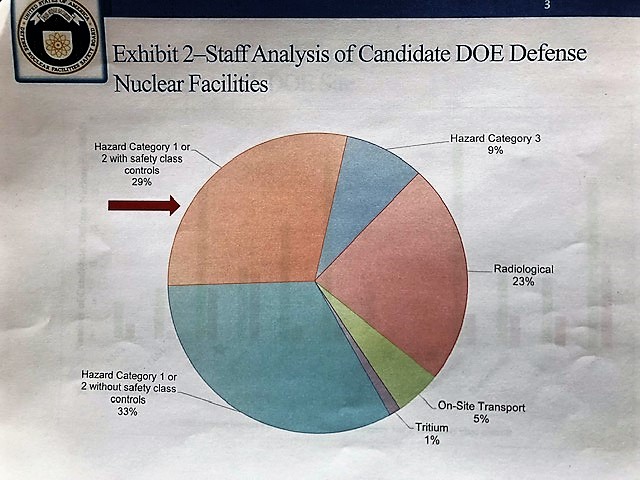
Continue reading

Putin warns new weapons will point toward U.S. if missiles are deployed in Europe

MOSCOW (Reuters) In his annual address Feb. 19, Russian President Vladimir Putin warned about consequences if the United States deployed missiles in Europe.

BY  | washingtonpost.com February 20, 2019

MOSCOW — Russian President Vladimir Putin said Wednesday that his country’s new missiles would point toward the United States if Washington deploys missiles in Europe. Putin emphasized that Russia will only respond if the United States makes the first move, but his remarks were among the strongest yet on a potential new arms race after the countries’ mutual pullout from a Cold War-era nuclear weapons treaty.

“Let me be loud and clear,” Putin told lawmakers gathered at a historic hall near the Kremlin for an annual address that is akin to the U.S. State of the Union speech.

He continued with a message to Europe, saying Russia would be “forced to create and deploy types of weapons” that can be used against nations that pose “direct threats.” And in a clear reference to the United States, Putin said the Russian missiles also could be trained on where “the centers of decision-making are located.”

Nuclear saber-rattling has become key to the Kremlin’s projection of power both at home and abroad, and could be an attempt to bring Washington to the negotiating table.

Continue reading

I Was a Nuclear Site Guard. My Colleagues Sexually Assaulted Me.

BY JENNIFER GLOVER | nytimes.com 

Ms. Glover was a security guard at the Department of Energy’s Nevada National Security Site.


The violence and lack of accountability I experienced at such a sensitive location put us all at risk.

The sexual harassment and violence I endured while working as a security guard at the Department of Energy’s Nevada National Security Site loops over and over through my mind. I have nightmares about it to this day.

Continue reading

United States Files False Claims Act Lawsuit in Connection With MOX Fuel Fabrication Facility Contract

Department of Justice Office of Public Affairs

FOR IMMEDIATE RELEASE ― Thursday, February 14, 2019

The Department of Justice announced today that the United States has filed suit against CB&I AREVA MOX Services LLC (MOX Services) and Wise Services Inc. under the False Claims Act and the Anti-Kickback Act in connection with a contract between MOX Services and the National Nuclear Security Administration relating to the design and operation of the MOX Fuel Fabrication Facility (MFFF) at the NNSA Savannah River Site in Aiken, South Carolina.  MOX Services is a South Carolina Limited Liability Corporation with headquarters in Aiken, South Carolina.  Wise Services, which subcontracted with MOX Services, is an Ohio corporation with headquarters in Dayton, Ohio.

Under the MOX Contract, MOX Services agreed to design, build, operate (and ultimately decommission) the MFFF. The MFFF is designed to transform weapons-grade plutonium into mixed oxide fuel rods that may be irradiated in commercial nuclear power plants.  In performing the MOX Contract, MOX Services entered into a series of subcontracts with Wise Services between 2008 and 2016. Each of these subcontracts provided for Wise Services to supply labor, materials, equipment, and supervision for unplanned construction activities (e.g. general labor, plumbing, electrical, carpentry) deemed necessary to support MOX Services’ efforts at the MFFF.

Continue reading

Watch – A Woman’s Chernobyl Story

Natalia Manzurova is one of few surviving ‘liquidators,’ or nuclear workers sent into deal with the Chernobyl aftermath by the Soviet government. She is now in need of financial help with medical expenses associated with treatment for a brain tumor — the result of her 4.5 years at Chernobyl in the cleanup of the most extensive and tragic nuclear power plant accident in human history.
Read More & Find Out HOW TO DONATE 

Joe Cirincione (@Cirincione)
2/7/19, 7:50 PM

This is an incredible interview. If you doubted that Bolton was behind the killing of the #INFTreaty , or that Trump has no plan for what to do next, or that we are in a new arms race, just watch ⁦‪@UnderSecT‬⁩ struggle under ⁦‪@nickschifrin‬⁩ honest questioning.

Nuke Waste Destined to Remain

BY COLIN DEMAREST | thetandd.com 

Aiken Standard: ‘I’m not confident at all’: U.S. Sen. Lindsey Graham casts real doubt on Energy Department

GREENVILLE — South Carolina’s senior senator, who often stumps for the Savannah River Site, has little faith in the U.S. Department of Energy’s abilities going forward.

“No, I’m not confident the DOE can do almost anything,” U.S. Sen. Lindsey Graham said Monday during a question-and-answer session with reporters. “I’m not confident at all.”

That lack of trust casts a dark shadow over the prospective expansion of plutonium pit production, an enduring weapons mission of which SRS is an integral part, according to a joint recommendation from the National Nuclear Security Administration and the U.S. Department of Defense.

Continue reading

The Cost to Clean Up America’s Cold War Nuclear Waste Jumps to $377 Billion

The bill for a half century of nuclear weapons production is growing fast.

“The GAO [Government Accountability Office] estimates the EM’s “environmental liability grew by almost $105 billion, from $163 billion to $268 billion.”That’s the equivalent of taking one step forward and then being pushed seven steps back.”

BY popularmechanics.com February 5, 2019

The United States developed and built tens of thousands of nuclear weapons during the Cold War. A new report by the General Accounting Office (GAO) estimates the total cleanup cost for the radioactive contamination incurred by developing and producing these weapons at a staggering $377 billion, a number that jumped by more than $100 billion in just one year.

Most people think of the U.S. Department of Energy (DoE) and think of oil rigs, coal mines, solar energy panels, and wind farms. While the DoE does handle energy production—including nuclear power—it also handles the destructive side of nuclear energy. A large part of the DoE’s portfolio over the past several decades has been the handling of nuclear weapons research, development, and production. The DoE’s Office of Environmental Management (EM) is responsible for cleaning up radioactive and hazardous waste left over from nuclear weapons production and energy research at DoE facilities.
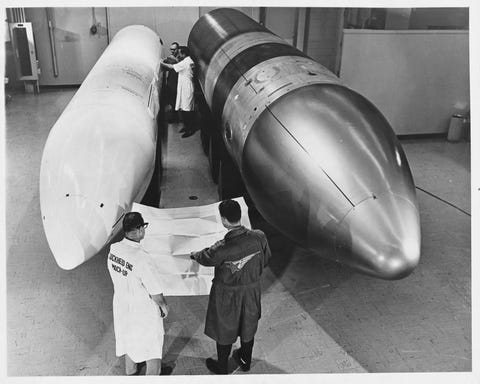
Mock-ups of Poseidon Missiles
Polaris and Poseidon missiles. GETTY IMAGES//HULTON DEUTSCH

In 1967 at the height of the U.S.–Soviet nuclear arms race, the U.S. nuclear stockpile totaled 31,255 weapons of all types. Today, that number stands at just 6,550. Although the U.S. has deactivated and destroyed 25,000 nuclear weapons, their legacy is still very much alive. Nuclear weapons were developed and produced at more than one hundred sites during the Cold War. Cleanup began in 1989, and the Office of Environmental Management has completed cleanup at 91 of 107 nuclear sites, Still, according to the GAO, “but 16 remain, some of which are the most challenging to address.” Those sites include Lawrence Livermore National Laboratory in California, the Hanford site in Washington, and the Nevada National Security Site.

Continue reading

Near site of Fukushima nuclear disaster, a shattered town and scattered lives

 Noboru Honda lost 12 members of his extended family when a tsunami struck the Fukushima prefecture in northern Japan nearly eight years ago. Last year, he was diagnosed with cancer and initially given a few months to live.

Today, he is facing a third sorrow: watching what may be the last gasps of his hometown.

For six years, Namie was deemed unsafe after a multiple-reactor meltdown at the Fukushima Daiichi Nuclear Power Plant following a 2011 earthquake and tsunami. In March 2017, the government lifted its evacuation order for the center of Namie. But hardly anyone has ventured back. Its people are scattered and divided. Families are split. The sense of community is coming apart.

LANL’s New Director Discusses Changing Culture

BY REBECCA MOSS | santafenewmexican.com 

Three months into his tenure as the 12th director of Los Alamos National Laboratory, Thomas Mason acknowledged that fixing the lab’s problems is going to take time, and setbacks could prevent Los Alamos from meeting key nuclear production goals.

But Mason said transforming the lab’s culture to one in which success is replicated — department to department, day after day — is the key to long-term success.

“The most important thing is to become more of a learning organization — where we can take practices [that work] and move them from one part of the organization to the next, and we can respond to stuff that happens … in a way that gets better over time,” Mason said in a recent interview.

“It is tricky,” he added. “There are 12,000 people who work at the lab every day.”

Continue reading

Russia Pulls Out of I.N.F. Treaty in ‘Symmetrical’ Response to U.S. Move

BY ANDREW E. KRAMERnytimes.com February 2, 2019

MOSCOW — President Vladimir V. Putin of Russia, in a decision that was widely expected, suspended his country’s observance of a key nuclear arms control pact on Saturday in response to a similar move by the United States a day before.

But adding to a sense that the broader architecture of nuclear disarmament has started to unravel, Mr. Putin also said that Russia would build weapons previously banned under the treaty and would no longer initiate talks with the United States on any matters related to nuclear arms control.

The Trump administration withdrew from the treaty, a keystone of the late Cold War disarmament pacts known as the Intermediate-Range Nuclear Forces Treaty, saying that Russia had been violating it for years. The decision holds the potential to initiate a new arms race, not only with Russia, but also China, which was never a signatory to the 1987 treaty.

Continue reading

The U.S. And Russia Are Stocking Up On Missiles And Nukes For A Different Kind Of War

NPR, February 1, 2019, 6:07 AM ET By GEOFF BRUMFIEL

The true battle over these new weapons may end up in Congress. While Republicans seem ready to back the Trump administration’s request for more battlefield nukes, the newly elected Democratic majority in the House of Representatives seems intent on blocking them.

“We do not view nuclear weapons as a tool in warfare,” Adam Smith, now the Democratic chair of the House Armed Services Committee, said in a speech in November. “It makes no sense for us to build low-yield nuclear weapons.”

Continue reading

Trump makes it official: The US is pulling out of a Cold War-era nuclear weapons treaty with Russia

The world’s two greatest nuclear powers are set to pull out of a crucial nuclear weapons treaty beginning this weekend. The Intermediate-Range Nuclear Forces Treaty, prohibits the production or testing of ground-launched cruise missiles with a range of 300 to 3,400 miles.
Trump says the U.S. will withdraw from the INF Treaty on Saturday.

BY  | cnbc.com February 1, 2019

Brendan Smialowski | AFP | Getty Images
Russia’s President Vladimir Putin listens while U.S. President Donald Trump speaks during a press conference in Helsinki, Finland.

WASHINGTON — President Donald Trump said Friday that the United States is ready to withdraw from a crucial nuclear weapons treaty with Russia on Saturday, a move that has sparked concerns of a budding arms race between the world’s two biggest nuclear powers.

The announcement comes a day after Russia and the United States said that discussions to save the Intermediate-Range Nuclear Forces Treaty had failed.

“Tomorrow, the United States will suspend its obligations under the INF Treaty and begin the process of withdrawing … which will be completed in six months unless Russia comes back into compliance by destroying all of its violating missiles, launchers, and associated equipment,” Trump said in a statement.


Continue reading

MERKLEY, SENATORS INTRODUCE BILL TO PREVENT NUCLEAR ARMS RACE

merkley.senate.gov Thursday, January 31, 2019 WASHINGTON, D.C. 

Oregon’s Senator Jeff Merkley and Senators Elizabeth Warren (D-MA), Kirsten Gillibrand (D-NY), Edward J. Markey (D-MA), Ron Wyden (D-OR), and Bernie Sanders (I-VT), along with Senators Chris Van Hollen (D-MD), Tammy Baldwin (D-WI), Kamala Harris (D-CA), and Sherrod Brown (D-OH), today announced the introduction of the Prevention of Arms Race Act of 2019, legislation that would pull the United States and Russia back from the brink of a 21st Century nuclear arms race. Merkley and Markey are members of the Senate Foreign Relations Committee, and Warren and Gillibrand serve on the Senate Armed Services Committee.

“There’s a reason that kids today don’t do duck-and-cover drills in schools and that nobody has bomb shelters in their backyards anymore. That reason is because of key agreements like the Intermediate-Range Nuclear Forces Treaty and the New Strategic Arms Reduction Treaty,” said Merkley. “This era of stability is put at great risk by President Trump’s decision to unilaterally pull out of the INF Treaty. This decision ignores all the lessons from the Cold War. There is no doubt that Russia is violating the INF Treaty, but the right path forward is to work to bring them back into compliance, not free them to produce more nuclear weapons. Blowing up the Treaty risks the proliferation of nuclear-capable systems by Russia, threatening Europe and jeopardizing decades of bipartisan efforts to reduce nuclear dangers with Russia.”

“A nuclear arms race would endanger the entire world and threaten every single person in our country, and Congress has a responsibility to ensure that President Trump does not start one. President Trump’s imminent unilateral withdrawal from a bipartisan weapons treaty with Russia, without consulting Congress, would mean the Prevention of Arms Race Act is more important than ever,” said Gillibrand. “A reckless withdrawal would further damage our relationships with our allies, Russia would not be legally constrained from deploying larger numbers of their previously prohibited missiles, and the world would be much less safe. I urge my colleagues to support this bill to prevent a new arms race, and I will continue to do everything I can to keep all Americans safe.”

“Pulling out of the INF Treaty plays squarely into Russia’s hands while undermining America’s security and betraying our NATO allies,” Markey said. “The Trump administration needs to work more closely with our NATO allies to force Russia back into compliance. And as the chance of a confrontation between American and Chinese forces rises the Indo-Pacific, it makes little sense to add further ambiguity over whether U.S. missiles stationed around the region are nuclear-armed. This legislation will help ensure that we don’t match two major adversaries missile-for-missile, trigger a new nuclear arms race, and incur unacceptable amounts of risk in an already tenuous security environment.”

“If Donald Trump walks out of the INF Treaty, he will risk a new destabilizing and costly arms race and antagonize important allies,” said Wyden. “The administration should instead be working with European allies to pressure Russia back into compliance.”

The Senators’ legislation comes in advance of the Trump Administration’s expected action this weekend to unilaterally withdraw the United States from the Intermediate-Range Nuclear Forces Treaty (INF)  treaty. The State Department set a February 2, 2019 deadline for Russia to return to compliance with the Treaty after a hasty and un-vetted declaration by President Trump in October that the United States intended to withdraw from the landmark treaty with Russia. The INF was originally signed by President Reagan and Soviet General Secretary Mikhail Gorbachev in 1987.

Continue reading

Opponents fight back against WIPP permit change on waste volume tracking, appeal filed

“Scott Kovac of Nuclear Watch New Mexico said the change should not have been approved without an explanation from the DOE about how to address lost space after a contamination incident in 2014 that led to a three-year closure of the facility.”

By Adrian Hedden Carlsbad Current-Argus

Two advocacy groups in New Mexico filed a legal appeal Thursday seeking to undo a New Mexico Environment Department order that allows the Energy Department to change the way it records underground transuranic waste volume at its Waste Isolation Pilot Plant (WIPP) near Carlsbad.

The Southwest Research and Information Center (SRIC) and Nuclear Watch New Mexico (NWNM) filed their notice of appeal in the New Mexico Court of Appeals to block the modification to WIPP’s state hazardous waste permit.

While it technically takes effect this month, as a practical matter the new counting system won’t be instituted right away because DOE has not drafted its policy on implementation, said SRIC Administrator Don Hancock by email.

A Dec. 21 order from then-state Environment Department Secretary Butch Tongate authorized DOE to stop recording empty spaces between container drums as waste. The order adopted the findings of state Hearing Officer Max Shepherd, who recommended waste volume counted against the disposal cap set by the 1992 WIPP Land Withdrawal Act should cover only the actual waste inside containers.

“The modification is contrary to federal law, changes 20 years of practice in the WIPP Permit and operations, ignores the record in the proceeding including testimony in three days of hearings, and violates the New Mexico-DOE Consultation and Cooperation Agreement,” Hancock said in a press release.

He called on New Mexico’s new governor and environment chief not to back the change in court, but rather overturn it. Given the official implementation date is Jan. 20, any administrative delay or rejection would happen soon, he added.

Continue reading

NV Governor and AG speak against DOE plutonium shipment

kolotv.com | RENO January 30th, 2019

See video of news conference by governor & attorney general of Nevada, angry about DOE’s secret shipment of plutonium from SRS to NV, with SRS Watch comments: https://www.kolotv.com/content/news/505096611.html

Filings by State of Nevada in Nevada district court, in plutonium shipment docket (3:18-cv-00569), January 31, 2019:
PLAINTIFF’S MOTION FOR A TEMPORARY
RESTRAINING ORDER
(REQUEST FOR RULING BY JANUARY 31, 2019)

PLAINTIFF’S STATUS REPORT

PLAINTIFF’S MOTION FOR A STATUS HEARING

energy.gov | WASHINGTON D.C. – The Department of Energy’s National Nuclear Security Administration (DOE/NNSA) is committed to protecting the health, safety, and security of the public at all of our sites as we conduct our important national security missions.  The recent plutonium shipments to the Nevada National Security Site were undertaken to comply with an order issued by the U.S. District Court in South Carolina.

It is inaccurate to state that the Members of the Nevada delegation were not informed of this movement. The Department of Energy was as transparent as operational security would permit. Efforts were made to ensure that Members of Congress representing the states involved were notified of the planned movement ahead of time, as early as August 2018 when NNSA publicly released the plan in a Supplement Analysis. Since then, NNSA confirmed that it was “actively engaged” in removing one metric ton of plutonium from South Carolina to Nevada, Texas, and New Mexico.**

It is also inaccurate to characterize this material as “waste”. This material is essential for maintenance of the U.S. weapons stockpile, and is handled with the highest standards for safety and security. NNSA routinely ships this type of material between its sites as part of our national security missions and has done so safely and securely for decades.

###

**Aiken Standard, “NNSA: Weapons-grade plutonium will be moved out of SC this year, next year” www.aikenstandard.com

Russia & China Will Join Forces on Nuclear Weapons Strategy as U.S. Threatens to Leave Arms Deal

Russia and China are boosting bilateral cooperation on nuclear weapons strategies as they accused the United States of disrupting non-proliferation measures during a high-level meeting of the top five nuclear powers.

BY TOM O’CONNOR | newsweek.com January 30th, 2019

U.S. Under Secretary of State Andrea Thompson (center) and the U.S. delegation are seen in front of the Russian delegation as they attend a Treaty on the Non-Proliferation of Nuclear Weapons (NPT) conference consisting of the U.N. Security Council’s five permanent members (P5)—China, France, Russia, Britain and the U.S.—in Beijing, on January 30. THOMAS PETER/AFP/GETTY IMAGES

Representatives of the so-called “Nuclear Five” met Wednesday in Beijing, at a time of heightened tensions between the Eastern and Western permanent members of the United Nations Security Council. The grouping included China, France, Russia, the United Kingdom and the U.S., signatories of the Treaty on the Non-Proliferation of Nuclear Weapons (NPT), a landmark document that sought to curb the spread of weapons of mass destruction during a decades-long arms race between Washington and Moscow.

As the White House threatened to scrap another Cold War-era weapons treaty, China and Russia have sought to align their approach in the face of what they considered to be a destabilizing U.S. position.

“Issues of our cooperation and Chinese-Russian and Russian-Chinese coordination will surely be the focus of our attention,” Russian Deputy Foreign Minister Sergey Ryabkov said, according to the state-run Tass Russian News Agency. “It is very productive work. In 2016, we approved the statement on strategic stability at the level of the leaders. It is just an example of how Russia and China are registering joint common positions more precisely.”

The U.S. has accused Russia of violating the 1987 Intermediate-range Nuclear Forces (INF) treaty, which established a mutual ban on ground-launched nuclear and conventional missiles within the ranges of around 310 and 3,420 miles. Washington argues that Russia’s new Novator 9M729 missile violates the treaty, while Moscow claims that the extensive U.S. missile shield in Europe could be used offensively as well, effectively breaching the deal.

Continue reading

Nuclear News Archives – 2021

It seems we can’t find what you’re looking for. Perhaps searching can help.

Scroll to top