
In 1985, US President Ronald Reagan and and Russian President Mikhail Gorbachev declared that “a nuclear war cannot be won and must never be fought.”


2022 BLOG POSTS
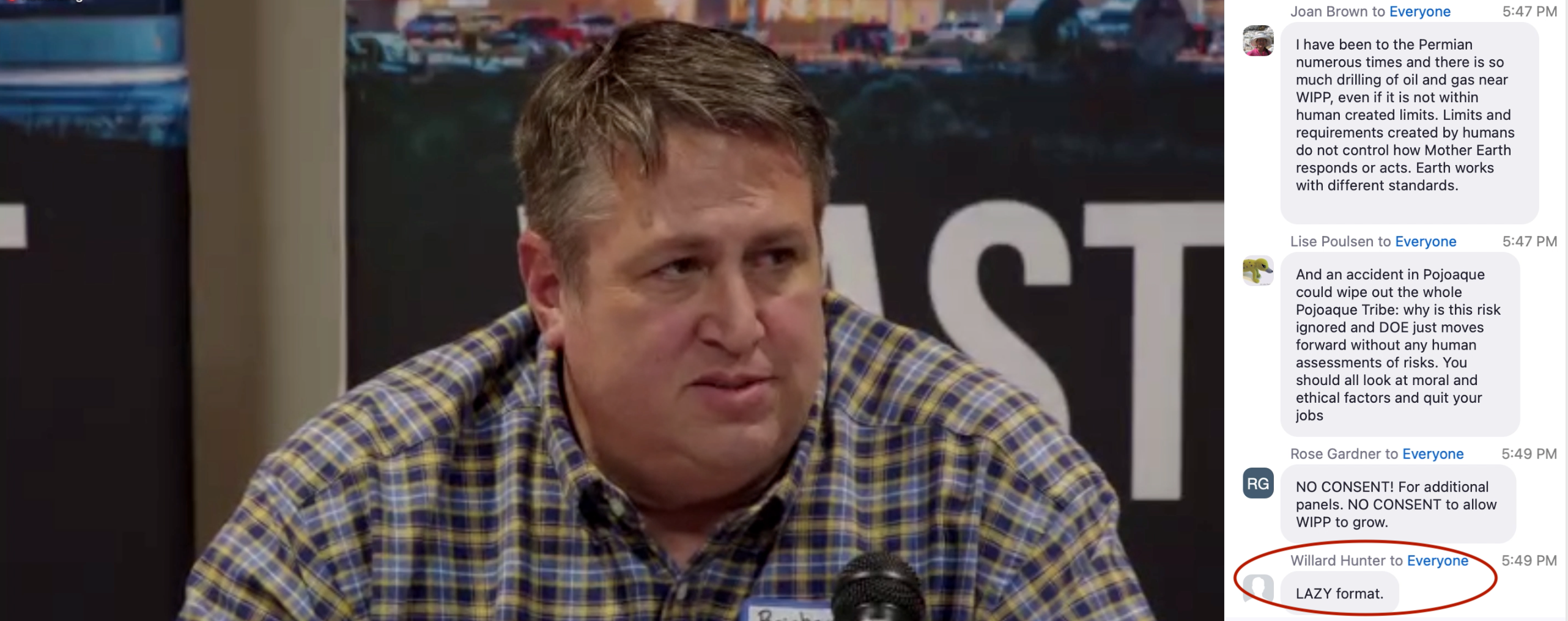
“LAZY format”: A Failed WIPP Community Engagement Meeting in Santa Fe
The U.S. Department of Energy and the Office of Environmental Management held a Presentation and “Community Forum” for Santa Fe on the Waste Isolation Pilot Plant (WIPP), formatted as a hybrid in-person and Zoom meeting on Thursday, July 7, 2022. Nuclear Watch New Mexico is extremely unsatisfied with the outcome of this meeting, and is not alone in criticizing both the substance of the meeting and the format.
We have recorded this public forum with the chat included because there was an overwhelming amount of participation within the chat, and we feel the chat is a valuable resource in and of itself, as well as a testament to the large amount of community concern present around the subject of WIPP. View that recording HERE (and below).

77th Anniversary of the Atomic Bombing of Nagasaki, Japan – Interfaith Discussion
SAVE THE DATE: 77th Anniversary of the Atomic Bombing of Nagasaki, Japan
Interfaith Discussion
Tuesday, August 9, 2022
5:15 p.m. Mass at the Cathedral Basilica of St. Francis of Assisi
Followed by Panel Discussion with Interfaith Leaders at 6:15 p.m.
ALBUQUERQUE – Friday, July 1, 2022 – Join Most Rev. John C. Wester, Archbishop of Santa Fe, for 5:15 p.m. Mass at the Cathedral Basilica of St. Francis of Assisi in Santa Fe, NM. His homily will be centered on his pastoral letter on nuclear disarmament, “Living in the Light of Christ’s Peace: A Conversation Toward Nuclear Disarmament,” released on January 11, 2022. Following Mass, at approximately 6:15 p.m., a panel discussion with prominent interfaith leaders on today’s need for nuclear disarmament will be held with a question and answer session. All are welcomed to either event.
In his pastoral letter, Archbishop Wester reflects upon his trip to Hiroshima and Nagasaki, the history of Catholic social teaching on nuclear weapons, the history of the development and production of nuclear weapons in New Mexico, and Jesus’ example of nonviolence. He encourages all to read the pastoral letter and use the reflection questions and suggestions for action.
Archbishop’s pastoral letter can be found here.
For more information, contact the Office of Social Justice & Respect Life (505) 831-8205.

Why Funding for the SLCM Nuclear Warhead Should Be Deleted
Introduction: In 1991, in response to the ongoing collapse of the Soviet Union, President George H. Bush ordered the withdrawal of all nuclear-armed sea-launched cruise missiles (SLCMs) from U.S. surface ships and submarines. In 2018 President Trump’s Nuclear Posture Review proposed to redeploy SLCMs on Virginia-class attack submarines, saying they would provide the United States with “a needed non-strategic regional presence” that would address “the increasing need for flexible and low-yield options.”1 Congress subsequently approved $15.2 million in FY 2022 funding for the Navy’s new cruise missile and nuclear warhead.
In March 2022 President Biden transmitted a new classified Nuclear Posture Review to Congress that reportedly canceled the Sea-Launched Cruise Missile. In parallel, his proposed FY 2023 budget for the National Nuclear Security Administration (NNSA) has no funding for the SLCM nuclear warhead. This has prompted some congressional pushback, with one suggested compromise being continuing modest research funding. But as a Congressional Research Service analysis put it: “The Navy indicated that the program was “cost prohibitive and the acquisition schedule would have delivered capability late to need.”
New & Updated
Uranium debate resurfaces at conference
“Protest, speakers highlight industry’s legacy pollution”
A panel of tribal, state and federal officials kicked off a pro-nuclear conference Monday (April 20) near Albuquerque with detailed warnings about the harm uranium extraction can cause, stressing that any burgeoning mining projects in the state will face stiff opposition from communities still reeling from legacy pollution.
The Clean Energy Association of New Mexico organized the “Nuclear in New Mexico” conference at a hotel on Santa Ana Pueblo, convening hundreds of industry executives, as well as government officials and community members, to discuss what organizers called the nuclear “renaissance” occurring in New Mexico and across the country.
Since President Donald Trump’s second term began in January 2025, the state has seen renewed activity from companies with long-stalled uranium mine permit applications, as well as new notices of intent from companies seeking federal and state permissions to operate the first new mine in the state in decades.
The conference, which runs through Wednesday, includes panels on the nation’s increasing need for uranium, both for electricity and nuclear weapons, as well as new and emerging extraction processes that industry leaders tout as safe for the environment.

Plaintiffs Tour the Savannah River Site’s Plutonium “Pit” Bomb Core Plant –
Most Expensive Building in U.S. History is Key to New Nuclear Arms Race
FOR IMMEDIATE RELEASE, April 22, 2026
Contact: Tom Clements, Director, SRS Watch, 803-240-7268 | Email
Jay Coghlan, 505.989.7342, c. 505.470.3154 | Email
Shelby Cohen, Comms Manager, SC Env. Law Project, 864.414.7726 | Email
Columbia, SC – On April 21, plaintiffs Savannah River Site Watch, Nuclear Watch New Mexico and Tri-Valley CAREs toured the plutonium “pit” bomb core production plant at the National Nuclear Security Administration’s (NNSA’s) Savannah River Site (SRS) near Aiken, South Carolina. They were accompanied by their attorney from the South Carolina Environmental Law Project and a science consultant from the Union of Concerned Scientists.
Plutonium pits are the core components of all U.S. nuclear weapons. The NNSA is seeking to expand production to at least 30 plutonium pits per year at the Los Alamos National Laboratory (LANL) in New Mexico and at least 50 pits per year at SRS, which has never previously produced pits. NNSA pushed forward with the project without required public review, in violation of the National Environmental Policy Act (NEPA).
Plaintiffs sued in federal court in Columbia, SC and won, requiring the NNSA to complete a nationwide programmatic environmental impact statement (PEIS), with public hearings to be held this May (listed below). The court-approved settlement agreement also required an inspection of the Savannah River Plutonium Processing Facility by plaintiffs to ensure that no production begins before the completion of the final PEIS and simultaneous Record of Decision, which NNSA now says is expected in early 2027. NNSA officials also informed plaintiffs that 90% design and “rebaselined” costs will not be completed until September 2026, which means that once again Congress will be appropriating taxpayers’ money without knowing full costs.
The SRS pit plant will be the most expensive buildings ever built in the USA, with a current NNSA estimate of up to $30 billion even before all total costs are known (includes at least $5 billion in sunk costs for SRS’ failed MOX Fuel Fabrication Facility being “repurposed” to pit production). The agency’s recent budget request for FY 2027 (pp 17-19) reveals an 87% jump in combined pit production funding for LANL and SRS, averaging $5 billion for each of the next six years.
LIVE: Press Briefing After Plaintiffs Inspect Savannah River Site Plutonium “Pit” Bomb Core Plant

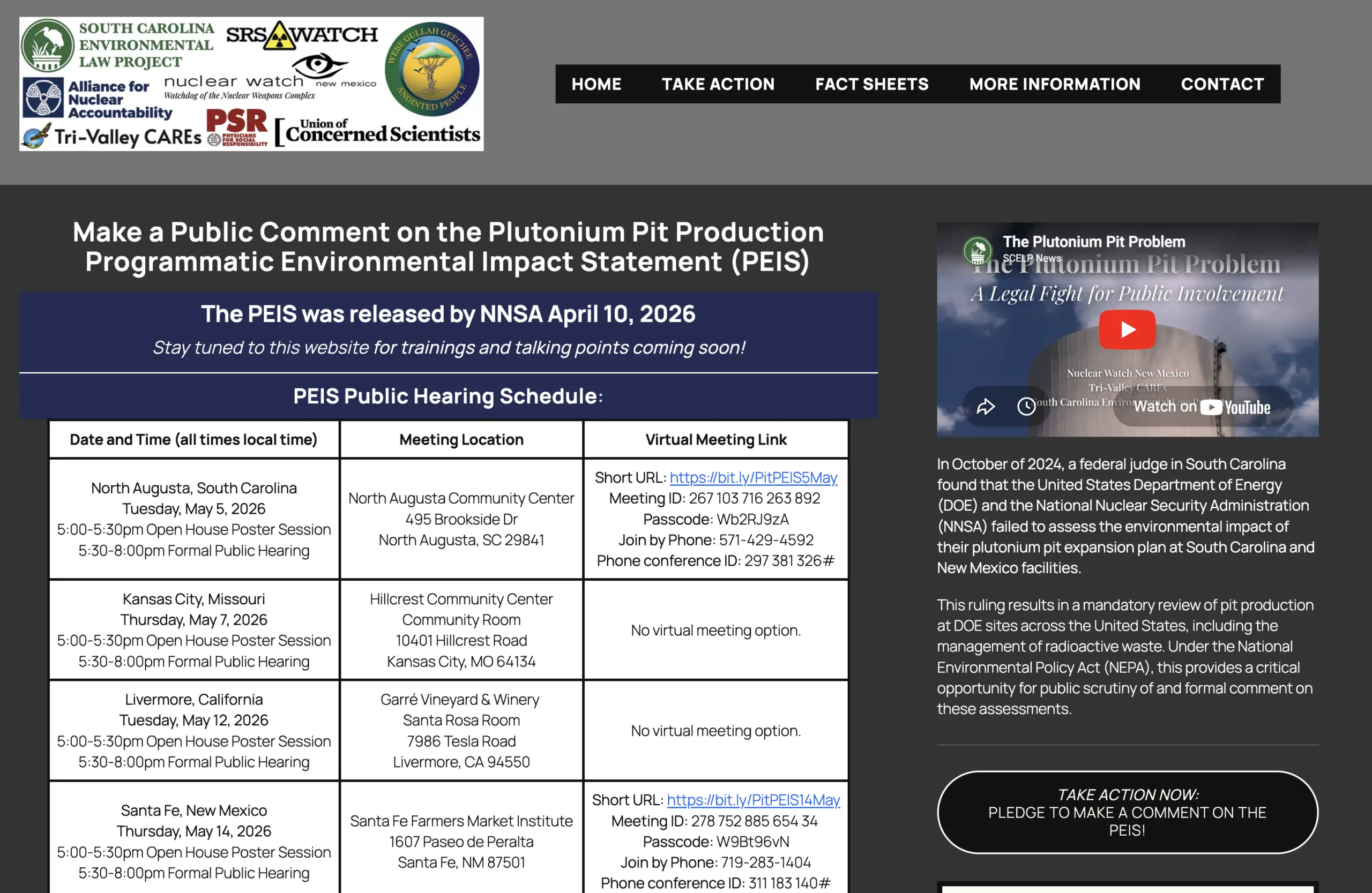
Plutonium Pit Production Programmatic Environmental Impact Statement (PEIS) is Out Now! Visit PitPEIS.com for More!
The Draft Programmatic Environmental Impact Statement (PEIS) for Plutonium Pit Production was released by NNSA on Friday, April 10th. This opens a critical window for public comment on NNSA’s unnecessary plan to expand production of plutonium “pit” bomb cores. This PEIS was brought on by a lawsuit against NNSA over its failure to complete the NEPA process for this plan. As you likely know, NEPA is fully under attack by the current administration — this may be the last foreseeable full NEPA process taking place, making it all the more critical to be involved.
As a resource to help you comment and encourage widespread comment-making in your community, we (lawsuit plaintiffs Nuclear Watch New Mexico and Tri-Valley CAREs, as well as the Union of Concerned Scientists, Physicians for Social Responsibility, and groups from the Alliance for Nuclear Accountability), created a website that is now live!
Your Pit PEIS central hub for information and action: https://pitpeis.com/
Please take a look and feel free to share, and note that we’ll be continuing to update it as soon as new resources become available.
For example, we will soon have:
– A schedule of comment trainings
– Sample comments and talking points
– Regional-focused resources to help engage your local community around this issue
Nuclear Weapons Issues & The Accelerating Arms Race: April 2026
Nuclear Weapons:
Trump has gone beyond the pale, threatening to wipe out an entire civilization (Iran). The Senate majority leader John Thune tweeted thuggishly, “Iran would be wise to take President Trump at his word. They can choose the easy way or the hard way.” Speaker Mike Johnson had adjourned the House.
There is only one thing made by man that can wipe out a civilization overnight and that is nuclear weapons. NNSA and LANL are all complicit in this. 46 Democratic House members have invoked the 25th amendment to get rid of Trump but no Republicans. We have a two week truce which Netanyahu seems determined to destroy by carpet bombing Lebanon.
FY 2027 budget: See press release and press release.
- Military spending in FY 2026 was already a record breaker at $1 trillion. Trump proposes nearly $1.5 trillion for FY 2027. $1.1 trillion as base budget, $355 billion through reconciliation.
- $18 billion for Golden Dome through reconciliation. In the Alice in Wonderland world of nuclear weapons policies, defense is offense.
- $53.9 billion for the Department of Energy (DOE) in FY 2027. Sixty-one per cent ($32.8 billion) is for its semi-autonomous nuclear weapons agency, the National Nuclear Security Administration (NNSA). DOE’s Office of Science is gutted by $1.1 billion which “eliminates funding for climate change and Green New Scam research.” DOE’s Office of Energy Efficiency and Renewable Energy is eliminated. Nationwide cleanup of legacy Cold War radioactive and toxic wastes at DOE sites is cut by $386 million to $8.2 billion. LANL’s cleanup program is given a modest 5% bump but there is escalating conflict with the New Mexico Environment Department.
- Funding for plutonium pit production is increased by 87%, an average of $5.1 billion in projected costs for each year FY 2028-2031, pretty much equally divided between LANL and the Savannah River Site (SRS) in South Carolina. LANL will spend $14 billion for pit production over the next six years. None of this is to maintain the safety and reliability of the existing nuclear weapons stockpile. It is all for new designs.
- Aggressive nuclear warhead production, including the new-design W93. More new designs in the wings.
Performance Evaluation Reports: Received via the Freedom of Information Act and posted into NNSA’s E-FOIA reading room, thanks to our two earlier lawsuits. Concerning the LANL PER please see our press release at https://nukewatch.org/press-release-item/lanl-2025-per-pr-3-6-26/ Tom Clements of SRS Watch points out that the SRS PER makes clear poor contractor performance at the Savannah River Plutonium Processing Facility. This shows the value of the PERs and can be used as a cudgel against them. I smell blood in the water over the Savannah River Plutonium Processing Facility.
LANL AI center in Ypsilanti, MI: The Township lawyer contacted me after the article Tiny City Fears Iran Drone Strikes Because of New Nuclear Weapons Datacenter was published. I ended up having a 1.5 hour zoom with him and Township staff. They are fighting LANL’s AI center hard. I sent them our press release on the LANL SWEIS which they say was helpful. In response to a commenter’s question (probably me), the final SWEIS explicitly says that a data center will not be built at LANL. However, it completely fails to mention the one in Ypsilanti, is really duplicitous.
Accelerating Arms Race: Trump’s threat to obliterate a 7.000 year old civilization. Now Iran will really want nuclear weapons.
Los Alamos Lab Banking on Plutonium “Pit” Production and New-Design Nuclear Warheads But Fights Against Cleanup
FOR IMMEDIATE RELEASE, April 7, 2026
Contact: Jay Coghlan, 505.989.7342, c. 505.470.3154 | Email
Sophie Stroud, 505.231.9736 | Email
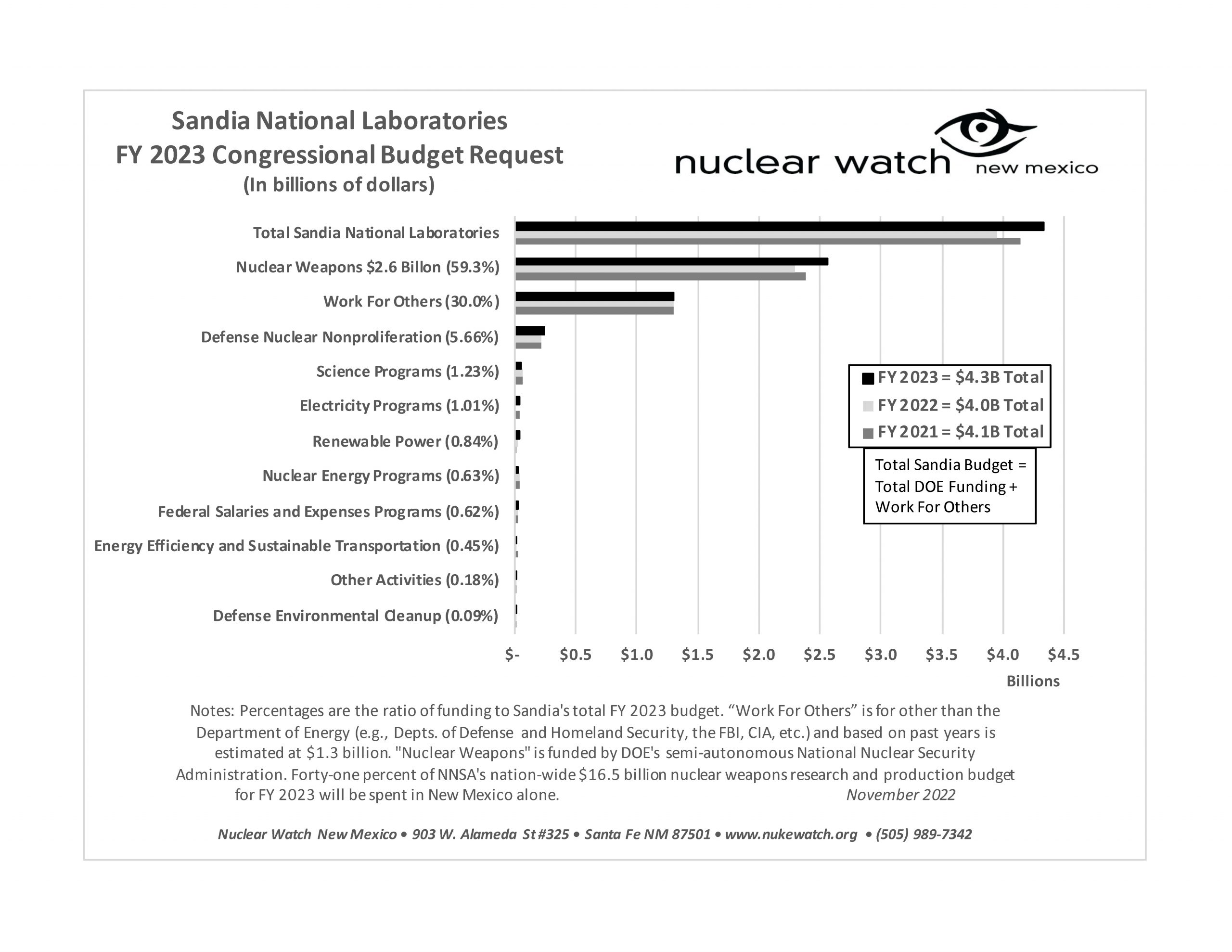
Santa Fe, NM – The Department of Energy (DOE) has released additional details for the Los Alamos National Laboratory’s fiscal year 2027 budget. Earlier budget documents showed an 83% increase in funding for plutonium “pit” bomb core production, bringing it to $2.4 billion in FY 2027. An average of $2.3 billion will be spent in each of the following five years, for a total of $14 billion over six years. The National Nuclear Security Administration (NNSA) has directed the Lab to double pit production to at least 60 pits per year, making it more and more a nuclear weapons production site. However, no future pit production is to maintain the safety and reliability of the existing nuclear weapons stockpile. Instead, it is all for new-design nuclear weapons for the new nuclear arms race.
As a direct case in point, a newly released DOE budget document demonstrates that LANL will be funded $478 million in FY 2027 for the U.S.’ first completely new-design nuclear warhead since the Cold War, the submarine-launched W93. This is despite the recent completion of life extension programs for the U.S.’ two existing sub-launched warheads (the W76 and W88) that gave them new military capabilities, costing around $12 billion dollars. Nevertheless, the W93 program is moving forward, largely because of lobbying by the United Kingdom.
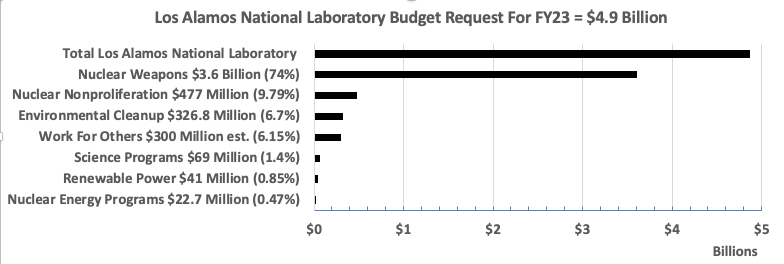
As LANL becomes more and more a nuclear weapons production site, non-weapons “Science” is being cut nearly in half ($84.7 million in FY 2026 to $43 million in FY 2027). Nonproliferation programs are cut from $377 million in FY 2026 to $345 million in FY 2027. All funding for renewable energy research has been eliminated, with the exception of $5.5 million for geothermal.
Trump Accelerates New Nuclear Warhead Production
Nearly Doubles Funding for Plutonium “Pit” Bomb Core Production
FOR IMMEDIATE RELEASE, April 6, 2026
Contact: Jay Coghlan, 505.989.7342, c. 505.470.3154 | Email
Sophie Stroud, 505.231.9736 | Email
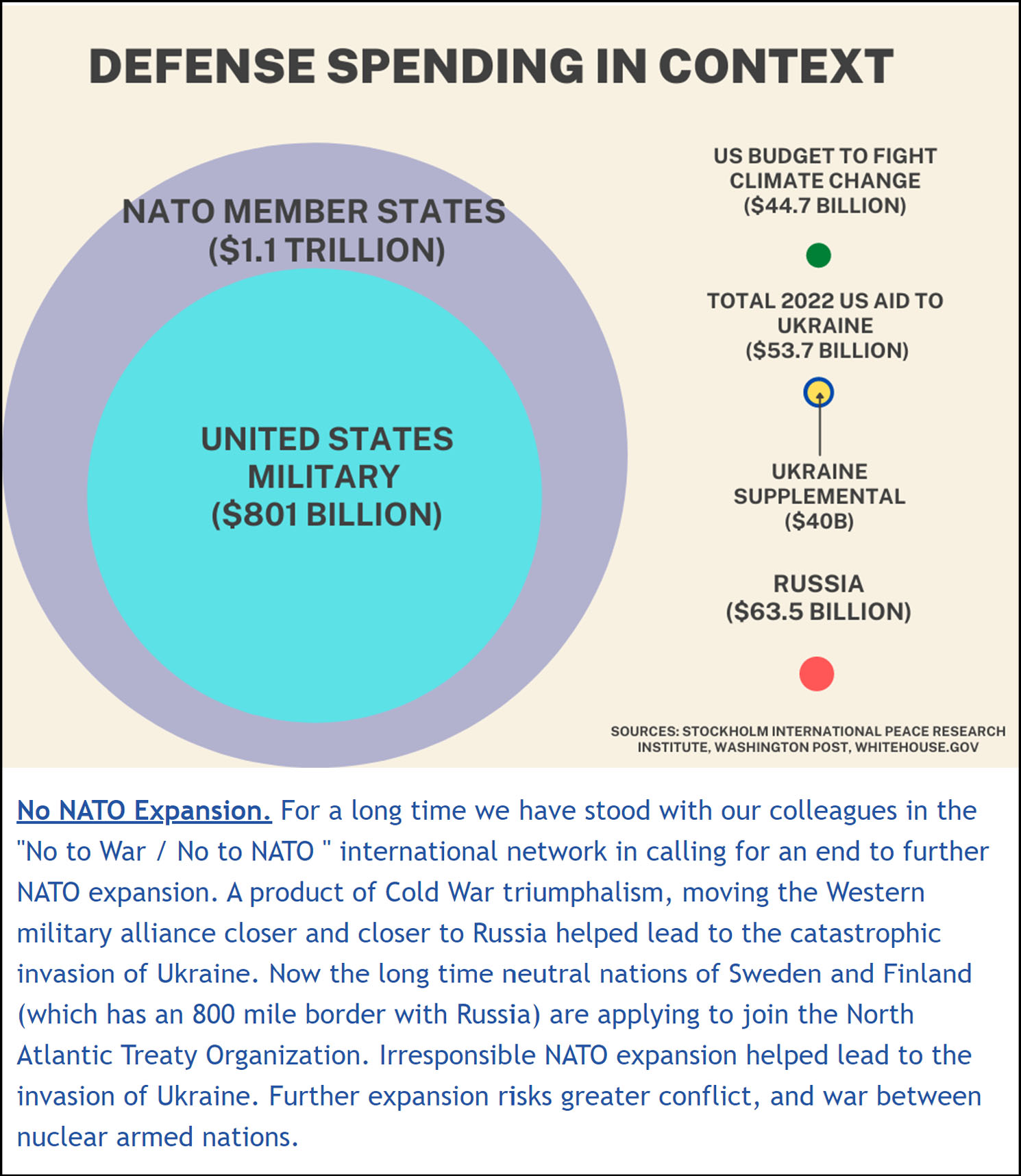
Santa Fe, NM – The Trump Administration has released military budget numbers for the federal fiscal year 2027 (which begins October 1, 2026). This still current fiscal year 2026 is already a record breaker for military spending at one trillion dollars. Trump now proposes nearly $1.5 trillion in military spending in FY 2027, of which $1.1 trillion is base funding for the Department of War and an additional $350 million is through so-called budget reconciliation. On top of all this, Trump will likely seek $200 billion in supplementary appropriations for the war in Iran, for a potential total of $1.7 trillion in military spending in FY 2027 (a 70% increase above FY 2026). At the same time, there is a 10% across-the-board cut to non-military spending. Much of the remaining discretionary funding for education, wildfire protection, environmental regulations, health care, etc., will be constrained by a focus on border control and immigration enforcement.
Trump proposes $53.9 billion for the Department of Energy (DOE) in FY 2027. Sixty-one per cent ($32.8 billion) is for its semi-autonomous nuclear weapons agency, the National Nuclear Security Administration (NNSA). DOE’s Office of Science is gutted by $1.1 billion which “eliminates funding for climate change and Green New Scam research.” DOE’s Office of Energy Efficiency and Renewable Energy is eliminated. Nationwide cleanup of legacy Cold War radioactive and toxic wastes at DOE sites is cut by $386 million to $8.2 billion ($3 billion of which is reserved for the Hanford Site; other site-specific cleanup budget numbers are still not yet available).

LANL Plans to Spend $11.5B on Pit Production over Next Five Years, While New Mexico Remains One of the Poorest States in the Nation
A full one billion dollars is being added to plutonium “pit” bomb core production at the Los Alamos Lab for fiscal year 2027 (which begins this October 1). This tops out at $2.3 billion for each of the next five fiscal years, for a total of $11.5 billion.
None of this pit production is to maintain the safety and reliability of the existing nuclear weapons stockpile. Instead, it’s all for new-design nuclear weapons which can’t be tested because of the international testing moratorium, thereby perhaps eroding confidence in the stockpile. Alternatively, it could prompt the U.S. to resume testing (which Trump has already threatened), after which other nuclear weapons powers would surely follow, thereby accelerating the new nuclear arms race.
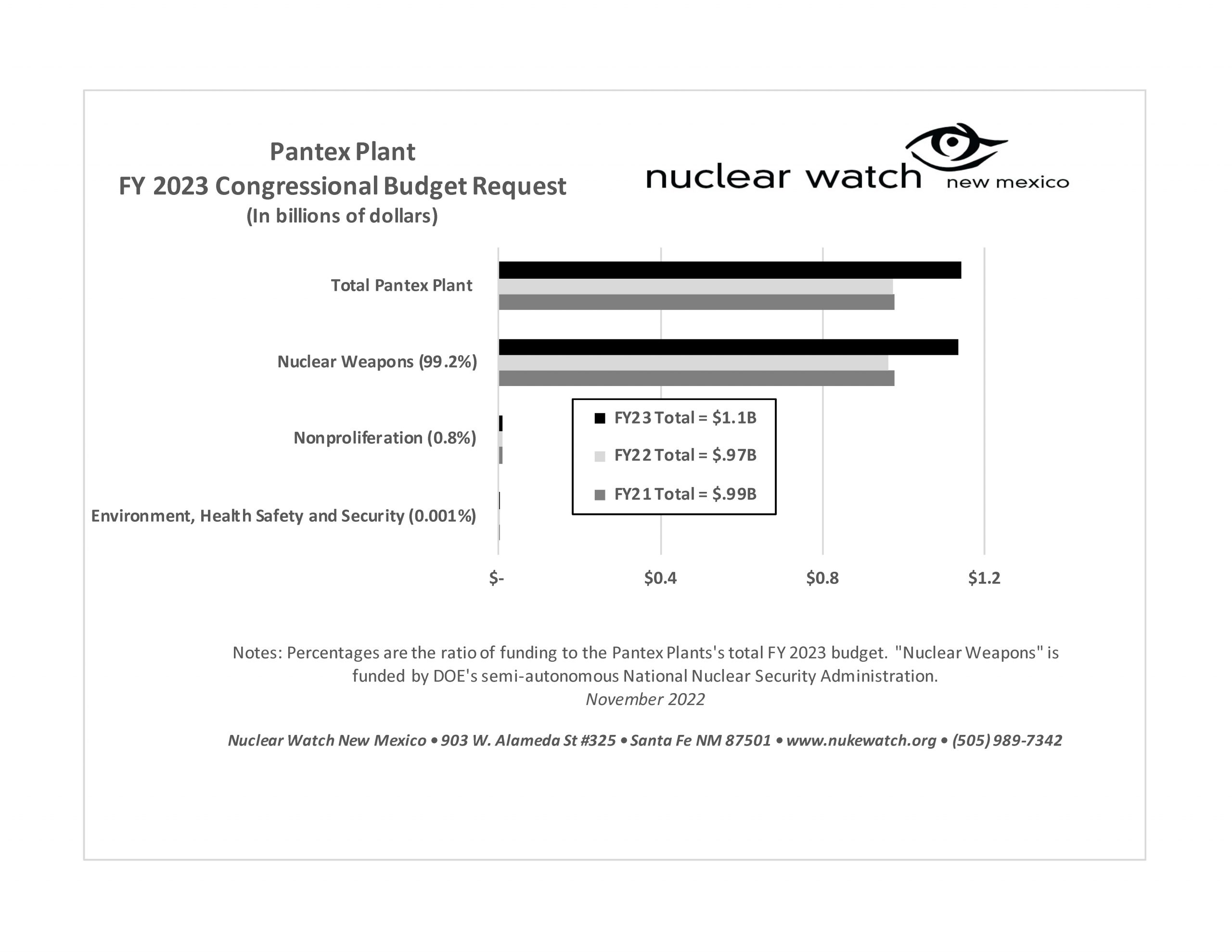
Other than for new-design nuclear weapons, plutonium pit production is simply not needed. In 2006 independent experts found that plutonium pits have serviceable lifetimes of at least 100 years (their average is now around 43 years). The National Nuclear Security Administration (NNSA) has avoided fully updated pit lifetime studies since then. There are already at least 15,000 existing pits stored at the NNSA’s Pantex Plant near Amarillo, TX.
Plutonium pit production is the NNSA’s most expensive and complex program ever.
Trump Accelerates New Nuclear Warhead Production
Nearly Doubles Funding for Plutonium “Pit” Bomb Core Production
FOR IMMEDIATE RELEASE, April 6, 2026
Contact: Jay Coghlan, 505.989.7342, c. 505.470.3154 | Email
Sophie Stroud, 505.231.9736 | Email
Santa Fe, NM – The Trump Administration has released military budget numbers for the federal fiscal year 2027 (which begins October 1, 2026). This still current fiscal year 2026 is already a record breaker for military spending at one trillion dollars. Trump now proposes nearly $1.5 trillion in military spending in FY 2027, of which $1.1 trillion is base funding for the Department of War and an additional $350 million is through so-called budget reconciliation. On top of all this, Trump will likely seek $200 billion in supplementary appropriations for the war in Iran, for a potential total of $1.7 trillion in military spending in FY 2027 (a 70% increase above FY 2026). At the same time, there is a 10% across-the-board cut to non-military spending. Much of the remaining discretionary funding for education, wildfire protection, environmental regulations, health care, etc., will be constrained by a focus on border control and immigration enforcement.
Trump proposes $53.9 billion for the Department of Energy (DOE) in FY 2027. Sixty-one per cent ($32.8 billion) is for its semi-autonomous nuclear weapons agency, the National Nuclear Security Administration (NNSA). DOE’s Office of Science is gutted by $1.1 billion which “eliminates funding for climate change and Green New Scam research.” DOE’s Office of Energy Efficiency and Renewable Energy is eliminated. Nationwide cleanup of legacy Cold War radioactive and toxic wastes at DOE sites is cut by $386 million to $8.2 billion ($3 billion of which is reserved for the Hanford Site; other site-specific cleanup budget numbers are still not yet available).
Federal budget could mean nearly $1.7B more for Los Alamos lab
“A 21% surge in spending for defense programs funded by the U.S. Department of Energy would mean a more than $1.7 billion boost for nuclear weapons work at Los Alamos National Laboratory.”
| April 6, 2026 santafenewmexican.com
Early budget documents for the agency are in line with a presidential budget proposal released Friday, which emphasizes military spending — with a whopping $1.5 trillion recommendation for the Department of War — partially offset by cuts to domestic programs like health care and education, as well as what the federal government calls the “Green New Scam”, or climate-related work.
New nuclear safety rules reduce protections for workers, the public
“They’re pulling away from what’s kept us safe all these years.”
Bradley P. Clawson spent more than three decades handling highly radioactive materials at Idaho National Laboratory, a nuclear energy testing and production hub outside Idaho Falls. His work ranged from shipping and receiving nuclear naval fuels to helping bring hundreds of canisters of leftover fuel to Idaho for storage after the catastrophic Three Mile Island meltdown. He often handled nuclear fuel in “hot cells,” immensely contaminated areas reinforced with thick concrete.
Throughout, Clawson, a member of the United Steelworkers union, leaned on safety standards to argue for extra protections against radiation, including respirators and additional shielding.
But President Donald Trump’s sweeping agenda to expand nuclear energy and modernize nuclear weapons now includes easing the radiation standards that Clawson credits with keeping his exposure as low as possible.
Final Los Alamos Lab Site-Wide Environmental Impact Statement
The National Nuclear Security Administration’s Future Path for the Lab:
Radically Expanded Nuclear Weapons Production
“Defers” Comprehensive Cleanup Until Plutonium “Pit” Production is Done
FOR IMMEDIATE RELEASE, March 25, 2026
Contact: Jay Coghlan, 505.989.7342, c. 505.470.3154 | Email
Santa Fe, NM – Today the Department of Energy’s semi-autonomous nuclear weapons agency, the National Nuclear Security Administration (NNSA), released its final Site-Wide Environmental Impact Statement (SWEIS) for Continued Operation of the Los Alamos National Laboratory. This is eighteen years after the last site-wide EIS, during which time the Lab has been increasingly transformed into a nuclear weapons production site for the new global nuclear arms race. As the final SWEIS’ accompanying Record of Decision puts it, “NNSA has decided to fully implement the Expanded Operations Alternative.” Final LANL SWEIS ROD, page 5.
The final LANL SWEIS also states “At this time, MDA C will be deferred until no longer associated with active facility operations.” Final LANL SWEIS, page N-41. Material Disposal Area C is an old radioactive and toxic waste dump, inactive since 1974. Not mentioned is the fact that the New Mexico Environment Department has issued a draft order mandating comprehensive cleanup at Area C, which Nuclear Watch New Mexico strongly supports and DOE and LANL bitterly oppose. The reason DOE and LANL now claim that Area C is “associated with active facility operations” is because it is located within a few hundred yards of PF-4, LANL’s production facility for plutonium “pit” bomb cores. This strongly implies that the Lab will never be comprehensively cleaned up until LANL’s nuclear weapons production mission is over, which in effect means never. Further, LANL still hasn’t documented the extent of the massive groundwater contamination that it has caused.
Aggressive Los Alamos labs expansion plan wins approval from National Nuclear Security Administration
“Jay Coghlan, executive director of Nuclear Watch New Mexico, said struggles at the Savannah River Site in South Carolina, which also was expected to become a pit production site, mean the onus will be on LANL.”
“’Eighty pits per year is becoming more and more likely,” Coghlan said. “LANL is going to have to fill in for delays at the Savannah River Site.’”
Coghlan argued the lab’s heightened focus on pit production will lead to a weakening commitment toward cleanup at Los Alamos National Laboratory.
“The[y] are so obsessed with it they are indefinitely postponing comprehensive cleanup when we know the groundwater has been contaminated,” he added.
| March 26, 2026 santafenewmexican.com
Federal officials have adopted the most aggressive of three operational plans under consideration for Los Alamos National Laboratory.
The “expanded operations alternative,” which lab officials announced Wednesday, when they also released a new sitewide environmental impact statement, includes facilities upgrades and other actions “to respond to future national security challenges and meet increasing requirements.”
DOE Plans to Pave Pueblo People’s Cultural Sites, Put Up a Parking Lot
“The U.S. Department of Energy’s National Nuclear Security Administration (NNSA) today released a final Site-Wide Environmental Impact Statement (SWEIS) for the Los Alamos National Laboratory (LANL) in New Mexico. The SWEIS lays out several alternatives for the laboratory’s growth and operations through 2038 for nuclear weapons activities and identifies the agency’s preferred path forward. ”
The NNSA chose the option that would most drastically increase LANL’s ramifications for the community, environment and resources. It would also severely impact the cultural resources of neighboring Pueblos. The addition of a parking lot, bus transfer station, and several solar energy installations number among the NNSA’s priorities over the cultural heritage of local Pueblos.
Below is a statement from Dr. Dylan Spaulding, senior scientist in the Global Security Program at the Union of Concerned Scientists (UCS):
“The NNSA’s selected plan has the biggest impacts on the site’s energy use including nearly doubling its consumption of petroleum fuel, electricity, and water, all the while the agency continues to struggle to remediate existing contamination to groundwater both on and offsite.”
“NNSA has made clear that it is prioritizing the creation of a new parking lot, for example, over safeguarding the cultural heritage sites of local Pueblo peoples. UCS has previously called for meaningful consideration and integration of Pueblos’ concerns into the laboratory’s plans, particularly around environmental justice issues. Not only were environmental justice topics removed from the plan due to a federal executive order, but as many as 33 cultural heritage sites could be impacted to make way for new construction.”
“Plutonium pit production remains a top driver of the lab’s expansion, but the assumptions and analyses in this document may already be out of date. The NNSA recently announced new quotas that double LANL’s requirements to 60 pits a year. That means the upper limit for pit production in this document may already be closer to the new baseline.”


Interfaith Panel Discussion on Nuclear Disarmament - August 9