
Most Recent

Public Interest Groups Warn NNSA on Plutonium Giveaway
FOR IMMEDIATE RELEASE, September 8, 2026
Joint Press Release from: South Carolina Environmental Law Project, Savannah River Site Watch & Nuclear Watch New Mexico
Contact: Tom Clements, Director, SRS Watch, 803-240-7268 | Email
Jay Coghlan, Nuclear Watch NM, 505-989-7342 | Email
Shelby Cohen, Comms Manager, SC Env. Law Project, 864.414.7726 | Email
South Carolina – Today, the South Carolina Environmental Law Project (SCELP) sent a letter of demand to the Department of Energy (DOE) and its semi-autonomous agency, the National Nuclear Security Administration (NNSA), about their proposed unsound and dangerous management of U.S. plutonium. The letter notified them that they must comply with the federal National Environmental Policy Act (NEPA) requirement for public review of the Trump Administration’s troubling plan to give away 19.7 metric tons of nuclear weapons-grade plutonium to private corporations.
SCELP’S letter, on behalf of Nuclear Watch New Mexico, Savannah River Site Watch, and a private citizen who lives near the Savannah River Site (SRS) in South Carolina, outlines why NNSA must be held to its legal NEPA obligations. The letter describes how recently issued presidential executive orders:
…constitute a vast change in the prior decisions and purposes of the DOE/NNSA surplus plutonium disposition program that has been in place since at least 1996… This change is also contrary to the larger nuclear non-proliferation policy of the United States restricting the commercial use of plutonium that has been in place for approximately fifty years.
This action follows SCELP’s earlier NEPA lawsuit on behalf of SRS Watch and Nuclear Watch New Mexico. In a landmark settlement, that litigation successfully compelled the NNSA to prepare a nationwide programmatic environmental impact statement on the production of plutonium “pit” bomb cores for nuclear weapons (the “Pit Production PEIS”).
Where Have All Your Dollars Gone? Long Time Passing
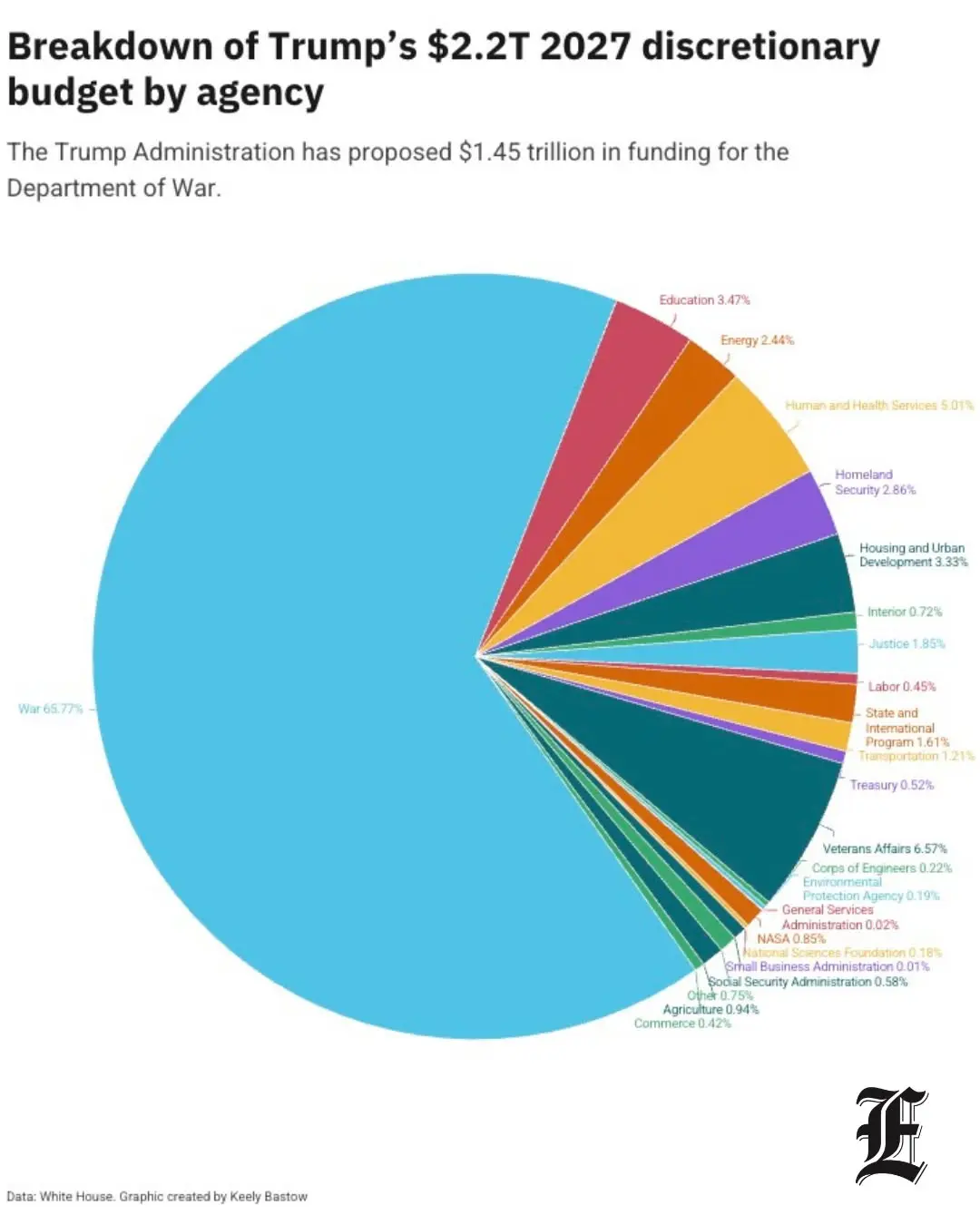
“When you ask people what sort of budget they’d like, and even when you ask them what they think the budget is, you get enormous pie slices for environmental protection and education. Here, in stark contrast, our so-called representatives are contemplating giving us 3.47% for education…”
By: David Swanson, World BEYOND War | August 18, 2026 worldbeyondwar.org
The discretionary budget for the U.S. government next year as proposed by Trump is depicted by the Washington Examiner in the above pie chart. It has passed the House and might pass the Senate. As long as half of Congress Members see their job as boot licking and the other half see their job as tweaking, these annual proposals are good indications of each fresh hell into which we are careening.
This pie chart includes 65.77% of federal discretionary spending for War, plus 6.57% for a woefully inadequate job of addressing the suffering of people sent into war (Veterans Affairs), 2.86% for so-called “Homeland Security” (in case you wanted to bring the wars closer), 1.61% for a State Department that is wholly subservient to the Pentagon (“State and International Program”), and 0.85% for weaponizing the solar system (NASA).
After that 77.66% of the money Congress will spend next year has been spent, what’s left?
If you’re already afraid, just wait until you hear about Manhattan Project 2.0
“Executive Order 14302, “Reinvigorating the Nuclear Industrial Base”, further endangers the safety of nuclear workers and the wider public by providing the nuclear industry with Cold War-era plutonium-239 harvested from dismantled nuclear warheads. Because the U.S. doesn’t currently have enough uranium for Manhattan Project 2.0, Oklo, Standard Nuclear, Exodys Energy, SHINE Technologies and Flibe Energy plan to convert plutonium into SMR fuel.
Plutonium is highly toxic if inhaled and requires special ventilation to handle. Other countries that have attempted to use plutonium have found converting it not worth the expense. It’s also highly sought after for bomb-making and requires heightened security measures. With a half-life of more than 24,000 years, managing plutonium is not a short-term commitment.”
By: Kristen Thomason Baptist News | August 10, 2026 baptistnews.com
Summers spent at my grandparents’ house in Tennessee were hot and humid. With enough cousins piled into the porch swing, you could stir up a bit of a breeze. But when that was no longer effective, we would retreat to the air-conditioned splendor of the American Museum of Science and Energy in Oak Ridge and stroll through exhibits like “Wildcatting for Oil” and “Atoms for Autos.”
Among these varied installations, however, pride of place was given to documenting Oak Ridge’s role as the secret headquarters for the Manhattan Project and source of the Hiroshima bomb’s enriched uranium. Most of the 30,000 covert workers on that project only discovered the truth of what they had been helping to build on Aug. 6, 1945, when they awoke to the headline “Oak Ridge Attacks Japan.”
Eighty years later, on May 23, 2025, President Donald Trump signed a series of executive orders to further the Department of Energy’s “Manhattan Project 2.0.” And just like the original, the second iteration of the Manhattan Project has plenty of secrets of its own.
The executive orders came at the behest of tech giants like Amazon, Meta, Google and Microsoft, who want cheap, abundant nuclear power to run their AI data centers. And according to the United Nations, these data centers will have doubled their voracious consumption of electricity and water by 2030.
Nuclear Weapons Issues & The Accelerating Arms Race: July 2026
Nuclear Weapons:
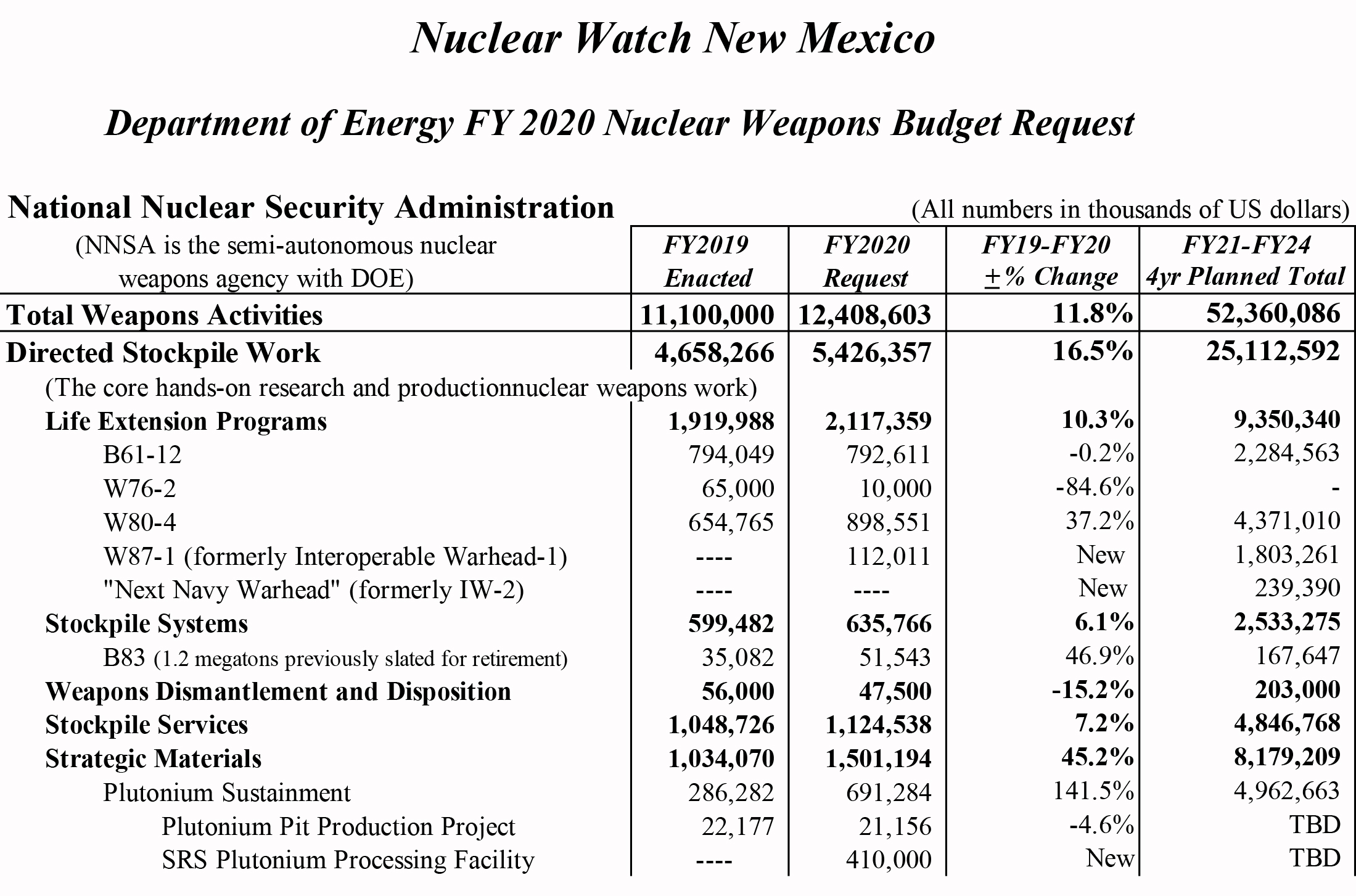
Budget: The House of Representatives passed a fiscal 2027 continuing resolution to keep the government running through Dec. 4 (the new fiscal year begins Oct 1). The White House Office of Management and Budget is requesting a series of anomalies, or exceptions, to the CR rule that funding be limited to the levels of the prior fiscal year. One anomaly is for the new Trump-class battleship.
For the National Nuclear Security Administration (NNSA): it’s the Electrical Power Capacity Upgrade (the new powerline across the Caja del Rio); enhanced subcritical tests at the Nevada National Security Site; and, most dangerous of all, allowing the NNSA to reprogram funding by itself within its Total Weapons Activities budget category.
The Senate is basically doing the same, plus an anomaly for ‘‘21– D–401 Hoisting Capability Project’’ at the Waste Isolation Pilot Plant. WIPP has been operationally shut down for a few months now due to a burnt-out hoist motor.
The House and Senate must resolve their relatively minor differences and get Trump’s signature before October 1 to prevent a government shutdown.
Regular authorization (the annual Defense Authorization Act) and appropriations are unlikely to move until mid-term elections (~86 days to go).
Plutonium pit production:
- exchangemonitor.com/williams-nnsa-accelerating-plutonium-pit-production-toward-2028-goal/ August 06, 2026 Williams: NNSA accelerating plutonium pit production toward 2028 goal – OMAHA, Neb. – Brandon Williams, administrator of the National Nuclear Security Administration (NNSA), said here Thursday Los Alamos National Laboratory in New Mexico is accelerating plutonium pit production, with the site targeting 100 pits by December 2028.
- We filed suit under the Freedom of Information Act (FOIA) for DOE’s “Special Study.” See https://nukewatch.org/wp-content/uploads/2026/08/Nuclear-Weapons-Watchdog-Sues-for-Pit-Production-Special-Study.pdf
- The South Carolina Environmental Law Project sent a letter to DOE/NNSA demanding 3 crucial documents: the “Special Study,” the unclassified summary of the new JASON pit life study, and LANL’s new Probabilistic Seismic Hazard Analysis. See our press release at https://nukewatch.org/wp-content/uploads/2026/07/Plaintiffs-Demand-Release-of-Critical-Documents-and-Extension-of-Public-Comment-Period-on-Expanded-Plutonium-Bomb-Core-Production.pdf
- The Pit Production PEIS comment period ended July 16 (81st anniversary of the Trinity Test). We submitted 64-page comments plus exhibits, see nukewatch.org/wp-content/uploads/2026/07/Formal-Comments-on-the-Pit-Production-Programmatic-Environmental-Impact-Statement.pdf NNSA ignored our demand for a comment period time extension because of the withheld documents.
- We received an unredacted version of the new JASON pit life study (see https://nukewatch.org/wp-content/uploads/2026/08/2026-JASON-Plutonium-Aging-Executive-Summary.pdf). “High Level Finding:… “The Pu in the stockpile appears to be aging slowly. The degradation issues that have been observed do not call into question present weapons performance.” We had received one title page and 2 completely blank narrative pages the day before the PEIS comment period expired.
Other/Related
https://subscriber.politicopro.com/article/2026/08/why-hill-republicans-are-competing-for-nuclear-waste-01015140 Why some Republicans want to bring nuclear waste home – For decades, politicians have treated nuclear waste as politically radioactive. Now, Republicans are competing to bring it home. The Department of Energy announced last week that it had signed memorandums of agreement with Utah, Tennessee, Oklahoma, Louisiana and Idaho to explore creating facilities to support the full nuclear fuel cycle — from enrichment of uranium and fabricating fuel to disposing of waste. Rather than resisting an initiative that could bring more nuclear waste to their states, some Republicans are actively courting the Nuclear Lifecycle Innovation Campuses, arguing they could anchor advanced nuclear industries and bring billions of dollars in investment.
*Also mixed in with AI and data centers, for which Small Modular Reactors might supply power.
Accelerating Arms Race:
- nbcnews.com/politics/national-security/pentagon-drafting-new-us-nuclear-strategy-case-regional-war-china-russ-rcna587370 Pentagon drafting a new U.S. nuclear strategy in case of regional war with China or Russia, sources say – The Defense Department’s policy chief is drafting a new U.S. nuclear strategy that emphasizes the possible use of shorter-range tactical weapons in case of a regional war with China or Russia, according to five people familiar with the plans. The new strategy, which is classified, challenges the approach to nuclear weapons that has been settled policy for decades… Colby has long pushed for an emphasis on tactical weapons, arguing that America’s adversaries would simply not believe the U.S. would seriously contemplate launching long-range weapons aimed at wiping out an enemy’s nuclear forces — as is the emphasis of the
- united24media.com/world/nato-weighs-nuclear-expansion-as-poland-finland-lithuania-emerge-as-options-21249NATO Weighs Nuclear Expansion as Poland, Finland, Lithuania Emerge as Options – NATO is currently examining options to position additional American nuclear capabilities across Europe as a response to threats posed by Russia. Poland, Finland, and Lithuania are under consideration as potential host countries, according to Süddeutschen Zeitung on July 31. The discussions include Poland aiming to join the Nuclear Sharing program, Finland lifting its long-standing prohibition on nuclear weapons transit and import, and the Lithuanian parliament reviewing legislation to remove its constitutional ban on nuclear deployments.
- https://carnegieendowment.org/emissary/2026/07/saudi-us-nuclear-deal-abraham-accords-123-agreement – What We Know About the U.S.-Saudi Nuclear Deal – Peaceful nuclear cooperation agreements, known colloquially as 123 agreements (after the relevant section in the U.S. Atomic Energy Act), rarely make headlines, but this one stands out. Although the administration has not yet released the full text, the agreement reportedly will not require Riyadh to categorically forgo fuel cycle activities that would be conducive to a nuclear weapons program (namely enrichment and reprocessing) or to accept the highest standard of International Atomic Energy Agency (IAEA) safeguards, known as the Additional Protocol, or AP.
Trump Administration Providing Weapons Grade Plutonium to Sam Altman
“If there were adults in the room and I could trust the federal government to impose the right standards, it wouldn’t be such a great concern, but it just doesn’t seem feasible.”
By: Joe Wilkins | October 24, 2025 futurism.com
With the economy the way it is these days, it’s nice to have a little walking around money.
Donald Trump certainly thinks so. Since his return to the White House, the president has labeled 440 federal properties for possible sale, leased 13.1 million acres of public land for strip mining, and held a fire sale for satellites developed by NASA’s Jet Propulsion Lab.
In one of his wildest money moves to date, the Financial Times reports that Trump is now offering companies access to plutonium from America’s arsenal of cold war nuclear missiles.
On Tuesday, the US Department of Energy (DOE) launched an application for interested parties to apply for access to a maximum of 19 metric tonnes — a little under 42,000 pounds — of weapons-grade plutonium, which has long been a key resource undergirding the US nuclear arsenal.
One of the companies anticipated to receive shipments of the fissile isotope from the DOE is Oklo, a “nuclear startup” backed — and formerly chaired — by OpenAI CEO Sam Altman. Earlier in October, Oklo was one of four US companies chosen by the DOE to join a new pilot program meant to rush the testing and approval of experimental reactor designs.
As the FT reports, we won’t know for certain until December 31, when the DOE announces the companies selected to purchase the plutonium, but it’s likely Oklo will be among them. That’s stirring up plenty of anxiety throughout the scientific community, who say the relaxed approach to nuclear development is a major cause for alarm.
“If there were adults in the room and I could trust the federal government to impose the right standards, it wouldn’t be such a great concern, but it just doesn’t seem feasible,” Edwin Lyman, a physicist with the Union of Concerned Scientists told the FT.

Brief Analysis of Today’s U.S. Supreme Court Oral Arguments on the Illegality of Licensing Radwaste Dumps in TX and NM
Today the United States Supreme Court heard arguments in the case of the Nuclear Regulatory Commission vs. Texas. At issue is whether the NRC exceeded its authority when it approved licenses for proposed “consolidated interim storage facilities” for high-level radioactive waste, and this includes highly irradiated “spent” fuel from nuclear power plants.
Two consolidated interim storage facilities are planned for western Texas and southeastern New Mexico. The Nuclear Waste Policy Act of 1982, as Amended specifically prohibits private “interim” storage of federal spent nuclear fuel, and disallows the Department of Energy from taking title to the waste unless a permanent geologic repository is licensed, built and opened. The law intended to prevent private “interim” storage of federal radioactive waste because interim storage is much less robust than permanent storage, and would double the risk of accident or attack during transport, since consolidated “interim” storage means the waste has to be moved twice, once to the CISF and again to a permanent repository.
Lawsuit filed against owners of Seabrook nuclear plant over alleged project sabotage
““The hydropower supplied by NECEC would displace the sale of more expensive (and highly polluting) power generated from NextEra’s fossil fuel plants, as well as reduce the prices paid to NextEra for output at its nuclear plant,” the lawsuit says.”
Beyond Nuclear | December 2, 2024 nhpr.org
The energy company Avangrid is accusing NextEra Energy, owners of the Seabrook nuclear power plant, of sabotaging the development of a transmission line meant to bring Canadian hydropower onto the New England grid.
In a lawsuit filed last month, Avangrid alleges NextEra Energy tried to prevent the New England Clean Energy Connect from coming online to protect their profits, including by delaying an upgrade to the Seabrook nuclear power plant’s circuit breaker.
Ex-Westinghouse VP sentenced to jail in $9 billion nuclear heist of SC ratepayers
“In both the SC and GA cases, the state governments helped pave the way for the financial mismanagement of the projects by legislating that state electric ratepayers be responsible to pay for the nuclear construction in their monthly bills many years ahead of receiving a single watt of utility services.”
Beyond Nuclear | November 21, 2024 beyondnuclear.org
On November 20, 2024, the ex-Westinghouse Electric Corporation Vice President, who once headed the company’s AP1000 advanced reactor global marketing division, Jeffrey Alan Benjamin was sentenced in the District of South Carolina Federal Court to one year and a day in prison and a $100,000 fine for his role to defraud the South Carolina Public Utility Commission (PUC) and state electric ratepayers out of billions of dollars following the 2017 abandonment of the V.C. Summer units 2 & 3 nuclear plant construction project.
The US Justice Department had originally charged Westinghouse’s senior global nuclear project manager with 16 federal felony counts including conspiracy to commit wire and mail fraud by withholding and providing false financial information to South Carolina regulators and state customers while the V.C. Summer AP1000 pressurized water reactor project was financially collapsing from skyrocketing cost overruns and mounting construction delays. After years of legal wrangling, Benjamin entered into a guilty plea deal to a single “information felony charge” for “aiding and abetting the failure to keep accurate corporate records.”
Uranium Haul Route Risky, Fatal Accident Data Shows
Four of the five most dangerous sections of the haul route are on the Navajo Nation.
By: Amber Reimondo, Energy Director, Grand Canyon Trust | October 1, 2024 grandcanyontrust.org
A recent analysis of fatal vehicle accidents along the haul route uranium trucks travel between Canyon Mine (renamed Pinyon Plain Mine), a uranium mine near the Grand Canyon, and the White Mesa uranium millOpens a new window in southeastern Utah shows an elevated risk along long stretches of the more than 300-mile route, especially on the Navajo Nation.
The most risky segments of the route are between 240% and 700% more dangerous than an average stretch of road in the United States in terms of vehicle accident fatalities per mile driven.
That means that any vehicles traveling in these sections face an elevated risk of fatal accidents. Energy Fuels Resources, which owns the controversial Pinyon Plain Mine, has said it intends to send six to eight large trucks loaded with uranium ore from the Grand Canyon area mine to its Utah mill every day.
Fatal accidents common along uranium haul route:
Clean Energy or Weapons? What the ‘Breakthrough’ in Nuclear Fusion Really Means
 From Tri-Valley CAREs: On NIF, Nuclear Weapons and Fusion Hype

“On December 13, the Department of Energy (DOE) and Livermore Lab held a press conference and, with maximum hoopla, announced that an experiment at the National Ignition Facility earlier that month had achieved fusion “ignition”.
Physicist MV Ramana, who is currently with the University of British Columbia and was previously at Princeton’s Nuclear Futures Laboratory and its Program on Science and Global Security, wrote this article for a science and tech magazine. For more information on what did and did not happen at NIF, we highly recommend it:”
Clean Energy or Weapons? What the ‘Breakthrough’ in Nuclear Fusion Really Means
SCIENCE – THE WIRE | December 19, 2022 science.thewire.in
- On December 13, the US Department of Energy announced that the National Ignition Facility had reached a “milestone”: the achievement of “ignition” in nuclear fusion earlier in the month.
- While the step has been described as a milestone in clean energy, generating electricity commercially or at an industrial scale through fusion is likely unattainable in any realistic sense – at least within the lifetimes of most readers of this article.
- The main utility that the facility offers nuclear weapons designers and planners is by providing a greater understanding of the underlying science and modernizing these weapons.
The Guardian [Letters]: Nuclear fusion ‘holy grail’ is not the answer to our energy prayers
Dr Mark Diesendorf questions the claim that nuclear fusion is safe and clean, while Dr Chris Cragg suspects true fusion power is a long way off. Plus letters from Dick Willis and Martin O’Donovan
“It is great news that scientists have succeeded in getting more energy out of fusion than they put in. It brings to mind a quote from a past director of the Central Electricity Generating Board: ‘One day you may get more energy out of nuclear fusion than you put in, but you will never get more money out than you put in.’” – Martin O’Donovan (Ashtead, Surrey)
THE GUARDIAN: LETTERS | December 19, 2022 theguardian.com
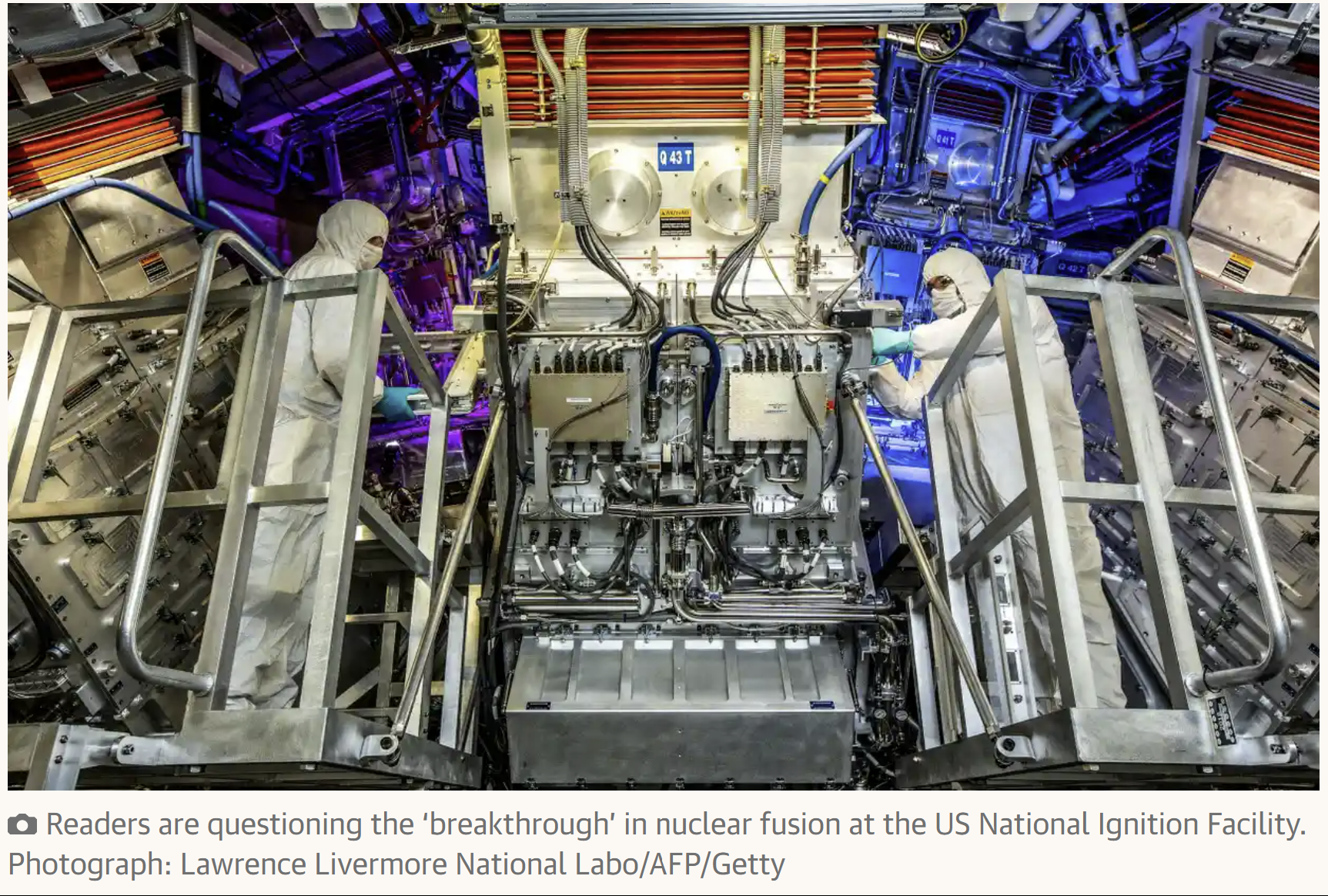
You report on the alleged “breakthrough” on nuclear fusion, in which US researchers claim that break-even has been achieved (Breakthrough in nuclear fusion could mean ‘near-limitless energy’, 12 December). To go from break-even, where energy output is greater than total energy input, to a commercial nuclear fusion reactor could take at least 25 years. By then, the whole world could be powered by safe and clean renewable energy, primarily solar and wind.
The claim by the researchers that nuclear fusion is safe and clean is incorrect. Laser fusion, particularly as a component of a fission-fusion hybrid reactor, can produce neutrons that can be used to produce the nuclear explosives plutonium-239, uranium-235 and uranium-233. It could also produce tritium, a form of heavy hydrogen, which is used to boost the explosive power of a fission explosion, making fission bombs smaller and hence more suitable for use in missile warheads. This information is available in open research literature.
The US National Ignition Facility, which did the research, is part of the Lawrence Livermore National Laboratory, which has a history of involvement with nuclear weaponry.
Dr Mark Diesendorf
University of New South Wales
Public Interest Groups Warn NNSA on Plutonium Giveaway
FOR IMMEDIATE RELEASE, September 8, 2026
Joint Press Release from: South Carolina Environmental Law Project, Savannah River Site Watch & Nuclear Watch New Mexico
Contact: Tom Clements, Director, SRS Watch, 803-240-7268 | Email
Jay Coghlan, Nuclear Watch NM, 505-989-7342 | Email
Shelby Cohen, Comms Manager, SC Env. Law Project, 864.414.7726 | Email
South Carolina – Today, the South Carolina Environmental Law Project (SCELP) sent a letter of demand to the Department of Energy (DOE) and its semi-autonomous agency, the National Nuclear Security Administration (NNSA), about their proposed unsound and dangerous management of U.S. plutonium. The letter notified them that they must comply with the federal National Environmental Policy Act (NEPA) requirement for public review of the Trump Administration’s troubling plan to give away 19.7 metric tons of nuclear weapons-grade plutonium to private corporations.
SCELP’S letter, on behalf of Nuclear Watch New Mexico, Savannah River Site Watch, and a private citizen who lives near the Savannah River Site (SRS) in South Carolina, outlines why NNSA must be held to its legal NEPA obligations. The letter describes how recently issued presidential executive orders:
…constitute a vast change in the prior decisions and purposes of the DOE/NNSA surplus plutonium disposition program that has been in place since at least 1996… This change is also contrary to the larger nuclear non-proliferation policy of the United States restricting the commercial use of plutonium that has been in place for approximately fifty years.
This action follows SCELP’s earlier NEPA lawsuit on behalf of SRS Watch and Nuclear Watch New Mexico. In a landmark settlement, that litigation successfully compelled the NNSA to prepare a nationwide programmatic environmental impact statement on the production of plutonium “pit” bomb cores for nuclear weapons (the “Pit Production PEIS”).
Where Have All Your Dollars Gone? Long Time Passing
“When you ask people what sort of budget they’d like, and even when you ask them what they think the budget is, you get enormous pie slices for environmental protection and education. Here, in stark contrast, our so-called representatives are contemplating giving us 3.47% for education…”
By: David Swanson, World BEYOND War | August 18, 2026 worldbeyondwar.org
The discretionary budget for the U.S. government next year as proposed by Trump is depicted by the Washington Examiner in the above pie chart. It has passed the House and might pass the Senate. As long as half of Congress Members see their job as boot licking and the other half see their job as tweaking, these annual proposals are good indications of each fresh hell into which we are careening.
This pie chart includes 65.77% of federal discretionary spending for War, plus 6.57% for a woefully inadequate job of addressing the suffering of people sent into war (Veterans Affairs), 2.86% for so-called “Homeland Security” (in case you wanted to bring the wars closer), 1.61% for a State Department that is wholly subservient to the Pentagon (“State and International Program”), and 0.85% for weaponizing the solar system (NASA).
After that 77.66% of the money Congress will spend next year has been spent, what’s left?
If you’re already afraid, just wait until you hear about Manhattan Project 2.0
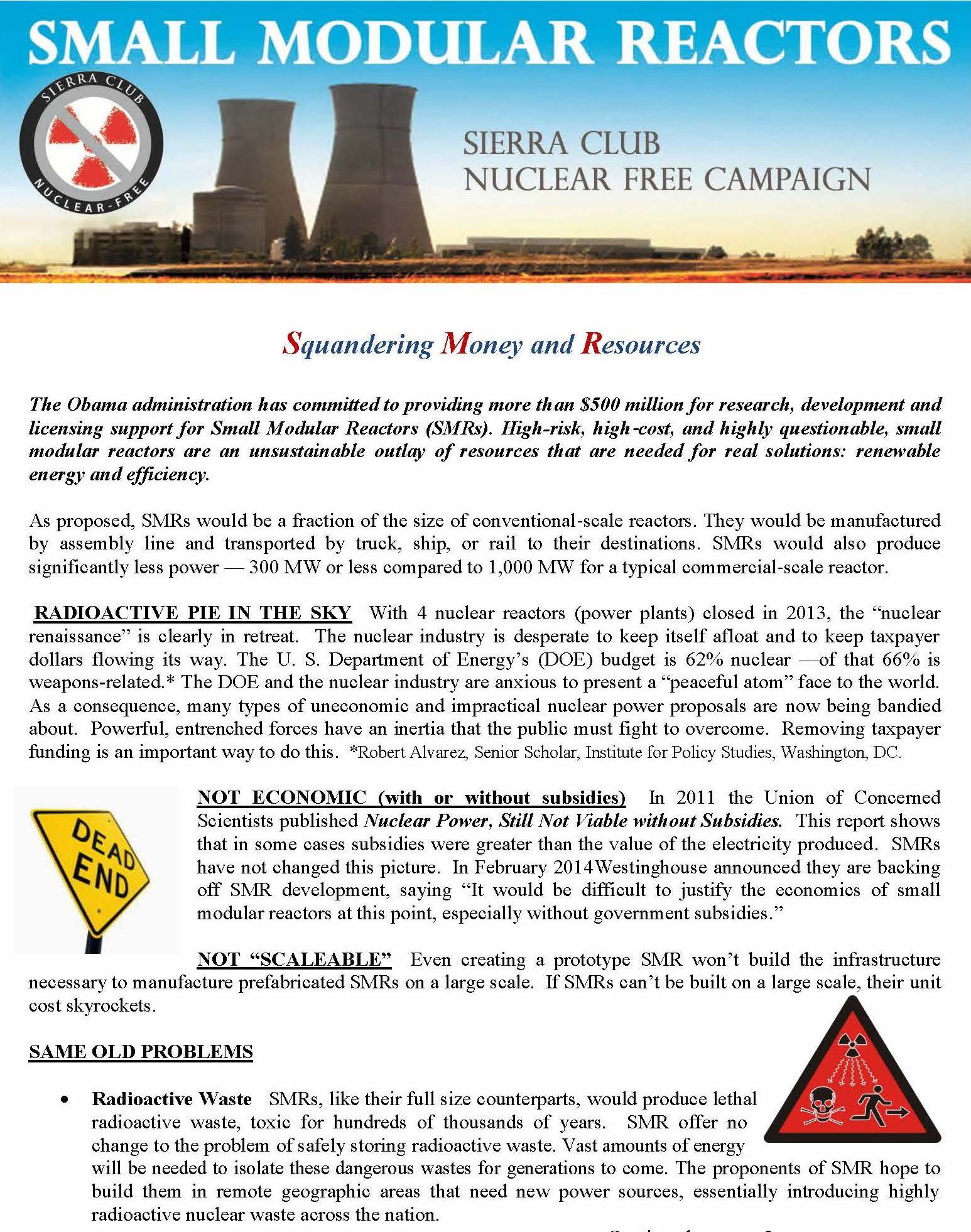
“Executive Order 14302, “Reinvigorating the Nuclear Industrial Base”, further endangers the safety of nuclear workers and the wider public by providing the nuclear industry with Cold War-era plutonium-239 harvested from dismantled nuclear warheads. Because the U.S. doesn’t currently have enough uranium for Manhattan Project 2.0, Oklo, Standard Nuclear, Exodys Energy, SHINE Technologies and Flibe Energy plan to convert plutonium into SMR fuel.
Plutonium is highly toxic if inhaled and requires special ventilation to handle. Other countries that have attempted to use plutonium have found converting it not worth the expense. It’s also highly sought after for bomb-making and requires heightened security measures. With a half-life of more than 24,000 years, managing plutonium is not a short-term commitment.”
By: Kristen Thomason Baptist News | August 10, 2026 baptistnews.com
Summers spent at my grandparents’ house in Tennessee were hot and humid. With enough cousins piled into the porch swing, you could stir up a bit of a breeze. But when that was no longer effective, we would retreat to the air-conditioned splendor of the American Museum of Science and Energy in Oak Ridge and stroll through exhibits like “Wildcatting for Oil” and “Atoms for Autos.”
Among these varied installations, however, pride of place was given to documenting Oak Ridge’s role as the secret headquarters for the Manhattan Project and source of the Hiroshima bomb’s enriched uranium. Most of the 30,000 covert workers on that project only discovered the truth of what they had been helping to build on Aug. 6, 1945, when they awoke to the headline “Oak Ridge Attacks Japan.”
Eighty years later, on May 23, 2025, President Donald Trump signed a series of executive orders to further the Department of Energy’s “Manhattan Project 2.0.” And just like the original, the second iteration of the Manhattan Project has plenty of secrets of its own.
The executive orders came at the behest of tech giants like Amazon, Meta, Google and Microsoft, who want cheap, abundant nuclear power to run their AI data centers. And according to the United Nations, these data centers will have doubled their voracious consumption of electricity and water by 2030.
Nuclear Weapons Issues & The Accelerating Arms Race: July 2026
Nuclear Weapons:
Budget: The House of Representatives passed a fiscal 2027 continuing resolution to keep the government running through Dec. 4 (the new fiscal year begins Oct 1). The White House Office of Management and Budget is requesting a series of anomalies, or exceptions, to the CR rule that funding be limited to the levels of the prior fiscal year. One anomaly is for the new Trump-class battleship.
For the National Nuclear Security Administration (NNSA): it’s the Electrical Power Capacity Upgrade (the new powerline across the Caja del Rio); enhanced subcritical tests at the Nevada National Security Site; and, most dangerous of all, allowing the NNSA to reprogram funding by itself within its Total Weapons Activities budget category.
The Senate is basically doing the same, plus an anomaly for ‘‘21– D–401 Hoisting Capability Project’’ at the Waste Isolation Pilot Plant. WIPP has been operationally shut down for a few months now due to a burnt-out hoist motor.
The House and Senate must resolve their relatively minor differences and get Trump’s signature before October 1 to prevent a government shutdown.
Regular authorization (the annual Defense Authorization Act) and appropriations are unlikely to move until mid-term elections (~86 days to go).
Plutonium pit production:
- exchangemonitor.com/williams-nnsa-accelerating-plutonium-pit-production-toward-2028-goal/ August 06, 2026 Williams: NNSA accelerating plutonium pit production toward 2028 goal – OMAHA, Neb. – Brandon Williams, administrator of the National Nuclear Security Administration (NNSA), said here Thursday Los Alamos National Laboratory in New Mexico is accelerating plutonium pit production, with the site targeting 100 pits by December 2028.
- We filed suit under the Freedom of Information Act (FOIA) for DOE’s “Special Study.” See https://nukewatch.org/wp-content/uploads/2026/08/Nuclear-Weapons-Watchdog-Sues-for-Pit-Production-Special-Study.pdf
- The South Carolina Environmental Law Project sent a letter to DOE/NNSA demanding 3 crucial documents: the “Special Study,” the unclassified summary of the new JASON pit life study, and LANL’s new Probabilistic Seismic Hazard Analysis. See our press release at https://nukewatch.org/wp-content/uploads/2026/07/Plaintiffs-Demand-Release-of-Critical-Documents-and-Extension-of-Public-Comment-Period-on-Expanded-Plutonium-Bomb-Core-Production.pdf
- The Pit Production PEIS comment period ended July 16 (81st anniversary of the Trinity Test). We submitted 64-page comments plus exhibits, see nukewatch.org/wp-content/uploads/2026/07/Formal-Comments-on-the-Pit-Production-Programmatic-Environmental-Impact-Statement.pdf NNSA ignored our demand for a comment period time extension because of the withheld documents.
- We received an unredacted version of the new JASON pit life study (see https://nukewatch.org/wp-content/uploads/2026/08/2026-JASON-Plutonium-Aging-Executive-Summary.pdf). “High Level Finding:… “The Pu in the stockpile appears to be aging slowly. The degradation issues that have been observed do not call into question present weapons performance.” We had received one title page and 2 completely blank narrative pages the day before the PEIS comment period expired.
Other/Related
https://subscriber.politicopro.com/article/2026/08/why-hill-republicans-are-competing-for-nuclear-waste-01015140 Why some Republicans want to bring nuclear waste home – For decades, politicians have treated nuclear waste as politically radioactive. Now, Republicans are competing to bring it home. The Department of Energy announced last week that it had signed memorandums of agreement with Utah, Tennessee, Oklahoma, Louisiana and Idaho to explore creating facilities to support the full nuclear fuel cycle — from enrichment of uranium and fabricating fuel to disposing of waste. Rather than resisting an initiative that could bring more nuclear waste to their states, some Republicans are actively courting the Nuclear Lifecycle Innovation Campuses, arguing they could anchor advanced nuclear industries and bring billions of dollars in investment.
*Also mixed in with AI and data centers, for which Small Modular Reactors might supply power.
Accelerating Arms Race:
- nbcnews.com/politics/national-security/pentagon-drafting-new-us-nuclear-strategy-case-regional-war-china-russ-rcna587370 Pentagon drafting a new U.S. nuclear strategy in case of regional war with China or Russia, sources say – The Defense Department’s policy chief is drafting a new U.S. nuclear strategy that emphasizes the possible use of shorter-range tactical weapons in case of a regional war with China or Russia, according to five people familiar with the plans. The new strategy, which is classified, challenges the approach to nuclear weapons that has been settled policy for decades… Colby has long pushed for an emphasis on tactical weapons, arguing that America’s adversaries would simply not believe the U.S. would seriously contemplate launching long-range weapons aimed at wiping out an enemy’s nuclear forces — as is the emphasis of the
- united24media.com/world/nato-weighs-nuclear-expansion-as-poland-finland-lithuania-emerge-as-options-21249NATO Weighs Nuclear Expansion as Poland, Finland, Lithuania Emerge as Options – NATO is currently examining options to position additional American nuclear capabilities across Europe as a response to threats posed by Russia. Poland, Finland, and Lithuania are under consideration as potential host countries, according to Süddeutschen Zeitung on July 31. The discussions include Poland aiming to join the Nuclear Sharing program, Finland lifting its long-standing prohibition on nuclear weapons transit and import, and the Lithuanian parliament reviewing legislation to remove its constitutional ban on nuclear deployments.
- https://carnegieendowment.org/emissary/2026/07/saudi-us-nuclear-deal-abraham-accords-123-agreement – What We Know About the U.S.-Saudi Nuclear Deal – Peaceful nuclear cooperation agreements, known colloquially as 123 agreements (after the relevant section in the U.S. Atomic Energy Act), rarely make headlines, but this one stands out. Although the administration has not yet released the full text, the agreement reportedly will not require Riyadh to categorically forgo fuel cycle activities that would be conducive to a nuclear weapons program (namely enrichment and reprocessing) or to accept the highest standard of International Atomic Energy Agency (IAEA) safeguards, known as the Additional Protocol, or AP.
Trump Administration Providing Weapons Grade Plutonium to Sam Altman
“If there were adults in the room and I could trust the federal government to impose the right standards, it wouldn’t be such a great concern, but it just doesn’t seem feasible.”
By: Joe Wilkins | October 24, 2025 futurism.com
With the economy the way it is these days, it’s nice to have a little walking around money.
Donald Trump certainly thinks so. Since his return to the White House, the president has labeled 440 federal properties for possible sale, leased 13.1 million acres of public land for strip mining, and held a fire sale for satellites developed by NASA’s Jet Propulsion Lab.
In one of his wildest money moves to date, the Financial Times reports that Trump is now offering companies access to plutonium from America’s arsenal of cold war nuclear missiles.
On Tuesday, the US Department of Energy (DOE) launched an application for interested parties to apply for access to a maximum of 19 metric tonnes — a little under 42,000 pounds — of weapons-grade plutonium, which has long been a key resource undergirding the US nuclear arsenal.
One of the companies anticipated to receive shipments of the fissile isotope from the DOE is Oklo, a “nuclear startup” backed — and formerly chaired — by OpenAI CEO Sam Altman. Earlier in October, Oklo was one of four US companies chosen by the DOE to join a new pilot program meant to rush the testing and approval of experimental reactor designs.
As the FT reports, we won’t know for certain until December 31, when the DOE announces the companies selected to purchase the plutonium, but it’s likely Oklo will be among them. That’s stirring up plenty of anxiety throughout the scientific community, who say the relaxed approach to nuclear development is a major cause for alarm.
“If there were adults in the room and I could trust the federal government to impose the right standards, it wouldn’t be such a great concern, but it just doesn’t seem feasible,” Edwin Lyman, a physicist with the Union of Concerned Scientists told the FT.
Brief Analysis of Today’s U.S. Supreme Court Oral Arguments on the Illegality of Licensing Radwaste Dumps in TX and NM
Today the United States Supreme Court heard arguments in the case of the Nuclear Regulatory Commission vs. Texas. At issue is whether the NRC exceeded its authority when it approved licenses for proposed “consolidated interim storage facilities” for high-level radioactive waste, and this includes highly irradiated “spent” fuel from nuclear power plants.
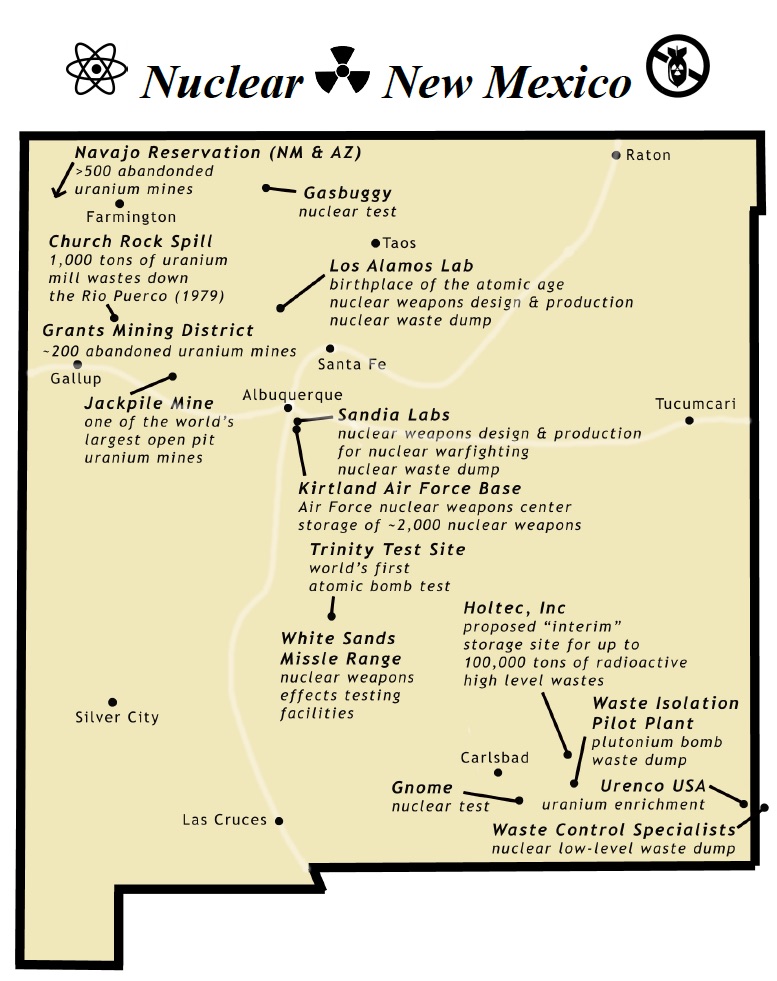
Two consolidated interim storage facilities are planned for western Texas and southeastern New Mexico. The Nuclear Waste Policy Act of 1982, as Amended specifically prohibits private “interim” storage of federal spent nuclear fuel, and disallows the Department of Energy from taking title to the waste unless a permanent geologic repository is licensed, built and opened. The law intended to prevent private “interim” storage of federal radioactive waste because interim storage is much less robust than permanent storage, and would double the risk of accident or attack during transport, since consolidated “interim” storage means the waste has to be moved twice, once to the CISF and again to a permanent repository.
Lawsuit filed against owners of Seabrook nuclear plant over alleged project sabotage
““The hydropower supplied by NECEC would displace the sale of more expensive (and highly polluting) power generated from NextEra’s fossil fuel plants, as well as reduce the prices paid to NextEra for output at its nuclear plant,” the lawsuit says.”
Beyond Nuclear | December 2, 2024 nhpr.org
The energy company Avangrid is accusing NextEra Energy, owners of the Seabrook nuclear power plant, of sabotaging the development of a transmission line meant to bring Canadian hydropower onto the New England grid.
In a lawsuit filed last month, Avangrid alleges NextEra Energy tried to prevent the New England Clean Energy Connect from coming online to protect their profits, including by delaying an upgrade to the Seabrook nuclear power plant’s circuit breaker.
Ex-Westinghouse VP sentenced to jail in $9 billion nuclear heist of SC ratepayers
“In both the SC and GA cases, the state governments helped pave the way for the financial mismanagement of the projects by legislating that state electric ratepayers be responsible to pay for the nuclear construction in their monthly bills many years ahead of receiving a single watt of utility services.”
Beyond Nuclear | November 21, 2024 beyondnuclear.org
On November 20, 2024, the ex-Westinghouse Electric Corporation Vice President, who once headed the company’s AP1000 advanced reactor global marketing division, Jeffrey Alan Benjamin was sentenced in the District of South Carolina Federal Court to one year and a day in prison and a $100,000 fine for his role to defraud the South Carolina Public Utility Commission (PUC) and state electric ratepayers out of billions of dollars following the 2017 abandonment of the V.C. Summer units 2 & 3 nuclear plant construction project.
The US Justice Department had originally charged Westinghouse’s senior global nuclear project manager with 16 federal felony counts including conspiracy to commit wire and mail fraud by withholding and providing false financial information to South Carolina regulators and state customers while the V.C. Summer AP1000 pressurized water reactor project was financially collapsing from skyrocketing cost overruns and mounting construction delays. After years of legal wrangling, Benjamin entered into a guilty plea deal to a single “information felony charge” for “aiding and abetting the failure to keep accurate corporate records.”
Uranium Haul Route Risky, Fatal Accident Data Shows
Four of the five most dangerous sections of the haul route are on the Navajo Nation.
By: Amber Reimondo, Energy Director, Grand Canyon Trust | October 1, 2024 grandcanyontrust.org
A recent analysis of fatal vehicle accidents along the haul route uranium trucks travel between Canyon Mine (renamed Pinyon Plain Mine), a uranium mine near the Grand Canyon, and the White Mesa uranium millOpens a new window in southeastern Utah shows an elevated risk along long stretches of the more than 300-mile route, especially on the Navajo Nation.
The most risky segments of the route are between 240% and 700% more dangerous than an average stretch of road in the United States in terms of vehicle accident fatalities per mile driven.
That means that any vehicles traveling in these sections face an elevated risk of fatal accidents. Energy Fuels Resources, which owns the controversial Pinyon Plain Mine, has said it intends to send six to eight large trucks loaded with uranium ore from the Grand Canyon area mine to its Utah mill every day.
Fatal accidents common along uranium haul route:
Clean Energy or Weapons? What the ‘Breakthrough’ in Nuclear Fusion Really Means
From Tri-Valley CAREs: On NIF, Nuclear Weapons and Fusion Hype
“On December 13, the Department of Energy (DOE) and Livermore Lab held a press conference and, with maximum hoopla, announced that an experiment at the National Ignition Facility earlier that month had achieved fusion “ignition”.
Physicist MV Ramana, who is currently with the University of British Columbia and was previously at Princeton’s Nuclear Futures Laboratory and its Program on Science and Global Security, wrote this article for a science and tech magazine. For more information on what did and did not happen at NIF, we highly recommend it:”
Clean Energy or Weapons? What the ‘Breakthrough’ in Nuclear Fusion Really Means
SCIENCE – THE WIRE | December 19, 2022 science.thewire.in
- On December 13, the US Department of Energy announced that the National Ignition Facility had reached a “milestone”: the achievement of “ignition” in nuclear fusion earlier in the month.
- While the step has been described as a milestone in clean energy, generating electricity commercially or at an industrial scale through fusion is likely unattainable in any realistic sense – at least within the lifetimes of most readers of this article.
- The main utility that the facility offers nuclear weapons designers and planners is by providing a greater understanding of the underlying science and modernizing these weapons.
The Guardian [Letters]: Nuclear fusion ‘holy grail’ is not the answer to our energy prayers
Dr Mark Diesendorf questions the claim that nuclear fusion is safe and clean, while Dr Chris Cragg suspects true fusion power is a long way off. Plus letters from Dick Willis and Martin O’Donovan
“It is great news that scientists have succeeded in getting more energy out of fusion than they put in. It brings to mind a quote from a past director of the Central Electricity Generating Board: ‘One day you may get more energy out of nuclear fusion than you put in, but you will never get more money out than you put in.’” – Martin O’Donovan (Ashtead, Surrey)
THE GUARDIAN: LETTERS | December 19, 2022 theguardian.com
You report on the alleged “breakthrough” on nuclear fusion, in which US researchers claim that break-even has been achieved (Breakthrough in nuclear fusion could mean ‘near-limitless energy’, 12 December). To go from break-even, where energy output is greater than total energy input, to a commercial nuclear fusion reactor could take at least 25 years. By then, the whole world could be powered by safe and clean renewable energy, primarily solar and wind.
The claim by the researchers that nuclear fusion is safe and clean is incorrect. Laser fusion, particularly as a component of a fission-fusion hybrid reactor, can produce neutrons that can be used to produce the nuclear explosives plutonium-239, uranium-235 and uranium-233. It could also produce tritium, a form of heavy hydrogen, which is used to boost the explosive power of a fission explosion, making fission bombs smaller and hence more suitable for use in missile warheads. This information is available in open research literature.
The US National Ignition Facility, which did the research, is part of the Lawrence Livermore National Laboratory, which has a history of involvement with nuclear weaponry.
Dr Mark Diesendorf
University of New South Wales