

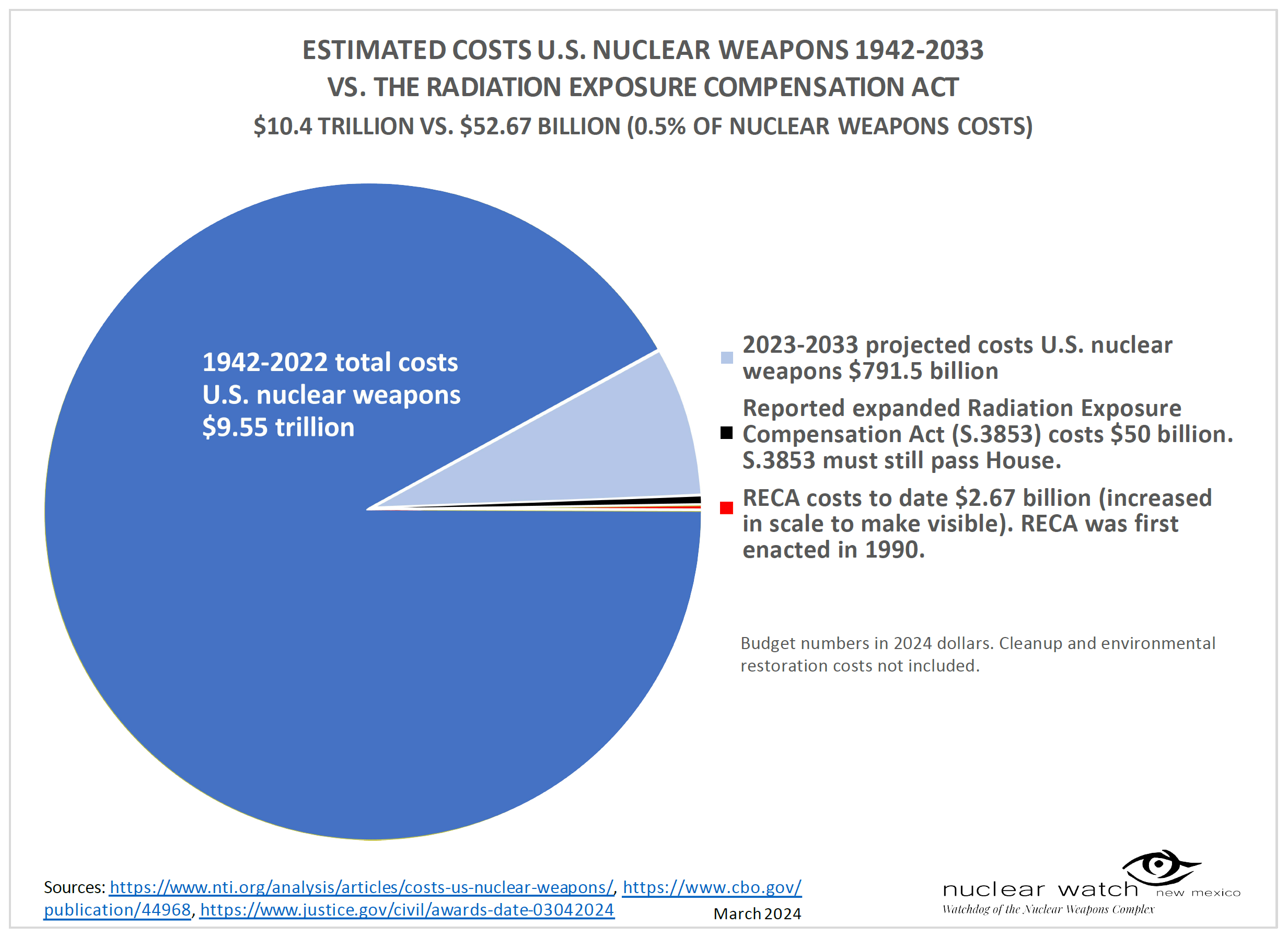
Cost of RECA Chart
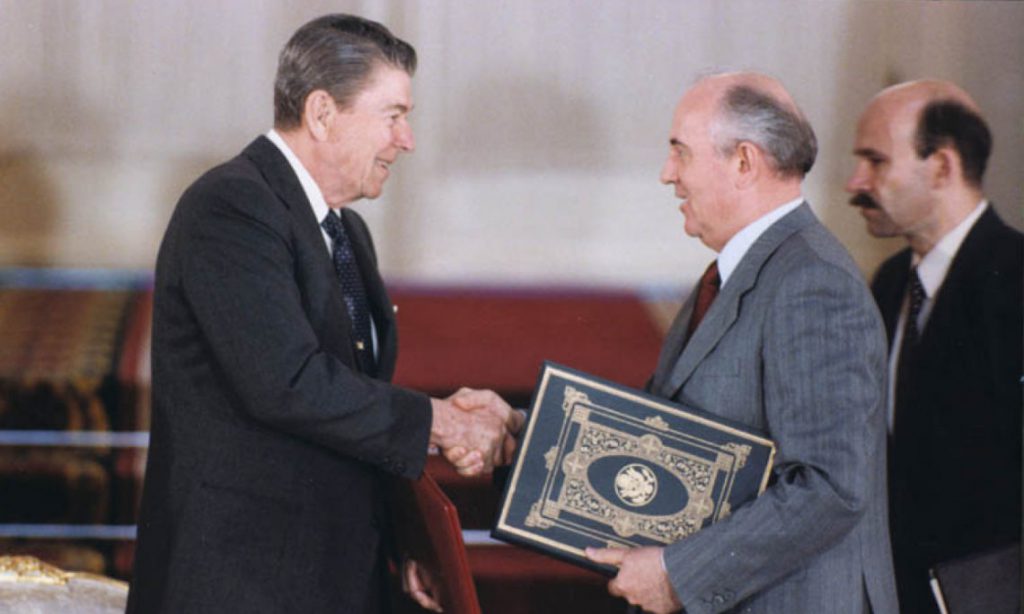
In 1985, US President Ronald Reagan and Russian President Mikhail Gorbachev declared that “a nuclear war cannot be won and must never be fought.”
 NukeWatch NM Google News Feed
- UNM faculty featured in USA Today documentary on New Mexico's nuclear legacy - UNM Newsroom October 28, 2026UNM faculty featured in USA Today documentary on New Mexico's nuclear legacy UNM Newsroom
- Once secret report on atomic weapons production released as greens fight plans in SC, NM - The State August 14, 2026Once secret report on atomic weapons production released as greens fight plans in SC, NM The State
- Nuclear Watch New Mexico sues Department of Energy for plutonium pit report - Santa Fe New Mexican August 5, 2026Nuclear Watch New Mexico sues Department of Energy for plutonium pit report Santa Fe New Mexican
- Santa Fe nonprofit sues Trump administration over withheld plutonium pit study - Albuquerque Journal August 5, 2026Santa Fe nonprofit sues Trump administration over withheld plutonium pit study Albuquerque Journal
- Nuclear weapons pit study kept secret, groups say. Here’s what to know - The State July 14, 2026Nuclear weapons pit study kept secret, groups say. Here’s what to know The State
- Hidden study casts doubt on need for nuclear weapons factories in SC, NM, critics say - The State July 11, 2026Hidden study casts doubt on need for nuclear weapons factories in SC, NM, critics say The State
- Report: DOGE resignation program led to high nuclear cleanup vacancies in New Mexico - Santa Fe New Mexican May 29, 2026Report: DOGE resignation program led to high nuclear cleanup vacancies in New Mexico Santa Fe New Mexican
- New Mexico environment officials mandate more legacy nuclear waste at WIPP - Source New Mexico April 24, 2026New Mexico environment officials mandate more legacy nuclear waste at WIPP Source New Mexico
- A major environmental decision is now locked in, with lingering questions about the process behind it - Federal News Network April 22, 2026A major environmental decision is now locked in, with lingering questions about the process behind it Federal News Network
- Nuclear watchdogs toured a planned SC plutonium plant. Here’s what they saw. - SC Daily Gazette April 22, 2026Nuclear watchdogs toured a planned SC plutonium plant. Here’s what they saw. SC Daily Gazette
- WATCH: Vasquez Presses Administration Officials on Their Openness to Resuming Above-Ground Nuclear Testing, Jeopardizing American Health and Safety - Representative Gabe Vasquez | (.gov) April 22, 2026WATCH: Vasquez Presses Administration Officials on Their Openness to Resuming Above-Ground Nuclear Testing, Jeopardizing American Health and Safety Representative Gabe Vasquez | (.gov)
- “They didn’t want to see us” - Searchlight New Mexico July 15, 2025“They didn’t want to see us” Searchlight New Mexico
- Lawsuit Forces U.S. To Review Nuclear Plans - Arms Control Association March 3, 2025Lawsuit Forces U.S. To Review Nuclear Plans Arms Control Association
NEW & UPDATED

LANL Expands Nuclear Bomb Production, Rejects Cleanup, Still Plans to Release Tritium
FOR IMMEDIATE RELEASE, August 3, 2025
Contact: Scott Kovac – 505.316.4148 | Email
Santa Fe, NM – Eighty years after the first radioactive waste was buried at the Los Alamos National Laboratory (LANL), Lab officials have released plans to “defer” cleanup of one of the older radioactive dumps. Material Disposal Area C (“Area C”) is an 11.8-acre site that was active from 1948 to 1974. It contains metals, hazardous constituents, and radioactively and chemically contaminated materials in six unlined disposal pits and 108 shafts. The total waste and fill in the pits and shafts are estimated at 198,104 cubic meters. Area C also has a serious gas plume of industrial solvents. Given the amount of long-lived plutonium wastes that are likely to be in Area C, leaving it buried 25 feet deep in a landfill rated for only 1,000 years is not acceptable.
On June 18, 2025, the Department of Energy (DOE) sent the New Mexico Environment Department (NMED) a letter outlining its plans to “defer corrective action” (i.e. cleanup) at Area C. It stated that the dump “is associated with active Facility operations and will be deferred from further corrective action under [NMED’s] Consent Order [governing cleanup] until MDA C is no longer associated with active Facility operations.”
Time Zero: 05: The Lab (Part 01)
https://964f6bfd-c857-4667-8d59-615efbd0d7c4.libsyn.com/05-the-lab-part-01
“When the Manhattan Project arrived on the Pajarito Plateau in northern New Mexico, the land was not uninhabited. To establish the highly secretive Site Y, the United States military forcibly removed generations of Nuevomexicano ranchers and blocked regional Indigenous groups from accessing sacred sites. Almost immediately, the lab began detonating massive amounts of explosives, scarring the landscape. Military personnel regularly dumped nuclear waste into local canyon systems that ultimately flowed into the Rio Grande. When World War II came to a close, though, the lab did not.
More than eight decades later, an apocalyptic weapons factory—Los Alamos National Laboratory—still looms over the Pueblos and villages north of Santa Fe. Ninety miles south, Sandia National Laboratory and Kirtland Air Force Base store thousands of nuclear warheads beneath the city of Albuquerque. Both laboratories are expanding in scope and scale.
Santa Fe Archbishop Wester on RECA, Nuclear Weapons

80 years after nuclear bomb tested in N.M., victims will get reparations
NBC News NOW, July 16, 2025, nbcnewsnow.com
Trinity “downwinders” of New Mexico exposed to the first ever nuclear explosion are receiving recognition and compensation 80 years after the bomb was tested. NBC News’ Aaron Gilchrest spoke with several people who shared their sacrifice and suffering over the years.
An appreciation of Bob Alvarez, a fearless advocate for those harmed by the US nuclear weapons complex

By Michael Slater – The Bulletin of Atomic Scientists| July 10, 2025, thebulletin.org
SEE ALSO: THIS WONDERFUL TRIBUTE TO BOB ALVAREZ FROM BEYOND NUCLEAR & OTHERS: https://beyondnuclear.org/bob-alvarez-presente/
And view the Alliance for Nuclear Accountability’s Lifetime Achievement Awared given to Bob in 2022: https://ananuclear.org/bob-alvarez/
Nuclear Weapons Issues & The Accelerating Arms Race: June/July 2025
Nuclear Weapons Budget:
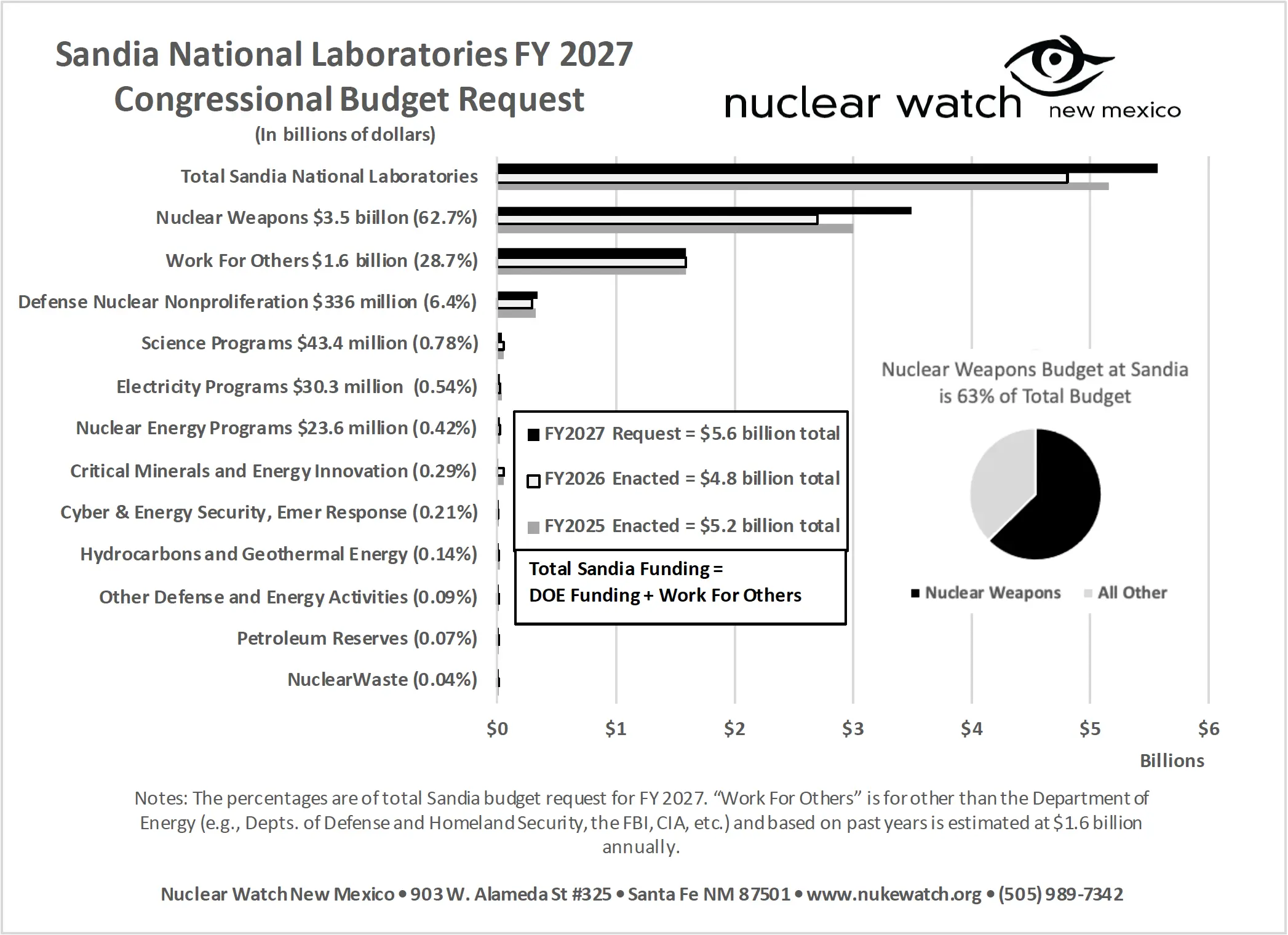
• The just passed “reconciliation” bill and Trump’s proposed FY 2026 budget are reverse Robin Hood iniatives, robbing from the poor to give to the rich. While Medicaid is gutted, there are huge tax breaks for the ultra-wealthy and a big bump up for nuclear weapons.
• The following is from the DC-based Center for Arms Control and Non-Proliferation (https://armscontrolcenter.org/fiscal-year-2026-defense-budget-request-briefing-book/):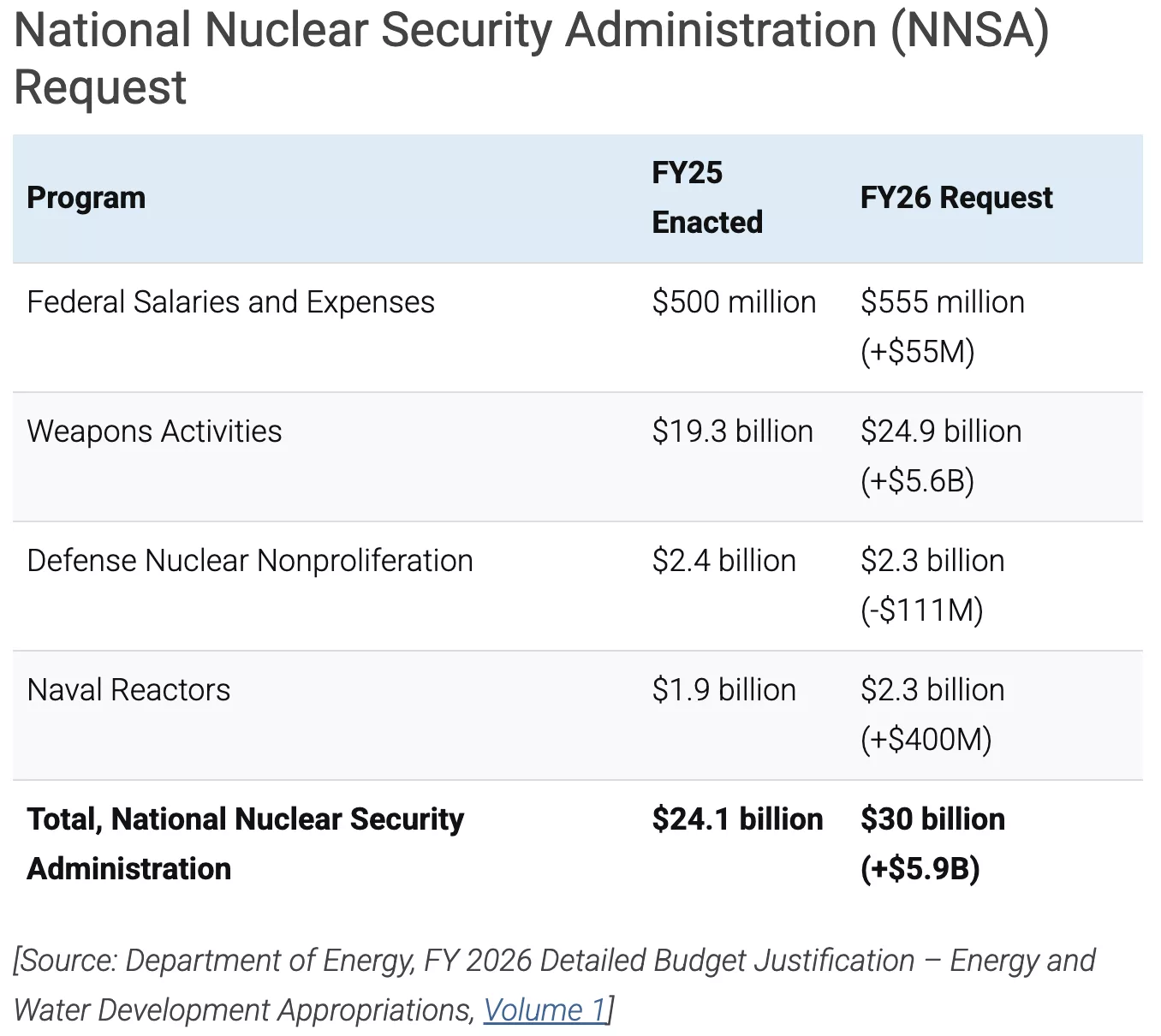
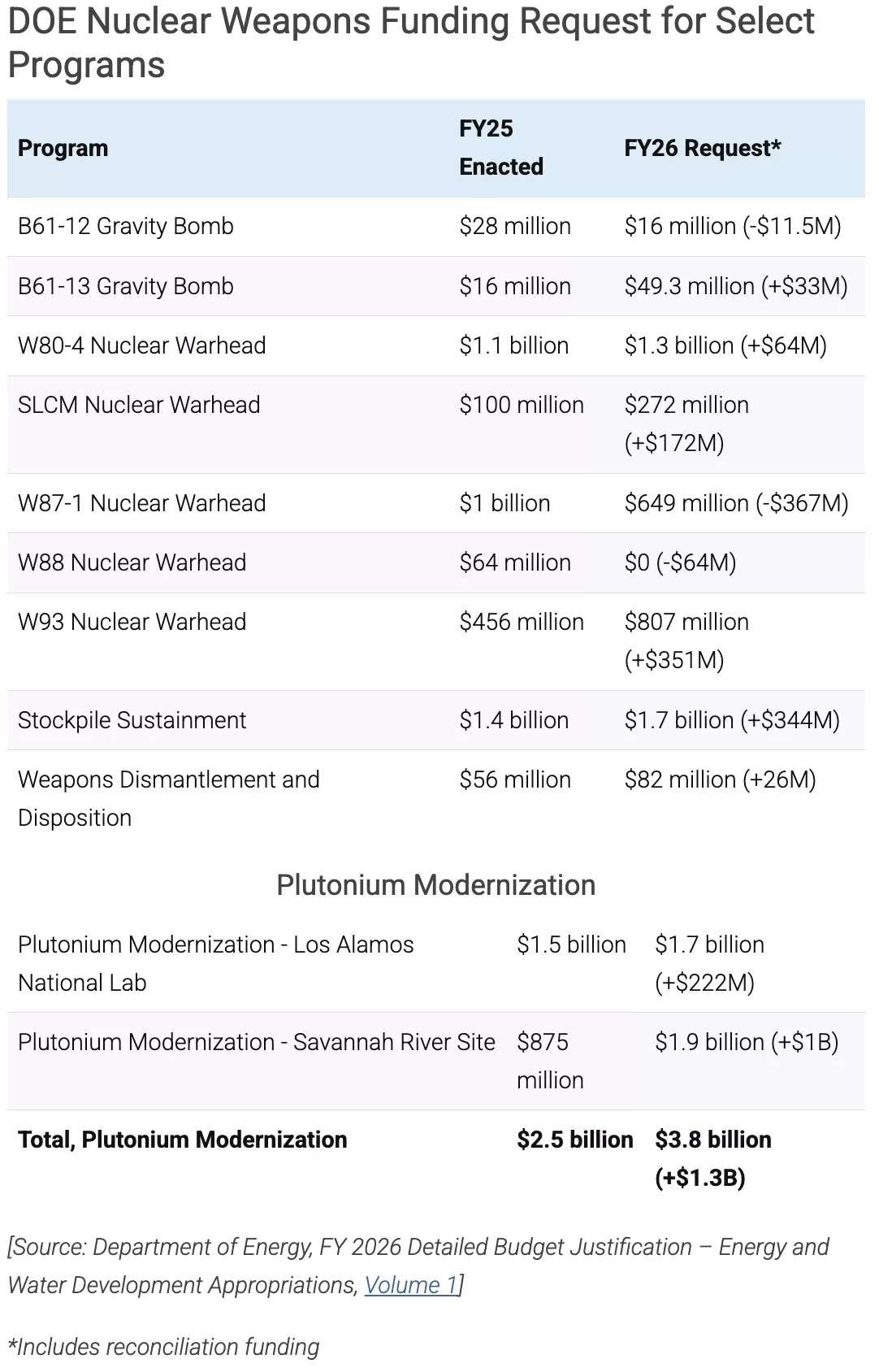 Note: the + or – signs result from the “reconciliation” bill.
• Radiation Exposure Compensation Act: Sen. Josh Hawley of MO got RECA extension and expansion attached to the bill, which is really something. Tina Cordova of the Tularosa Basin Downwinders Consortium has acknowledged that many deserving people have still been left out. See more: https://www.santafenewmexican.com/news/local_news/new-mexico-downwinders-celebrate-bittersweet-victory-in-trumps-big-beautiful-bill/article_9dc4ae5e-d4d0-4689-a255-a83576076963.html Finally, it is good for only two years because it was part of budget “reconciliation” that is supposed to deal only with funding matters (hence is limited to this 2-year term of Congress). We will continue to fight to get RECA permanently extended and expanded.
Nuclear Weapons Update:
The manufacture of new pits has more to do, as per the last Nuclear Posture Review (NPR), with preserving and “modernizing” the infrastructure than it does with the warheads themselves. This is in essence a huge continuing program of institutional preservation that guarantees large inflows of taxpayer dollars and corporate profits.
Further, we are talking about W87-1 pits for the new Sentinel intercontinental ballistic missile, which is already 80% over budget before the Air Force admitted it had to build new silos. Moreover, the reported production of ~800 plutonium pits when there are only to be 400 fielded Sentinels may lead to the uploading of multiple warheads per missile (AKA MIRVing for Multiple Independently-targeted Reentry Vehicles). This is regarded as deeply destabilizing since land-based ICBMs are known fixed targets which encourage pre-emptive strikes and/or use them or lose them scenarios.
Accelerating Arms Race
• The U.S. bombed Iranian hardened, deeply buried uranium enrichment sites with B2s carrying 30,000 lb. conventional bunker busters (32 hours roundtrip from Whiteman AFB in Missouri). The U.S. has rushed produced nuclear B61-13s for this kind of job.
Planned Nuclear Weapons Activities Increase to 84% of Lab’s Budget; All Other Programs Cut
FOR IMMEDIATE RELEASE, June 30, 2025
Contact: Scott Kovac – 505.316.4148 | Email
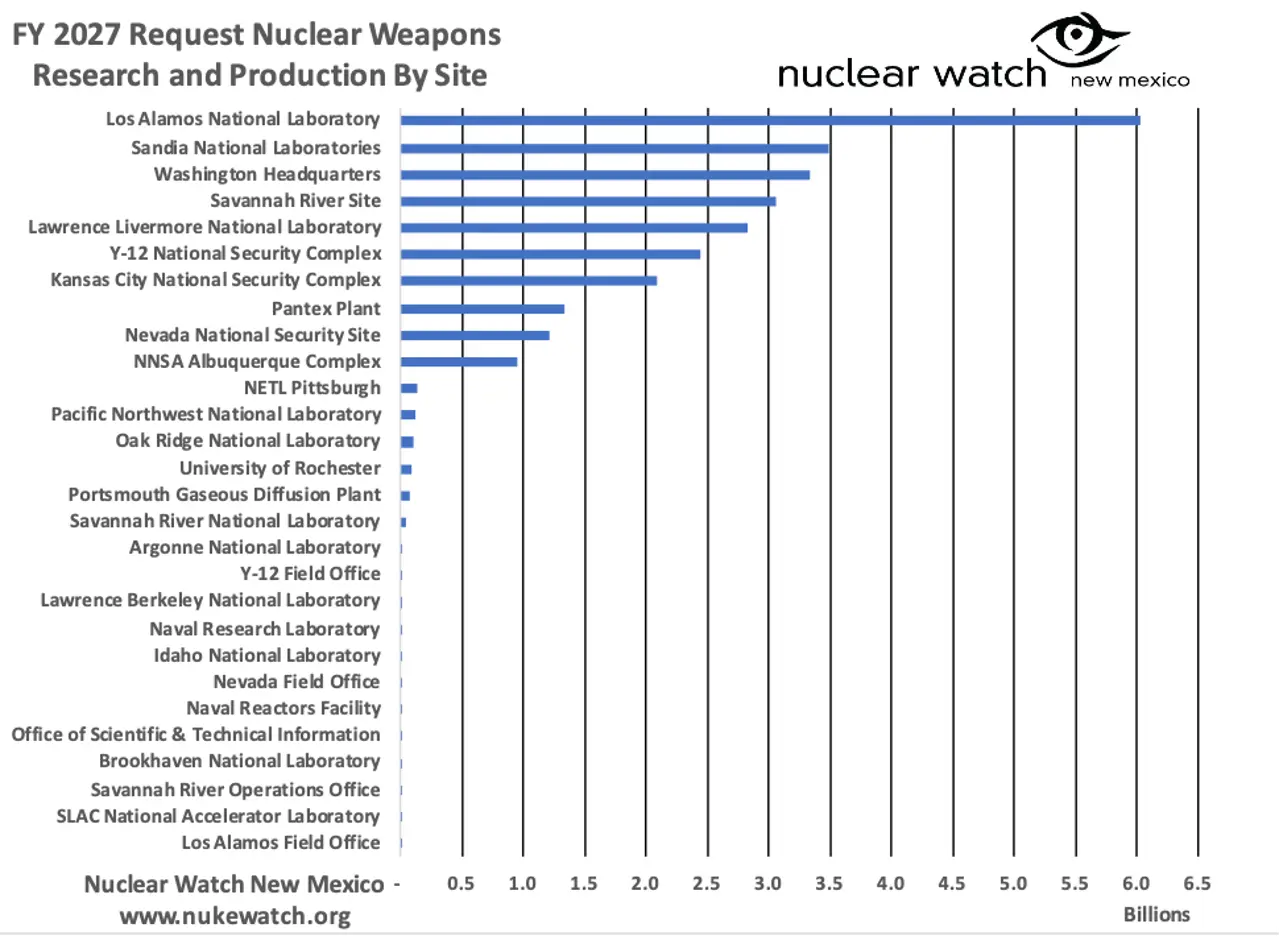
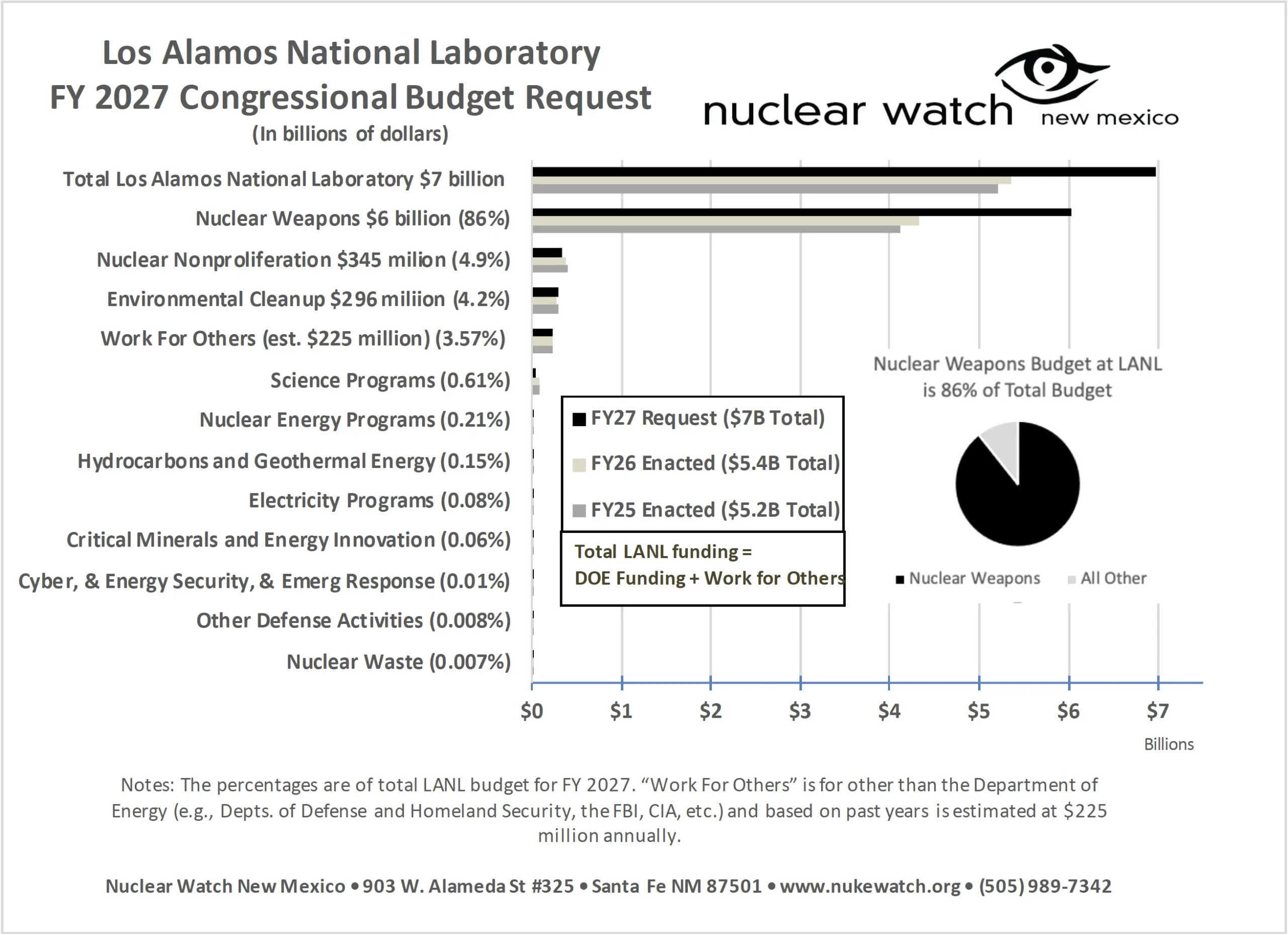
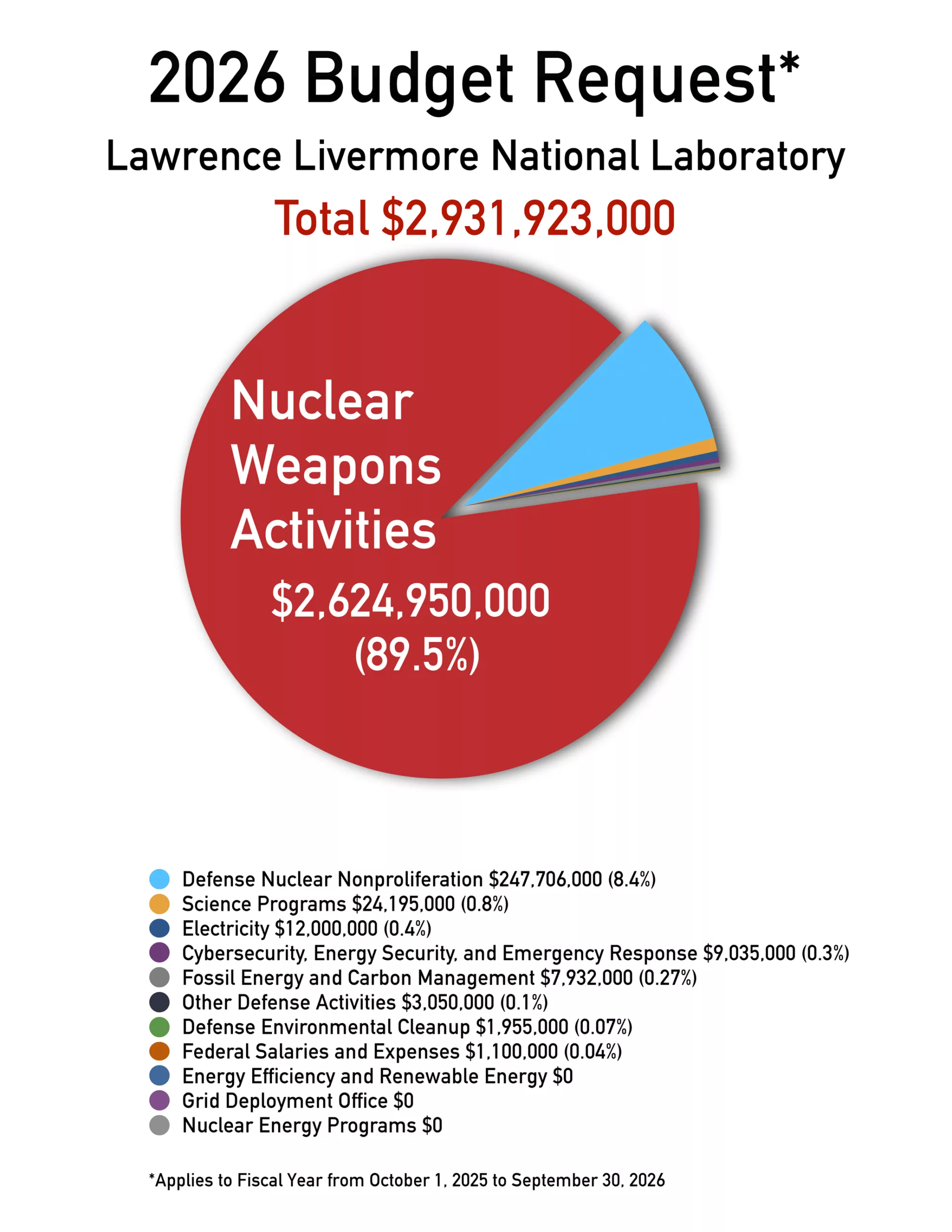
The Department of Energy and Los Alamos National Laboratory have released the LANL congressional budget request for the upcoming fiscal year, 2026, which begins on October 1, 2025. The request shows a continued major increase and expansion of the plutonium pit production program (plutonium pits are the triggers of nuclear weapons). LANL is frantically trying to increase its capabilities to begin making 30 pits per year by 2028.
NukeWatch created the above chart to give a visual of how taxpayer dollars are annually spent at the Lab. LANL’s FY 2026 total budget request is $6 billion, which is a 17% increase over the FY 2025 $5.2 billion total budget. This includes a 24% increase in the nuclear weapons budget over FY 2025.
Planned Nuclear Weapons Activities Increase to 84% of Lab’s Budget; All Other Programs Cut
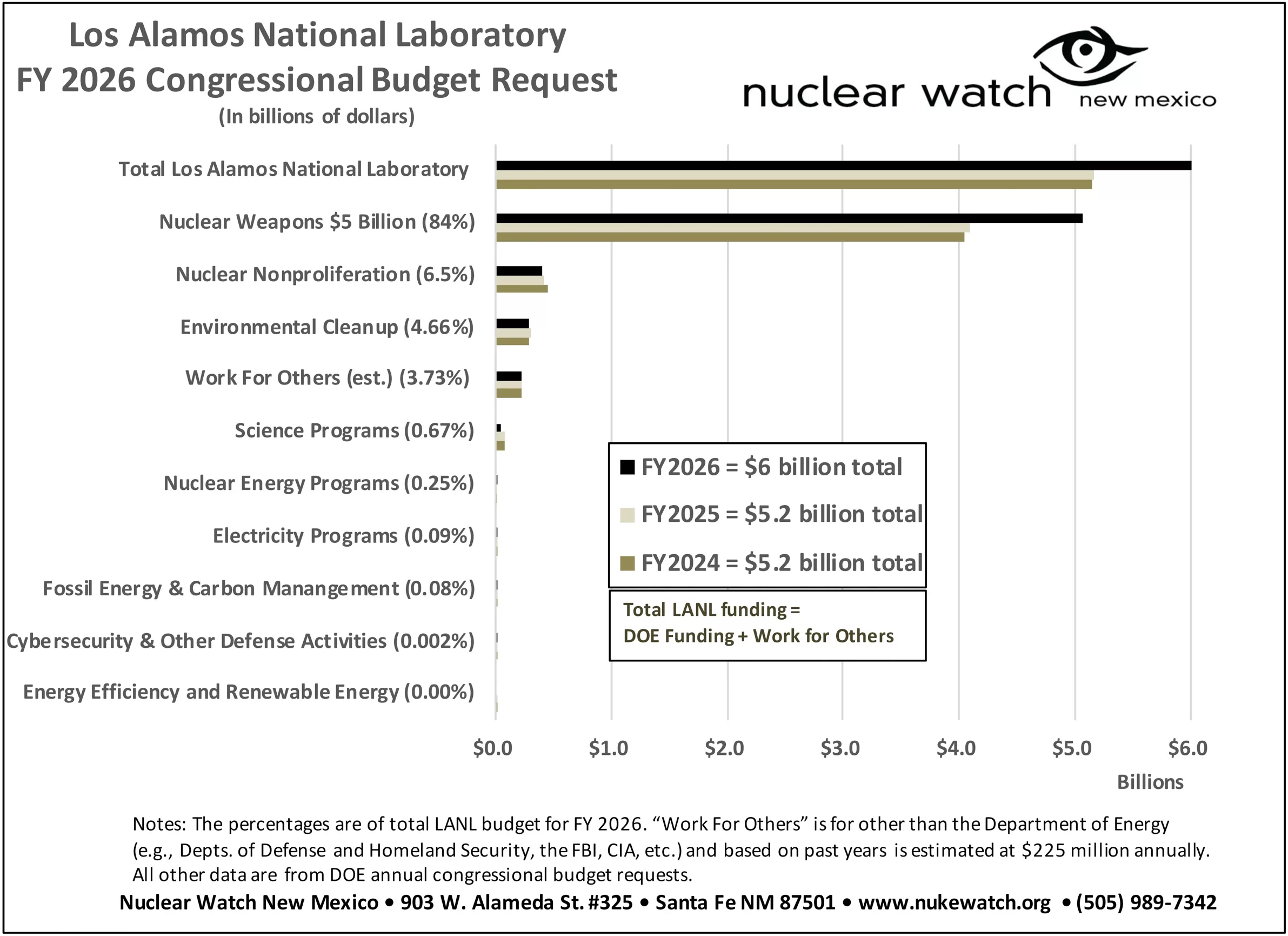
The Department of Energy and Los Alamos National Laboratory have released the LANL congressional budget request for the upcoming fiscal year, 2026, which begins on October 1, 2025. The request shows a continued major increase and expansion of the plutonium pit production program (plutonium pits are the triggers of nuclear weapons). LANL is frantically trying to increase its capabilities to begin making 30 pits per year by 2028.
NukeWatch created the attached chart to give a visual of how taxpayer dollars are annually spent at the Lab. LANL’s FY 2026 total budget request is $6 billion, which is a 17% increase over the FY 2025 $5.2 billion total budget. This includes a 24% increase in the nuclear weapons budget over FY 2025.
Continue reading


New Nuclear Media: Art, Films, Books & More
A September 11th Catastrophe You’ve Probably Never Heard About
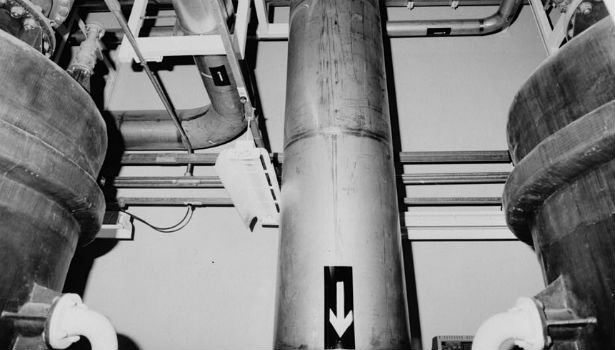
In 1957, America narrowly averted a nuclear meltdown at the Rocky Flats plant in Colorado. A new book explores how close we all came to disaster.
ANDREW COHEN | theatlantic.com
Our work is made possible by a generous grant from 