
QUOTE OF THE WEEK

Trump’s Talk of Nuclear Tests Recalls Fears of the Cold War
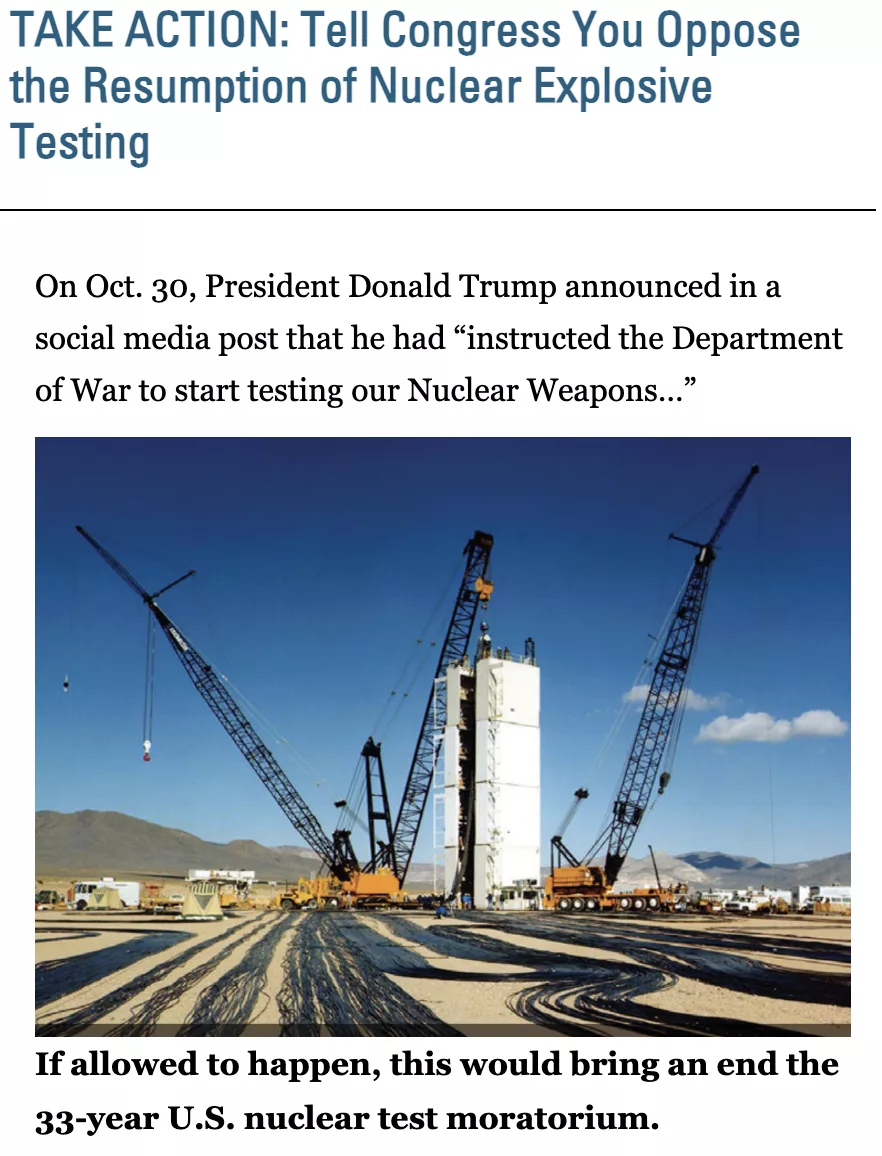
“Yes, we can learn things by nuclear testing. But when you look at the big picture, we have much more to lose by going back to testing than we have to gain.”
– SIEGFRIED S. HECKER, a former director of the Los Alamos weapons lab in New Mexico, where the first atomic bomb was created, after President Trump’s call to resume nuclear testing revived a Cold War debate. The New York Times nytimes.com
“There is nothing comparable in our history to the deceit and the lying that took place as a matter of official Government policy in order to protect this industry. Nothing was going to stop them and they were willing to kill our own people.”

— Stewart Udall, United States Secretary of the Interior under President Kennedy and President Johnson.
He was the father of Senator Tom Udall (who ended up being a vigorous supporter of expanded nuclear weapons “modernization” plans).
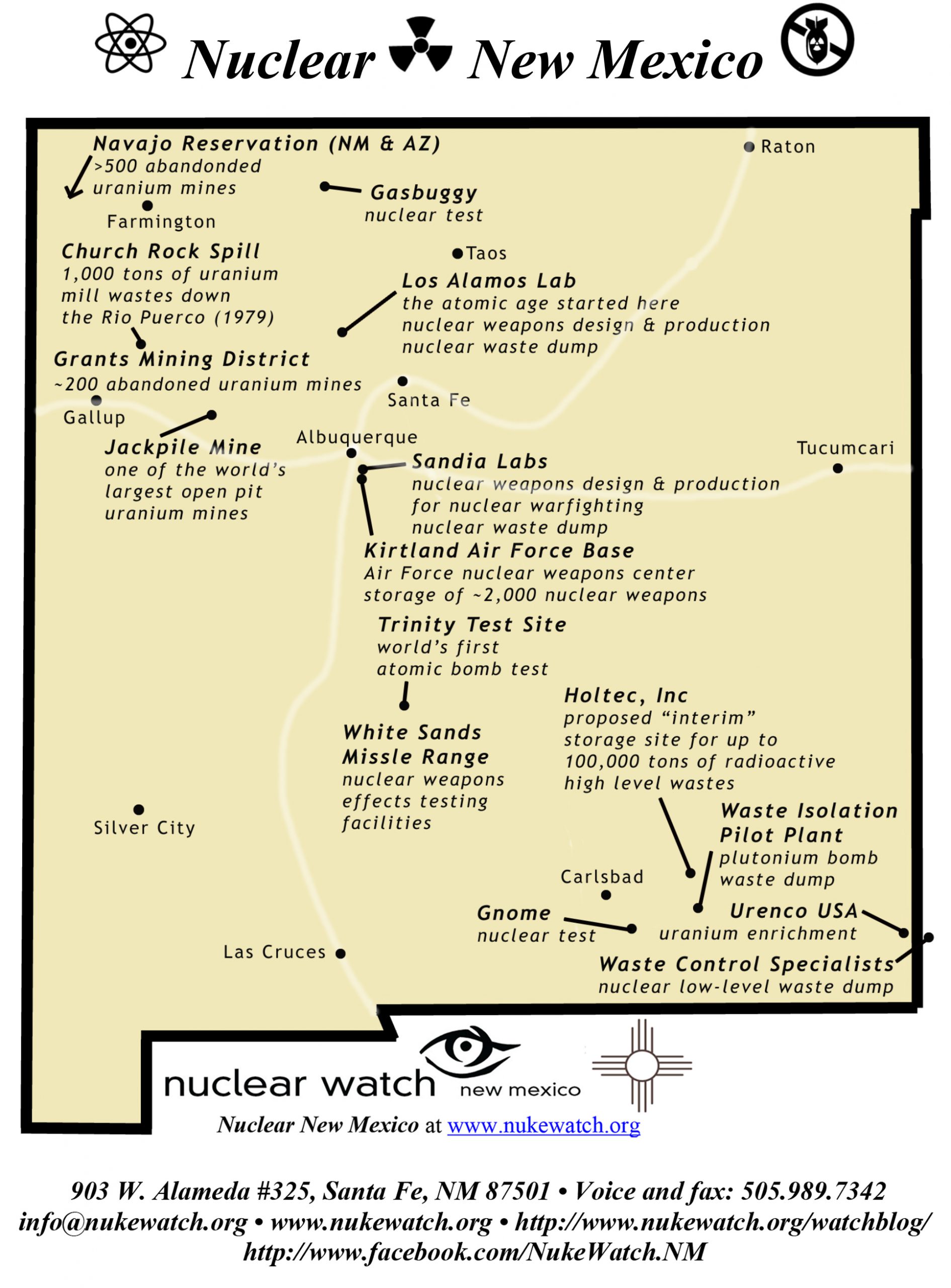
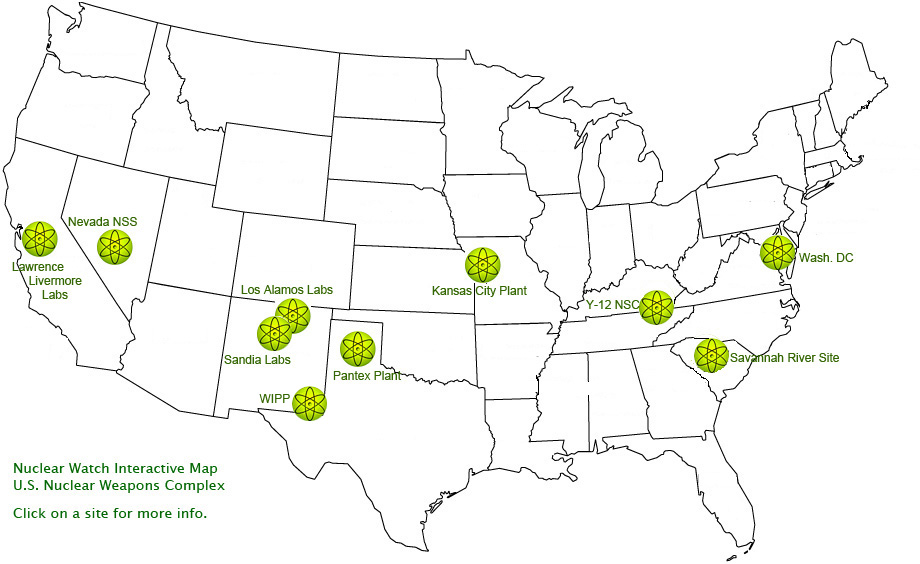
In 1985, US President Ronald Reagan and and Russian President Mikhail Gorbachev declared that “a nuclear war cannot be won and must never be fought.”


2022 BLOG POSTS
Trump Accelerates New Nuclear Warhead Production
Nearly Doubles Funding for Plutonium “Pit” Bomb Core Production
FOR IMMEDIATE RELEASE, April 6, 2026
Contact: Jay Coghlan, 505.989.7342, c. 505.470.3154 | Email
Sophie Stroud, 505.231.9736 | Email
Santa Fe, NM – The Trump Administration has released military budget numbers for the federal fiscal year 2027 (which begins October 1, 2026). This still current fiscal year 2026 is already a record breaker for military spending at one trillion dollars. Trump now proposes nearly $1.5 trillion in military spending in FY 2027, of which $1.1 trillion is base funding for the Department of War and an additional $350 million is through so-called budget reconciliation. On top of all this, Trump will likely seek $200 billion in supplementary appropriations for the war in Iran, for a potential total of $1.7 trillion in military spending in FY 2027 (a 70% increase above FY 2026). At the same time, there is a 10% across-the-board cut to non-military spending. Much of the remaining discretionary funding for education, wildfire protection, environmental regulations, health care, etc., will be constrained by a focus on border control and immigration enforcement.
Trump proposes $53.9 billion for the Department of Energy (DOE) in FY 2027. Sixty-one per cent ($32.8 billion) is for its semi-autonomous nuclear weapons agency, the National Nuclear Security Administration (NNSA). DOE’s Office of Science is gutted by $1.1 billion which “eliminates funding for climate change and Green New Scam research.” DOE’s Office of Energy Efficiency and Renewable Energy is eliminated. Nationwide cleanup of legacy Cold War radioactive and toxic wastes at DOE sites is cut by $386 million to $8.2 billion ($3 billion of which is reserved for the Hanford Site; other site-specific cleanup budget numbers are still not yet available).
New Mexico’s Revolving Nuclear Door: Top Environment Officials Sell Out to Nuclear Weapons Labs
As part of a long, ingrained history, senior officials at the New Mexico Environment Department (NMED) have repeatedly resigned to go to work for the nuclear weapons labs, the Department of Energy, or DOE contractors. In a number of cases that is where they came from to begin with.
The hierarchy of leadership at NMED starts with the Secretary, Deputy Secretaries and then Division Directors. The position of Resource Protection Division Director is particularly critical because it oversees the two NMED bureaus most directly involved with DOE facilities in New Mexico, the Hazardous Waste Bureau and the DOE Oversight Bureau.
FULL PRESS RELEASE [PDF]
Biden’s Nuclear Posture Review Fuels the New Nuclear Arms Race
Santa Fe, NM– Today, the Biden Administration has released its long awaited unclassified Nuclear Posture Review. It headlines a “Comprehensive, balanced approach to defending vital national security interests and reducing nuclear dangers.” It also declares that “deterrence alone will not reduce nuclear dangers.”
“Deterrence” against others has always been the publicly sold rationale for the United States’ nuclear weapons stockpile. First, there is the inconvenient fact that the U.S. was the first and only to use nuclear weapons in war. But secondly, the United States and the USSR (now Russia) never possessed their huge stockpiles for the sole purpose of deterrence anyway. Instead, their nuclear weapons policies have always been a hybrid of deterrence and nuclear war fighting, which threatens global annihilation to this very day.
FULL PRESS RELEASE [PDF]
/cdn.vox-cdn.com/uploads/chorus_image/image/71550878/GettyImages_515016314a.0.jpg)
New & Updated

Los Alamos Lab Banking on Plutonium “Pit” Production and New-Design Nuclear Warheads But Fights Against Cleanup
FOR IMMEDIATE RELEASE, April 7, 2026
Contact: Jay Coghlan, 505.989.7342, c. 505.470.3154 | Email
Sophie Stroud, 505.231.9736 | Email
Santa Fe, NM – The Department of Energy (DOE) has released additional details for the Los Alamos National Laboratory’s fiscal year 2027 budget. Earlier budget documents showed an 83% increase in funding for plutonium “pit” bomb core production, bringing it to $2.4 billion in FY 2027. An average of $2.3 billion will be spent in each of the following five years, for a total of $14 billion over six years. The National Nuclear Security Administration (NNSA) has directed the Lab to double pit production to at least 60 pits per year, making it more and more a nuclear weapons production site. However, no future pit production is to maintain the safety and reliability of the existing nuclear weapons stockpile. Instead, it is all for new-design nuclear weapons for the new nuclear arms race.
As a direct case in point, a newly released DOE budget document demonstrates that LANL will be funded $478 million in FY 2027 for the U.S.’ first completely new-design nuclear warhead since the Cold War, the submarine-launched W93. This is despite the recent completion of life extension programs for the U.S.’ two existing sub-launched warheads (the W76 and W88) that gave them new military capabilities, costing around $12 billion dollars. Nevertheless, the W93 program is moving forward, largely because of lobbying by the United Kingdom.
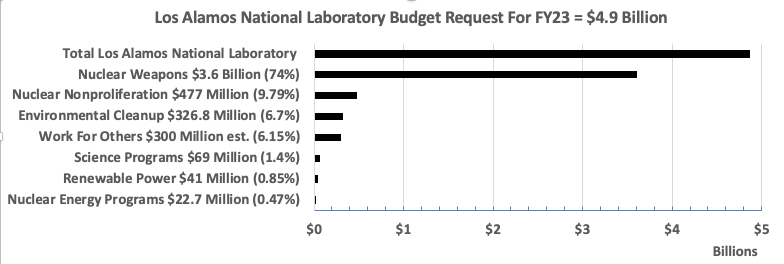
As LANL becomes more and more a nuclear weapons production site, non-weapons “Science” is being cut nearly in half ($84.7 million in FY 2026 to $43 million in FY 2027). Nonproliferation programs are cut from $377 million in FY 2026 to $345 million in FY 2027. All funding for renewable energy research has been eliminated, with the exception of $5.5 million for geothermal.
Trump Accelerates New Nuclear Warhead Production
Nearly Doubles Funding for Plutonium “Pit” Bomb Core Production
FOR IMMEDIATE RELEASE, April 6, 2026
Contact: Jay Coghlan, 505.989.7342, c. 505.470.3154 | Email
Sophie Stroud, 505.231.9736 | Email
Santa Fe, NM – The Trump Administration has released military budget numbers for the federal fiscal year 2027 (which begins October 1, 2026). This still current fiscal year 2026 is already a record breaker for military spending at one trillion dollars. Trump now proposes nearly $1.5 trillion in military spending in FY 2027, of which $1.1 trillion is base funding for the Department of War and an additional $350 million is through so-called budget reconciliation. On top of all this, Trump will likely seek $200 billion in supplementary appropriations for the war in Iran, for a potential total of $1.7 trillion in military spending in FY 2027 (a 70% increase above FY 2026). At the same time, there is a 10% across-the-board cut to non-military spending. Much of the remaining discretionary funding for education, wildfire protection, environmental regulations, health care, etc., will be constrained by a focus on border control and immigration enforcement.
Trump proposes $53.9 billion for the Department of Energy (DOE) in FY 2027. Sixty-one per cent ($32.8 billion) is for its semi-autonomous nuclear weapons agency, the National Nuclear Security Administration (NNSA). DOE’s Office of Science is gutted by $1.1 billion which “eliminates funding for climate change and Green New Scam research.” DOE’s Office of Energy Efficiency and Renewable Energy is eliminated. Nationwide cleanup of legacy Cold War radioactive and toxic wastes at DOE sites is cut by $386 million to $8.2 billion ($3 billion of which is reserved for the Hanford Site; other site-specific cleanup budget numbers are still not yet available).

LANL Plans to Spend $11.5B on Pit Production over Next Five Years, While New Mexico Remains One of the Poorest States in the Nation
A full one billion dollars is being added to plutonium “pit” bomb core production at the Los Alamos Lab for fiscal year 2027 (which begins this October 1). This tops out at $2.3 billion for each of the next five fiscal years, for a total of $11.5 billion.
None of this pit production is to maintain the safety and reliability of the existing nuclear weapons stockpile. Instead, it’s all for new-design nuclear weapons which can’t be tested because of the international testing moratorium, thereby perhaps eroding confidence in the stockpile. Alternatively, it could prompt the U.S. to resume testing (which Trump has already threatened), after which other nuclear weapons powers would surely follow, thereby accelerating the new nuclear arms race.
Other than for new-design nuclear weapons, plutonium pit production is simply not needed. In 2006 independent experts found that plutonium pits have serviceable lifetimes of at least 100 years (their average is now around 43 years). The National Nuclear Security Administration (NNSA) has avoided fully updated pit lifetime studies since then. There are already at least 15,000 existing pits stored at the NNSA’s Pantex Plant near Amarillo, TX.
Plutonium pit production is the NNSA’s most expensive and complex program ever.
Federal budget could mean nearly $1.7B more for Los Alamos lab
“A 21% surge in spending for defense programs funded by the U.S. Department of Energy would mean a more than $1.7 billion boost for nuclear weapons work at Los Alamos National Laboratory.”
| April 6, 2026 santafenewmexican.com
Early budget documents for the agency are in line with a presidential budget proposal released Friday, which emphasizes military spending — with a whopping $1.5 trillion recommendation for the Department of War — partially offset by cuts to domestic programs like health care and education, as well as what the federal government calls the “Green New Scam”, or climate-related work.
New nuclear safety rules reduce protections for workers, the public
“They’re pulling away from what’s kept us safe all these years.”
Bradley P. Clawson spent more than three decades handling highly radioactive materials at Idaho National Laboratory, a nuclear energy testing and production hub outside Idaho Falls. His work ranged from shipping and receiving nuclear naval fuels to helping bring hundreds of canisters of leftover fuel to Idaho for storage after the catastrophic Three Mile Island meltdown. He often handled nuclear fuel in “hot cells,” immensely contaminated areas reinforced with thick concrete.
Throughout, Clawson, a member of the United Steelworkers union, leaned on safety standards to argue for extra protections against radiation, including respirators and additional shielding.
But President Donald Trump’s sweeping agenda to expand nuclear energy and modernize nuclear weapons now includes easing the radiation standards that Clawson credits with keeping his exposure as low as possible.
Final Los Alamos Lab Site-Wide Environmental Impact Statement
The National Nuclear Security Administration’s Future Path for the Lab:
Radically Expanded Nuclear Weapons Production
“Defers” Comprehensive Cleanup Until Plutonium “Pit” Production is Done
FOR IMMEDIATE RELEASE, March 25, 2026
Contact: Jay Coghlan, 505.989.7342, c. 505.470.3154 | Email
Santa Fe, NM – Today the Department of Energy’s semi-autonomous nuclear weapons agency, the National Nuclear Security Administration (NNSA), released its final Site-Wide Environmental Impact Statement (SWEIS) for Continued Operation of the Los Alamos National Laboratory. This is eighteen years after the last site-wide EIS, during which time the Lab has been increasingly transformed into a nuclear weapons production site for the new global nuclear arms race. As the final SWEIS’ accompanying Record of Decision puts it, “NNSA has decided to fully implement the Expanded Operations Alternative.” Final LANL SWEIS ROD, page 5.
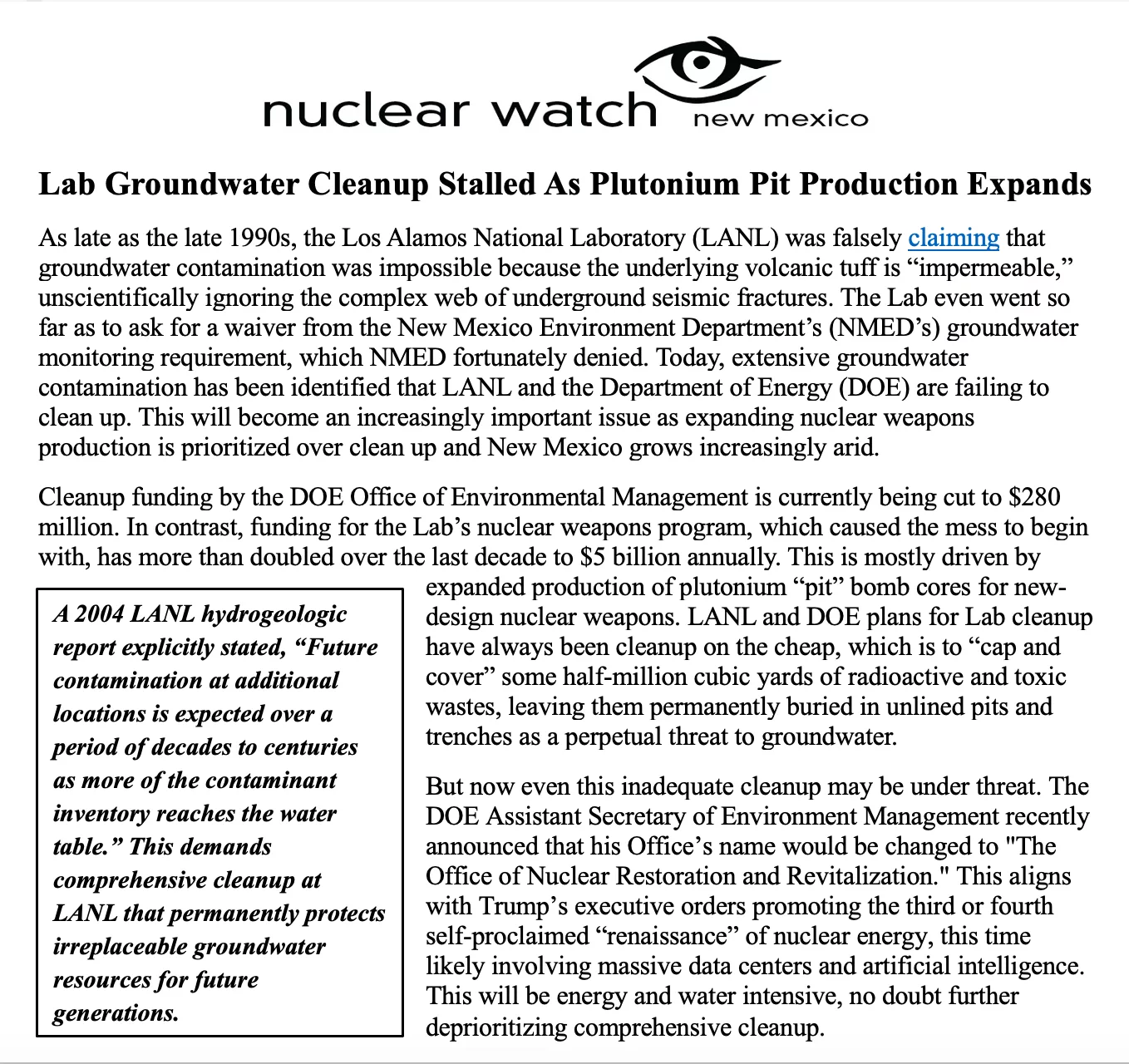
The final LANL SWEIS also states “At this time, MDA C will be deferred until no longer associated with active facility operations.” Final LANL SWEIS, page N-41. Material Disposal Area C is an old radioactive and toxic waste dump, inactive since 1974. Not mentioned is the fact that the New Mexico Environment Department has issued a draft order mandating comprehensive cleanup at Area C, which Nuclear Watch New Mexico strongly supports and DOE and LANL bitterly oppose. The reason DOE and LANL now claim that Area C is “associated with active facility operations” is because it is located within a few hundred yards of PF-4, LANL’s production facility for plutonium “pit” bomb cores. This strongly implies that the Lab will never be comprehensively cleaned up until LANL’s nuclear weapons production mission is over, which in effect means never. Further, LANL still hasn’t documented the extent of the massive groundwater contamination that it has caused.
Aggressive Los Alamos labs expansion plan wins approval from National Nuclear Security Administration
“Jay Coghlan, executive director of Nuclear Watch New Mexico, said struggles at the Savannah River Site in South Carolina, which also was expected to become a pit production site, mean the onus will be on LANL.”
“’Eighty pits per year is becoming more and more likely,” Coghlan said. “LANL is going to have to fill in for delays at the Savannah River Site.’”
Coghlan argued the lab’s heightened focus on pit production will lead to a weakening commitment toward cleanup at Los Alamos National Laboratory.
“The[y] are so obsessed with it they are indefinitely postponing comprehensive cleanup when we know the groundwater has been contaminated,” he added.
| March 26, 2026 santafenewmexican.com
Federal officials have adopted the most aggressive of three operational plans under consideration for Los Alamos National Laboratory.
The “expanded operations alternative,” which lab officials announced Wednesday, when they also released a new sitewide environmental impact statement, includes facilities upgrades and other actions “to respond to future national security challenges and meet increasing requirements.”
DOE Plans to Pave Pueblo People’s Cultural Sites, Put Up a Parking Lot
“The U.S. Department of Energy’s National Nuclear Security Administration (NNSA) today released a final Site-Wide Environmental Impact Statement (SWEIS) for the Los Alamos National Laboratory (LANL) in New Mexico. The SWEIS lays out several alternatives for the laboratory’s growth and operations through 2038 for nuclear weapons activities and identifies the agency’s preferred path forward. ”
The NNSA chose the option that would most drastically increase LANL’s ramifications for the community, environment and resources. It would also severely impact the cultural resources of neighboring Pueblos. The addition of a parking lot, bus transfer station, and several solar energy installations number among the NNSA’s priorities over the cultural heritage of local Pueblos.
Below is a statement from Dr. Dylan Spaulding, senior scientist in the Global Security Program at the Union of Concerned Scientists (UCS):
“The NNSA’s selected plan has the biggest impacts on the site’s energy use including nearly doubling its consumption of petroleum fuel, electricity, and water, all the while the agency continues to struggle to remediate existing contamination to groundwater both on and offsite.”
“NNSA has made clear that it is prioritizing the creation of a new parking lot, for example, over safeguarding the cultural heritage sites of local Pueblo peoples. UCS has previously called for meaningful consideration and integration of Pueblos’ concerns into the laboratory’s plans, particularly around environmental justice issues. Not only were environmental justice topics removed from the plan due to a federal executive order, but as many as 33 cultural heritage sites could be impacted to make way for new construction.”
“Plutonium pit production remains a top driver of the lab’s expansion, but the assumptions and analyses in this document may already be out of date. The NNSA recently announced new quotas that double LANL’s requirements to 60 pits a year. That means the upper limit for pit production in this document may already be closer to the new baseline.”

On National FOIA Day, let’s celebrate a law ‘vital to the functioning of a democratic society’
Under the law, anyone — not just reporters — has the right to request access to documents and information, writes guest columnist Rebecca Tallent.
Rebecca Tallent| March 16, 2026 idahocapitalsun.com
For many of us, March 16 is a special day. Happy birthday to James Madison, and happy Freedom of Information Day to everyone else.
National Freedom of Information Day celebrates the ability of people to look at most government records and is observed on the birthday of the man who wrote the First Amendment.
The U.S. Justice Department says the basic function of the federal Freedom of Information Act “is to ensure informed citizens, vital to the functioning of a democratic society.”
While most people think this is just a law for reporters, it’s not. It is for anyone who wants to check their government’s actions.
A bit of background on the federal FOIA: The law was passed in 1966, signed into law by President Lyndon Johnson and went into effect in 1967. The original law said government documents (at that time only paper documents) are open for public inspection.
Thirty years later, President Bill Clinton signed the Electronic FOIA, which covers electronic documents (texts, emails and other e-documents) as open for public inspection. As with paper documents, there are exceptions to what can be released. For example, most classified documents, personnel documents and ongoing criminal investigation files are not open for public viewing.
Under the law, anyone has the right to request access to documents and information, but they must make the request in writing and many agencies have forms the requestor must complete. For complete information about how to use FOIA on the federal level, the Reporter’s Committee for Freedom of the Press has created a Wiki page at https://foia.wiki/wiki/Main_Page.
Nuclear Weapons Issues & The Accelerating Arms Race: March 2026
Nuclear Weapons:
Trump’s FY 2027 budget is expected at the end of this month, where he has said that he will add a half-trillion to the already $1 trillion military budget, primarily for Golden Dome. It will probably be topline numbers only, with details to dribble out over weeks. On top of this there will likely be supplemental appropriations for the U.S.-Israel assault on Iran.
Post-New START, U.S. headed to MIRVING land-based ICBMs: 3/6/26 Exchange Monitor reports that a March 3, 2026 Minuteman III flight test launched from Vandenberg Space Force Base (formerly AFB) to the Kwajalein Atoll had two warheads. Under the now-expired New START, the U.S. previously limited land-based ICBMs to one warhead each. “Multiple Independently-targeted Reentry Vehicles” are regarded as particularly dangerous and destabilizing since land-based solos are fixed, known targets inviting preemptive strike and/or use them or lose them scenarios. The ICBM fields in the Upper Mid-West are meant in part to act as a “nuclear sponge” for incoming Russian warheads.
AI Opted to Use Nuclear Weapons 95% of the Time During War Games: Researcher www.commondreams.org/news/ai-nuclear-war-simulation Feb 25, 2026
“There was little sense of horror or revulsion at the prospect of all out nuclear war, even though the models had been reminded about the devastating implications.”
An artificial intelligence researcher conducting a war games experiment with three of the world’s most used AI models found that they decided to deploy nuclear weapons in 95% of the scenarios he designed.
AI Opted to Use Nuclear Weapons 95% of the Time During War Games: Researcher
NNSA’s FY 2025 Performance Evaluation Report for LANL made clear the Lab’s growing involvement with artificial intelligence.
Plutonium pit production:
NNSA is directing LANL to double plutonium pit production to at least 60 pits per year. This is largely due to ongoing delays and cost escalation at the Savannah River Site. At the same time the Department of Energy is lowering worker safety regulations (see https://nukewatch.org/press-release-item/department-of-energy-seeks-to-eliminate-radiation-protections-requiring-controls-as-low-as-reasonably-achievable/ from last November):
NNSA is also reportedly eliminating the “diamond stamp” certification for individual plutonium pits and instead certifying “processes.” National Environmental Policy Act requirements are being quashed as well. In short, it looks like NNSA and LANL are trying to cut corners and remove all speed bumps for plutonium pit production, which is being prioritized above everything else.
Accelerating Arms Race (in addition to the U.S.-Israel assault on Iran, it’s unfortunately been a busy month):
Iran will target Israeli nuclear site if regime change is sought, Iranian official says https://www.reuters.com/world/middle-east/iran-will-target-israeli-nuclear-site-if-regime-change-is-sought-iranian-2026-03-04/
Iran will target the Israeli nuclear site of Dimona if Israel and the U.S. seek regime change in the Islamic Republic, semi-official ISNA news agency reported on Wednesday, citing an Iranian military official.
————
Allegations of a Chinese nuclear blast may reignite weapons testing
As new global arms race looms, accusation highlights limits to monitoring low-yield tests
In the afternoon on 22 June 2020, a seismic station in eastern Kazakhstan registered two small earthquakes 12 seconds apart near China’s Lop Nur nuclear test site. Closely spaced jolts can arise from underground explosions followed by a cavity collapse, or simply from earthquakes. But U.S. officials this month asserted the shaking was from a clandestine nuclear detonation—an accusation that could sound the starting gun for a new global arms race.
————
Exclusive: US intelligence agencies tie Chinese explosive test to push for a completely new nuclear arsenal
https://www.cnn.com/2026/02/21/politics/china-nuclear-arsenal-new-technology, Feb 20, 2026
US intelligence agencies believe that China is developing a new generation of nuclear weapons and has conducted at least one covert explosive test in recent years as part of a broader push to completely transform its nuclear arsenal into the world’s most technologically advanced, according to multiple sources familiar with the US intelligence assessments.
The US assessment of China’s intention to radically advance its nuclear weapons is fueling debate inside the intelligence community and beyond over whether there has been a shift in Beijing’s thinking on nuclear strategy, the sources said. The investment in its nuclear arsenal is pushing China closer to peer status with Russia and the US and could yield technical capabilities neither of the two dominant nuclear powers currently possess.
————
Institute for Study of War
Kim Jong Un reaffirmed the centrality of nuclear weapons to North Korea’s deterrence strategy and outlined plans to expand North Korea’s nuclear arsenal during the 9th Party Congress, a continuation of his 8th Party Congress objectives. North Korean state media released a report on February 20 and 21 that established Kim’s “uncompromising” stance on maintaining its nuclear capabilities. Kim mentioned the enactment of the 2022 Nuclear Force Policy Law, which states that an attack against senior leadership or the nuclear command and control (C2) system would result in an automatic North Korean nuclear attack against the perpetrator. Kim also formalized the “nuclear trigger” system, established in 2023, which is intended to provide a more systematic approach to nuclear decision-making during periods of crisis. This system would allow for “automatic” retaliation against nuclear threats, which echoes other statements Kim made pushing for the development of artificial intelligence (AI)-driven military technology. Kim’s statements at the 9th Party Congress expanded on his remarks at the 8th Party Congress, where he called for the development of a nuclear deterrent.
————
Finland to lift full ban on hosting nuclear arms, government says https://www.reuters.com/business/aerospace-defense/finland-lift-full-ban-hosting-nuclear-arms-government-says-2026-03-05/
HELSINKI, March 5 (Reuters) – Finland plans to lift a long-standing ban on having nuclear arms on its territory, the government said on Thursday, aligning with Nordic neighbours in a move that could open the door to deploying atomic bombs on Finnish soil during times of war.
Finland’s Nuclear Energy Act, passed in 1987, prohibits the import, manufacture, possession and detonation of nuclear explosives on its soil, seen by some Finns as a clause that would benefit only Russia if there ever was a war.
Feds Give LANL “Very Good” in Accelerating Nuclear Arms Race; “Pit” Bomb Core Production Scheduled Through 2050 — Public Review of NNSA Programs Is Being Gutted
FOR IMMEDIATE RELEASE, March 6, 2026
Contact: Jay Coghlan, 505.989.7342, c. 505.470.3154 | Email
Sophie Stroud, 505.231.9736 | Email
“Rationality will not save us… this is very important: at the end we lucked out. It was luck that prevented nuclear war.” Robert McNamara, Defense Secretary, “Lessons Learned from the Cuban Missile Crisis”
Santa Fe, NM – The National Nuclear Security Administration (NNSA) has posted its annual Performance Evaluation Reports for FY 2025. In 2012 Nuclear Watch New Mexico had to sue the NNSA for these unclassified reports on contractors growing rich at taxpayers’ expense. The NNSA and/or its parent Department of Energy have been on the Government Accountability Office’s “High Risk List” for project mismanagement and waste of taxpayers’ dollars ever since 1990. According to a recent report, the NNSA currently has $4.8 billion in cost overruns for major construction projects (likely an underestimate), which represents a significant decline in performance since the GAO’s last assessment in 2023. In three years, cumulative schedule delays for NNSA’s construction projects increased from 9 years to 30 years, attributable to poor contractor project management, poor vendor/subcontractor performance, and general inflationary costs.
In 2019 the NNSA began restricting access to its Performance Evaluation Reports again, so Nuclear Watch New Mexico sued again in 2022. This time we compelled NNSA to post the Reports in an online Freedom of Information Act Reading Room. These Performance Evaluation Reports provide important insights into all of NNSA’s eight active nuclear weapons research and production sites.
In its latest Performance Evaluation Report for the Los Alamos National Laboratory (LANL), the NNSA graded the Lab’s expanding nuclear weapons programs as “Very Good.” At the same time, NNSA praised LANL for:
“… collaborat[ing] with stakeholders across the NSE [“National Security Enterprise”] to develop a programmatic baseline schedule supporting the pit production mission through FY 2050. This represents… a significant advancement in the planning for the pit mission at LANL and the national security needs of the United States.”
Nuclear Watch New Mexico argues that the true national security needs of not only the United States, but the entire world as well, is to avoid a staggering new nuclear arms race. The world’s last arms control treaty expired a few weeks ago and now war is raging across the Middle East over Iran’s alleged nuclear weapons program. A Review Conference of the 1970 NonProliferation Treaty, to which 191 countries are State Parties, is scheduled to begin in late April. However, it is widely assumed that it will utterly fail for the third consecutive time to make any progress whatsoever toward nuclear disarmament. The U.S. should be leading by example toward universal, verifiable nuclear disarmament as mandated by the NPT, instead of, in reality, acting diametrically opposed to it through its $2 trillion “modernization” program to keep nuclear weapons forever.
Plan on LANL’s path for next 15 years expected ‘any day now’
“When the draft was announced last year, some LANL critics decried that even the ‘no action alternative’ would still mean expansion for the lab. Jay Coghlan, executive director of Nuclear Watch New Mexico, told The New Mexican the process felt ‘rigged.’”
“It’s a choice between expanded nuclear weapons programs, yet more expanded nuclear weapons programs or far more expanded nuclear weapons programs,”
| March 5, 2026 santafenewmexican.com
An analysis of the potential impacts of the next 15 years of Los Alamos National Laboratory operations is expected to be signed “any day now,” according to officials from the local National Nuclear Security Administration field office.
A draft of the sitewide environmental impact statement was released early last year and offers three futures for the laboratory. One would continue existing operations and finish already approved projects, another would modernize lab infrastructure and a third would see an expansion of lab facilities and operations.
The National Nuclear Security Administration is suggesting the third, although NNSA officials presenting at a Tuesday meeting of the Los Alamos County Council stressed it’s more of a choose-your-own adventure: While approving the expanded plan would allow for additional growth, not every project on the list will be completed based on need and funding availability.
A spokesperson for the Los Alamos Field Office confirmed Thursday the document had not yet been signed by NNSA Administrator Brandon Williams.
Growth at LANL
The lab has been experiencing a growth spurt in recent years. During Tuesday’s update to the Los Alamos County Council, Ted Wyka, manager of the NNSA’s Los Alamos office, said the lab would have a “solid and stable” budget of roughly $5.3 billion in federal appropriations — about 33% higher than the $4 billion operating budget for fiscal year 2022.
Wyka said the lab also expects to hire between 1,000 and 1,400 employees this year.
That doesn’t include the loss of roughly 900 workers every year, Wyka said, so the number of employees will only grow from between 100 and 500.
About three years ago, the lab hired a record number of workers. The growth has slowed since, with the number of employees plateauing over the past two years. Since fiscal year 2021, the number of employees, excluding contractors, has increased around 28%.
That comes after Sandia National Laboratories announced last year it planned to cut between 1% and 3% of its workforce with a voluntary reduction program.
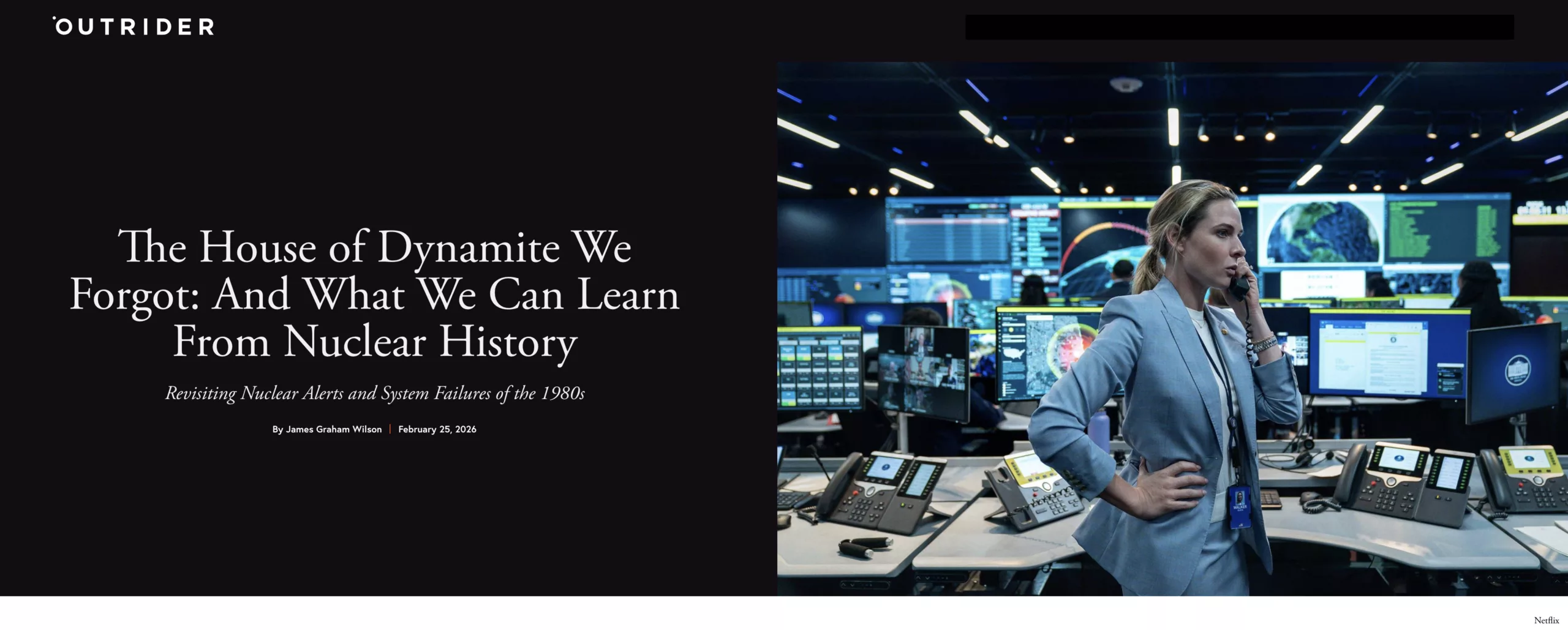
The House of Dynamite We Forgot: And What We Can Learn From Nuclear History
“It’s like we all built a house filled with dynamite,” the President of the United States bemoans toward the end of A House of Dynamite, ‘making all these bombs and all these plans and the walls are just ready to blow.’”
Outrider | February 26, 2026 outrider.org
A House of Dynamite depicts the tense, shrinking window of options leaders have as a nuclear weapon of unknown origin hovers over Chicago—a scenario complicated by human judgment, defense failures, and political uncertainty.
“We did everything right, right?” asks a missile defense officer, as things go awry.
While director Katherine Bigelow’s tense drama was fiction, it might be a good time to use A House of Dynamite to illuminate the historical nuclear missile scares of the past—all of them terrifying, but nearly all of them forgotten in the popular consciousness—and learn from them.
ACTION ALERTS


– ICAN Executive Director Beatrice Fihn on the release of the letter January 11, 2022

Interfaith Panel Discussion on Nuclear Disarmament - August 9


HELP US SUPPORT NEW MEXICO’S GOVERNOR IN ACTING TO STOP WIPP EXPANSION!
STOP “FOREVER WIPP!”
The Department of Energy is seeking to modify the nuclear waste permit for southeastern New Mexico’s Waste Isolation Pilot Plant. Dragging out WIPP’s operations decades past the original 20-year agreement violates the social contract made with New Mexicans. WIPP is being equipped to take the waste that will be generated from production of plutonium pits for nuclear warheads, and it was never supposed to do that. An expansion of WIPP will impact the entire country, not just residents of southeastern New Mexico.
View the videos below for more information, and, if you live in an area that may be endangered by these nuclear waste transportation risks, please consider making your own “This is My Neighborhood” video!
Background Information – Problems with Nuclear Waste
Mixed Waste Landfill Facts

New Nuclear Media
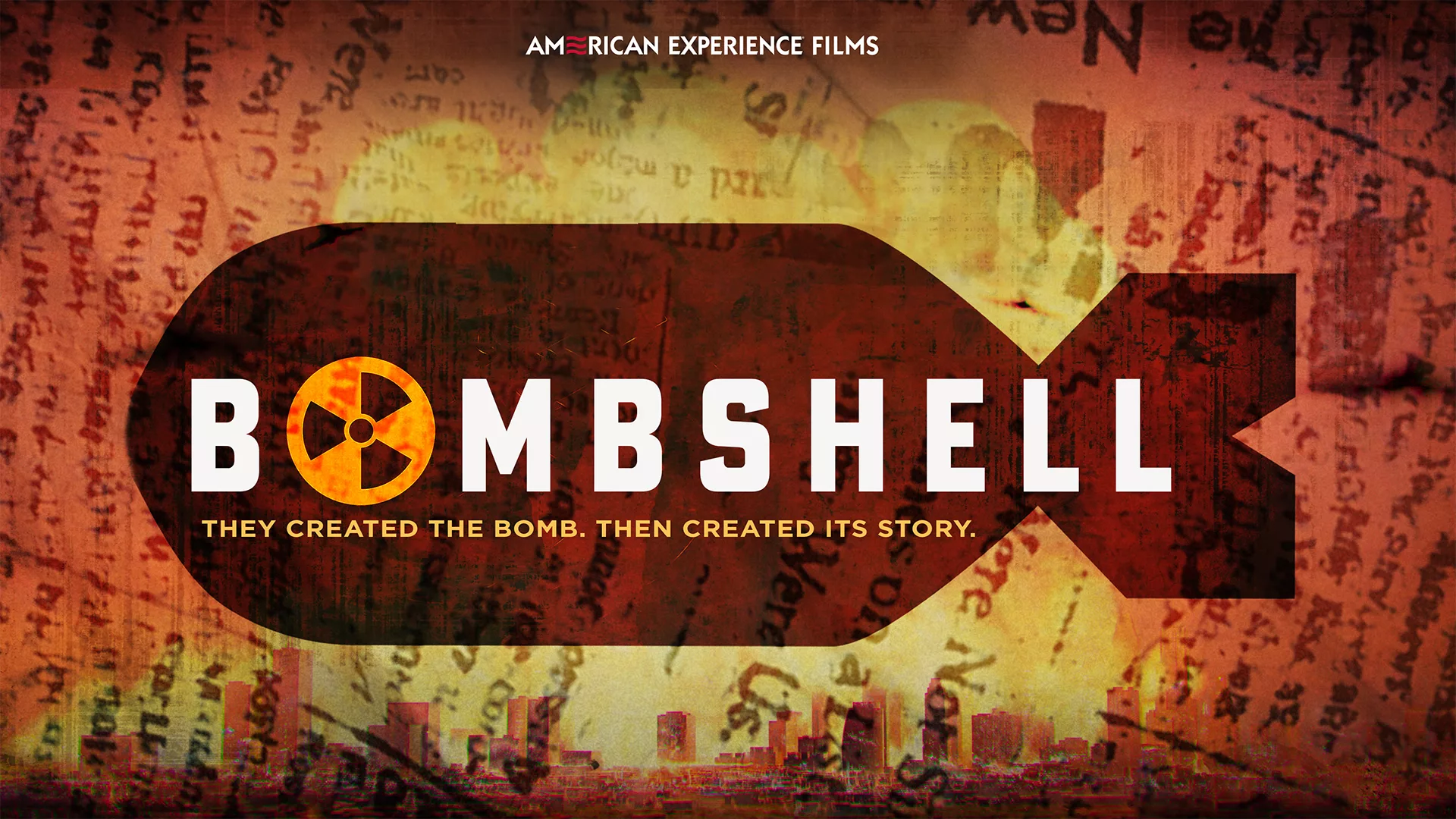
Watch BOMBSHELL on PBS American Experience — streaming across all PBS-branded platforms, including YouTube, PBS.org and the PBS App!
The wait is over! BOMBSHELL is available NOW on PBS American Experience — and will be streaming simultaneously across all PBS-branded platforms, including YouTube, PBS.org and the PBS App.
BOMBSHELL examines how the U.S. government manipulated public opinion through propaganda and censorship to justify the use of nuclear weapons and to minimize the human toll. Against this powerful machinery, a small group of journalists—including a Black pool reporter, a Japanese American staffer, a Japanese photographer, and a freelance magazine writer—identified gaps in the official narrative and courageously reported on the human consequences of the atomic bombings.
The Wall Street Journal described BOMBSHELL as offering “lessons for our own age of ascendant AI,” while Foreign Policy called it “provocative history that brings to life the dangers that arise when government secrecy and control overwhelm press freedom.”