
In 1985, US President Ronald Reagan and and Russian President Mikhail Gorbachev declared that “a nuclear war cannot be won and must never be fought.”


2022 BLOG POSTS
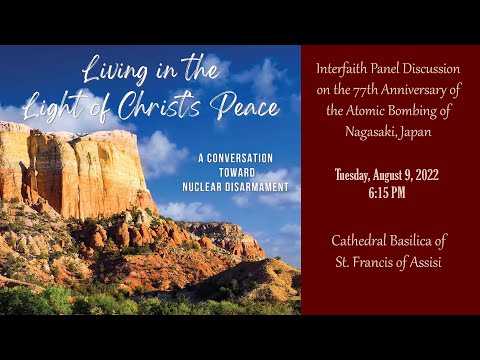
[Separate from Mass & Healing Ceremony] Watch Recording of Nagasaki Anniversary: Panel Discussion on Nuclear Disarmament from Local Interfaith Leaders


“Each Day Begins with the Sun Rising” – 77 Years Later, 4 Artists from Hiroshima Reflect
Today marks the 77 years since the United States dropped an atomic bomb on Nagasaki, Japan during World War II. Three days ago, August 6, marks the same anniversary for the bombing of the city of Hiroshima, Japan. In both cities the blast completely annihilated everything within a 1-mile radius from the center of explosion. The bombs not only decimated the current population, destroyed property, and scorched the land; the entirety of the ways of life of these communities was ripped away in a terrorizing flash.
"The atomic explosion almost completely destroyed Hiroshima's identity as a city. Over a fourth of the population was killed in one stroke and an additional fourth seriously injured, so that even if there had been no damage to structures and installations the normal city life would still have been completely shattered." - The Atomic Bombings of Hiroshima and Nagasaki (atomicarchive.com)
The total effects of the only two nuclear weapons ever detonated in warfare are not fully known, despite 77 years of people (scientists, military experts, civilians, Japan, etc.) trying to estimate the number of the dead and injured. "The most credible estimates cluster around a “low” of 110,000 mortalities and a “high” of 210,000, an enormous gap (the estimates for each city have a range of ±10,000)." - Bulletin of Atomic Scientists
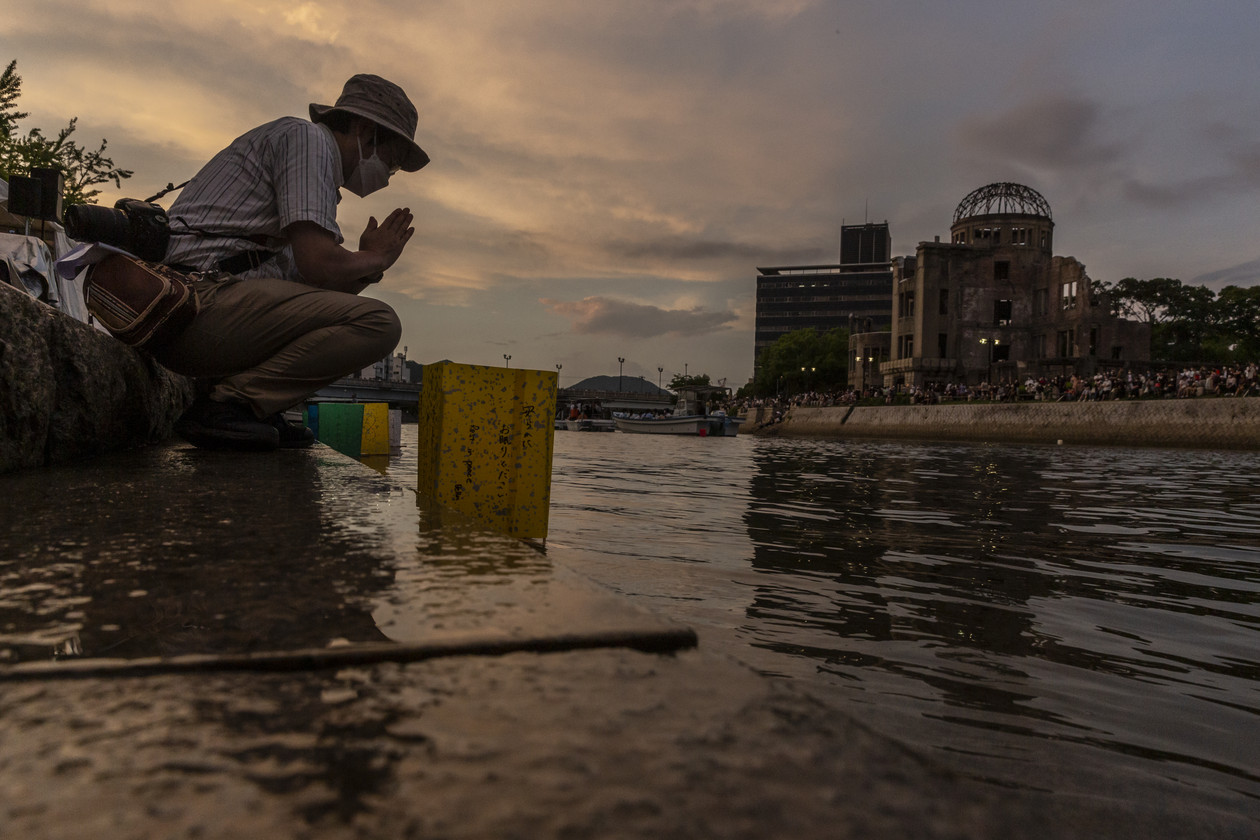
The events of August 6 and 9, 1945, forever changed the world. But today, besides continuing to attempt to know the extent of the cost of life of these bombings, how are we moving forward in reflection and in growth? How, as a global community, can we explore and prioritize processing the deep, deep pain of these events? The city of Nagasaki has been rebuilt since World War II and is today an important tourist site, serving as a significant spiritual center for movements to ban nuclear weapons. Aging survivors, known in Japan as hibakusha, continue to push for a nuclear ban and hope to convince younger generations to join the movement.
New & Updated
How Congress Can Stop Worrying and Learn to Govern the Bomb: A New Era of Congressional Responsibilities in Nuclear Weapons Policy
“It is long past time for Congress to reinvigorate our oversight of nuclear weapons policies. In this Essay, I will argue that Congress has been overly deferential to claims from the nuclear enterprise and has fallen short in its oversight of nuclear weapons policies by inadequately weighing and evaluating costs and risks.
Although Congress has tools to influence nuclear strategy and oversee the development and employment of America’s nuclear arsenal, in recent years, Congress has failed to use them effectively. For example, a recent Strategic Posture Review was conducted by a bipartisan congressional commission but failed to evaluate the key constraint at the core of congressional responsibilities: cost. As others have observed, the report “does not account for the major fiscal, logistical, and political constraints that would inhibit implementation of its recommendations.” In other examples, Congress has failed to hold hearings on the status of the severely delayed, over-budget Sentinel Intercontinental Ballistic Missile (“ICBM”) program.”
 Harvard Law School Journal on Legislation Volume 63.1 (Winter 2026) • Articles Rep. John Garamendi[*] | January 24, 2026 ucs.org
Abstract
Since the development of the first nuclear weapons, policymakers have been forced to grapple with the implications of their extraordinary destructive potential. Congress, with its constitutional remit on matters of war and peace, has responsibility to shape the development of policies which govern nuclear weapons, including in their acquisition and use. In the decades following the invention of nuclear weapons, Congress has at times taken active roles in oversight of nuclear weapons policy and programs in accordance with its constitutional prerogatives. However, in part due to Congress’s structure, this oversight has recently tended towards dictating programmatic minutiae rather than addressing the strategic questions about the role that nuclear weapons should play in the national security of the United States. On such an important political issue, Congress must engage in fulsome debate and take an active role in shaping policy regarding the role of nuclear weapons in our security, society, and international relations.
I. Introduction
A. The Beginning of the Modern Era
Eighty years ago, nuclear weapons were used in war for the first and only time.1 The horrific death toll made clear that nuclear weapons enabled destruction at a scale that was previously unthinkable.2 Once such destructive capabilities were available, governments faced new questions about the future of these weapons.
Nuclear weapons have unique attributes, particularly in the scale of their destructiveness, which left policymakers and military planners struggling to understand what strategic role these weapons would play in global defense.3 In democracies, where civil-military norms have often emphasized a split between political leaders who set war objectives and military leaders who manage the conduct of war, nuclear weapons posed a particular challenge by erasing the line between political and military decisions.4
Today, policymakers still grapple with these questions. I will argue that one conclusion has become increasingly clear through these debates: nuclear weapons are not merely military weapons. Their capacity to destroy makes them, by some assessments, “useless” as military implements since their use would far exceed most rational military objectives.5 They are instead “strategic” weapons whose use rests at the heart of existential political decisions for countries and their governments. As I will discuss below, these unique characteristics remain at the core of debates about their management.6
Partnership for a World without Nuclear Weapons: Statement on the Fifth Anniversary of the Treaty on the Prohibition of Nuclear Weapons
ALBUQUERQUE—Wednesday, January 21, 2026—The Partnership for a World without Nuclear Weapons released a statement in recognition of the fifth anniversary of the entry into force of the Treaty on the Prohibition of Nuclear Weapons:
We hope for its further expansion through additional ratifications, now that a majority of the world’s countries have signed the Treaty. In July 2017, the Vatican was the first nation-state to sign and ratify the Treaty as part of its “unwavering commitment to the total elimination of nuclear weapons.”
We condemn the fact that the nuclear weapons powers have never honored their long-held obligations under the 1970 NonProliferation Treaty to enter serious negotiations leading to global nuclear disarmament.
In contrast, the Treaty on the Prohibition of Nuclear Weapons was a great step toward the light of peace. The nuclear-armed states have a moral obligation to hear the voices of the majority of the world, and to listen to those who face the threat of annihilation due to the reckless decisions of any one of their nine leaders. Russia’s nuclear saber-rattling over Ukraine makes this clear, while ongoing crises in the Middle East further escalate the risks. Meanwhile, the nuclear weapons powers are engaged in massive “modernization” programs, designed to keep nuclear weapons forever.
The international legal force of the nuclear weapons ban treaty is limited to those states that have formally ratified it. But its moral power does not recognize boundaries between nations, nor lines on a map. The moral power of this Treaty is global and universal. We hope and pray that it will exert moral pressure on the nuclear weapons states to finally honor their disarmament obligations under the Non-Proliferation Treaty.
On the fifth anniversary of the Treaty on the Prohibition of Nuclear Weapons, we specifically call upon world leaders to demonstrate measurable progress toward nuclear disarmament. Eight decades of nuclear threats are far too long, as evidenced by the horrors documented by the atomic bombing museums in Japan. It is long past time for the nuclear weapons powers to begin to make tangible progress toward that end.
As our close colleague Robert McElroy, Cardinal of Washington, DC, declared last August in Hiroshima on the 80th anniversary of the atomic bombing:
“We refuse to live in a world of nuclear proliferation and risk-taking. We will resist, we will organize, we will pray, we will not cease, until the world’s nuclear arsenals have been destroyed.”
A Grave Problem with South Carolina’s New Nuclear Warhead
In South Carolina, contractors say new plutonium pit warhead waste will be shipped to New Mexico. Is it true?
“The coming showdown over SRNS’s TRU waste underscores what has long been a truism of the US nuclear weapons complex: that the government’s urgency to produce new weapons outstrips its commitment to plan and fund the cleanup of the sites across the American landscape that are contaminated while doing so.”
| January 22, 2026 inkstickmedia.com
On a crisp evening last October, Savannah River Nuclear Solutions (SRNS), a federal contractor that hopes to manufacture thousands of cores for new nuclear warheads at a Cold War-era weapons plant in rural South Carolina, put on a public information session at a library in the town of North Augusta. The purpose of the event was to address any concern from locals that its plan to produce 50 plutonium pits per year for 50 years would leave toxic waste, including radioactive refuse known as TRU waste, in and around the 310-square-mile Savannah River Site (SRS) that people in towns like Allendale and Aiken find themselves neighboring.
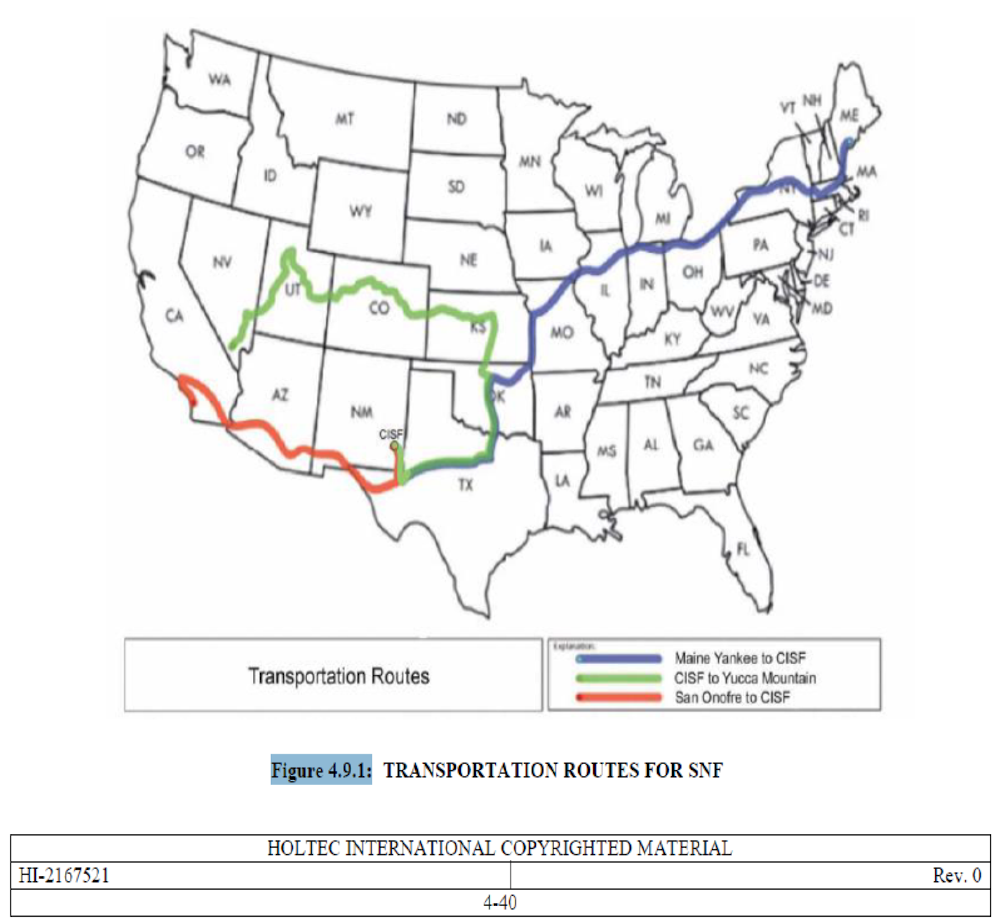
The session included about 30 presenters whom SRNS employs. They handed out Halloween candy while standing beside posterboards laying out what they described as a “cradle-to-grave” process for TRU waste generated by producing those pits. They described a plan to store batches of radioactive waste for only one year in both existing and to-be-constructed buildings around an abandoned nuclear fuel plant at the SRS. The waste, according to contractor employees and a map they displayed, would then be transported in trucks along Interstate 20 through Atlanta, Birmingham, and Fort Worth before reaching southern New Mexico, where it would be buried in an 2,150-foot-deep salt mine called the Waste Isolation Pilot Project (WIPP). The 1976 Resource Conservation and Recovery Act requires the company to detail those steps, including, crucially, the final “disposition of such wastes,” in order to apply for a local permit to build and operate what SRNS says will be just temporary waste storage buildings at the plant site. An information sheet from SRNS said the company plans for the permit application to be submitted in January and for the new storage buildings to begin construction a year later.
Trump offers states a deal to take nuclear waste
“Governors would effectively be invited to compete for what the administration believes is a once-in-a-generation economic development prize in exchange for hosting the nation’s most politically and environmentally toxic byproduct.”
The Trump administration wants to quadruple America’s production of nuclear power over the next 25 years and is hoping to entice states to take the nuclear waste those plants produce by dangling the promise of steering massive investments their way.
President Donald Trump’s big bet on amping up nuclear production is not an easy feat, fraught with NIMBY concerns about safety and waste byproducts. The administration hopes to solve at least one of those issues — what to do with toxic nuclear waste — with a program they plan to roll out this week.
Governors would effectively be invited to compete for what the administration believes is a once-in-a-generation economic development prize in exchange for hosting the nation’s most politically and environmentally toxic byproduct.
Energy Secretary Chris Wright has already begun laying groundwork with governors. Over the last two weeks, Wright has met with at least two governors who have expressed interest, according to two officials familiar with the private meetings granted anonymity to discuss them.
Americans Across Party Lines Want the U.S. to Keep Nuclear Limits with Russia, New Poll Finds
YouGov poll commissioned by ReThink Media and the Nuclear Threat Initiative.
“As the last remaining U.S.-Russia nuclear limitations treaty expires on Feb. 5, an overwhelming majority of Americans (91 percent) say the United States should negotiate a new agreement with Russia to either maintain current limits on nuclear weapons or further reduce both countries’ arsenals.”
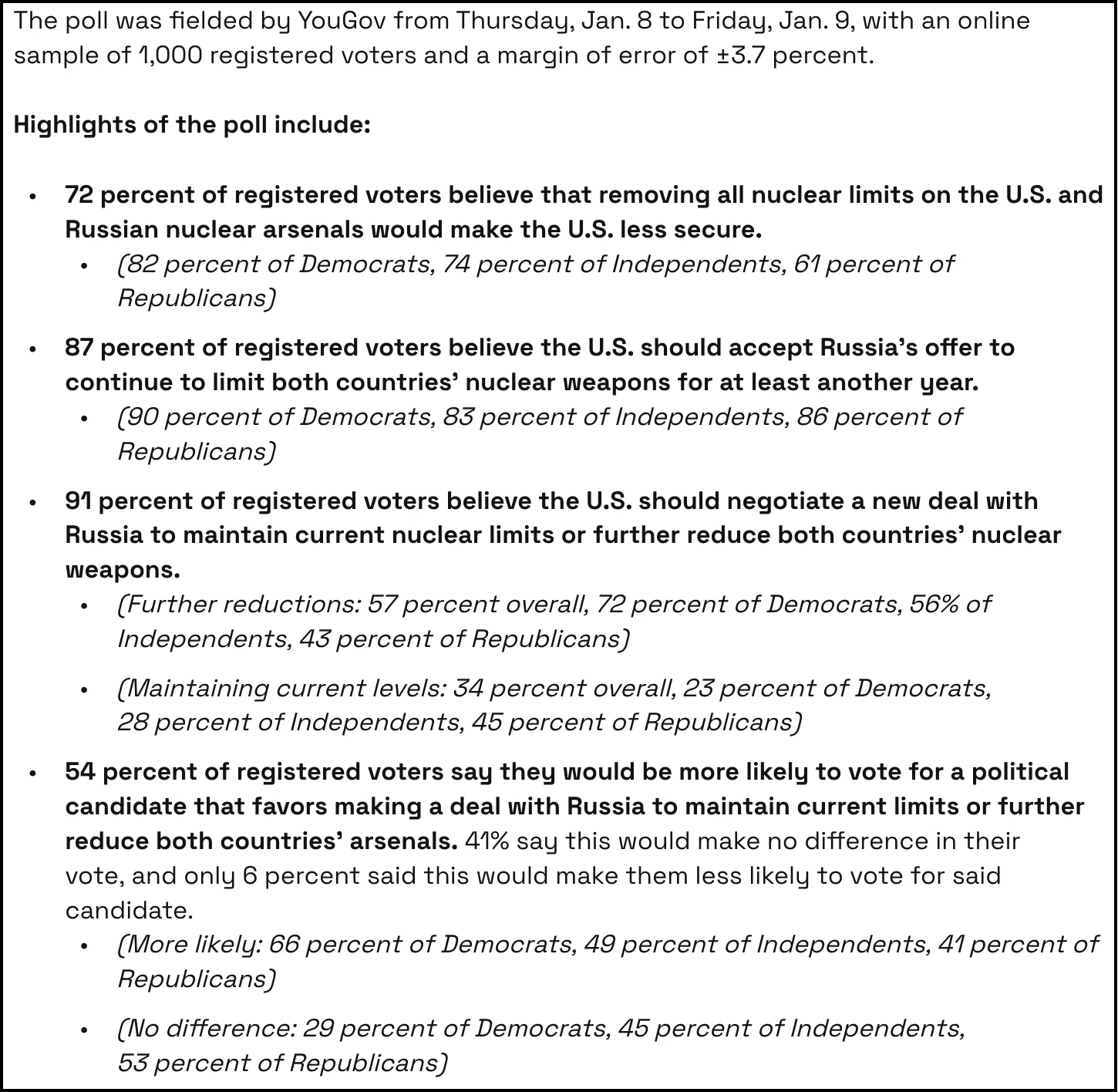 The poll of 1,000 registered voters also finds that the vast majority of Americans—including 85 percent of those who voted for President Trump—believe the president should agree to Russia’s proposal to continue abiding by the limits imposed by the New START treaty for at least another year after the treaty expires. In addition, 72 percent of registered voters believe that removing all nuclear limits on U.S. and Russian nuclear arsenals would make the United States less secure.
When New START expires, it will be the first time in decades that there are no limits capping the number of nuclear weapons for the world’s two largest arsenals. Together, the U.S. and Russia own almost 90 percent of all nuclear weapons in the world.
President Trump recently said he intends to negotiate a better agreement with Russia after New START expires. Previously, he warned that “when you take off nuclear restrictions – that’s a big problem” and made favorable comments about Russia’s one-year offer to voluntarily maintain the treaty’s limits. He repeatedly has warned of the threat posed by nuclear weapons. However, his administration has not yet taken concrete actions to secure a new nuclear limitations agreement with Russia.
Palomares: Reflections of an American, sixty years later
This past Saturday marked 60 years since the 1966 Palomares mid-air crash that left plutonium contamination scattered around the Spanish village. Dr. Michael E. Ketterer, Professor Emeritus of Chemistry and Biochemistry at Northern Arizona University in Flagstaff, AZ, has authored “Palomares: Reflections of an American, sixty years later.” See his English language version here and below and the Spanish version here.
| January 17, 2026 eldiario.es
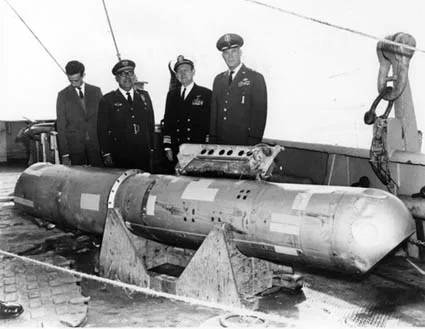
By U.S. Navy, Courtesy of the Natural Resources Defense Council – Transferred from en.wikipedia to Commons by EH101 using CommonsHelper., The original uploader was Asterion at English Wikipedia., 31 May 2007 (original upload date), Public Domain, https://commons.wikimedia.org/w/index.php?curid=2630293
During the early morning hours of January 17, 1966, the six-year-old author was in his bed, asleep in the Buffalo, New York suburb of North Tonawanda. During those very same moments, a crash took place between two US planes: a B-52 bomber and a fully loaded KC-135, which were in the midst of refueling the bomber in-flight. The B-52 was crossing the Iberian Peninsula that morning as part of US Air Force’s Strategic Air Command’s daily routes, performing vigilance on the Soviet Union. Three thermonuclear bombs fell to the land, and a fourth fell into the sea, after the collision in the skies over Palomares, a small village located about two kilometers from the Mediterranean, in the province of Almeria, Andalucía in southeastern Spain.
All of that happened before I got out of bed that day.
Two of the bombs were destroyed upon impact, although neither produced a nuclear explosion. Instead, several kilograms of plutonium (Pu) were dispersed on a windy day, onto several square kilometers of the tomato fields and residential zones of Palomares. An additional bomb was found by a local resident; fortunately, it wasn’t significantly damaged since its parachute had opened. On the other hand, the fourth bomb appeared to have been lost in the Mediterranean, and very soon, that was obviously true. The US Air Force’s top priority quickly became to use whatever resources and heroes that were available, for an urgent mission: find the lost bomb before the Soviets could do so. The search and recovery of the bomb became the success story, and the history that was told. That was the lesson learned from Palomares, among the two governments, their military forces, and in the press. The photos of the military commanders from both countries posing with the recovered bomb aboard the USS Petrel are some of the most famous Internet images of Palomares.
Watch BOMBSHELL on PBS American Experience — streaming across all PBS-branded platforms, including YouTube, PBS.org and the PBS App!
The wait is over! BOMBSHELL is available NOW on PBS American Experience — and will be streaming simultaneously across all PBS-branded platforms, including YouTube, PBS.org and the PBS App.
BOMBSHELL examines how the U.S. government manipulated public opinion through propaganda and censorship to justify the use of nuclear weapons and to minimize the human toll. Against this powerful machinery, a small group of journalists—including a Black pool reporter, a Japanese American staffer, a Japanese photographer, and a freelance magazine writer—identified gaps in the official narrative and courageously reported on the human consequences of the atomic bombings.
The Wall Street Journal described BOMBSHELL as offering “lessons for our own age of ascendant AI,” while Foreign Policy called it “provocative history that brings to life the dangers that arise when government secrecy and control overwhelm press freedom.”
New Mexico, Department of Energy at odds over cleanup halt at LANL waste site
In a December public meeting, the field office’s manager indicated approval from the Environment Department likely wasn’t needed to defer the study and cleanup of Area C. According to the compliance decree, “NMED approval is not required” in several cases to change the status of an area to deferred, as long as the Department of Energy complied with other requirements.
Environment Department spokesperson Drew Goretzka wrote in an email to The New Mexican a site can be deferred in one of four cases, including if it is involved in active operations and if the amount of time needed for deferment is assessed.
The department doesn’t agree those requirements have been met, Goretzka wrote, “resulting in a breach of the Consent Order.”
| January 9, 2026 santafenewmexican.com
 The U.S. Department of Energy has put cleanup of a hazardous waste disposal site at Los Alamos National Laboratory on hold, a decision that seems to have drawn the ire of the New Mexico Environment Department.
The state last year was planning to hold a public hearing in early 2026 on how to handle legacy waste left behind at Material Disposal Area C, according to a letter from an official in the Hazardous Waste Bureau.
The Department of Energy, however, had already made up its mind: Any corrective actions at the site would have to wait due to ramped-up operations near Area C. The public hearing is now on hold until the conflict over the deferment of corrective actions is settled, according to an Environment Department spokesperson.
The 11-acre waste site, in use from 1948 to 1974, is located within Technical Area 50 along Pajarito Road. Its six disposal pits were used for various types of waste, including radioactive materials and heavy metals.
Nuclear Weapons Issues & The Accelerating Arms Race: January 2026
American imperialism:
On the U.S. raid on Venezuela to oust Nicolás Maduro, the Venezuelan president:
Stephen Miller, Donald Trump’s deputy chief of staff for policy and homeland security advisor, told CNN’s Jake Tapper on Monday January 5, 2026:
“We live in a world in which you can talk all you want about international niceties and everything else, but we live in a world—in the real world, Jake—that is governed by strength, that is governed by force, that is governed by power. These are the iron laws of the world that have existed since the beginning of time.”
The “Donroe Doctrine” is a more aggressive Trumpian take on the 1823 Monroe Doctrine, a foreign policy approach focused on unilateral U.S. dominance in the Western Hemisphere. How far does this administration intend to force this new doctrine?
DOE now department of nuclear weapons and Venezuelan oil: The Trump administration engaged the Department of Energy (DOE) and Secretary Chris Wright to oversee the seizure and marketing of Venezuelan oil following the capture of Nicolás Maduro. The U.S. intends to control Venezuelan oil, aiming to sell 30–50 million barrels of accumulated, sanctioned crude to the American people.
Greenland:
Trump describes Greenland as an “absolute necessity” for national security and the defense of the Arctic.
U.S. Treasury Secretary Scott Bessent has said that the president believes Greenland is “essential for the Golden Dome missile shield.” https://www.wcvb.com/article/greenland-trump-explainer/70097863
Chicago Tribune Editorial: Tick, tick goes the Doomsday Clock
“It would be madness to resume nuclear testing, let treaties lapse and expand arsenals that already could wipe out the planet. Diplomacy worked for decades, mainly because of an understanding that avoiding nuclear war was essential to humanity’s future. Today’s global leaders need to start acting accordingly.”
By The Editorial Board | Chicago Tribune – January 6, 2026 chicagotribune.com
 This month, the Bulletin of the Atomic Scientists at the University of Chicago is scheduled to announce whether the hands of its famous Doomsday Clock will move closer to midnight. It feels like a safe bet that Armageddon is drawing nearer today than it has in a long, long time.
The Doomsday Clock started almost 80 years ago, when physicists who developed the Bomb grew alarmed at its use against Japan to end World War II.
Between the late 1940s and the early 1990s, nuclear war wasn’t a remote possibility: It almost happened, repeatedly, as America and the Soviet Union fought the Cold War. Chicago’s atomic scientists moved the hands of their clock from seven minutes to midnight at its start in 1947 to just two minutes to midnight as of 1953, when the U.S. and Soviets started testing enormously powerful hydrogen bombs.
*The image above differs from the article photo due to usage rights.
NEW INTERACTIVE PIECE from USA TODAY: THE NUCLEAR SPONGE — & Much More!
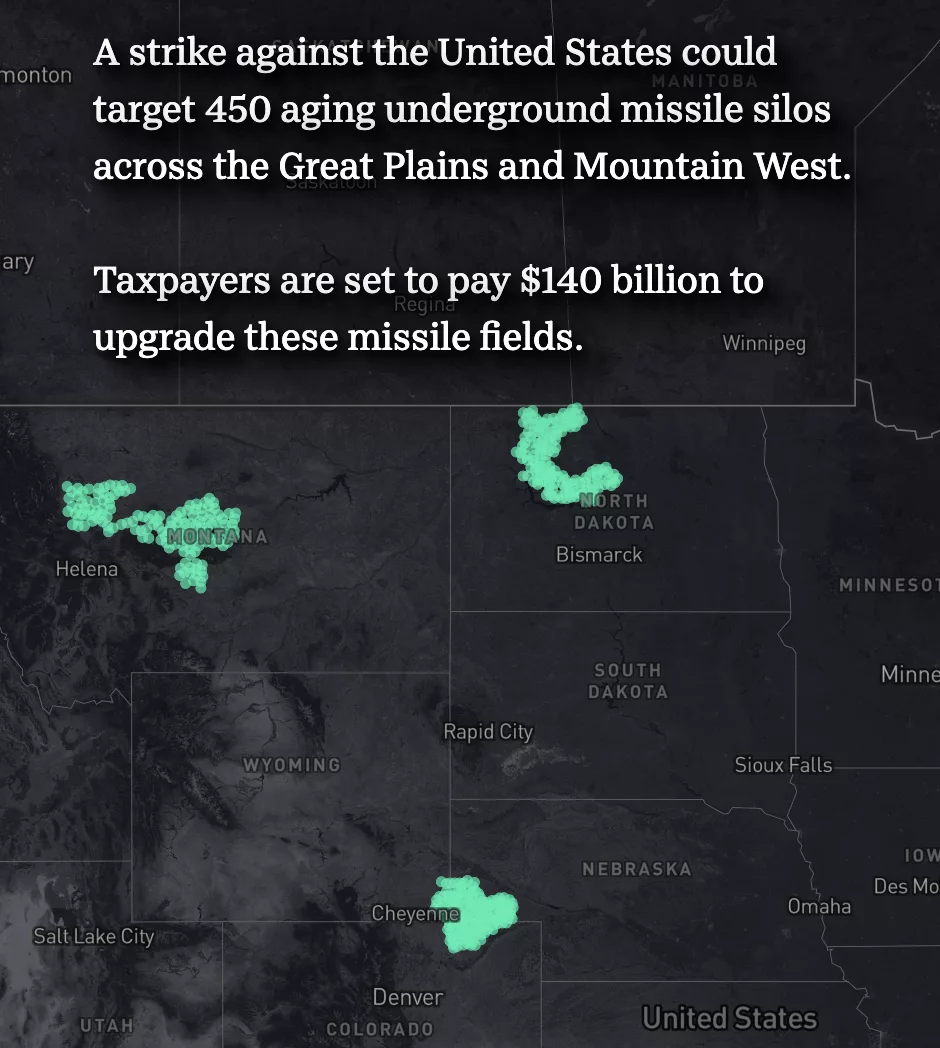
Screenshot from USA Today article January 5, 2026 usatoday.com/graphics/interactives/us-nuclear-weapons-expansion-fallout-map/
THE NUCLEAR SPONGE
Fallout maps show what could happen if America’s nuclear missile silos were attacked
By Davis Winkie, Ramon Padilla, Stephen Beard, Karina Zaiets and Carlie Procell, USA TODAY | usatoday.com
U.S. nuclear strategy revolves around the idea of the “triad.” Each of the military’s methods for delivering a nuclear strike represents a leg – the air leg (bomber planes), the sea leg (missile submarines) and the land leg (silo-based intercontinental ballistic missiles).
In recent years, arms control advocates have argued that the land leg of the triad is useless compared with its peers and makes the world a more dangerous place. The root of the debate is the vulnerability of the underground silos: An enemy can – and probably would – destroy them in a first strike against the United States.
Those opposed to land-based nuclear missiles, such as Daryl Kimball of the Arms Control Association, say that this vulnerability would push the president into a “use-or-lose logic” if he or she believed the United States were under nuclear attack. If the president launched a nuclear missile counterattack under a false warning, the results would be catastrophic.
The naysayers also highlight the cost of replacing the existing 1970s-vintage fleet of 400 Minuteman III missiles with the under-development Sentinel missiles, which the Air Force estimated will cost $140 billion (an increase from a 2020 estimate of $78 billion).
Warren, Garamendi Press Energy Secretary on Mismanagement and Taxpayer Waste in Plutonium Pit Production Program
Without transparency, accountability, and action around the pit program, the Department of Energy may be enabling the waste of billions of taxpayer dollars.
“In rushing to production, NNSA has developed an excessively risky program structure, with management concerns around fundamental aspects such as the cost and schedule.”
Sen. Elizabeth Warren and Rep. John Garamendi | warren.senate.gov – garamendi.house.gov
Washington, D.C. — In a new letter, U.S. Senator Elizabeth Warren (D-Mass.) and Representative John Garamendi (D-Calif.), both members of their respective Armed Services Committees and of the Nuclear Weapons and Arms Control Working Group, are urging Department of Energy Secretary Chris Wright to review the scope of and the need for the nuclear weapon plutonium pit production program, and pause the program’s Savannah River site until the National Nuclear Security Administration (NNSA) has established guardrails to prevent additional waste of taxpayer funds.
In August, the Department of Energy (DOE) launched a special study into NSSA’s leadership and management of the plutonium pit production mission. The lawmakers believe that, if properly conducted, the study will find that years of mismanagement have put billions of taxpayer dollars at risk with an unrealistic pit production schedule and goals.
“The Trump administration is blindly spending tens of billions of dollars to produce plutonium pits for nuclear weapons without a real budget or plan,” said Senator Warren. “This program is already years behind schedule and over budget, and Congressman Garamendi and I are urging the Secretary of Energy to conduct a vigorous review to rein in years of waste and mismanagement.”
“For years I have called for Congress to take action to fix the failing plutonium modernization effort. Congress has continued to pour billions of dollars into efforts to restart production with arbitrary targets,” said Congressman Garamendi. “This letter cuts to the core of the matter and asks necessary questions of NNSA, including about the questionable management and faulty assumptions underlying the program. I eagerly await their response, along with the results of the Department of Energy’s 120-day special investigation.”
The lawmakers raise concerns about how, years into this program, it is still unclear what the pit production program’s schedule and full cost will be. The Government Accountability Office recommended NNSA create a master schedule to comply with its best practices, but the agency has yet to produce one…
Livermore Lab Uses Trump Executive Order Gutting Environmental Laws to Push Through Enhanced Plutonium Utilization without Public Input
A November notice from the U.S. Department of Energy’s (DOE) National Nuclear Security Administration (NNSA) erases the previously announced public involvement requirement and thereby fast-tracks increased plutonium use at its Lawrence Livermore National Laboratory after decades of limits protected the public from potential risks.
News from our friends at Tri-Valley CAREs | trivalleycares.org
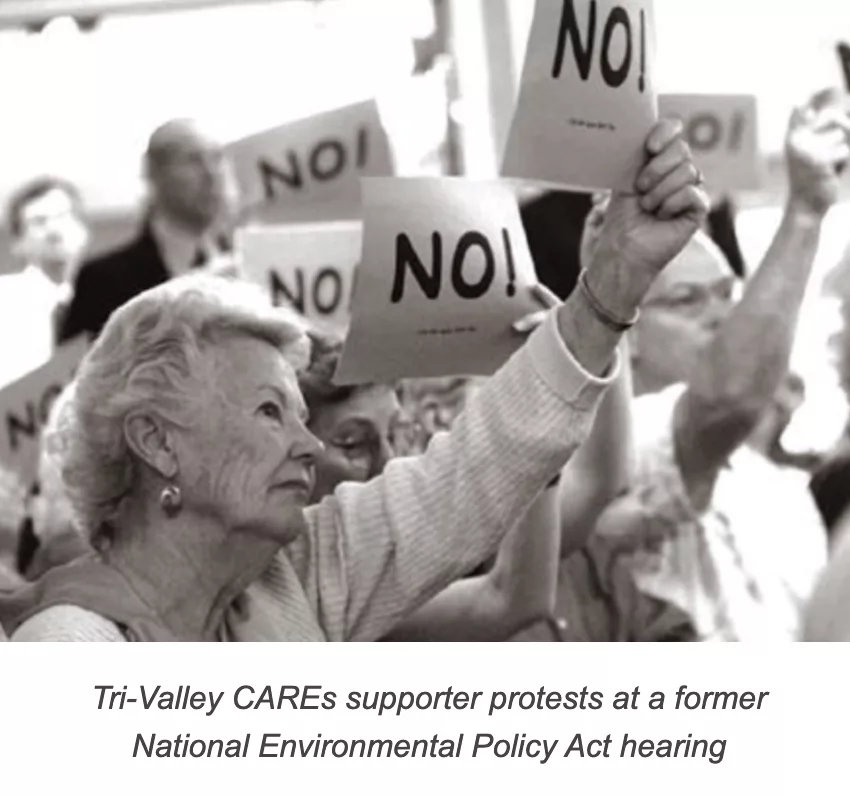 First announced In January 2025, the NNSA proposal for “Enhanced Plutonium Facility Utilization” at the Livermore Lab was to include a “Draft Supplemental Environmental Impact Statement” (SEIS) according to its Federal Register Notice. It specifically stated that, “NNSA will prepare a Draft SEIS. NNSA will announce the availability of the Draft SEIS in the Federal Register and local media outlets. NNSA will hold one or more public hearings for the Draft SEIS. Any comments received on the Draft SEIS will be considered and addressed in the Final SEIS.”
Now the agency has reneged on this promise, instead fast-tracking directly to a Final SEIS and a Record of Decision without any further opportunity for public input!
DOE using its own land to help pair AI centers, nuclear reactors
The Energy Department wants to build nuclear-powered artificial intelligence data centers on federal land using new public-private partnerships.
By Kelly Livingston and Allison Mollenkamp | rollcall.com
Co-locating advanced nuclear reactors with data centers on DOE sites is part of the Trump administration’s bid to accelerate the development of both technologies, sources say, as research efforts tease out their “symbiotic relationship.” But questions remain about how these projects could affect local communities and the actual timeline for bringing more nuclear power online.
DOE first announced its intention to use federal land for data center development and co-location in early April with a request for information to gauge industry interest. According to the RFI, the department intends to begin construction at the selected DOE sites by the end of the year, with operations beginning by the end of 2027.