

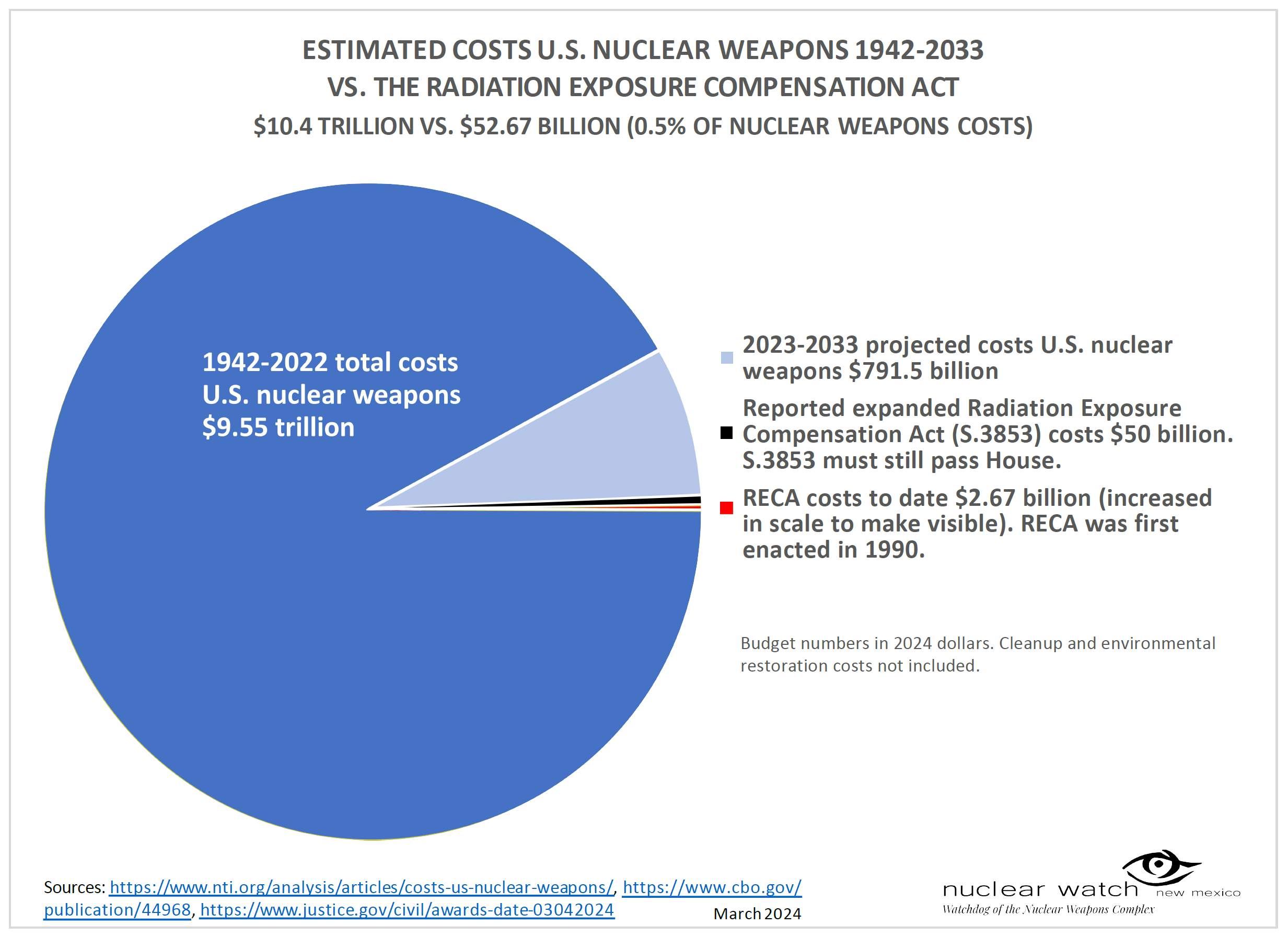
Cost of RECA Chart
In 1985, US President Ronald Reagan and Russian President Mikhail Gorbachev declared that “a nuclear war cannot be won and must never be fought.”

NEW & UPDATED
New Mexico lawmakers warn of ‘urgent threat’ over federal nuclear oversight shortfalls
A bipartisan committee of the New Mexico Legislature on Wednesday warned that two developments in the federal government’s nuclear administration — the rollback of safety requirements and the obstruction of independent safety oversight — have created an “urgent threat” to workers, communities and national security.
| September 17, 2026 santafenewmexican.com
The Legislature’s Radioactive and Hazardous Materials Committee unanimously approved letters from its chair, state Sen. Jeff Steinborn (D-Las Cruces), to U.S. Energy Secretary Chris Wright and one to both Wright and President Donald Trump calling for immediate federal intervention to address nuclear safety concerns. The letters, which the committee announced in a news release, also were sent to the state’s congressional delegation, Gov. Michelle Lujan Grisham and other state officials.
The letter to Wright raises concerns about the so-called “Project Velocity,” which the letter characterizes as DOE’s “effort to reduce its regulatory requirements.”
Last month, the letter says, the DOE issued 46 new or revised directives.
“The RHMC is gravely concerned that these extensive changes to nuclear safety requirements have moved forward without sufficient transparency or critical review regarding the technical and experiential basis for the changes and that the new directives pose serious risks to the residents of New Mexico,” the lawmakers write.
In a letter addressed to both Trump and Wright, lawmakers wrote that the 46 new or revised directives issued by the U.S Department of Energy in August “moved forward without sufficient transparency or critical review” and that subject matter experts “were kept in the dark.”
The DOE removed or weakened requirements that were developed by prior safety concerns, the letter continues, citing the removal of emergency preparedness requirements and the process for employees to raise technical safety concerns. The effort to revise the directives was to “remove unnecessary barriers” in federal nuclear operations. Energy Secretary Wright said in a statement in August.
U.S. Sen. Patty Murray (D-WA) and U.S. Rep. Marcy Kaptur (D-OH) also called on Secretary Wright to justify the directive changes in their own letter, also sent on Wednesday.
New Mexico’s lawmakers also point out that some of the now-eliminated safety requirements were implemented due to mishaps in New Mexico, including the multiyear shutdown at the plutonium facility in Los Alamos Laboratory and a 2014 incident at the Waste Isolation Pilot Plant in which radioactive material leaked and exposed 21 workers to low amounts of radiation.
The letter to both Wright and Trump details concerns regarding “the collapse in communication and cooperation” between the DOE and the U.S. Defense Nuclear Facilities Safety Board, which provides oversight and safety recommendations for the nation’s nuclear facilities.

Public Interest Groups Warn NNSA on Plutonium Giveaway
FOR IMMEDIATE RELEASE, September 8, 2026
Joint Press Release from: South Carolina Environmental Law Project, Savannah River Site Watch & Nuclear Watch New Mexico
Contact: Tom Clements, Director, SRS Watch, 803-240-7268 | Email
Jay Coghlan, Nuclear Watch NM, 505-989-7342 | Email
Shelby Cohen, Comms Manager, SC Env. Law Project, 864.414.7726 | Email
South Carolina – Today, the South Carolina Environmental Law Project (SCELP) sent a letter of demand to the Department of Energy (DOE) and its semi-autonomous agency, the National Nuclear Security Administration (NNSA), about their proposed unsound and dangerous management of U.S. plutonium. The letter notified them that they must comply with the federal National Environmental Policy Act (NEPA) requirement for public review of the Trump Administration’s troubling plan to give away 19.7 metric tons of nuclear weapons-grade plutonium to private corporations.
SCELP’S letter, on behalf of Nuclear Watch New Mexico, Savannah River Site Watch, and a private citizen who lives near the Savannah River Site (SRS) in South Carolina, outlines why NNSA must be held to its legal NEPA obligations. The letter describes how recently issued presidential executive orders:
…constitute a vast change in the prior decisions and purposes of the DOE/NNSA surplus plutonium disposition program that has been in place since at least 1996… This change is also contrary to the larger nuclear non-proliferation policy of the United States restricting the commercial use of plutonium that has been in place for approximately fifty years.
This action follows SCELP’s earlier NEPA lawsuit on behalf of SRS Watch and Nuclear Watch New Mexico. In a landmark settlement, that litigation successfully compelled the NNSA to prepare a nationwide programmatic environmental impact statement on the production of plutonium “pit” bomb cores for nuclear weapons (the “Pit Production PEIS”).
Nuclear Weapons Issues & The Accelerating Arms Race: September 2026
Nuclear Weapons:
Pentagon drafting a new U.S. nuclear strategy in case of regional war with China or Russia, sources say
The Defense Department’s policy chief is drafting a new U.S. nuclear strategy that emphasizes the possible use of shorter-range tactical weapons in case of a regional war with China or Russia, according to five people familiar with the plans. The new strategy, which is classified, challenges the approach to nuclear weapons that has been settled policy for decades… Colby has long pushed for an emphasis on tactical weapons, arguing that America’s adversaries would simply not believe the U.S. would seriously contemplate launching long-range weapons aimed at wiping out an enemy’s nuclear forces — as is the emphasis of the
Pentagon reviewing plans for low-level nuclear war: thebulletin.org/2026/09/pentagons-secret-plan-reviving-cold-war-doctrines-to-lower-the-threshold-for-nuclear-war/
Policy chief fears a regional nuclear conflict will dangerously escalate – The Washington Times https://www.washingtontimes.com/news/2026/aug/18/pentagon-reviewing-plans-low-level-nuclear-war/
- The NNSA Administrator is explicitly turning NNSA back into a nuclear weapons production agency. “NNSA is a production organization,” Williams said. “NNSA has always been a production organization all the way back to the Manhattan Project… But Williams said production is only one piece of the culture he is trying to establish. “Starting with deterrence really inspires people,” he said. “Urgency, because our times have changed.””
That only reinforces my opinion that we need to puncture the myth of deterrence. It’s not that deterrence is a lie, but that it’s a half-truth. The other side of the equation is that the U.S. and Russia have always maintain nuclear warfighting capabilities, which is why we have 1,000s of nuclear weapons and a $2 trillion “modernization” program to keep them forever.
Continue reading
FOLLOW-ON SUPPLEMENTAL Sample Comment on the Draft Plutonium Pit Production Programmatic Environmental Impact Statement (PEIS)
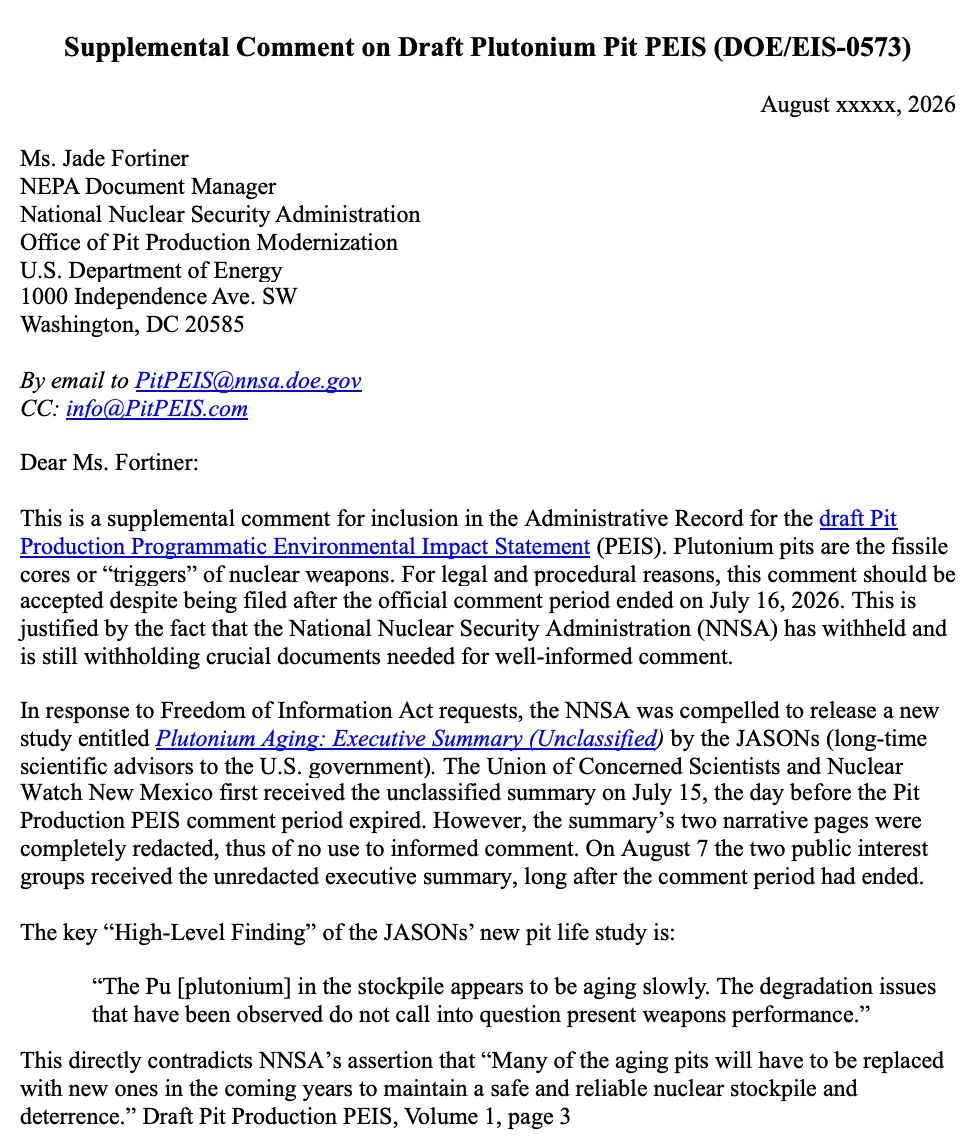
This is a sample supplemental comment for the draft Pit Production Programmatic Environmental Impact Statement (PEIS). Plutonium pits are the fissile cores or “triggers” of nuclear weapons. For legal and procedural reasons, this comment should be accepted despite being filed after the official comment period ended on July 16, 2026. This is justified by the fact that the National Nuclear Security Administration (NNSA) has withheld and is still withholding crucial documents needed for well-informed comment. Please download, edit, and send in your supplemental comment to PitPEIS@nnsa.doe.gov today (and please CC info@pitpeis.com)! We must stand up against NNSA’s lack of transparency.
Where Have All Your Dollars Gone? Long Time Passing
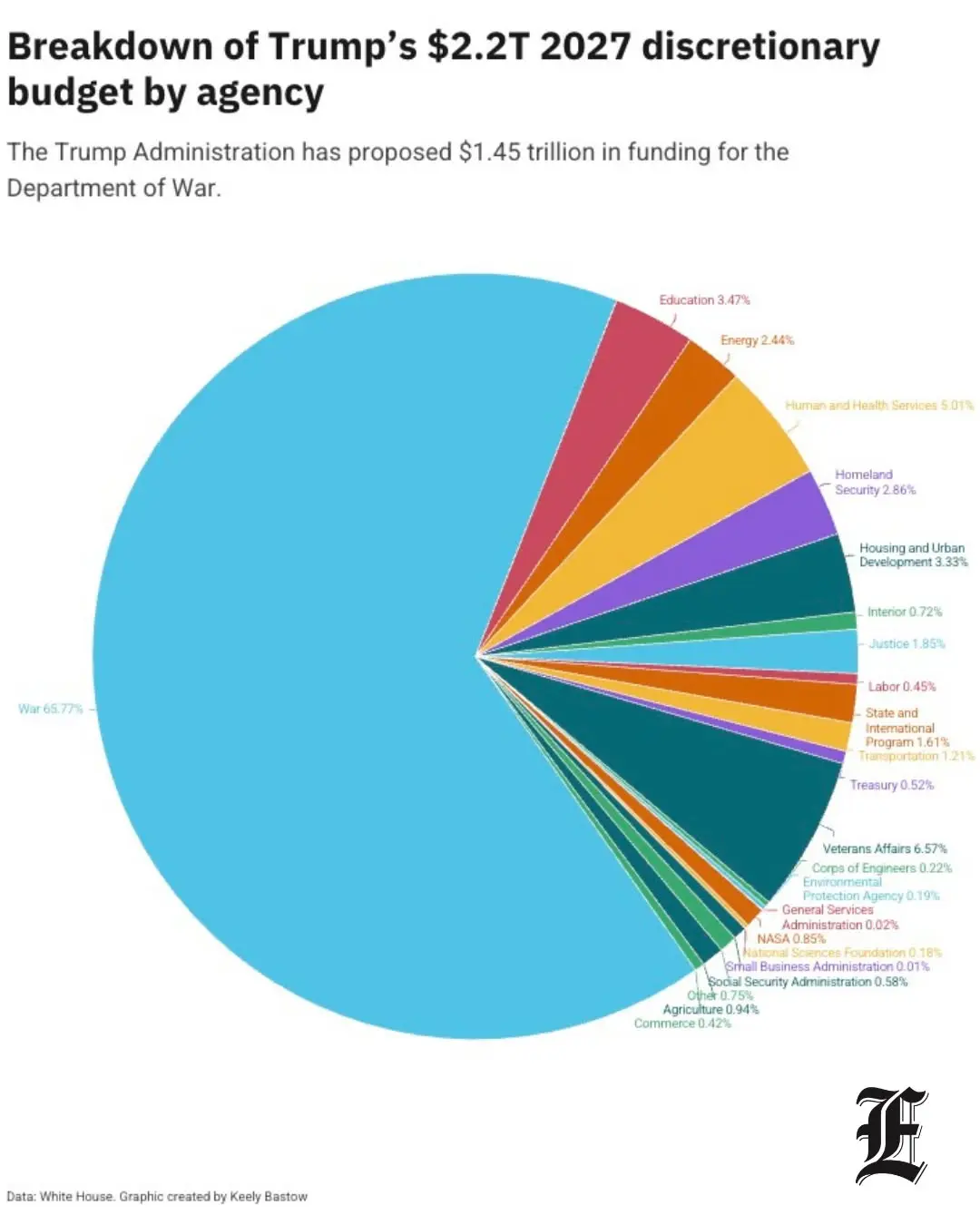
“When you ask people what sort of budget they’d like, and even when you ask them what they think the budget is, you get enormous pie slices for environmental protection and education. Here, in stark contrast, our so-called representatives are contemplating giving us 3.47% for education…”
By: David Swanson, World BEYOND War | August 18, 2026 worldbeyondwar.org
The discretionary budget for the U.S. government next year as proposed by Trump is depicted by the Washington Examiner in the above pie chart. It has passed the House and might pass the Senate. As long as half of Congress Members see their job as boot licking and the other half see their job as tweaking, these annual proposals are good indications of each fresh hell into which we are careening.
This pie chart includes 65.77% of federal discretionary spending for War, plus 6.57% for a woefully inadequate job of addressing the suffering of people sent into war (Veterans Affairs), 2.86% for so-called “Homeland Security” (in case you wanted to bring the wars closer), 1.61% for a State Department that is wholly subservient to the Pentagon (“State and International Program”), and 0.85% for weaponizing the solar system (NASA).
After that 77.66% of the money Congress will spend next year has been spent, what’s left?
If you’re already afraid, just wait until you hear about Manhattan Project 2.0
“Executive Order 14302, “Reinvigorating the Nuclear Industrial Base”, further endangers the safety of nuclear workers and the wider public by providing the nuclear industry with Cold War-era plutonium-239 harvested from dismantled nuclear warheads. Because the U.S. doesn’t currently have enough uranium for Manhattan Project 2.0, Oklo, Standard Nuclear, Exodys Energy, SHINE Technologies and Flibe Energy plan to convert plutonium into SMR fuel.
Plutonium is highly toxic if inhaled and requires special ventilation to handle. Other countries that have attempted to use plutonium have found converting it not worth the expense. It’s also highly sought after for bomb-making and requires heightened security measures. With a half-life of more than 24,000 years, managing plutonium is not a short-term commitment.”
By: Kristen Thomason Baptist News | August 10, 2026 baptistnews.com
Summers spent at my grandparents’ house in Tennessee were hot and humid. With enough cousins piled into the porch swing, you could stir up a bit of a breeze. But when that was no longer effective, we would retreat to the air-conditioned splendor of the American Museum of Science and Energy in Oak Ridge and stroll through exhibits like “Wildcatting for Oil” and “Atoms for Autos.”
Among these varied installations, however, pride of place was given to documenting Oak Ridge’s role as the secret headquarters for the Manhattan Project and source of the Hiroshima bomb’s enriched uranium. Most of the 30,000 covert workers on that project only discovered the truth of what they had been helping to build on Aug. 6, 1945, when they awoke to the headline “Oak Ridge Attacks Japan.”
Eighty years later, on May 23, 2025, President Donald Trump signed a series of executive orders to further the Department of Energy’s “Manhattan Project 2.0.” And just like the original, the second iteration of the Manhattan Project has plenty of secrets of its own.
The executive orders came at the behest of tech giants like Amazon, Meta, Google and Microsoft, who want cheap, abundant nuclear power to run their AI data centers. And according to the United Nations, these data centers will have doubled their voracious consumption of electricity and water by 2030.
NNSA Releases New Plutonium Life Study – Key Finding: Plutonium Aging Not Affecting Existing Nuclear Weapons
FOR IMMEDIATE RELEASE, August 10, 2026
Contact: Jay Coghlan, Nuclear Watch New Mexico, 505.989.7342, c. 505.470.3154 | Email
Sophia Stroud, Nuclear Watch New Mexico, 505.231.9736 | Email
Santa Fe, NM – In response to Freedom of Information Act requests, the Department of Energy’s semi-autonomous National Nuclear Security Administration (NNSA) has released a new study entitled Plutonium Aging: Executive Summary (Unclassified) by long-time scientific advisors to the U.S. government called the JASONs. The key “High-Level Finding” of this new report is:
“The Pu [plutonium] in the stockpile appears to be aging slowly. The degradation issues that have been observed do not call into question present weapons performance.”
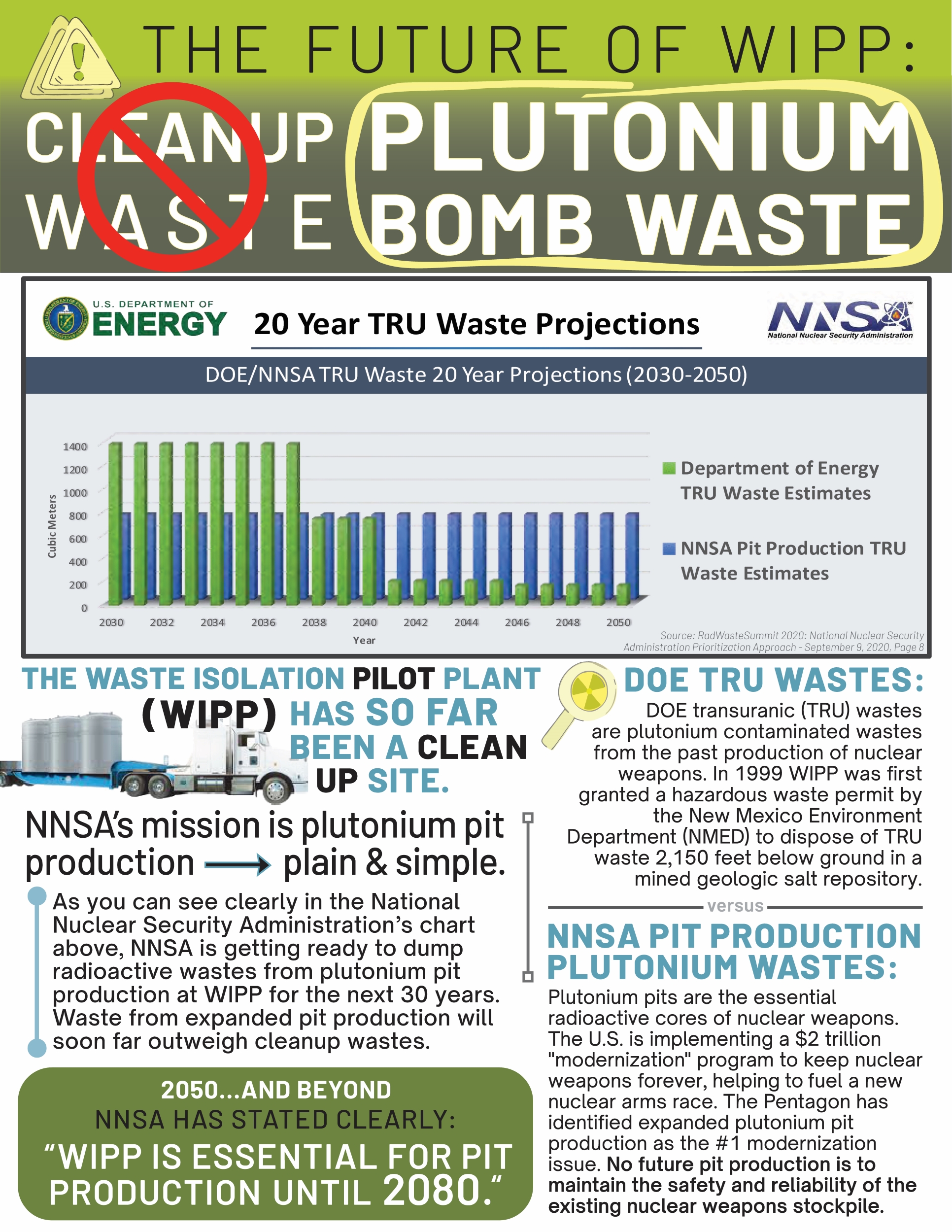
Plutonium “pits” are the all-important radioactive cores or “triggers” of nuclear weapons. The NNSA has repeatedly claimed that potential aging effects drive the need for the aggressive expansion of plutonium pit production, which is the agency’s most expensive and complex program ever. The Pentagon has stated that expanded pit production is one of the most critical issues in its $2 trillion “modernization” program to keep nuclear weapons forever.
However, the independent Government Accountability Office (GAO) has repeatedly stated that the NNSA has no credible costs estimates and no “Integrated Master Schedule” for simultaneous production at the Los Alamos National Laboratory (LANL) in northern New Mexico and the Savannah River Site (SRS) in South Carolina. In fact, DOE and NNSA have been on the GAO’s “High Risk List” for project mismanagement and waste of taxpayers’ dollars since 1991. At more than $30 billion, the plutonium pit plant at SRS is on track to become the most expensive building in U.S. history. A comparable amount will be spent at LANL on facility upgrades and related projects, for which the NNSA fails to keep total aggregated costs.
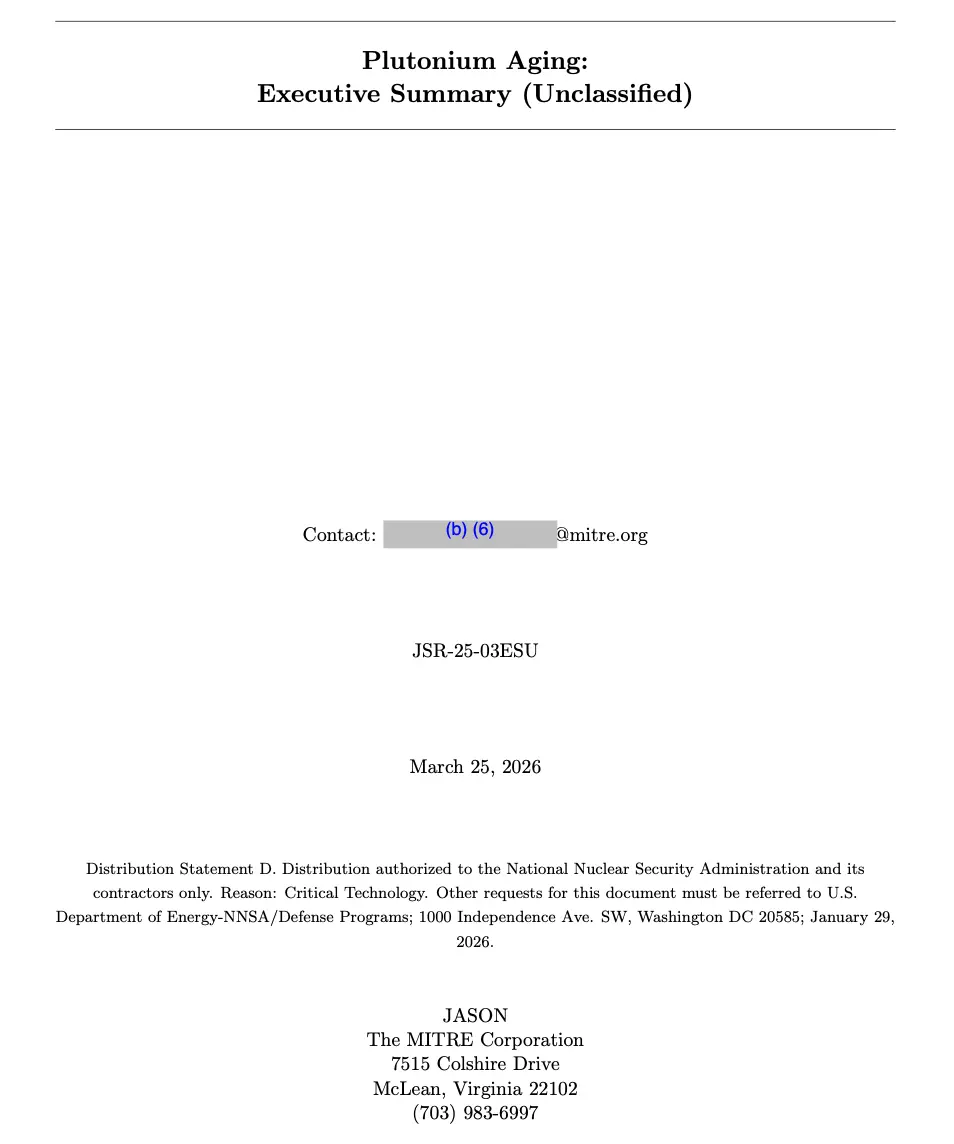
NEW 2026 JASON Plutonium Aging Executive Summary
“The Pu in the stockpile appears to be aging slowly. The degradation issues that have been observed do not call into question present weapons performance.”
Today, August 6, 2026, is the 81st Anniversary of the U.S. Atomic Bombing of Hiroshima.
Recommended Reading: John Hersey and the horrors of Hiroshima
The American journalist’s account of the Hiroshima bombing and its aftermath, told through the eyes of Japanese survivors, forced the world to reckon with the terrifying power of nuclear weapons.
Iain MacGregor August 5, 2026 engelsbergideas.com
The New START treaty – enforced since 2011 and the last remaining arms‑control agreement between the United States and Russia – expired in February 2026 with nothing to replace it. The final legal barrier limiting the world’s two largest nuclear arsenals was removed, ushering in what analysts describe as a period of Great Power uncertainty. China, meanwhile, is rapidly expanding and modernising its nuclear forces, with its stockpile more than doubling in just five years and further growth expected throughout the decade.
In the Middle East, the erosion of nuclear restraint has accelerated sharply. Recent US-Israeli attacks have pushed Iran closer than ever to abandoning the Nuclear Non‑Proliferation Treaty (NPT): Tehran still possesses enough enriched uranium to place it within short technical reach of multiple nuclear warheads, while senior political and security figures openly debate withdrawal from the NPT as a defensive necessity rather than a diplomatic taboo. The precedent – of a major regional power crossing the nuclear threshold outside any arms‑control framework – would reverberate far beyond the region.
North Korea, emboldened by global fragmentation, insists that its arsenal is ‘irreversible’. Across Europe and Asia, public opinion in countries such as Poland, Turkey and South Korea is shifting toward domestic nuclear capability as confidence in US security guarantees becomes frayed. The precarious equilibrium of the non‑proliferation era is cracking just when the living memory of the bomb’s human cost has never been more vital.
In such a landscape, the work of remembering what nuclear weapons do – not in theory, but to human bodies and cities – becomes urgent again. Eighty years ago, one American writer succeeded in forcing the world to confront this reality. His name was John Hersey, and the story he told in August 1946 in the New Yorker magazine, about the world’s first nuclear strike against the Japanese port city of Hiroshima the previous year, remains one of the clearest moral documents of the atomic age…
Ian MacGregor outlines precisely above the current state and reality of the new nuclear arms race we are now in, more dangerous than the first.
“Rationality will not save us… this is very important: at the end we lucked out. It was luck that prevented nuclear war.” Robert McNamara
Nuclear Watchdog Sues for Plutonium Pit Production “Special Study”
FOR IMMEDIATE RELEASE, August 4, 2026
Contact: Jules Zacher, Esq., 215.888.5183, | Email
Jay Coghlan, Nuclear Watch New Mexico, 505.989.7342, c. 505.470.3154 | Email
Sophia Stroud, Nuclear Watch New Mexico, 505.231.9736 | Email
Santa Fe, NM – Nuclear Watch New Mexico has sued the Department of Energy under the Freedom of Information Act for its Special Study of the National Nuclear Security Administration’s Leadership and Management of the Plutonium Pit Production Mission. The National Nuclear Security Administration (NNSA) is the semi-autonomous nuclear weapons agency within DOE.
Plutonium “pits” are the radioactive cores or “triggers” of nuclear weapons. Their expanded manufacturing has been the chokepoint of resumed industrial-scale nuclear weapons production by the U.S. Crucially, no future pit production is to maintain the safety and reliability of the existing stockpile. Instead, it is all for new-design nuclear weapons for the new arms race. These new weapons can’t be tested because of the existing global testing moratorium, thereby perhaps degrading confidence in the stockpile. Or new-design nuclear weapons testing could prompt the U.S. to resume testing, which would have severe international proliferation consequences.
Plutonium pit production is the NNSA’s most expensive and complex program to date. However, the independent Government Accountability Office (GAO) has repeatedly stated that the agency has no credible costs estimates and no “Integrated Master Schedule” for simultaneous production at the Los Alamos National Laboratory (LANL) in northern New Mexico and the Savannah River Site (SRS) in South Carolina. In fact, DOE and NNSA have been on the GAO’s “High Risk List” for project mismanagement and waste of taxpayers’ dollars since 1991. At more than $30 billion, the plutonium pit plant at SRS is on track to become the most expensive building in U.S. history. A comparable amount will be spent at LANL on facility upgrades and related projects, for which the NNSA fails to keep total aggregated costs.
Nuclear Watch New Mexico sues Department of Energy for plutonium pit report
Jay Coghlan, director of Nuclear Watch New Mexico, wrote in a statement there is a “massive coverup” related to plutonium pit production.
“To grease expanded nuclear weapons production, they have rescinded nuclear safety regulations, illegally restricted the access of the independent Defense Nuclear Facilities Safety Board, and are withholding crucial documents from the American taxpayer,” Coghlan wrote.
“We hope this lawsuit will help to bring [the National Nuclear Security Administration] plutonium house of cards tumbling down,” he added.
Santa Fe New Mexican | August 5, 2026 santafenewmexican.com
A nuclear watchdog group that focuses on Los Alamos National Laboratory recently sued the federal government for what it says are failures to comply with open records law and hand over a study.
Nuclear Watch New Mexico filed suit in U.S. District Court in Washington, D.C., on July 23 against the U.S. Department of Energy and the National Nuclear Security Administration. The group on Dec. 22 filed a records request under the Freedom of Information Act seeking a copy of a study related to plutonium pit production, the complaint states, but hasn’t received any of the records.
A spokesperson for the Department of Energy, which also houses the National Nuclear Security Administration, didn’t immediately respond to a request for comment Tuesday.
LANL is for now the only facility in the nation capable of producing plutonium pits, which serve as the trigger devices for nuclear weapons…
A World Without Nuclear Weapons: Trinity Test Commemoration Recording July 19, 2026
From Reflection to Action: An Interfaith Remembrance of the Trinity Test with Archbishop John Wester, Archdiocese of Santa Fe
Event Speakers Include:
- Jay Coghlan, Executive Director, Nuclear Watch New Mexico
- Tina Cordova, Co-Founder, Tularosa Basin Downwinders Consortium
- Dr. Michael Ketterer, Professor Emeritus, Northern Arizona University
- Keynote: Secretary James C. Kenney, New Mexico Environment Dept.
Note: You may have already seen this event as a livestream on YouTube. This recording is a significantly improved version with enhanced audio, where you can hear most all of the speakers loudly and clearly.



New Nuclear Media: Art, Films, Books & More
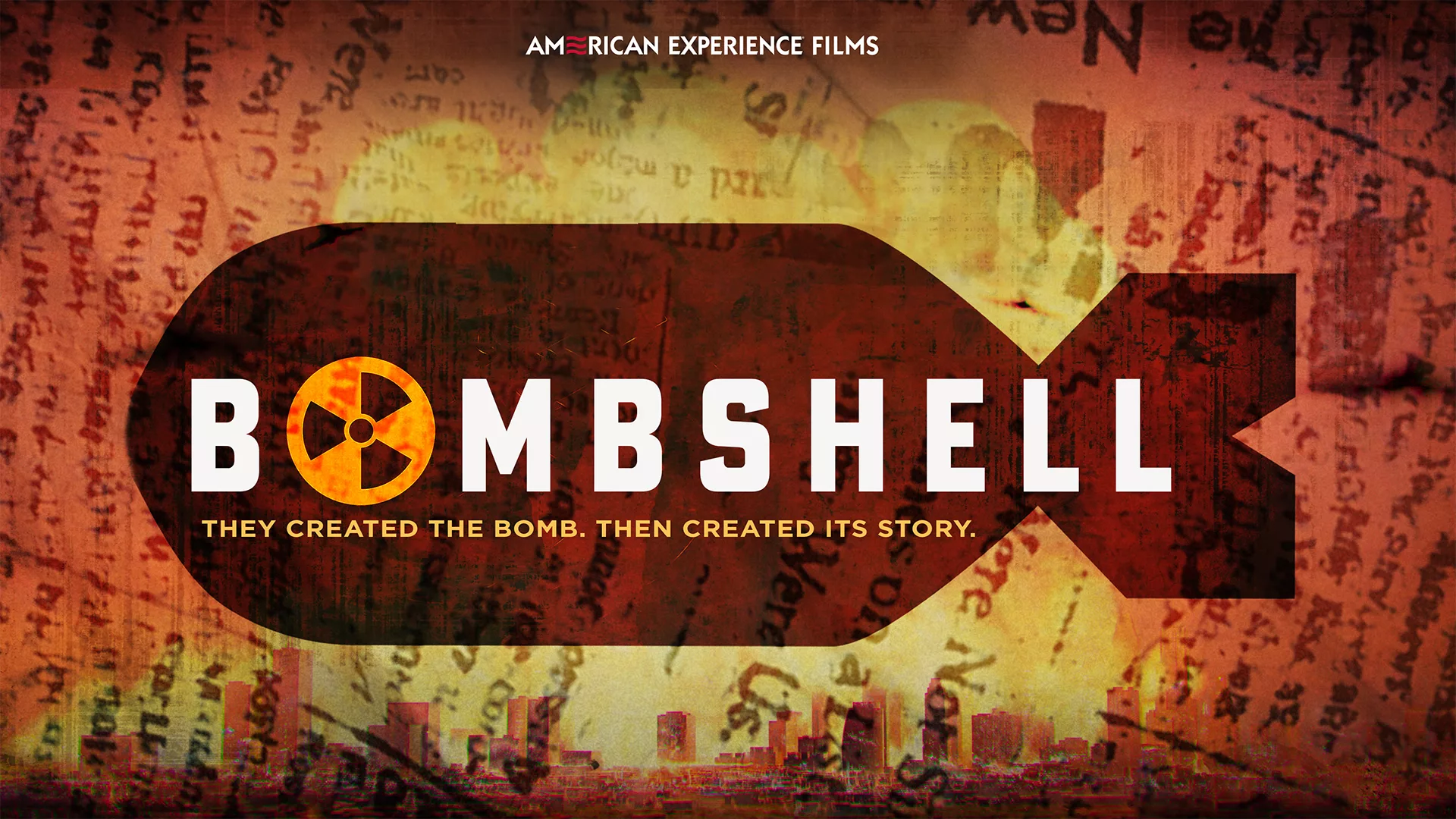
Watch BOMBSHELL on PBS American Experience — streaming across all PBS-branded platforms, including YouTube, PBS.org and the PBS App!
The wait is over! BOMBSHELL is available NOW on PBS American Experience — and will be streaming simultaneously across all PBS-branded platforms, including YouTube, PBS.org and the PBS App.
BOMBSHELL examines how the U.S. government manipulated public opinion through propaganda and censorship to justify the use of nuclear weapons and to minimize the human toll. Against this powerful machinery, a small group of journalists—including a Black pool reporter, a Japanese American staffer, a Japanese photographer, and a freelance magazine writer—identified gaps in the official narrative and courageously reported on the human consequences of the atomic bombings.
The Wall Street Journal described BOMBSHELL as offering “lessons for our own age of ascendant AI,” while Foreign Policy called it “provocative history that brings to life the dangers that arise when government secrecy and control overwhelm press freedom.”
A House of Dynamite review – Kathryn Bigelow’s nuclear endgame thriller is a terrifying, white-knuckle comeback
★★★★★: Amid a global arms race, ending the threat of nuclear war — and even the testing of nuclear weapons — is imperative, said the Holy See’s diplomat to the United Nations.
By Peter Bradshaw, The Guardian | September 2, 2025 theguardian.com
Kathryn Bigelow has reopened the subject that we all tacitly agree not to discuss or imagine, in the movies or anywhere else: the subject of an actual nuclear strike. It’s the subject which tests narrative forms and thinkability levels.
Maybe this is why we prefer to see it as something for absurdism and satire – a way of not staring into the sun – to remember Kubrick’s (brilliant) black comedy Dr Strangelove, with no fighting in the war room etc, rather than Lumet’s deadly serious Fail Safe.
Our work is made possible by a generous grant from 