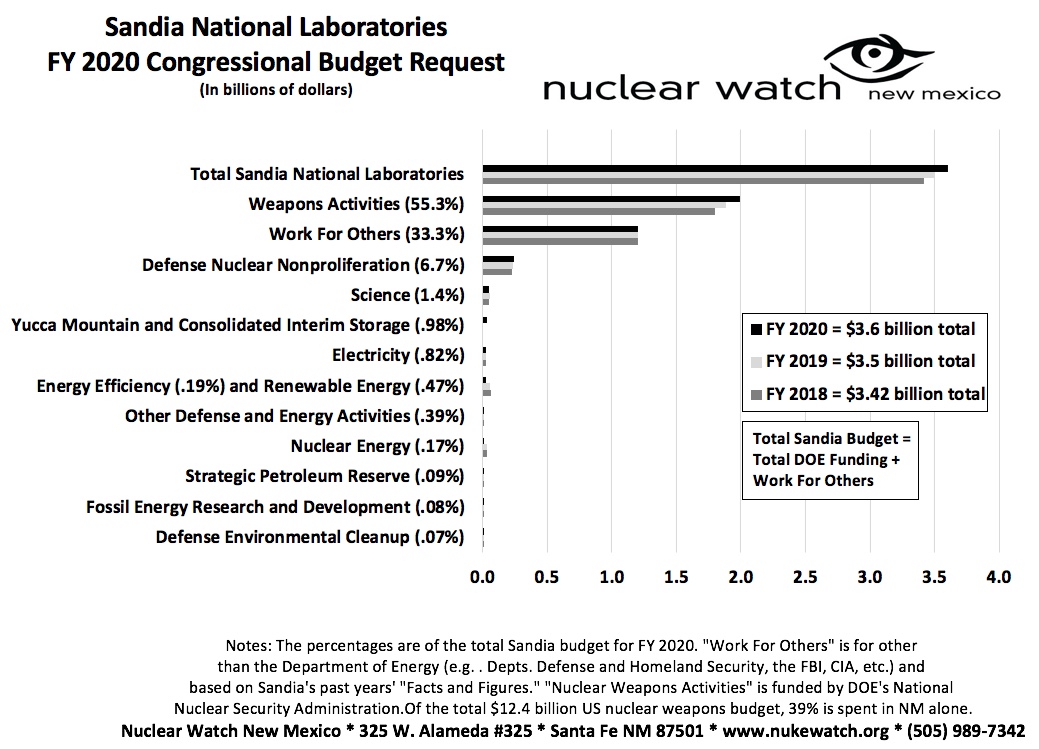
Posted by Scott Kovac – Sandia National Laboratories, has one of the Department Of Energy’s (DOE’s) largest annual budgets and the fiscal year 2020 (FY20) Congressional Budget Request shows continued military priorities for the Lab. There are two components of Sandia’s annual budget – work for DOE (with a $2.4 billion request for FY20) and ‘Work For Others’ (with an annual request of $1.2 billion). Sandia’s work for DOE centers around nuclear weapons engineering. ‘Work for Others’ (WFO) is work done for federal agencies other than the DOE and for non-federal entities. An annual total budget of $3.6 billion puts Sandia’s budget second only behind Washington Headquarters among DOE sites.
Category: DOE
Nuclear Weapons Spending at Los Alamos Is 71% of Annual Budget
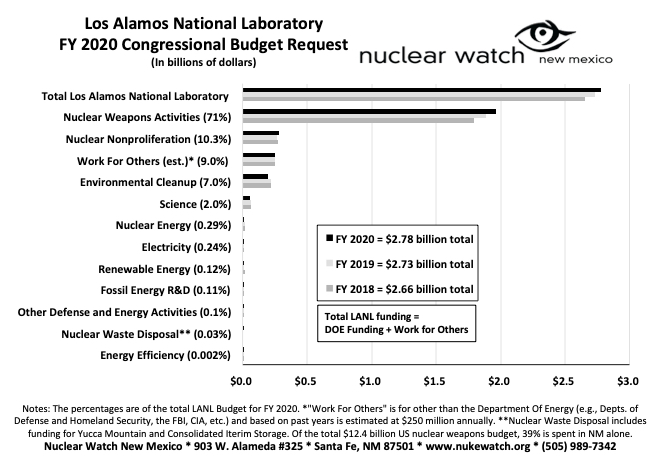
By Scott Kovac Los Alamos National Laboratory is first and foremost a nuclear weapons laboratory. The Department of Energy’s annual Congressional Budget Request for fiscal year 2020 shows that 71% of the Lab’s budget will go to nuclear weapons work if Mr. Trump has his way. While cleanup of Cold War wastes would be 7%. And electrical transmission research along with renewable energy and energy efficiency research were slashed to a mere 0.36% of the request for the Lab. As the country goes deeper in debt, we must let go of the old Cold War mentality and invest in our future.
The full Budget Laboratory Tables are Here
Or see our condensed version Here
New Momentum for Saner Nuclear Policy: Event Highlights

BY SOPHIA STROUD | – NukeWatch NM Web Designer
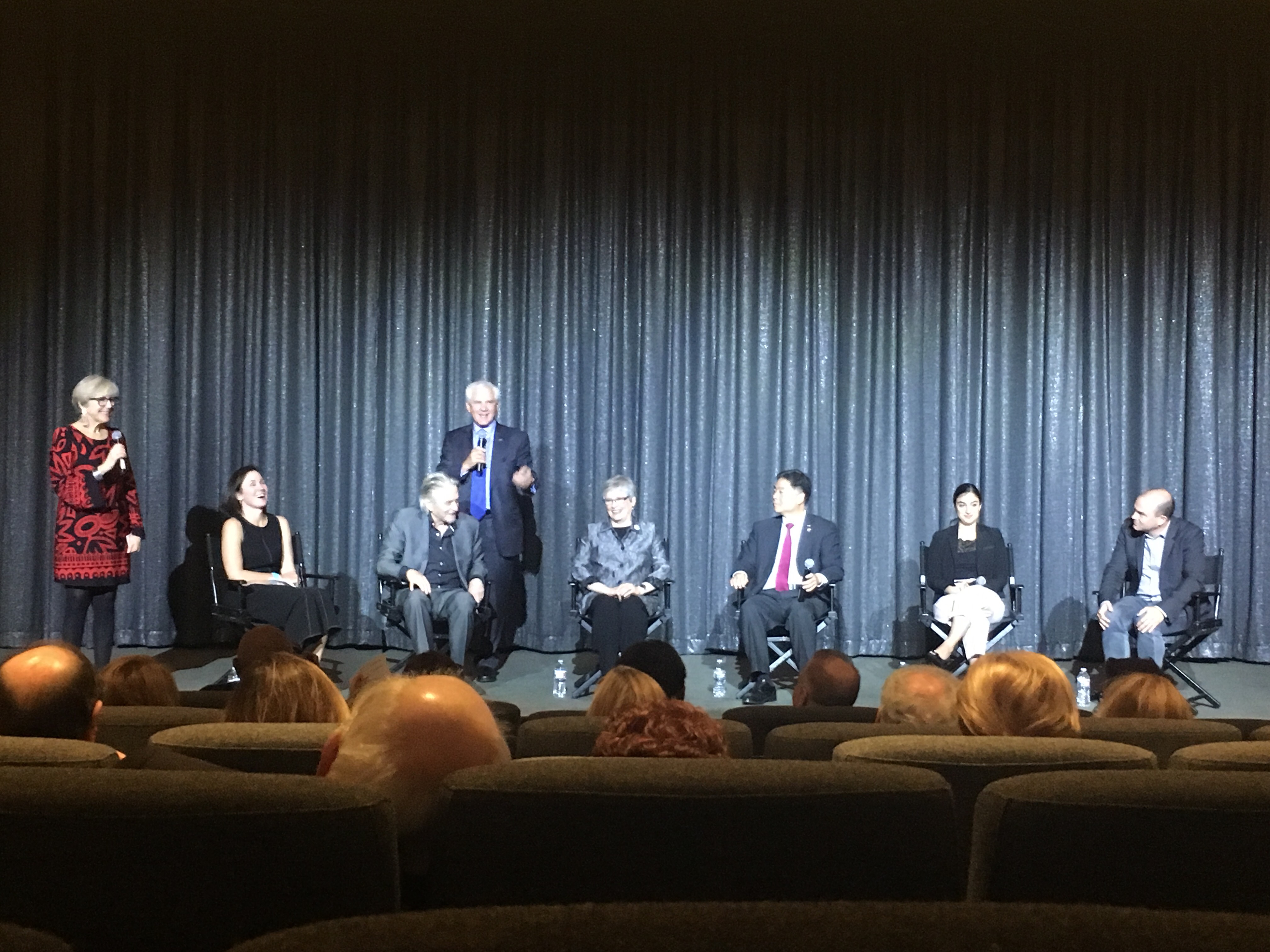
Monday 3/18 Ploughshares Fund hosted an in-depth discussion about the momentum building for a new, saner nuclear policy and how California can lead the way to a safer, more secure world.
“The more that I dug into the history of nuclear weapons and the legacy that system has today, the more I realized that all the issues I cared about, from gender-based violence, to environmental justice, to climate change, to human rights, to money in politics, is so influenced by the nuclear system. I realized that taking up this mantle now…not only would I be working on issues I’m passionate about and clearing those hurdles that the nuclear system have put up across the board for socialized institutions we care about, but also working on preventing nuclear Armageddon.”
– Yasmeen Silva, Lead organizer for Beyond the Bomb’s #NoFirstUse and other campaigns
Trump Budget Would Continue Nuclear Weapons Buildup and Bring More Nuclear Waste to NM

By Scott Kovac, Operations and Research Director
The White House released the top line numbers of its fiscal year 2020 Congressional budget request and, although there are some increases heading to New Mexico, they are not the increases that we’d like to see. It’s called – A Budget For a Better America, Promises Kept. Taxpayers First. but only Defense and Department of Energy (DOE) weapons contractors are going to think that anything is better. Meanwhile the rest of us taxpayers will, first and foremost, be looking at cuts to programs that affect us daily.
NNSA’s pet ‘Interoperable Warhead’ is DEAD

The study in question came about because Marylia Kelley, of Tri-Valley CARES, and NukeWatch’s Director, Jay Coghlan, suggested to congressional staff that it be done. But they wanted to ask independent scientists (the JASONs) to do it – instead just NNSA did it. And NNSA dodged the central congressional requirement to compare the benefits and costs of the Interoperable Warhead vs a “conventional” life extension program for the Air Force’s W78 ICBM warhead. NNSA simply said a conventional life extension program would not meet military requirements and therefore summarily dismissed it (no further explanation). Marylia and Jay had the opportunity to discuss this with the relevant congressional staffer who said this ain’t over.
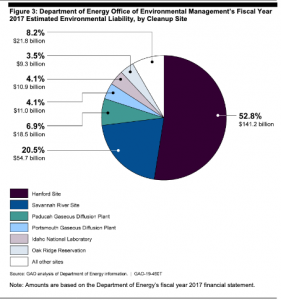
New Estimate ($377B) Raises Cost of Cold War Cleanup (Again)

At some point, DOE will have to admit that it has no idea what it will cost to cleanup the Cold War nuclear weapons complex sites. DOE should stop making more wastes until the existing wastes are remediated. The new estimate is more that twice the amount that has been spent in total since cleanup began in 1989, with the most difficult sites still to come.
We’ve said it before and we’ll say it again – Clean Up, Don’t Build Up!
The thing is that the new $377 billion estimate includes leaving much of the waste behind.
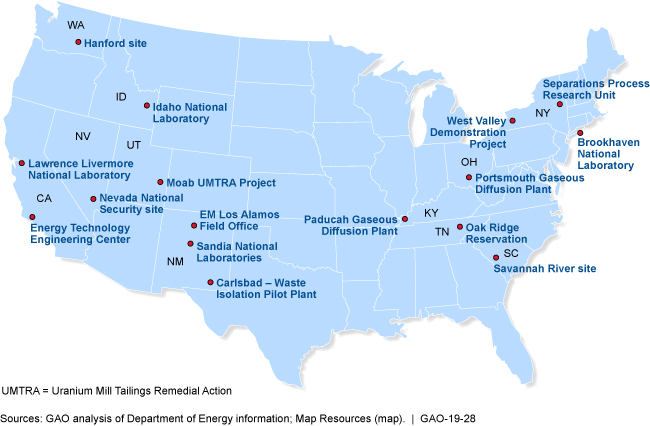
Program-Wide Strategy and Better Reporting Needed to Address Growing Environmental Cleanup Liability GAO-19-28: Published: Jan 29, 2019. Publicly Released: Jan 29, 2019.
The Department of Energy is tasked with cleaning up waste from Cold War nuclear weapons production, much of which is hazardous or radioactive. The department’s Office of Environmental Management estimates that future work could cost at least $377 billion—$109 billion more than last year’s estimate.
“Preliminary” Research Pushes Economic Impact Boundaries for LANL
While Sandia, LANL, and Journal Statements Leave Many Questions
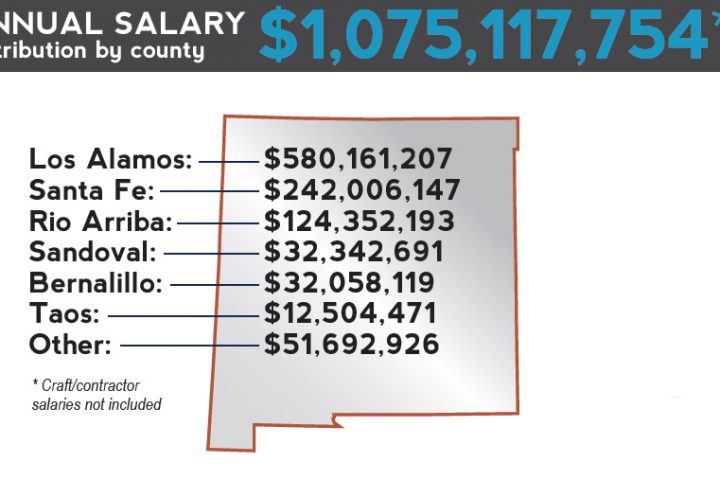
A January 15 Los Alamos National Laboratory (LANL) press release reviewed preliminary research from the University of New Mexico’s Bureau of Business and Economic Research (BBER). The research claimed that the “average annual total impact on economic output across New Mexico from 2015 to 2017 was $3.1 billion.” This implies that BBER estimates that LANL contributes an average of $3.1 billion a year to the state’s economy annually.
This $3.1B conclusion is based on unreleased data and pushes the boundaries of accepted economic theory. The authors or the title of the research are not given. No estimate of when the final report of this will be released is given. Is the research even complete? Will the results change? Has it been reviewed?
Costs of Nuclear Weapons Jump Dramatically
CBO is out with its every two year update on the cost of nuclear weapons over the next 10 years: https://www.cbo.gov/
[Credit: Kingston Reif of the Arms Control Association]
New CBO report: Nuclear weapons to cost half a trillion over the next decade
CBO projects $494 billion (in then-year dollars) in spending to sustain and modernize U.S. nuclear forces between FY 2019 – FY 2028 ($559 billion if you attribute 100% of the costs of strategic bombers to the nuclear mission). This is a major increase of $94 billion (or about 23%) above the projection of $400 billion in the last ten-year report covering FY 2017 and FY 2026.
The report also includes an estimate of the projected cost of some of the additions in the Trump NPR (the LYD5, a new SLCM, and increased pit production), which CBO puts at $17 billion through FY 2028.
The increase from the 2017 to the 2019 reports is due to several factors, including the report captures two additional years in the late-2020s when modernization is in full swing, the costs of some of the additions from the Trump NPR, and increases in the projected costs of some programs.
Overall the report highlights the growing cost of nuclear weapons, even relative to earlier projections, and reinforces the message that the Trump plans are unnecessary and unsustainable and that less expensive alternatives are available to sustain a credible arsenal.
View Reif’s Twitter thread on the report here: https://twitter.com/KingstonAReif/

NukeWatch Joins Suit To Stop WIPP Expansion

NukeWatch Joins Suit To Stop WIPP Expansion
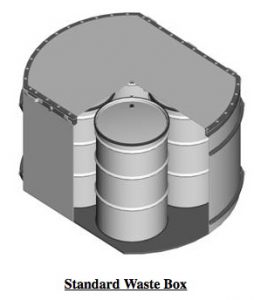
On January 17, 2019, Southwest Research and Information Center (SRIC) and Nuclear Watch New Mexico (NWNM) filed an appeal in the New Mexico Court of Appeals to overturn the New Mexico Environment Department (NMED) approval of the Waste Isolation Pilot Plant (WIPP) Disposal Volume permit modification, which was issued on December 21, 2018.
The modification would allow expansion of WIPP’s capacity by approximately 30 percent and was issued over the repeated opposition of many New Mexico organizations.
Columbia, SC – New aerial photos by pilot High Flyer of the nation’s costly and bungled nuclear construction projects are being released by Savannah River Site Watch.
Of primary importance, the photos – linked in “notes” below – reveal details at the Department of Energy’s terminated plutonium fuel (MOX) project at the Savannah River Site (SRS) near Aiken, SC and the canceled SCE&G/Dominion V.C. Summer AP100 reactor construction project near Jenkinsville, SC. The photos, taken on December 16, 2018, are being released in the public interest and can be used for free with proper credit (©High Flyer – see copyright statement at each photo section).
Also released are photos of Georgia Power’s bungled Vogtle nuclear reactor construction near Waynesboro, GA (and just across the Savannah River from SRS), the leaking Westinghouse uranium fuel fabrication facility near Columbia, SC and a large solar facility near Pelion, SC.
– DEPT. OF ENERGY HAD COMMITTED TO CLEANING UP ALL CONTAMINATION, NOW SAYS IT WILL LEAVE 98% OF CONTAMINATED SOIL NOT CLEANED UP – JUST WEEKS AFTER WOOLSEY FIRE BURNS SITE
– NEW REPORT DEVASTATES TOXIC AGENCY ASSURANCES THAT FIRE CAUSED NO TOXIC RELEASES
The Trump Administration’s Department of Energy (DOE) has announced it intends to leave almost all of the contaminated soil in its area of the Santa Susana Field Laboratory (SSFL) not cleaned up, despite admitting that would violate the legally binding agreement it entered into with California in 2010. The breach of long-standing promises is included in the final Environmental Impact Statement (EIS) for the SSFL cleanup, released by the Department of Energy on December 18, 2018.