

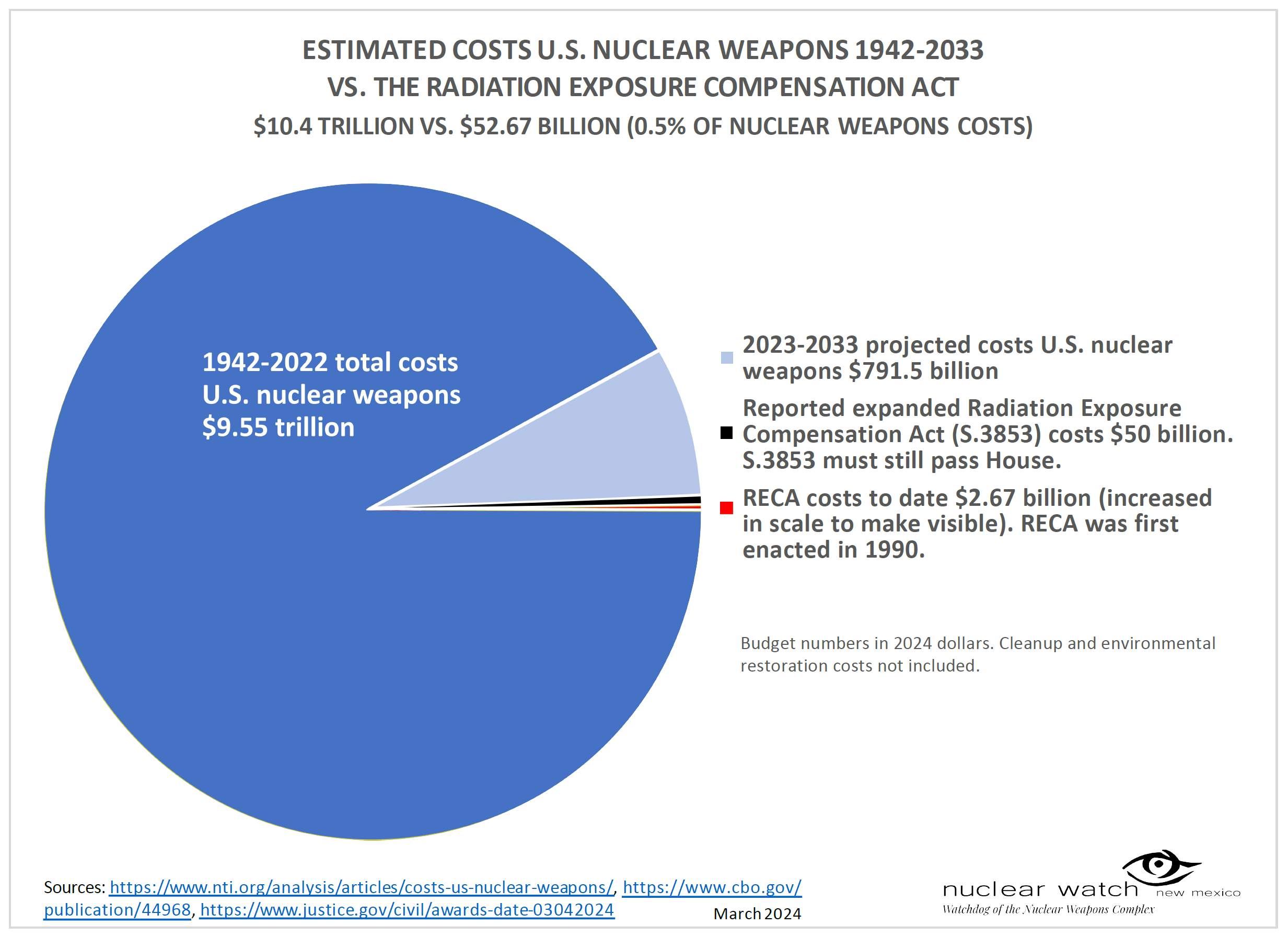
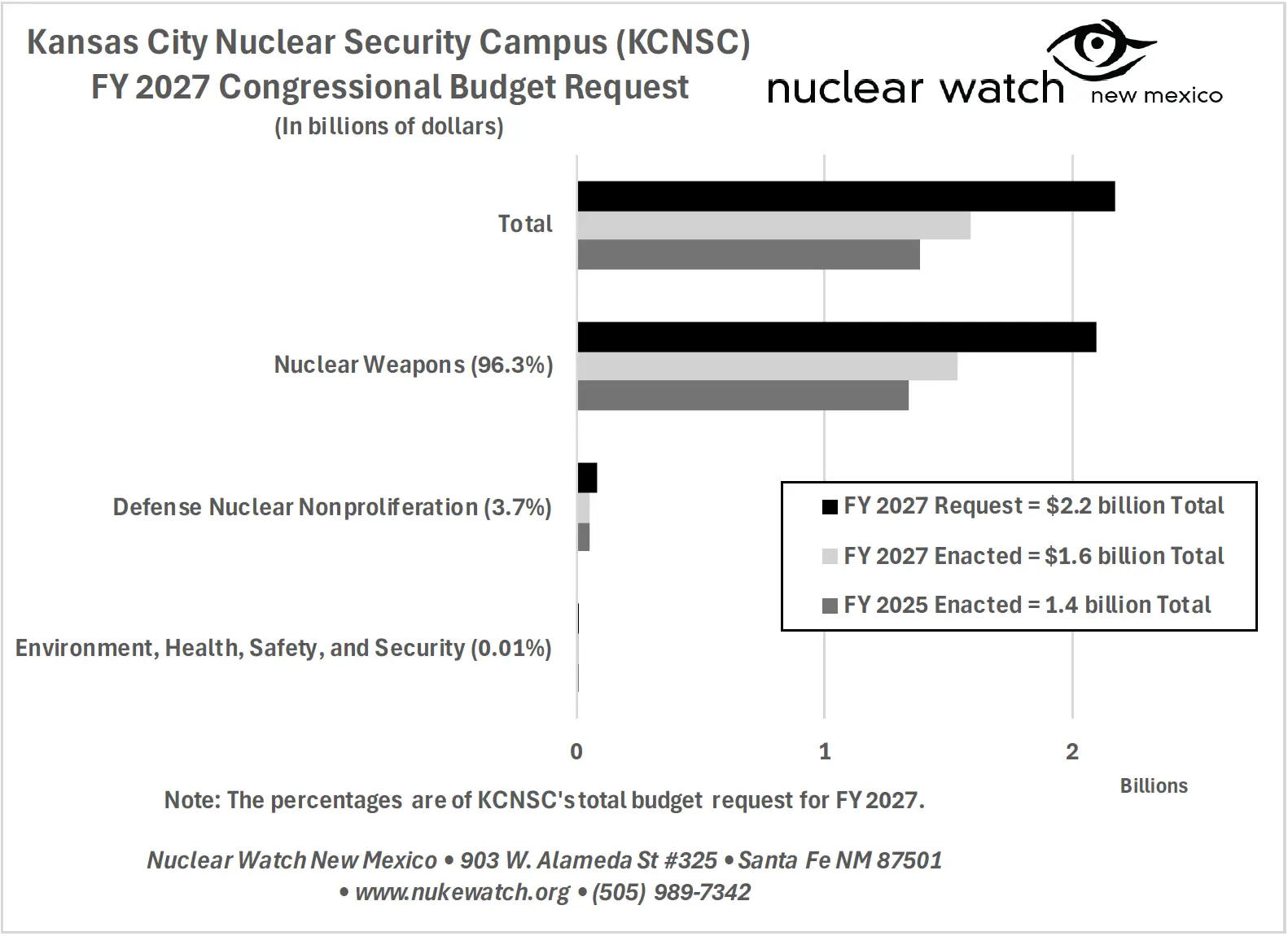
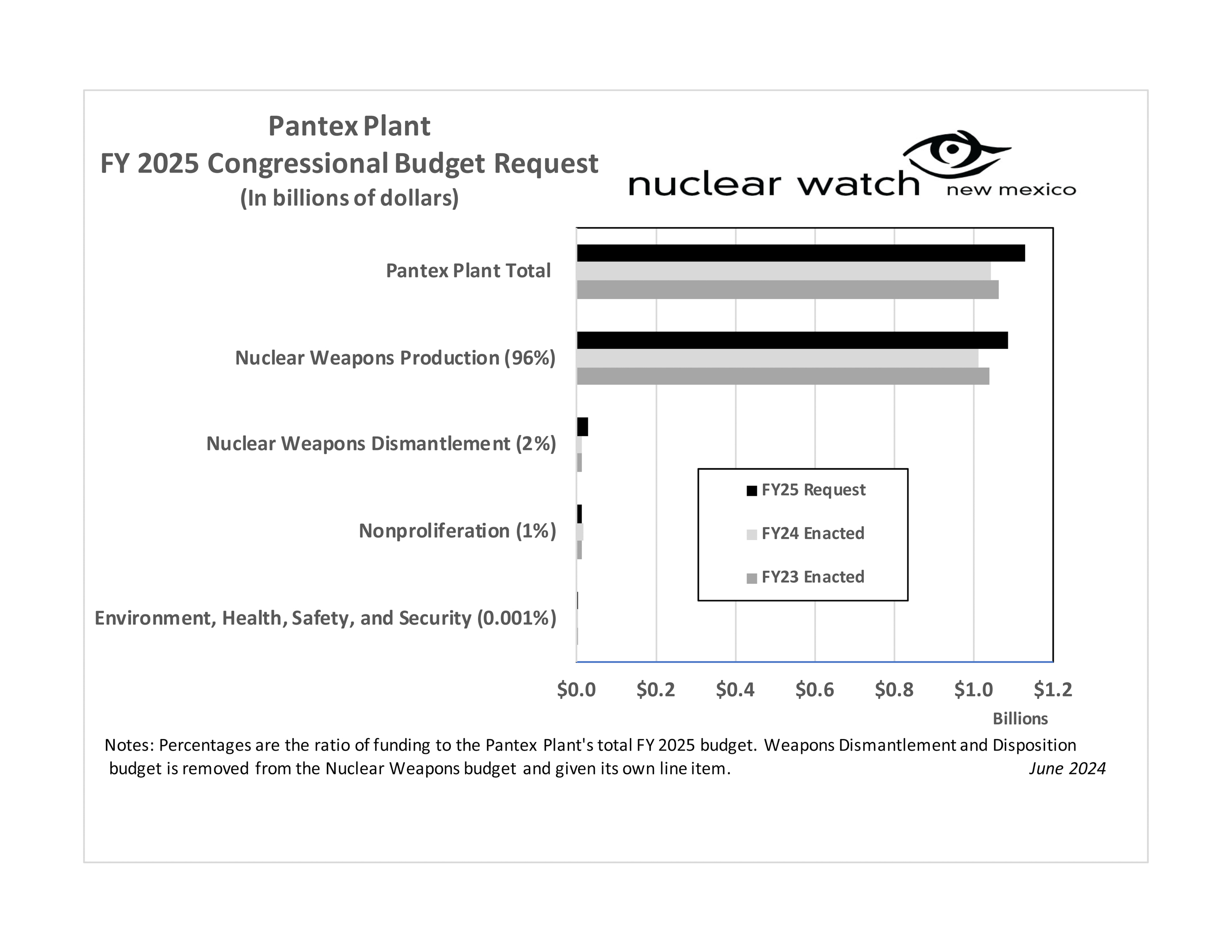
Cost of RECA Chart
In 1985, US President Ronald Reagan and Russian President Mikhail Gorbachev declared that “a nuclear war cannot be won and must never be fought.”

NEW & UPDATED
Find Out the Facts & Sign the Petition: Why NMED Should Deny LANL’s Request for Tritium Releases
Why NMED Should Deny LANL’s Request for Tritium Releases
The Los Alamos National Laboratory plans to begin large releases of radioactive tritium gas any time after June 2, 2025. The only roadblock to the Lab’s plans is that it needs a “Temporary Authorization” from the New Mexico Environment Department to do so.
Reasons why NMED should deny LANL’s request are:
- The state Environment Department has a duty to protect the New Mexican As it states, “Our mission is to protect and restore the environment and to foster a healthy and prosperous New Mexico for present and future generations.” 1
- Why the rush? LANL explicitly admits there is no urgency. According to the Lab’s publicly-released “Questions and Answers” in response to “What is the urgency for this project?”
“There is no urgency for this project beyond the broader mission goals to reduce onsite waste liabilities.” 2
-
- In addition, the National Nuclear Security Administration (NNSA) admits that the end time frame for action is 2028, not 2025.3 Therefore, there is time for deliberate consideration.
- Contrary to NMED’s Resource Conservation and Recovery Act permit for LANL, the Lab has not fulfilled its duty to inform the public via NMED of possible alternatives to its planned tritium releases.4 According to Tewa Women United, “LANL has told EPA there are 53 alternatives; that list of alternatives, initially requested in 2022, has not yet been Tewa Women United has repeatedly asked LANL to provide the public with that list.” 5
Formal Comments on the Draft Site-Wide Environmental Impact Statement for Continued Operation of the Los Alamos National Laboratory
The National Environmental Policy Act requires the Los Alamos National Laboratory to periodically prepare a new “Site-Wide Environmental Impact Statement (SWEIS) for Continued Operations.”
Please use NukeWatch NM’s recent extensive comments on the Lab’s new draft SWEIS as a resource and citizens’ guide to Lab issues.
Did you know, for example, that:
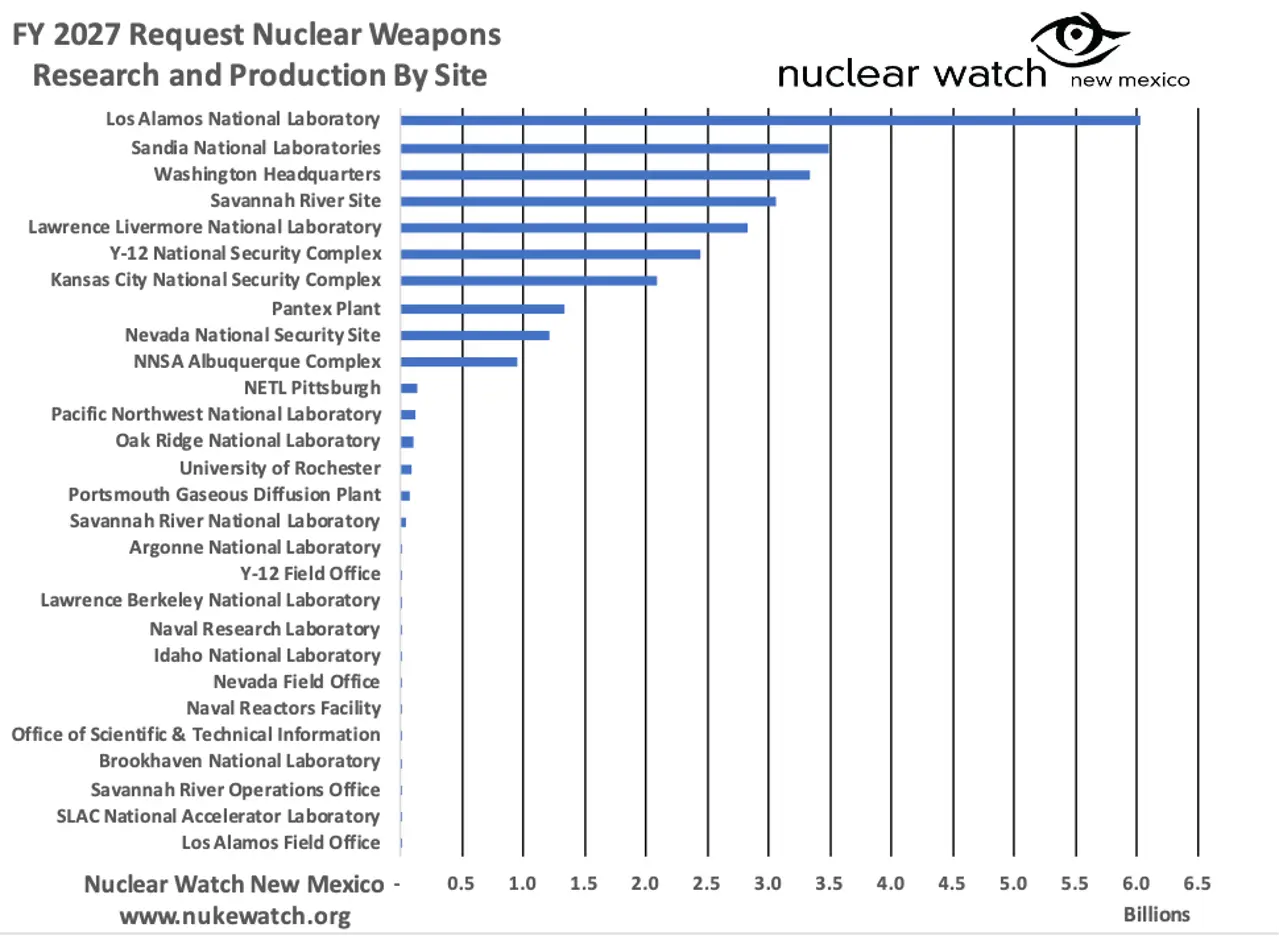
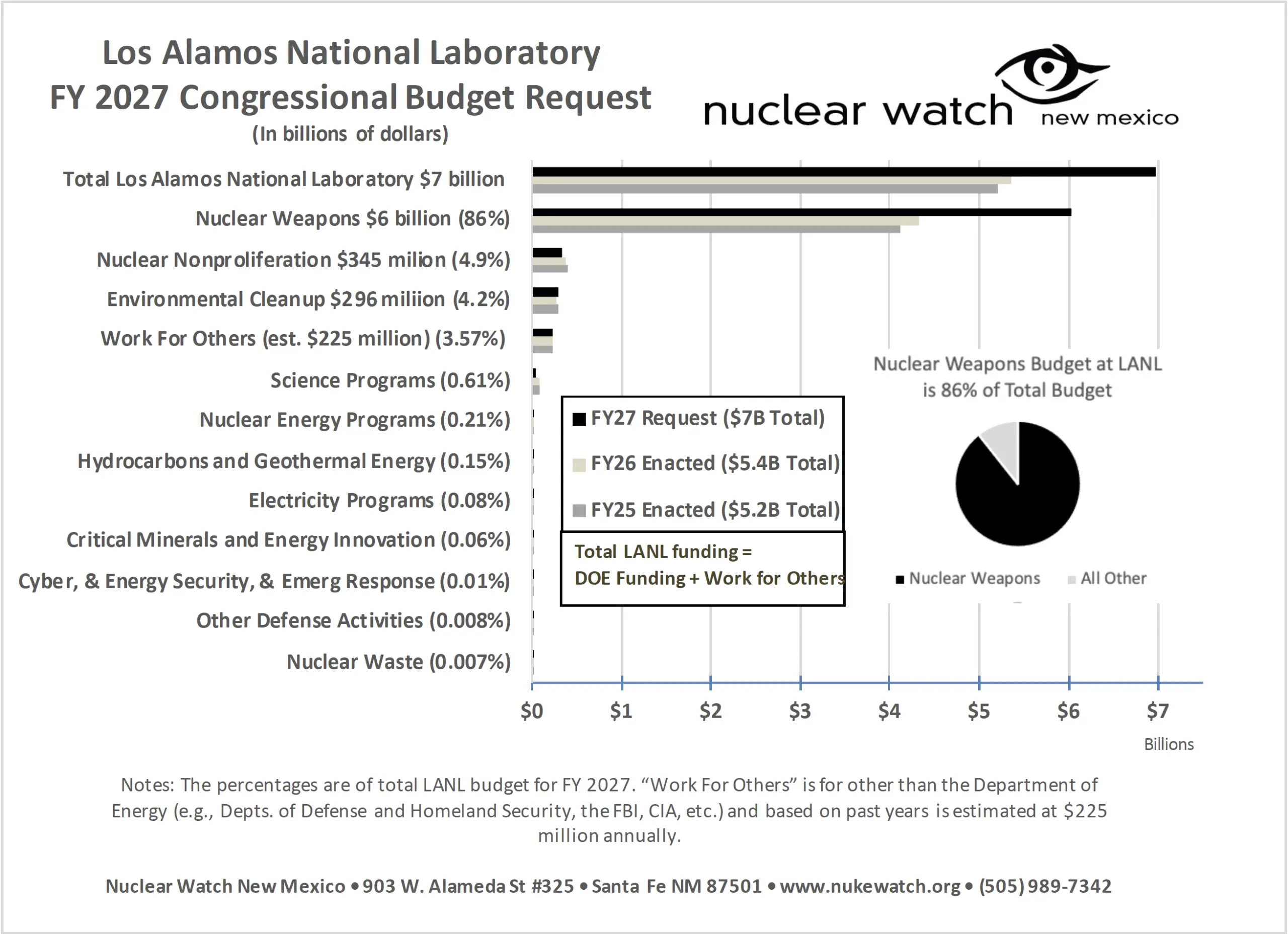
• LANL’s nuclear weapons production budget has doubled over the last decade?
• The Lab’s so-called cleanup plan is to “cap and cover” some 200,000 cubic yards of radioactive and toxic waste, leaving them permanently buried as a perpetual threat to groundwater?
• There is a planned intentional release of up to 30,000 curies of radioactive tritium gas, all without a public hearing?

Use our lengthy formal comments as a starting point, toolkit or resource for dissecting ongoing and future issues at LANL!
We encourage you to use our comments to ask for follow-up info, either from us here at NukeWatch or from the Lab, and to demand better accountability and transparency! Use as background or briefing material for local and congressional advocacy.
For example:
- Cite or excerpt our comments in future public processes under the National Environmental Policy Act. For example, we are expecting that a nationwide programmatic environmental impact statement for plutonium “pit” bomb core production will be announced soon, the result of a lawsuit in which NukeWatch led.
- Share with those organizing around stopping expanded plutonium pit production and advocating for genuine radioactive and toxic wastes cleanup.
- Learn about LANL’s proposed electrical transmission line across the environmentally and culturally sensitive Caja del Rio and alternatives that were not considered.
- The National Environmental Policy Act itself is under assault by the Trump Administration. We expect environmental justice and climate change issues to be stripped from LANL’s final Site-Wide Environmental Impact Statement. This needs to be resisted!
NukeWatch NM argued that the draft SWEIS should be withdrawn and a new one issued because:
• The NNSA has rigged the draft LANL Site-Wide EIS with three self-serving scenarios:
– Expanded nuclear weapons programs (contradictorily called the “No Action Alternative”).
– Yet more expanded nuclear weapons programs (“Modernized Operations Alternative”).
– Yet far more expanded nuclear weapons programs (“Expanded Operations Alternative”).
• A Reduced Operations Alternative must be included.
• The SWEIS’ fundamental justification for expanded nuclear weapons programs is “deterrence.” But “deterrence” has always included nuclear warfighting capabilities that could end human civilization overnight.
• The SWEIS purports to align with U.S. obligations under the 1970 NonProliferation Treaty. That is demonstrably false.
• Future plutonium pit production is NOT to maintain the safety and reliability of the existing nuclear weapons stockpile. Instead, it is for new-design nuclear weapons that could lower confidence in stockpile reliability and/or prompt a return to testing.
• The SWEIS’ No-Action Alternative violates the National Environmental Policy Act (NEPA).
• The legally required programmatic environmental impact statement on pit production should be completed first, followed by the LANL SWEIS.
• Plutonium pit reuse should be analyzed as a credible alternative to pit production.
• A recent proposal for a data center at LANL is not in the SWEIS. It raises huge issues of future water and electrical use, the appropriateness of commercial interests at a federal lab, and the possible fusion of artificial intelligence and nuclear weapons command and control.
• Recent Executive Orders could strip the final SWEIS of environmental justice and climate change analyses. This must have clarification.
• Planned tritium releases should be fully analyzed.
• The Electrical Power Capacity Upgrade should be analyzed will all credible alternatives.
• The proposed BioSafety Level-3 facility must have its own standalone EIS.
• All Defense Nuclear Facilities Safety Board concerns should be addressed and resolved.
• Genuine comprehensive cleanup should be a preferred alternative.
• A new SWEIS should follow a new overdue Probabilistic Seismic Hazard Analysis.
Nuclear Weapons Issues & The Accelerating Arms Race: April 2025
Nuclear weapons
Air Force Weighs Keeping 1970s-Era Missiles Until 2050
The US Air Force is considering contingency plans that would extend the life of 1970s-era intercontinental ballistic missiles by 11 more years to 2050 if delays continue to plague the new Sentinel models intended to replace them. The current plan is to remove all 400 Minuteman III ICBMs made by Boeing Co. from silos by 2039… The Sentinel was projected last year to be deployed starting in May 2029. The first test flight was once projected for December 2023, but fiscal 2025 budget documents indicated a slip to February 2026.
The estimated cost of the new Sentinel intercontinental ballistic missiles (ICBM), originally at ~$110 billion, is now north of $180 billion. And this is before recognition of the immensity of supplying new command and control communications and recent consideration that its hardened silos may have to be replaced. IMHO it’s a propitious time to argue again for eliminating the land-based ICBM leg of the Triad. After all, one of its stated purposes is to act as a “nuclear sponge” for incoming Russian warheads. The odds of that are not zero and may increase if ICBMs are uploaded with multiple warheads after the New Strategic Arms Reduction Treaty expires in February 2026. More temptation for a preemptive first strike.
Nuclear Watch New Mexico and Santa Fe Archbishop John C. Wester Attend the Third Meeting of States Parties to the Treaty on the Prohibition of Nuclear Weapons
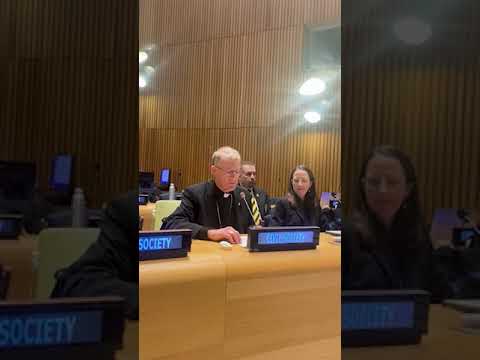
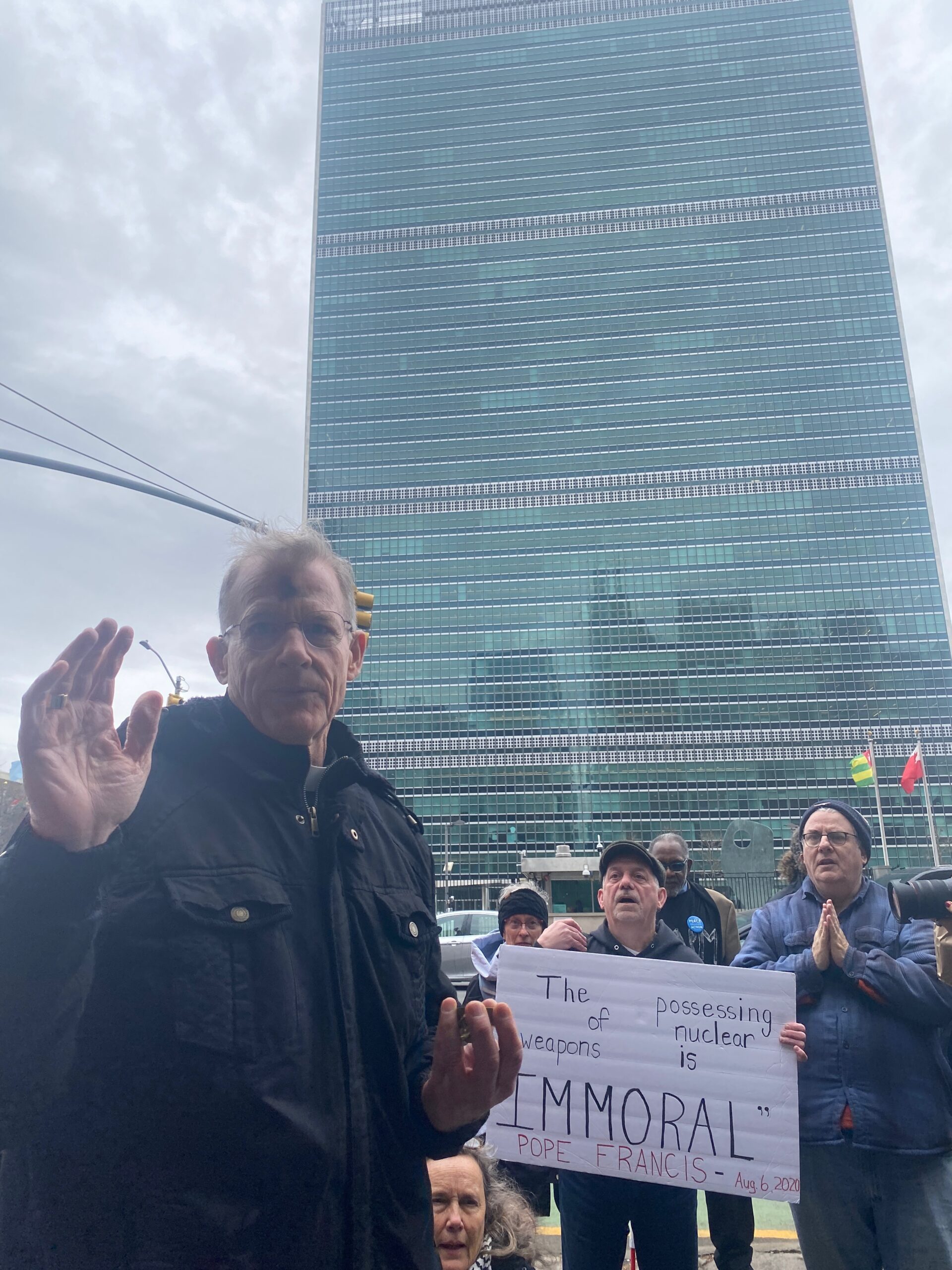
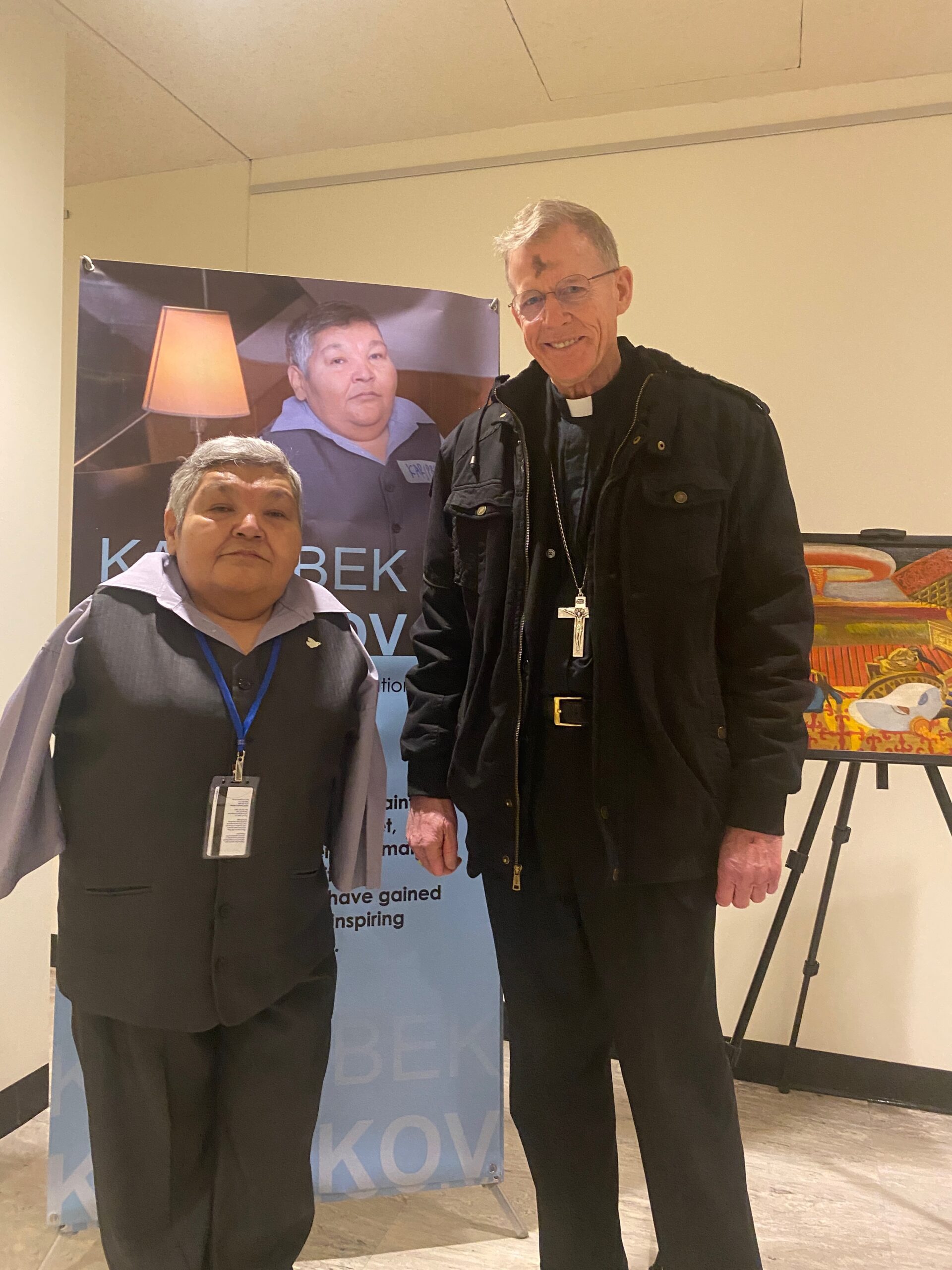
We had the honor of joining the Archbishop of Santa Fe, John Wester, in attending the third Meeting of States Parties to the Treaty on the Prohibition of Nuclear Weapons last week, March 3-7 in New York City. The archbishop gave mass to several different groups (see photos below) and spoke at the UN headquarters as part of Civil Society.
In New York City this week? Join Pax Christi members and friends at Mass with Archbishop John Wester (Santa Fe NM) on Tuesday, March 4, 6 pm, at the Church of Our Saviour, 59 Park Avenue at 38th Street. Use this link to RSVP. #TPNW #3MSP #nucleardisarmamentwww.dorothydayguild.org/WesterMass25
— Pax Christi USA (@paxchristiusa.bsky.social) 2025-03-03T16:35:50.942Z
Nuclear Weapons Issues & The Accelerating Arms Race: March 2025
Nuclear Weapons Budget:
• Trump wants a Continuing Resolution (CR) for the rest of the year, rather than doing an omnibus appropriation bill or partially shutting down the federal government on March 15. That means the federal government would run on FY 2024 budget levels through September 30, 2025. However, there are “anomalies”, one being a $185 million increase for nuclear weapons programs paid for by a corresponding cut to nonproliferation programs. This also means no individual or “omnibus” appropriations bills for FY 2025. It will be the first time that the government runs on a Continuing Resolution for an entire fiscal year.
• House and Senate approved their respective budget resolutions but still have to reconcile them. Both have $4 trillion in tax cuts for the rich paid for in part by $2 trillion in cuts in domestic programs, with Medicaid being the single biggest target. They also have an additional $300 billion toward new military and border security spending. The budget resolution is not legally binding so it’s not completely clear how it gets implemented should there be a Continuing Resolution (CR) for the entire FY 2025.
Nuclear Weapons Update:
Trump has been making noises about cutting nuclear weapons:
1. From Frank Chen, Rethink Media:
Addressing WEF in Davos, 1/23/25: “We’d like to see denuclearization. In fact, with President Putin…we were talking about denuclearization of our two countries, and China would have come along. China has a — a much smaller, right now, nuclear armament than us or field than us, but they’re — they’re going to be catching it at some point over the next four or five years.
And I will tell you that President Putin really liked the idea of — of cutting way back on nuclear. And I think the rest of the world, we would have gotten them to follow. And China would have come along too. China also liked it.
Tremendous amounts of money are being spent on nuclear, and the destructive capability is something that we don’t even want to talk about today, because you don’t want to hear it. It’s too depressing.
So, we want to see if we can denuclearize, and I think that’s very possible. And I can tell you that President Putin wanted to do it. He and I wanted to do it. We had a good conversation with China. They would have been involved, and that would have been an unbelievable thing for the planet.”
2. Joint press conference with Indian PM Modi, 2/13/25, “You know, the power of weaponry today is — and not only nuclear, but nuclear, in particular — the power of weaponry is very important. I said before that I had very constructive talks in my first term with President Putin about the denuclearization of the two countries. And then we were going to go to China after we worked some kind of a deal, and we had the confines of a deal…he really wanted to do it and so did I — denuclearize. And it’s such a beautiful term, when you think about it. In other words, to bring it down, because the power of those weapons is too great.
And I did speak to President Xi about that, and I was getting also a very good response. He’s building a very strong nuclear power. He’s not very close to Russia or the United States right now, but he will be soon. I mean, he’ll catch up over the period of four or five years, they say.
…But after I put out the fires, I’m going to meet with China, and I’m going to meet with Russia, and we’re going to see if we can de-escalate, if we can bring it down — military — especially as it pertains to nuclear.”
3. Speaking to reporters in the Oval Office, 2/13/25, “At some point, when things settle down, I’m gonna meet with China, and I’m gonna meet with Russia…we were talking about ‘de-nuking’, denuclearize. President Putin and I agreed we were gonna do it, in a very big way.
There’s no reason for us to be building brand new nuclear weapons, we already have so many. You could destroy the world 50 times over, 100 times over. And here we are building new nuclear weapons, and they’re building nuclear weapons, and China is building new nuclear weapons.
Hopefully there will never be a time when we need those weapons. If there is ever a time when we need nuclear weapons, like the kind of weapons that we are building, and that Russia has, and that China has––to a lesser extent, but will have––that’s gonna be a very sad day; that’s gonna be probably oblivion.
…We’re all spending a lot of money that we could be spending on other things that are actually, hopefully much more productive.”
Accelerating Arms Race
• New Strategic Arms Reduction Treaty (START) expires in February 2026. If not renewed it will be the first time the world is without any arms control treaty since the mid-1970s.
• Given Trump’s apparent siding with Putin over Ukraine, Europe is talking more about its own nuclear “deterrent”, particularly through the French. Through the United Kingdom is unlikely given that its nuclear weapons programs are so closely intertwined with the U.S.’ But relying upon either the French or UK has the strong advantage of not technically violating the 1970 NonProliferation Treaty. There is increasing noise in South Korea and Japan for their own nukes as well.

Brief Analysis of Today’s U.S. Supreme Court Oral Arguments on the Illegality of Licensing Radwaste Dumps in TX and NM
Today the United States Supreme Court heard arguments in the case of the Nuclear Regulatory Commission vs. Texas. At issue is whether the NRC exceeded its authority when it approved licenses for proposed “consolidated interim storage facilities” for high-level radioactive waste, and this includes highly irradiated “spent” fuel from nuclear power plants.
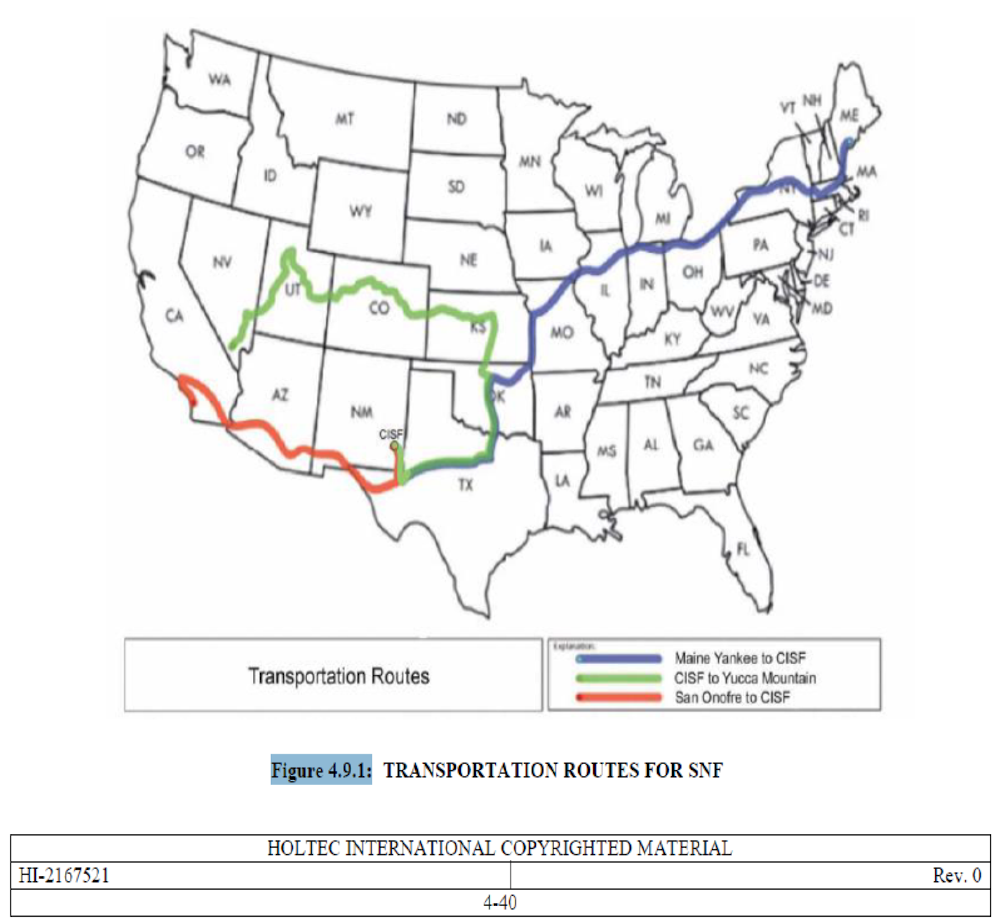
Two consolidated interim storage facilities are planned for western Texas and southeastern New Mexico. The Nuclear Waste Policy Act of 1982, as Amended specifically prohibits private “interim” storage of federal spent nuclear fuel, and disallows the Department of Energy from taking title to the waste unless a permanent geologic repository is licensed, built and opened. The law intended to prevent private “interim” storage of federal radioactive waste because interim storage is much less robust than permanent storage, and would double the risk of accident or attack during transport, since consolidated “interim” storage means the waste has to be moved twice, once to the CISF and again to a permanent repository.
LANL Site-Wide EIS Hearings in Santa Fe and Los Alamos Filled with Loud Protest and Vehement Dissent: Nuclear Weapons are IMMORAL
In this Site-Wide EIS we’re given three options: Expanded nuclear weapons programs (hypocritically called the no action alternative), then we’re presented with yet more expanded nuclear weapons programs, and the third alternative is even more expanded nuclear weapons programs. What we really need is a genuine alternative in this Site-Wide, and I hope that citizens will repeatedly bring this up. We need a TRUE ALTERNATIVE in which the US begins to show global leadership towards nuclear disarmament that it promised to in the Non-Proliferation Treaty, and that should be reflected in the sitewide which shows just passive maintenance of the stockpile. We don’t need Pit Production because it’s for NEW designs – NOT to ensure the safety and reliability of the existing stockpile. The US, for our own national security and global security, we need to lead the world towards global nuclear disarmament – and this Site-Wide EIS does the opposite.
The hearings in Santa Fe and Los Alamos on February 11 and February 13, 2025, respectively, both had virtual participation options. The attendees online and in person were equally vehement in protesting the “rigged game” we’re given with this SWEIS and decrying the fact that there is no alternative besides increased nuclear weapons production.
And read an exceprt from the Archbishop of Santa Fe, John Wester’s comments:
“As we all know, we’re in an accelerating new nuclear arms race that’s made even more dangerous because of artificial intelligence, multiple nuclear actors and hypersonic delivery systems. It’s an already scary situation that has become even scarier, and what concerns me is that Los Alamos and Santa Fe play a key role in naturally fostering and promoting this new nuclear arms race – a race which I believe is an affront to all that is good and holy, all from our perspective that God has placed in us to live in harmony with one another. Nuclear weapons pose one of the greatest threats to that harmony. I think it’s important to know what I’m learning more and more about is that expanded plutonium pit production is not simply to maintain the safety and reliability of our existing so-called deterrence. I think it’s important that people are aware that it’s really for new design nuclear weapons for this new particular armed race. I think it’s important that that people recognize that deterrence is not the way to go. In that light, I would say obviously for me is a Catholic Bishop, Pope Francis I think has really changed the whole moral landscape of looking at nuclear weapons. On the 70th anniversary of the Hiroshima atomic bombing, Pope Francis declared that the very possession of nuclear weapons is immoral. As Catholics this was an extremely important shift there. The 1983 United states conference of Catholic Bishops did allow for deterrence – it was promoting disarmament but made caveats for deterrence. But Pope Francis has taken that off the table in saying that even possessing nuclear weapons is immoral, it’s unethical. One of the main reasons for this church’s shift on this was that the nuclear weapons powers really have failed in their pledge in 1970 when they joined the Non-Proliferation Treaty. The TPNW came about because of that failure, and so it seems to me then based on what Pope Francis said, that if possessing nuclear weapons is immoral, then expanding plutonium pit cores and modernizing our weapons systems in order to be more involved in the new nuclear arms race is also immoral. This policy is unethical. Now I want to be careful here, I am not saying that anyone working at Los Alamos or Sandia or Lawrence Livermore in California, I’m not judging them or saying there are immoral – that’s a different matter in one’s conscience. I’m saying that the policy is involved and the Pope said that nuclear weapons themselves are intrinsically immoral. I think that’s an important thing to keep in mind, that that we need to be moving toward disarmament and that if we’re not, if that’s not our trajectory, rather if it’s just to build up our defenses, then that’s an immoral buildup.”

Remember the Downwinders
Today, Jan. 27 is a National Day of Remembrance for Downwinders. Nuclear testing by the U.S. government started in New Mexico with the Trinity Test in July 1945, and the Crossroads Series of three tests followed in the Pacific in 1946. The United States took part in nuclear testing as part of the escalating Cold War arms race, and nuclear weapons proliferated. Americans working and living downwind from nuclear testing sites became sick and killed by the radiation exposure generated from the aboveground atomic tests in Nevada, which began on January 27, 1951 and ended on July 17, 1962. With each nuclear test, radioactive fallout spread globally. Of course, downwinders are not only American. At the so-called “Pacific Proving Grounds” in the Marshall Islands, 67 nuclear weapons were detonated between 1945 and 1962.
From GUAM PACIFIC DAILY NEWS 1/27/25:
“It became a site of unimaginable destruction that did not stop at the blast zones. The radioactive fallout spread across the Pacific, settling on many islands like ours.” — Guam Senator Therese Terlaje
Seven of the top 10 adult cancers on Guam are now recognized as compensable for radiation exposure by the federal government, the senator noted.
Historic Settlement Reached in NEPA Lawsuit Over Plutonium “Pit” Bomb Core Production
Nonprofit public interest groups have reached an historic settlement agreement with the Department of Energy’s semi-autonomous nuclear weapons agency, the National Nuclear Security Administration (NNSA). This is the successful result of a lawsuit against NNSA over its failure to complete a programmatic environmental impact statement on the expanded production of plutonium “pit” bomb cores, as required by the National Environmental Policy Act (NEPA). This agreement and a joint motion to dismiss have been submitted to Judge Mary Lewis Geiger of the Federal District of South Carolina. Should the Court enter the dismissal and retain jurisdiction to enforce the settlement, the agreement will go into effect.
This lawsuit was first filed in June 2021 by co-plaintiffs Savannah River Site Watch of Columbia, SC; Nuclear Watch New Mexico of Santa Fe, NM; Tri-Valley Communities Against a Radioactive Environment (CAREs), based in Livermore, CA; and the Gullah/Geechee Sea Island Coalition of coastal Georgia. NNSA promptly moved to have the case dismissed which in February 2023 Judge Lewis rejected, calling her decision “not a close call.”
In September 2024, Judge Lewis ruled that DOE and NNSA had violated NEPA by failing to properly consider alternatives before proceeding with their plan to produce plutonium pits, a critical component of nuclear weapons, at the Los Alamos National Laboratory (LANL) in New Mexico and, for the first time ever, at the Savannah River Site (SRS) in South Carolina. The Court found that the plan’s purpose had fundamentally changed from NNSA’s earlier analyses which had not considered simultaneous pit production at two sites. Judge Lewis directed the Defendants and Plaintiffs to prepare a joint proposal for an appropriate remedy which fostered additional negotiations.
New Draft LANL Site-Wide Environmental Impact Statement is Released
NNSA’s Preferred Future for the Lab is Radically Expanded Nuclear Weapons Programs
The National Nuclear Security Administration (NNSA) has finally released its Draft Site-Wide Environmental Impact Statement (SWEIS) for Continued Operation of the Los Alamos National Laboratory. This is more than two years after it was first announced and sixteen years after the last site-wide EIS. During that time the Lab has become more and more a nuclear weapons production site for the new global nuclear arms race. Accordingly, the central point of the new draft LANL SWEIS is “NNSA has identified the Expanded Operations Alternative as the preferred alternative for the continuing operations of LANL.” Draft LANL SWEIS, page S-13.
As policy background, the draft LANL SWEIS pays lip service to the 1970 NonProliferation Treaty (NPT):
“In Article VI of the NPT, treaty parties “undertake to pursue negotiations in good faith on effective measures relating to cessation of the nuclear arms race at an early date and to nuclear disarmament…” The U.S. takes this commitment seriously and has emphasized dedication to both the long-term goal of eliminating nuclear weapons and the requirement that the U.S. has modern, flexible, and resilient nuclear capabilities that are safe and secure, until such a time as nuclear weapons can prudently be eliminated from the world.” P. 1-7.
Left unsaid is that no nuclear power, including the United States, has ever even tried to enter into good faith negotiations toward nuclear weapons disarmament, pledged to more than a half-century ago. Instead, all nuclear weapons states are now engaged in massive “modernization” programs to keep nuclear weapons forever, leading to today’s accelerating nuclear weapons arms race. Also, very much left unsaid is the Treaty on the Prohibition of Nuclear Weapons, ratified by 73 countries, nearing its fourth anniversary since it went into effect.

Independent Review of Chromium Groundwater Contamination Fails to Make Final Cleanup Recommendation
After 20 Years Los Alamos Lab Still Doesn’t Know Size of Plume
At Present Rate Cleanup Will Take More Than a Century
On December 30, 2024, in the middle of the holiday season, the Los Alamos National Laboratory (LANL) posted the report Independent Review of the Chromium Interim Measures Remediation System to its largely unknown Legacy Cleanup Electronic Public Reading Room. This report attempts to address the Lab’s extensive contamination of the region’s deep groundwater aquifer by a large plume of hexavalent chromium, whose potentially serious human health effects (including cancer) was the subject of the popular movie Erin Brockovich.
LANL’s chromium contamination plume is at least one mile long, a half mile wide and 100 feet thick.[1] It is commonly regarded as the Lab’s most serious environmental threat. One drinking water supply well for Los Alamos County has been shut down because of the plume. Lab maps of the contamination depict it as abruptly stopping at the border of San Ildefonso Pueblo, which is highly unlikely.
The bottom line of the newly released chromium report is:
“…at this time the plume is not sufficiently characterized to design a final remedy… data gaps and uncertainties need to be addressed before committing to an alternative or final remedy.”
This is a full two decades after the chromium plume was first reported.

New Nuclear Media: Art, Films, Books & More
“Turning Point: The Bomb and the Cold War” Explores Impact of US–Soviet Conflict
The nine-part doc examines how two global superpowers have irrevocably altered the course of history.
By Roxanne Fequiere, Netflix |
While the the Cold War ended in 1991, even a casual appraisal of current headlines reveals that relations between the United States and Russia — the one-time center of the Soviet Union — remain tense, to say the least. The global repercussions of the Cold War continue to ripple through the current geopolitical landscape to this day, but it can be difficult to understand just how a mid-20th century struggle for ideological dominance continues to ensnare countless nations in ongoing unrest.

In Search of Resolution: Documentary on Nuclear Dangers
“In Search of Resolution,” examines the current state of international nuclear arms control and is the third film of The Nuclear World Project.
Filmed in 2022 after the Russian invasion of Ukraine, this timely documentary examines the continuing dangers posed by the existence of nuclear weapons.