
Updates
There IS NO need for speed.
That is no need for speed other than the National Nuclear Security Administration’s and LANL’s aggressive agenda to get unneeded plutonium “pit” bomb core production established as a fait accompli by stripping safety standards and blocking independent oversight before the lack of true need and the astonishing costs are publicly recognized.
There is no need for speed because no future pit production is to maintain the safety and reliability of the existing nuclear weapons stockpile. Instead, it is all for new-design nuclear weapons for the new nuclear arms race that threatens us all. Further, these new-design nuclear weapons could prompt the U.S. to resume nuclear weapons testing, which Trump has already threatened. This would have disastrous international proliferation consequences (Putin has already said Russia will test if the U.S. does).
The Department of Energy and the NNSA have been on the independent Government Accountability Office’s High Risk List for project mismanagement and waste of taxpayers’ dollars ever since the GAO started the List in 1991. The NNSA is going to spend $4 billion at LANL and the Savannah River Site (SRS) in South Carolina for pit production over each of the next six years. Yet the GAO has repeatedly stated that NNSA has no credible cost estimates for its most expensive and complex program ever.
Plutonium pit production at LANL will cause more contamination and radioactive wastes.

Public Interest Groups Warn NNSA on Plutonium Giveaway
FOR IMMEDIATE RELEASE, September 8, 2026
Joint Press Release from: South Carolina Environmental Law Project, Savannah River Site Watch & Nuclear Watch New Mexico
Contact: Tom Clements, Director, SRS Watch, 803-240-7268 | Email
Jay Coghlan, Nuclear Watch NM, 505-989-7342 | Email
Shelby Cohen, Comms Manager, SC Env. Law Project, 864.414.7726 | Email
South Carolina – Today, the South Carolina Environmental Law Project (SCELP) sent a letter of demand to the Department of Energy (DOE) and its semi-autonomous agency, the National Nuclear Security Administration (NNSA), about their proposed unsound and dangerous management of U.S. plutonium. The letter notified them that they must comply with the federal National Environmental Policy Act (NEPA) requirement for public review of the Trump Administration’s troubling plan to give away 19.7 metric tons of nuclear weapons-grade plutonium to private corporations.
SCELP’S letter, on behalf of Nuclear Watch New Mexico, Savannah River Site Watch, and a private citizen who lives near the Savannah River Site (SRS) in South Carolina, outlines why NNSA must be held to its legal NEPA obligations. The letter describes how recently issued presidential executive orders:
…constitute a vast change in the prior decisions and purposes of the DOE/NNSA surplus plutonium disposition program that has been in place since at least 1996… This change is also contrary to the larger nuclear non-proliferation policy of the United States restricting the commercial use of plutonium that has been in place for approximately fifty years.
This action follows SCELP’s earlier NEPA lawsuit on behalf of SRS Watch and Nuclear Watch New Mexico. In a landmark settlement, that litigation successfully compelled the NNSA to prepare a nationwide programmatic environmental impact statement on the production of plutonium “pit” bomb cores for nuclear weapons (the “Pit Production PEIS”).
FOLLOW-ON SUPPLEMENTAL Sample Comment on the Draft Plutonium Pit Production Programmatic Environmental Impact Statement (PEIS)
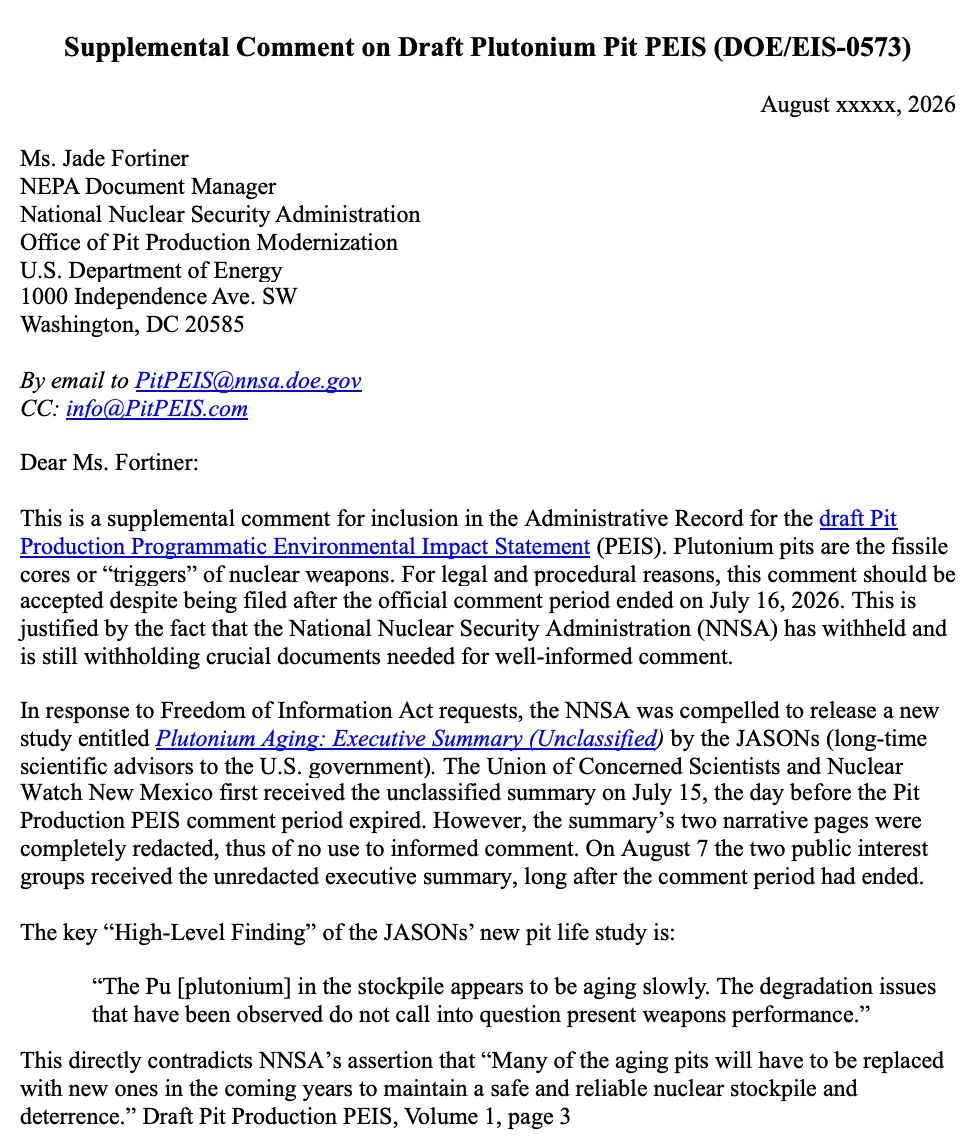
This is a sample supplemental comment for the draft Pit Production Programmatic Environmental Impact Statement (PEIS). Plutonium pits are the fissile cores or “triggers” of nuclear weapons. For legal and procedural reasons, this comment should be accepted despite being filed after the official comment period ended on July 16, 2026. This is justified by the fact that the National Nuclear Security Administration (NNSA) has withheld and is still withholding crucial documents needed for well-informed comment. Please download, edit, and send in your supplemental comment to PitPEIS@nnsa.doe.gov today (and please CC info@pitpeis.com)! We must stand up against NNSA’s lack of transparency.
NNSA Releases New Plutonium Life Study – Key Finding: Plutonium Aging Not Affecting Existing Nuclear Weapons
FOR IMMEDIATE RELEASE, August 10, 2026
Contact: Jay Coghlan, Nuclear Watch New Mexico, 505.989.7342, c. 505.470.3154 | Email
Sophia Stroud, Nuclear Watch New Mexico, 505.231.9736 | Email
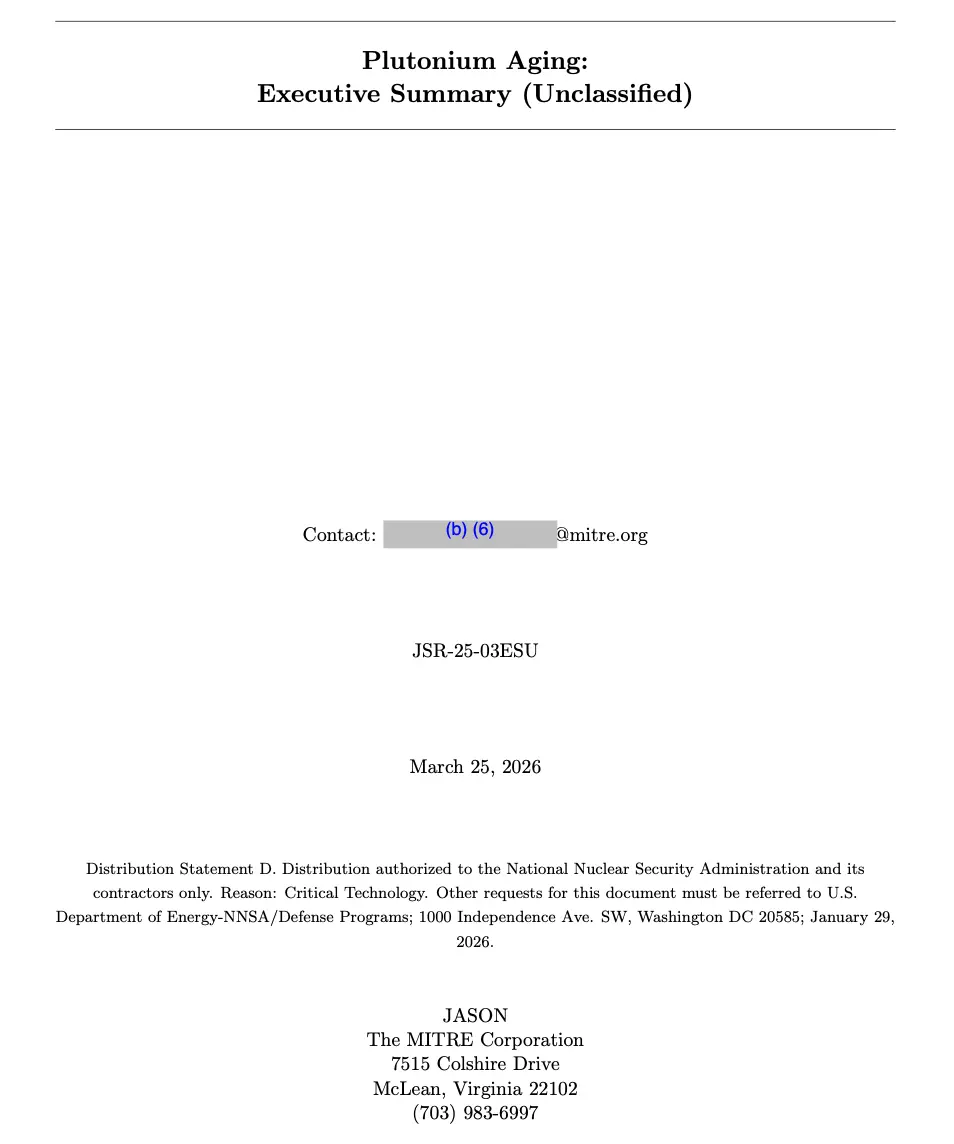
Santa Fe, NM – In response to Freedom of Information Act requests, the Department of Energy’s semi-autonomous National Nuclear Security Administration (NNSA) has released a new study entitled Plutonium Aging: Executive Summary (Unclassified) by long-time scientific advisors to the U.S. government called the JASONs. The key “High-Level Finding” of this new report is:
“The Pu [plutonium] in the stockpile appears to be aging slowly. The degradation issues that have been observed do not call into question present weapons performance.”
Plutonium “pits” are the all-important radioactive cores or “triggers” of nuclear weapons. The NNSA has repeatedly claimed that potential aging effects drive the need for the aggressive expansion of plutonium pit production, which is the agency’s most expensive and complex program ever. The Pentagon has stated that expanded pit production is one of the most critical issues in its $2 trillion “modernization” program to keep nuclear weapons forever.
However, the independent Government Accountability Office (GAO) has repeatedly stated that the NNSA has no credible costs estimates and no “Integrated Master Schedule” for simultaneous production at the Los Alamos National Laboratory (LANL) in northern New Mexico and the Savannah River Site (SRS) in South Carolina. In fact, DOE and NNSA have been on the GAO’s “High Risk List” for project mismanagement and waste of taxpayers’ dollars since 1991. At more than $30 billion, the plutonium pit plant at SRS is on track to become the most expensive building in U.S. history. A comparable amount will be spent at LANL on facility upgrades and related projects, for which the NNSA fails to keep total aggregated costs.
NEW 2026 JASON Plutonium Aging Executive Summary
“The Pu in the stockpile appears to be aging slowly. The degradation issues that have been observed do not call into question present weapons performance.”
Today, August 6, 2026, is the 81st Anniversary of the U.S. Atomic Bombing of Hiroshima.
Recommended Reading: John Hersey and the horrors of Hiroshima
The American journalist’s account of the Hiroshima bombing and its aftermath, told through the eyes of Japanese survivors, forced the world to reckon with the terrifying power of nuclear weapons.
Iain MacGregor August 5, 2026 engelsbergideas.com
The New START treaty – enforced since 2011 and the last remaining arms‑control agreement between the United States and Russia – expired in February 2026 with nothing to replace it. The final legal barrier limiting the world’s two largest nuclear arsenals was removed, ushering in what analysts describe as a period of Great Power uncertainty. China, meanwhile, is rapidly expanding and modernising its nuclear forces, with its stockpile more than doubling in just five years and further growth expected throughout the decade.
In the Middle East, the erosion of nuclear restraint has accelerated sharply. Recent US-Israeli attacks have pushed Iran closer than ever to abandoning the Nuclear Non‑Proliferation Treaty (NPT): Tehran still possesses enough enriched uranium to place it within short technical reach of multiple nuclear warheads, while senior political and security figures openly debate withdrawal from the NPT as a defensive necessity rather than a diplomatic taboo. The precedent – of a major regional power crossing the nuclear threshold outside any arms‑control framework – would reverberate far beyond the region.
North Korea, emboldened by global fragmentation, insists that its arsenal is ‘irreversible’. Across Europe and Asia, public opinion in countries such as Poland, Turkey and South Korea is shifting toward domestic nuclear capability as confidence in US security guarantees becomes frayed. The precarious equilibrium of the non‑proliferation era is cracking just when the living memory of the bomb’s human cost has never been more vital.
In such a landscape, the work of remembering what nuclear weapons do – not in theory, but to human bodies and cities – becomes urgent again. Eighty years ago, one American writer succeeded in forcing the world to confront this reality. His name was John Hersey, and the story he told in August 1946 in the New Yorker magazine, about the world’s first nuclear strike against the Japanese port city of Hiroshima the previous year, remains one of the clearest moral documents of the atomic age…
Ian MacGregor outlines precisely above the current state and reality of the new nuclear arms race we are now in, more dangerous than the first.
“Rationality will not save us… this is very important: at the end we lucked out. It was luck that prevented nuclear war.” Robert McNamara
Nuclear Watchdog Sues for Plutonium Pit Production “Special Study”
FOR IMMEDIATE RELEASE, August 4, 2026
Contact: Jules Zacher, Esq., 215.888.5183, | Email
Jay Coghlan, Nuclear Watch New Mexico, 505.989.7342, c. 505.470.3154 | Email
Sophia Stroud, Nuclear Watch New Mexico, 505.231.9736 | Email
Santa Fe, NM – Nuclear Watch New Mexico has sued the Department of Energy under the Freedom of Information Act for its Special Study of the National Nuclear Security Administration’s Leadership and Management of the Plutonium Pit Production Mission. The National Nuclear Security Administration (NNSA) is the semi-autonomous nuclear weapons agency within DOE.
Plutonium “pits” are the radioactive cores or “triggers” of nuclear weapons. Their expanded manufacturing has been the chokepoint of resumed industrial-scale nuclear weapons production by the U.S. Crucially, no future pit production is to maintain the safety and reliability of the existing stockpile. Instead, it is all for new-design nuclear weapons for the new arms race. These new weapons can’t be tested because of the existing global testing moratorium, thereby perhaps degrading confidence in the stockpile. Or new-design nuclear weapons testing could prompt the U.S. to resume testing, which would have severe international proliferation consequences.
Plutonium pit production is the NNSA’s most expensive and complex program to date. However, the independent Government Accountability Office (GAO) has repeatedly stated that the agency has no credible costs estimates and no “Integrated Master Schedule” for simultaneous production at the Los Alamos National Laboratory (LANL) in northern New Mexico and the Savannah River Site (SRS) in South Carolina. In fact, DOE and NNSA have been on the GAO’s “High Risk List” for project mismanagement and waste of taxpayers’ dollars since 1991. At more than $30 billion, the plutonium pit plant at SRS is on track to become the most expensive building in U.S. history. A comparable amount will be spent at LANL on facility upgrades and related projects, for which the NNSA fails to keep total aggregated costs.
Nuclear Watch New Mexico sues Department of Energy for plutonium pit report
Jay Coghlan, director of Nuclear Watch New Mexico, wrote in a statement there is a “massive coverup” related to plutonium pit production.
“To grease expanded nuclear weapons production, they have rescinded nuclear safety regulations, illegally restricted the access of the independent Defense Nuclear Facilities Safety Board, and are withholding crucial documents from the American taxpayer,” Coghlan wrote.
“We hope this lawsuit will help to bring [the National Nuclear Security Administration] plutonium house of cards tumbling down,” he added.
Santa Fe New Mexican | August 5, 2026 santafenewmexican.com
A nuclear watchdog group that focuses on Los Alamos National Laboratory recently sued the federal government for what it says are failures to comply with open records law and hand over a study.
Nuclear Watch New Mexico filed suit in U.S. District Court in Washington, D.C., on July 23 against the U.S. Department of Energy and the National Nuclear Security Administration. The group on Dec. 22 filed a records request under the Freedom of Information Act seeking a copy of a study related to plutonium pit production, the complaint states, but hasn’t received any of the records.
A spokesperson for the Department of Energy, which also houses the National Nuclear Security Administration, didn’t immediately respond to a request for comment Tuesday.
LANL is for now the only facility in the nation capable of producing plutonium pits, which serve as the trigger devices for nuclear weapons…
A World Without Nuclear Weapons: Trinity Test Commemoration Recording July 19, 2026
From Reflection to Action: An Interfaith Remembrance of the Trinity Test with Archbishop John Wester, Archdiocese of Santa Fe
Event Speakers Include:
- Jay Coghlan, Executive Director, Nuclear Watch New Mexico
- Tina Cordova, Co-Founder, Tularosa Basin Downwinders Consortium
- Dr. Michael Ketterer, Professor Emeritus, Northern Arizona University
- Keynote: Secretary James C. Kenney, New Mexico Environment Dept.
Note: You may have already seen this event as a livestream on YouTube. This recording is a significantly improved version with enhanced audio, where you can hear most all of the speakers loudly and clearly.

Nuclear Weapons Issues & The Accelerating Arms Race: July 2026
Nuclear Weapons:
Budget: The House of Representatives passed a fiscal 2027 continuing resolution to keep the government running through Dec. 4 (the new fiscal year begins Oct 1). The White House Office of Management and Budget is requesting a series of anomalies, or exceptions, to the CR rule that funding be limited to the levels of the prior fiscal year. One anomaly is for the new Trump-class battleship.
For the National Nuclear Security Administration (NNSA): it’s the Electrical Power Capacity Upgrade (the new powerline across the Caja del Rio); enhanced subcritical tests at the Nevada National Security Site; and, most dangerous of all, allowing the NNSA to reprogram funding by itself within its Total Weapons Activities budget category.
The Senate is basically doing the same, plus an anomaly for ‘‘21– D–401 Hoisting Capability Project’’ at the Waste Isolation Pilot Plant. WIPP has been operationally shut down for a few months now due to a burnt-out hoist motor.
The House and Senate must resolve their relatively minor differences and get Trump’s signature before October 1 to prevent a government shutdown.
Regular authorization (the annual Defense Authorization Act) and appropriations are unlikely to move until mid-term elections (~86 days to go).
Plutonium pit production:
- exchangemonitor.com/williams-nnsa-accelerating-plutonium-pit-production-toward-2028-goal/ August 06, 2026 Williams: NNSA accelerating plutonium pit production toward 2028 goal – OMAHA, Neb. – Brandon Williams, administrator of the National Nuclear Security Administration (NNSA), said here Thursday Los Alamos National Laboratory in New Mexico is accelerating plutonium pit production, with the site targeting 100 pits by December 2028.
- We filed suit under the Freedom of Information Act (FOIA) for DOE’s “Special Study.” See https://nukewatch.org/wp-content/uploads/2026/08/Nuclear-Weapons-Watchdog-Sues-for-Pit-Production-Special-Study.pdf
- The South Carolina Environmental Law Project sent a letter to DOE/NNSA demanding 3 crucial documents: the “Special Study,” the unclassified summary of the new JASON pit life study, and LANL’s new Probabilistic Seismic Hazard Analysis. See our press release at https://nukewatch.org/wp-content/uploads/2026/07/Plaintiffs-Demand-Release-of-Critical-Documents-and-Extension-of-Public-Comment-Period-on-Expanded-Plutonium-Bomb-Core-Production.pdf
- The Pit Production PEIS comment period ended July 16 (81st anniversary of the Trinity Test). We submitted 64-page comments plus exhibits, see nukewatch.org/wp-content/uploads/2026/07/Formal-Comments-on-the-Pit-Production-Programmatic-Environmental-Impact-Statement.pdf NNSA ignored our demand for a comment period time extension because of the withheld documents.
- We received an unredacted version of the new JASON pit life study (see https://nukewatch.org/wp-content/uploads/2026/08/2026-JASON-Plutonium-Aging-Executive-Summary.pdf). “High Level Finding:… “The Pu in the stockpile appears to be aging slowly. The degradation issues that have been observed do not call into question present weapons performance.” We had received one title page and 2 completely blank narrative pages the day before the PEIS comment period expired.
Other/Related
https://subscriber.politicopro.com/article/2026/08/why-hill-republicans-are-competing-for-nuclear-waste-01015140 Why some Republicans want to bring nuclear waste home – For decades, politicians have treated nuclear waste as politically radioactive. Now, Republicans are competing to bring it home. The Department of Energy announced last week that it had signed memorandums of agreement with Utah, Tennessee, Oklahoma, Louisiana and Idaho to explore creating facilities to support the full nuclear fuel cycle — from enrichment of uranium and fabricating fuel to disposing of waste. Rather than resisting an initiative that could bring more nuclear waste to their states, some Republicans are actively courting the Nuclear Lifecycle Innovation Campuses, arguing they could anchor advanced nuclear industries and bring billions of dollars in investment.
*Also mixed in with AI and data centers, for which Small Modular Reactors might supply power.
Accelerating Arms Race:
- nbcnews.com/politics/national-security/pentagon-drafting-new-us-nuclear-strategy-case-regional-war-china-russ-rcna587370 Pentagon drafting a new U.S. nuclear strategy in case of regional war with China or Russia, sources say – The Defense Department’s policy chief is drafting a new U.S. nuclear strategy that emphasizes the possible use of shorter-range tactical weapons in case of a regional war with China or Russia, according to five people familiar with the plans. The new strategy, which is classified, challenges the approach to nuclear weapons that has been settled policy for decades… Colby has long pushed for an emphasis on tactical weapons, arguing that America’s adversaries would simply not believe the U.S. would seriously contemplate launching long-range weapons aimed at wiping out an enemy’s nuclear forces — as is the emphasis of the
- united24media.com/world/nato-weighs-nuclear-expansion-as-poland-finland-lithuania-emerge-as-options-21249NATO Weighs Nuclear Expansion as Poland, Finland, Lithuania Emerge as Options – NATO is currently examining options to position additional American nuclear capabilities across Europe as a response to threats posed by Russia. Poland, Finland, and Lithuania are under consideration as potential host countries, according to Süddeutschen Zeitung on July 31. The discussions include Poland aiming to join the Nuclear Sharing program, Finland lifting its long-standing prohibition on nuclear weapons transit and import, and the Lithuanian parliament reviewing legislation to remove its constitutional ban on nuclear deployments.
- https://carnegieendowment.org/emissary/2026/07/saudi-us-nuclear-deal-abraham-accords-123-agreement – What We Know About the U.S.-Saudi Nuclear Deal – Peaceful nuclear cooperation agreements, known colloquially as 123 agreements (after the relevant section in the U.S. Atomic Energy Act), rarely make headlines, but this one stands out. Although the administration has not yet released the full text, the agreement reportedly will not require Riyadh to categorically forgo fuel cycle activities that would be conducive to a nuclear weapons program (namely enrichment and reprocessing) or to accept the highest standard of International Atomic Energy Agency (IAEA) safeguards, known as the Additional Protocol, or AP.
IDA Executive Summary on Pit Production
Recent
Public Interest Groups Warn NNSA on Plutonium Giveaway
FOR IMMEDIATE RELEASE, September 8, 2026
Joint Press Release from: South Carolina Environmental Law Project, Savannah River Site Watch & Nuclear Watch New Mexico
Contact: Tom Clements, Director, SRS Watch, 803-240-7268 | Email
Jay Coghlan, Nuclear Watch NM, 505-989-7342 | Email
Shelby Cohen, Comms Manager, SC Env. Law Project, 864.414.7726 | Email
South Carolina – Today, the South Carolina Environmental Law Project (SCELP) sent a letter of demand to the Department of Energy (DOE) and its semi-autonomous agency, the National Nuclear Security Administration (NNSA), about their proposed unsound and dangerous management of U.S. plutonium. The letter notified them that they must comply with the federal National Environmental Policy Act (NEPA) requirement for public review of the Trump Administration’s troubling plan to give away 19.7 metric tons of nuclear weapons-grade plutonium to private corporations.
SCELP’S letter, on behalf of Nuclear Watch New Mexico, Savannah River Site Watch, and a private citizen who lives near the Savannah River Site (SRS) in South Carolina, outlines why NNSA must be held to its legal NEPA obligations. The letter describes how recently issued presidential executive orders:
…constitute a vast change in the prior decisions and purposes of the DOE/NNSA surplus plutonium disposition program that has been in place since at least 1996… This change is also contrary to the larger nuclear non-proliferation policy of the United States restricting the commercial use of plutonium that has been in place for approximately fifty years.
This action follows SCELP’s earlier NEPA lawsuit on behalf of SRS Watch and Nuclear Watch New Mexico. In a landmark settlement, that litigation successfully compelled the NNSA to prepare a nationwide programmatic environmental impact statement on the production of plutonium “pit” bomb cores for nuclear weapons (the “Pit Production PEIS”).
FOLLOW-ON SUPPLEMENTAL Sample Comment on the Draft Plutonium Pit Production Programmatic Environmental Impact Statement (PEIS)
This is a sample supplemental comment for the draft Pit Production Programmatic Environmental Impact Statement (PEIS). Plutonium pits are the fissile cores or “triggers” of nuclear weapons. For legal and procedural reasons, this comment should be accepted despite being filed after the official comment period ended on July 16, 2026. This is justified by the fact that the National Nuclear Security Administration (NNSA) has withheld and is still withholding crucial documents needed for well-informed comment. Please download, edit, and send in your supplemental comment to PitPEIS@nnsa.doe.gov today (and please CC info@pitpeis.com)! We must stand up against NNSA’s lack of transparency.
NNSA Releases New Plutonium Life Study – Key Finding: Plutonium Aging Not Affecting Existing Nuclear Weapons
FOR IMMEDIATE RELEASE, August 10, 2026
Contact: Jay Coghlan, Nuclear Watch New Mexico, 505.989.7342, c. 505.470.3154 | Email
Sophia Stroud, Nuclear Watch New Mexico, 505.231.9736 | Email
Santa Fe, NM – In response to Freedom of Information Act requests, the Department of Energy’s semi-autonomous National Nuclear Security Administration (NNSA) has released a new study entitled Plutonium Aging: Executive Summary (Unclassified) by long-time scientific advisors to the U.S. government called the JASONs. The key “High-Level Finding” of this new report is:
“The Pu [plutonium] in the stockpile appears to be aging slowly. The degradation issues that have been observed do not call into question present weapons performance.”
Plutonium “pits” are the all-important radioactive cores or “triggers” of nuclear weapons. The NNSA has repeatedly claimed that potential aging effects drive the need for the aggressive expansion of plutonium pit production, which is the agency’s most expensive and complex program ever. The Pentagon has stated that expanded pit production is one of the most critical issues in its $2 trillion “modernization” program to keep nuclear weapons forever.
However, the independent Government Accountability Office (GAO) has repeatedly stated that the NNSA has no credible costs estimates and no “Integrated Master Schedule” for simultaneous production at the Los Alamos National Laboratory (LANL) in northern New Mexico and the Savannah River Site (SRS) in South Carolina. In fact, DOE and NNSA have been on the GAO’s “High Risk List” for project mismanagement and waste of taxpayers’ dollars since 1991. At more than $30 billion, the plutonium pit plant at SRS is on track to become the most expensive building in U.S. history. A comparable amount will be spent at LANL on facility upgrades and related projects, for which the NNSA fails to keep total aggregated costs.
NEW 2026 JASON Plutonium Aging Executive Summary
“The Pu in the stockpile appears to be aging slowly. The degradation issues that have been observed do not call into question present weapons performance.”
Nuclear Watchdog Sues for Plutonium Pit Production “Special Study”
FOR IMMEDIATE RELEASE, August 4, 2026
Contact: Jules Zacher, Esq., 215.888.5183, | Email
Jay Coghlan, Nuclear Watch New Mexico, 505.989.7342, c. 505.470.3154 | Email
Sophia Stroud, Nuclear Watch New Mexico, 505.231.9736 | Email
Santa Fe, NM – Nuclear Watch New Mexico has sued the Department of Energy under the Freedom of Information Act for its Special Study of the National Nuclear Security Administration’s Leadership and Management of the Plutonium Pit Production Mission. The National Nuclear Security Administration (NNSA) is the semi-autonomous nuclear weapons agency within DOE.
Plutonium “pits” are the radioactive cores or “triggers” of nuclear weapons. Their expanded manufacturing has been the chokepoint of resumed industrial-scale nuclear weapons production by the U.S. Crucially, no future pit production is to maintain the safety and reliability of the existing stockpile. Instead, it is all for new-design nuclear weapons for the new arms race. These new weapons can’t be tested because of the existing global testing moratorium, thereby perhaps degrading confidence in the stockpile. Or new-design nuclear weapons testing could prompt the U.S. to resume testing, which would have severe international proliferation consequences.
Plutonium pit production is the NNSA’s most expensive and complex program to date. However, the independent Government Accountability Office (GAO) has repeatedly stated that the agency has no credible costs estimates and no “Integrated Master Schedule” for simultaneous production at the Los Alamos National Laboratory (LANL) in northern New Mexico and the Savannah River Site (SRS) in South Carolina. In fact, DOE and NNSA have been on the GAO’s “High Risk List” for project mismanagement and waste of taxpayers’ dollars since 1991. At more than $30 billion, the plutonium pit plant at SRS is on track to become the most expensive building in U.S. history. A comparable amount will be spent at LANL on facility upgrades and related projects, for which the NNSA fails to keep total aggregated costs.
A World Without Nuclear Weapons: Trinity Test Commemoration Recording July 19, 2026
From Reflection to Action: An Interfaith Remembrance of the Trinity Test with Archbishop John Wester, Archdiocese of Santa Fe
Event Speakers Include:
- Jay Coghlan, Executive Director, Nuclear Watch New Mexico
- Tina Cordova, Co-Founder, Tularosa Basin Downwinders Consortium
- Dr. Michael Ketterer, Professor Emeritus, Northern Arizona University
- Keynote: Secretary James C. Kenney, New Mexico Environment Dept.
Note: You may have already seen this event as a livestream on YouTube. This recording is a significantly improved version with enhanced audio, where you can hear most all of the speakers loudly and clearly.
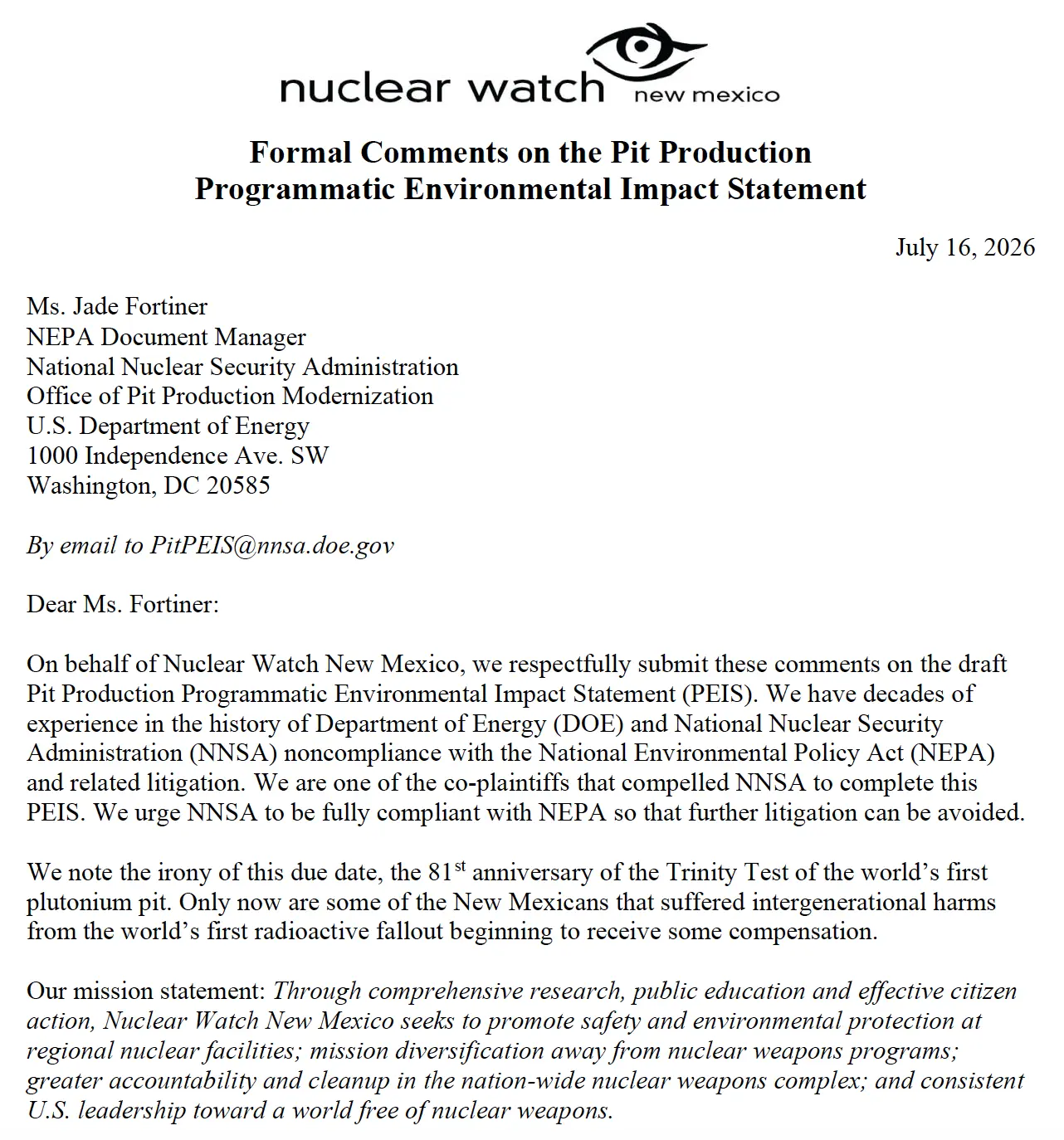
Sample Comments for the Draft Plutonium Pit Production Programmatic Environmental Impact Statement (PEIS)
Why should you comment? This process produces valuable information, increases government accountability and transparency, and creates a legal administrative record that has led to important litigation in the past. The Trump administration is severely limiting and removing key opportunities for public comment and objection. Significantly, there is no other legally required opportunity that enables the public to comment on the “modernization” program to keep nuclear weapons forever.
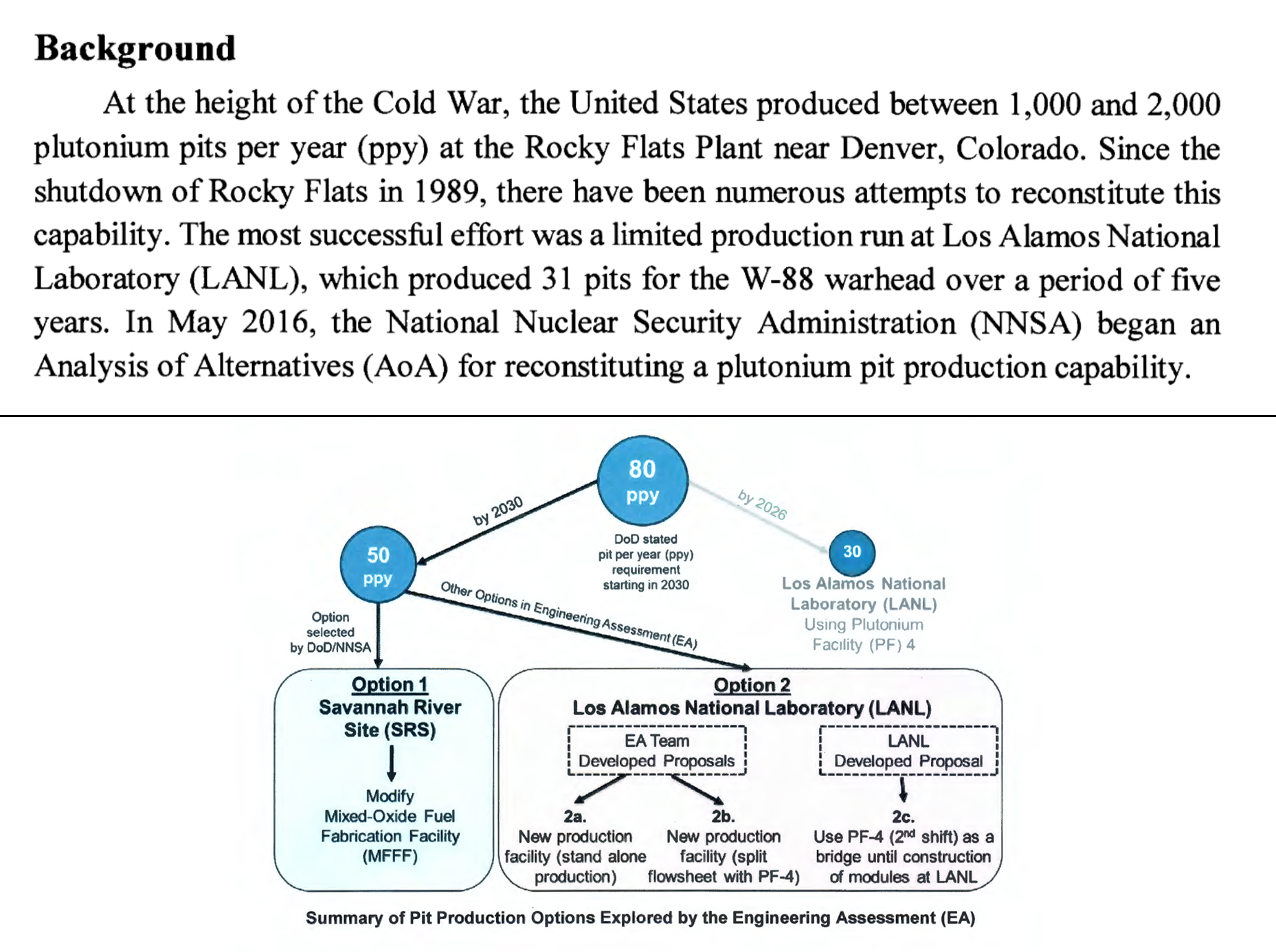
BACKGROUND: The Department of Energy’s (DOE’s) semi-autonomous National Nuclear Security Administration (NNSA) is aggressively expanding the production of plutonium pits, the radioactive cores or “triggers” of nuclear weapons. The Los Alamos National Laboratory (LANL) in New Mexico has been capable of producing plutonium pits since 1996, and until 2018 production was capped at no more than 20 pits per year. NNSA now plans to produce up to 205 pits every year for the new arms race, with at least 80 pits per year made at LANL and at least 125 per year at the Savannah River Site (SRS) in South Carolina.
Grassroots activist organizations Nuclear Watch New Mexico of Santa Fe, NM; Savannah River Site Watch of Columbia, SC; the Gullah/Geechee Sea Island Coalition of coastal Georgia, and Tri-Valley CARES of Livermore, CA successfully sued the NNSA over its failure to complete a required nationwide “programmatic environmental impact statement” (PEIS) for its plan to massively expand plutonium pits production. A draft of this PEIS was released in April 2026, kicking off in-person hearings in Livermore, CA, Santa Fe, NM, Aiken, SC, Kansas City, MO, and Washington, DC, as well as a 90-day public comment period ending July 16, 2026. This provides a unique and critical opportunity for public scrutiny of and formal comment on the government’s plans to make new nuclear bombs for a new arms race!
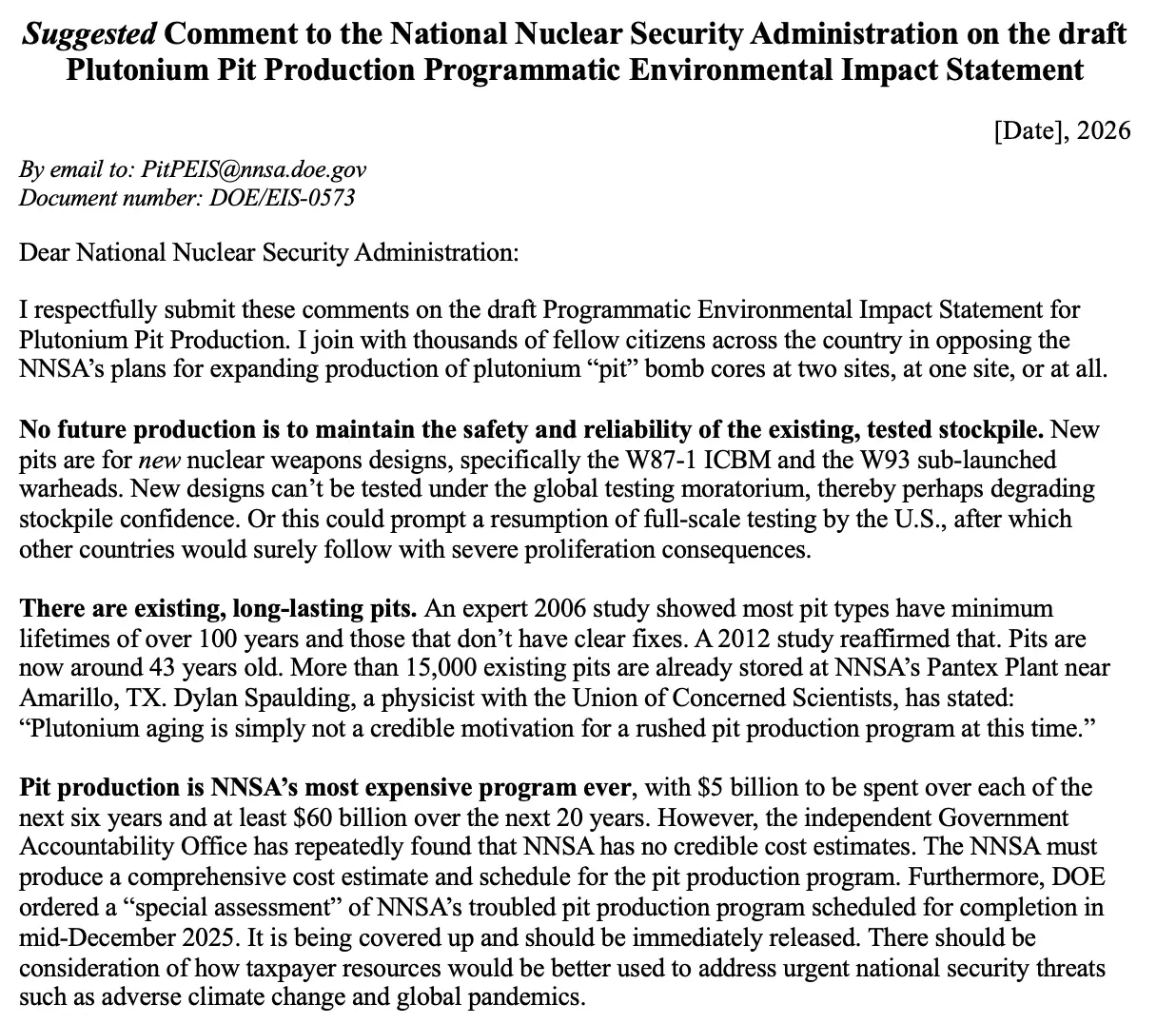
Plaintiffs Demand Release of Critical Documents and Extension of Public Comment Period on Expanded Plutonium Bomb Core Production
FOR IMMEDIATE RELEASE, July 6, 2026
Contact: Jay Coghlan, Nuclear Watch New Mexico, 505.989.7342, c. 505.470.3154 | Email
Scott Yundt, Tri-Valley CAREs, 925.443.7148 | Email
Georgetown, SC — Today the South Carolina Environmental Law Project (SCELP) notified the Department of Energy’s semi-autonomous nuclear weapons agency, the National Nuclear Security Administration (NNSA), that it must publicly release three critical documents. At issue is the fact that NNSA is withholding important information from American taxpayers during a public comment period for a Pit Production Programmatic Environmental Impact Statement (PEIS).[1] The public comment period ends this July 16 (ironically the 81st anniversary of the Trinity Test of the first plutonium pit).
Plutonium “pits” are the radioactive fissile cores or “triggers” of nuclear weapons. None of NNSA’s future pit production is to maintain the safety and reliability of the existing nuclear weapons stockpile. Instead, it is all for new-design nuclear weapons that could prompt the U.S. to return to testing and accelerate the new arms race.
SCELP, representing the nonprofit organizations Savannah River Site Watch, Tri-Valley CAREs and Nuclear Watch New Mexico, sued NNSA to force it to comply with the National Environmental Policy Act. This resulted in a federal judge finding NNSA violated NEPA and the agency ultimately agreeing to complete a Pit Production PEIS. Now it appears that NNSA is cherry-picking information to support its aggressive agenda of expanded plutonium pit production and suppressing negative information that could work against it.
The three documents that SCELP is demanding are:
- A new plutonium pit life study by independent scientists known as the JASONs. NNSA claims that potential aging effects drive the need for the immediate production of new pits, thereby ruling out the alternative of reusing some 15,000 existing pits. In contrast, a 2006 JASON pit life study concluded that most pit types have reliable lives of more than 100 years and those that don’t have relatively easy fixes[2] (the average pit age is now ~43). We believe that NNSA has been withholding an unclassified summary of the new JASON pit life study since the end of 2025. NNSA has not released it despite requests by Members of Congress and public Freedom of Information Act requests.
- A Department of Energy “Special Study” on NNSA leadership and management of its troubled plutonium pit production program, scheduled for completion in December 2025.[3] That Study is expected to be critical of the new pit production plant at the Savannah River Site (SRS) in South Carolina, which will be the most expensive building in US history ($30 billion-plus). DOE has not released this Special Study despite requests by Members of Congress and public Freedom of Information Act requests.
- A new “Probabilistic Seismic Hazard Analysis” (PSHA) for the Los Alamos National Laboratory (LANL) that is nearly a decade overdue.[4] A 2007 LANL seismic analysis prompted badly needed seismic upgrades to the Lab’s plutonium pit production facility. NNSA’s April 2026 draft Pit Production PEIS stated that the new PSHA would be completed in early 2026,[5] yet it is still not available for public comment.
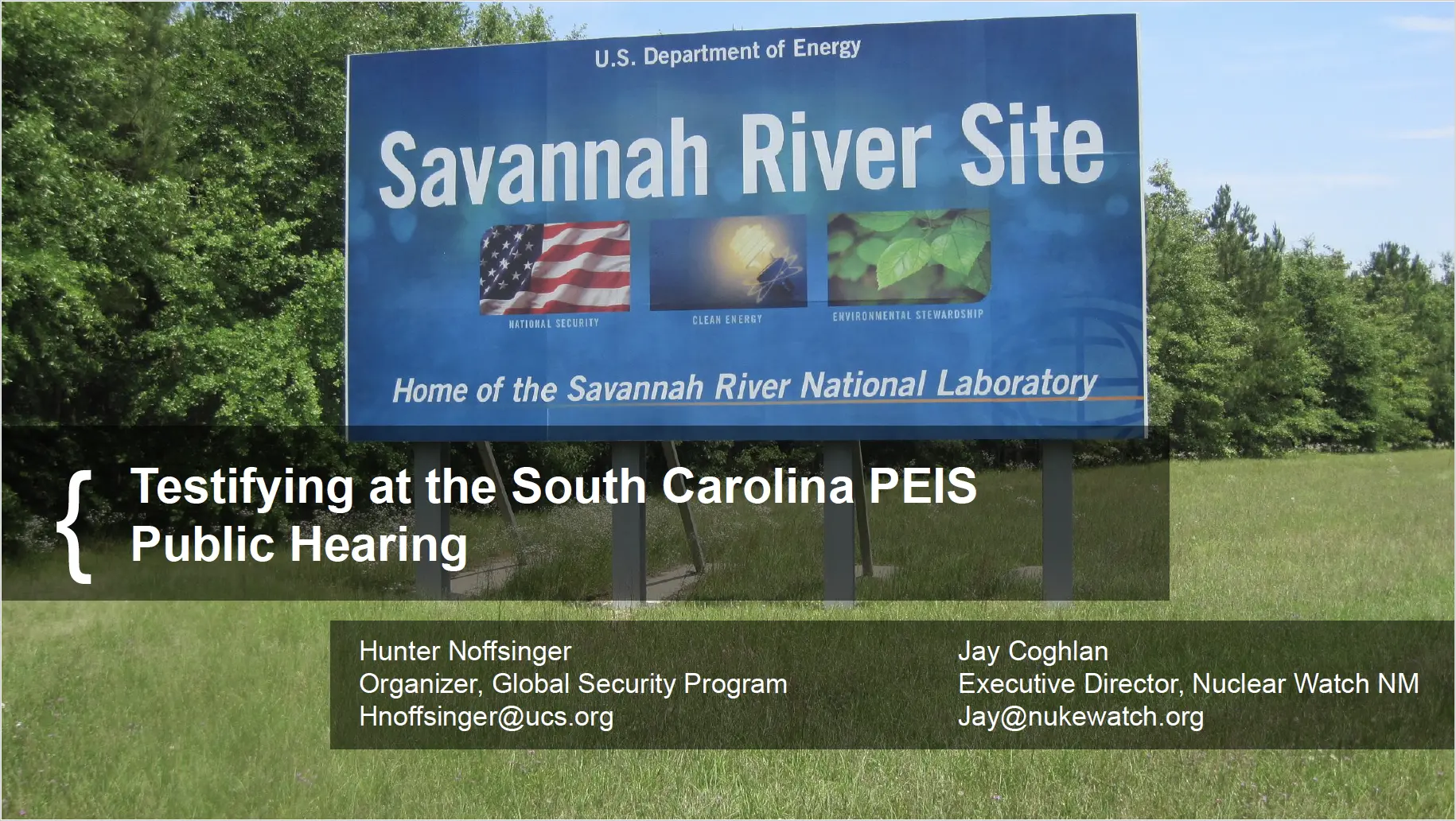

Historic Settlement Reached in NEPA Lawsuit Over Plutonium “Pit” Bomb Core Production
FOR IMMEDIATE RELEASE, January 17, 2025
Media Contacts:
Ben Cunningham, Esquire, SCELP, 843-527-0078, ben@scelp.org
Tom Clements, Savannah River Site Watch, 803-834-3084, tomclements329@cs.com
Jay Coghlan, Nuclear Watch New Mexico, 505-989-7342, jay@nukewatch.org
Scott Yundt, Tri-Valley CAREs, 925-443-7148, scott@trivalleycares.org
Queen Quet, Gullah/Geechee Sea Island Coalition, 843-838-1171, GullGeeCo@aol.com
AIKEN, S.C. — Nonprofit public interest groups have reached an historic settlement agreement with the Department of Energy’s semi-autonomous nuclear weapons agency, the National Nuclear Security Administration (NNSA). This is the successful result of a lawsuit against NNSA over its failure to complete a programmatic environmental impact statement on the expanded production of plutonium “pit” bomb cores, as required by the National Environmental Policy Act (NEPA). This agreement and a joint motion to dismiss have been submitted to Judge Mary Lewis Geiger of the Federal District of South Carolina. Should the Court enter the dismissal and retain jurisdiction to enforce the settlement, the agreement will go into effect.
This lawsuit was first filed in June 2021 by co-plaintiffs Savannah River Site Watch of Columbia, SC; Nuclear Watch New Mexico of Santa Fe, NM; Tri-Valley Communities Against a Radioactive Environment (CAREs), based in Livermore, CA; and the Gullah/Geechee Sea Island Coalition of coastal Georgia. NNSA promptly moved to have the case dismissed which in February 2023 Judge Lewis rejected, calling her decision “not a close call.”
Court Rules U.S. Nuclear Weapons Production Plan Violates Federal Law
FOR IMMEDIATE RELEASE, October 3, 2024
Media Contacts:
Ben Cunningham, Esquire, SCELP, 843-527-0078, ben@scelp.org
Tom Clements, Savannah River Site Watch, 803-834-3084, tomclements329@cs.com
Jay Coghlan, Nuclear Watch New Mexico, 505-989-7342, jay@nukewatch.org
Scott Yundt, Tri-Valley CAREs, 925-443-7148, scott@trivalleycares.org
Queen Quet, Gullah/Geechee Sea Island Coalition, 843-838-1171, GullGeeCo@aol.com
AIKEN, S.C. — On September 30, United States District Court Judge Mary Geiger Lewis ruled that the United States Department of Energy (“DOE”) and its semi-autonomous nuclear weapons agency, the National Nuclear Security Administration (“NNSA”), violated the National Environmental Policy Act (“NEPA”) by failing to properly consider alternatives before proceeding with their plan to produce plutonium pits, a critical component of nuclear weapons, at the Los Alamos National Laboratory (“LANL”) in New Mexico and, for the first time ever, at the Savannah River Site (“SRS”) in South Carolina.
The Court found that the plan’s purpose had fundamentally changed from NNSA’s earlier analyses which had not considered simultaneous pit production at two sites. These changes necessitated a reevaluation of alternatives, including site alternatives, which Defendants failed to undertake prior to moving forward while spending tens of billions of taxpayers’ dollars. Therefore, the Court entered judgment in favor of Plaintiffs, the nonprofit public interest groups Savannah River Site Watch, Nuclear Water New Mexico and Tri-Valley Communities Against a Radioactive Environment (CAREs); the Gullah/Geechee Sea Island Coalition; and Tom Clements as an individual plaintiff.
As a result of this ruling, the Defendants are required to newly assess pit production at a nation-wide programmatic level which will mean undertaking a thorough analysis of the impacts of pit production at DOE sites throughout the United States, including radioactive waste generation and disposal. Under the National Environmental Policy Act (NEPA), this will provide the opportunity for public scrutiny of and formal comment on their assessments.
High Detections of Plutonium in Los Alamos Neighborhood – As We Enter a New Nuclear Arms Race the Last One is Still Not Cleaned Up
FOR IMMEDIATE RELEASE, August 15, 2024
Dr. Michael Ketterer – 928.853.7188 | Email
Jay Coghlan – 505.989.7342 | Email
Santa Fe, NM – In April Nuclear Watch New Mexico released a map of plutonium contamination based on Lab data. Today, Dr. Michael Ketterer, Professor Emeritus of Chemistry and Biochemistry, Northern Arizona University, is releasing alarmingly high results from samples taken from a popular walking trail in the Los Alamos Town Site, including detections of some of the earliest plutonium produced by humankind.
On July 2 and 17 Dr. Ketterer, with the assistance of Nuclear Watch New Mexico, collected water, soil and plant samples from Acid Canyon in the Los Alamos Town Site and soil and plant samples in Los Alamos Canyon at the Totavi gas station downstream from the Lab. The samples were prepared and analyzed by mass spectrometry at Northern Arizona University to measure concentrations of plutonium, and to ascertain its sources in the environment.